 PSG v Arsenal: A Final Defined by Tactical Control and Mental Strength
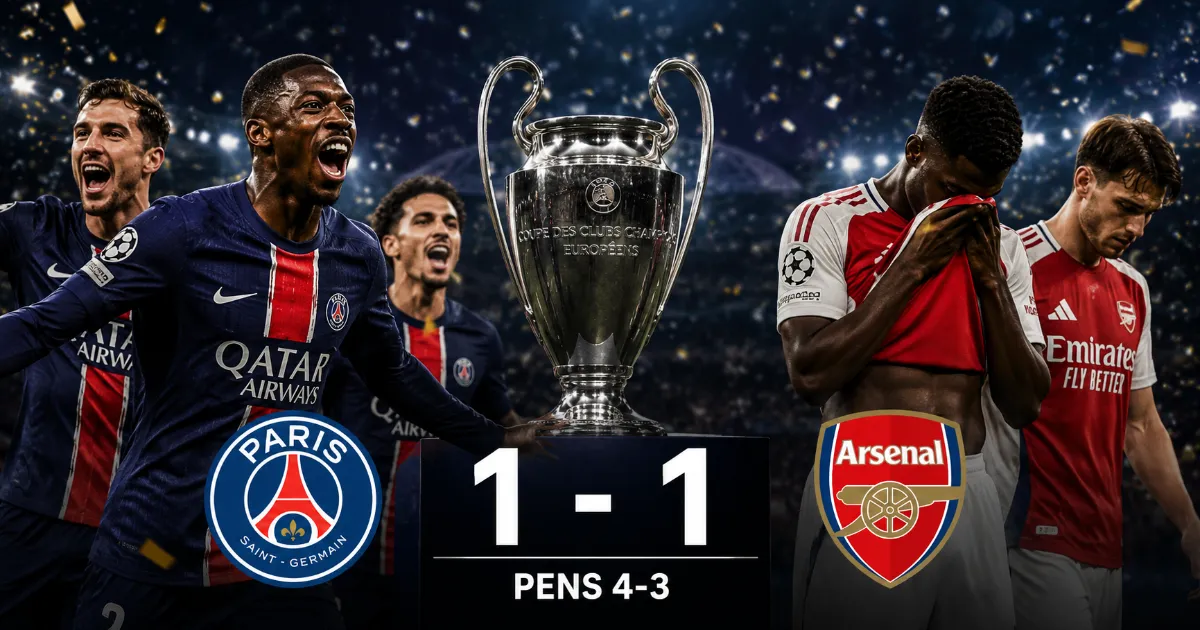
The PSG v Arsenal Champions League final delivered exactly what a European showpiece should: an early goal, a tactical battle, momentum swings and a penalty shootout that ultimately decided the champions. At the Puskás Aréna in Budapest, Arsenal took an early lead through Kai Havertz in the sixth minute, but Paris Saint-Germain responded through Ousmane Dembélé’s penalty in the 65th minute. Neither side could find a winner during the remaining 55 minutes of normal time or extra time, leaving PSG to secure a 4-3 victory in the shootout and retain the Champions League trophy.
Ousmane Dembélé Hat-Trick: The Numbers Behind the Most Clinical 32 Minutes of the Tournament
Can Mallorca Upset PSG? Full Club Friendly Match Preview
For Arsenal, the opening could hardly have been better. Havertz’s sixth-minute goal immediately gave Mikel Arteta’s side the advantage and allowed them to approach the rest of the match from a position of strategic comfort. Arsenal did not need to chase the game, while PSG suddenly had to take greater responsibility for possession and territory. That early goal also demonstrated the importance of efficiency in a final. Arsenal had limited opportunities in the opening period, but they converted one of them, forcing Luis Enrique’s team to rethink how aggressively they wanted to commit players forward.
PSG’s Possession Eventually Changed the Shape of the Game
The most significant tactical development was the enormous difference in possession during the first half. UEFA’s official half-time statistics recorded PSG with 74% possession compared with Arsenal’s 26%, while Paris had six attempts to Arsenal’s three. This did not mean Arsenal were being completely dominated, because Arteta’s side were deliberately allowing PSG to have the ball in less dangerous areas. Arsenal’s objective was to maintain their defensive structure, protect the central zones and make PSG work for every meaningful opportunity.
That approach worked for long stretches. PSG circulated possession through Vitinha, João Neves and Fabián Ruiz, attempting to move Arsenal’s defensive block from one side of the pitch to the other. The objective was not simply to accumulate passes but to create the moment when an Arsenal midfielder or defender would be pulled out of position. With players such as Dembélé, Désiré Doué and Khvicha Kvaratskhelia available in advanced areas, PSG had the individual quality to exploit even a small defensive gap.
Arsenal, meanwhile, relied heavily on discipline. Declan Rice was particularly important because his positioning allowed Arsenal to protect the defence while still offering a route forward when possession was recovered. Martin Ødegaard also had to balance two conflicting responsibilities: helping Arsenal progress the ball and contributing to the defensive structure. That made Arsenal’s performance less about dominating possession and more about controlling where PSG could use it.
Havertz’s Goal Gave Arsenal the Perfect Tactical Platform
The early breakthrough from Havertz changed the psychology of the final. Arsenal could afford to remain compact, and every PSG attack carried the possibility of producing a transition opportunity in the opposite direction. That was especially important because Arsenal possessed enough pace and technical quality in the attacking areas to punish PSG if the French side became careless.
The problem for Arsenal was that defending a lead against a team capable of maintaining 70-plus percent possession is physically and mentally demanding. Every defensive movement has to be repeated. Every midfielder must track runners. Every clearance has to be followed by another defensive phase if the opponent immediately recovers the ball.
That is where PSG’s patience became increasingly valuable. Luis Enrique’s side did not respond to the early goal by abandoning their structure. Instead, they continued to circulate the ball, increased the pressure on Arsenal’s defensive block and waited for opportunities to appear. This was one of the strongest aspects of PSG’s performance: they did not allow the scoreboard to dictate their tactical identity.
Dembélé’s Penalty Changed the Final
The equaliser in the 65th minute was the decisive turning point. Dembélé converted from the penalty spot to bring PSG level, and suddenly Arsenal’s original game plan became much more complicated. UEFA’s official match report records the equaliser at 65 minutes, followed by major PSG chances when Kvaratskhelia hit the post in the 77th minute and Vitinha narrowly missed a second goal in the 89th.ASEAN Championship 2026 Preview: A 30th Anniversary Like No Other
Those chances tell the story of the second half. PSG were no longer simply circulating possession; they were increasingly turning territorial control into genuine opportunities. Kvaratskhelia’s effort hitting the post was particularly significant because it showed how close Paris came to winning the match before extra time. Arsenal had survived the first wave, but after the equaliser, the balance of the contest increasingly shifted toward the defending champions.
The tactical reason was straightforward. Before the equaliser, Arsenal could remain conservative because the scoreline rewarded them. After the equaliser, they needed to consider whether continuing to defend was enough. That created a difficult decision for Arteta. Pushing more players forward could give Arsenal a chance to regain the lead, but it would also create additional space for PSG’s attackers.
Vitinha’s Influence Was Central to PSG’s Control
The official UEFA Player of the Match award went to Vitinha, and his performance explains much about PSG’s control of the contest. The Portuguese midfielder was central to PSG’s ability to dictate tempo, receive under pressure and move the ball through Arsenal’s defensive structure. His importance was not necessarily measured through spectacular attacking actions; it was his ability to make PSG’s possession function.
That role became even more important after Arsenal scored. When a team concedes early in a final, midfield composure becomes essential. A rushed team begins forcing passes, losing possession and exposing itself to counterattacks. PSG avoided that trap. Vitinha and his midfield partners continued to establish control, allowing their attackers to receive the ball in better positions.
This was also a reflection of PSG’s evolution under Luis Enrique. UEFA’s assessment of the champions’ campaign highlighted their tactical setup and their ability to navigate difficult knockout ties, including a 6-5 aggregate victory against Bayern Munich in the semi-finals. PSG were not simply relying on individual brilliance; they had developed a system capable of repeatedly surviving pressure and then imposing itself on opponents.
Arsenal’s Defensive Plan Deserves Credit
Despite eventually losing the final, Arsenal’s defensive performance should not be dismissed. The Gunners made PSG work extremely hard for their opportunities and managed to take the match all the way to penalties. Their compact shape prevented Paris from creating a constant stream of clear chances, even when PSG dominated possession.
The defensive contribution of the midfield was particularly important. Arsenal’s players had to continually close spaces between the lines, while the back four had to remain disciplined against PSG’s movement. This is difficult against attackers who do not remain in fixed positions. Dembélé could drift, Doué could rotate into different attacking zones and Kvaratskhelia could attack from the left or move inside.
Arsenal therefore faced a structural dilemma throughout the game. Follow every movement and risk opening a different space, or maintain the defensive shape and allow PSG’s attackers some freedom. For much of the match, Arsenal chose the second option. It was a reasonable strategy and almost delivered the trophy.
PSG’s Greater Squad Depth Became Important Late On
As the match moved toward extra time, the benches became increasingly relevant. Both managers made changes, with PSG introducing players including Bradley Barcola, Warren Zaïre-Emery and Gonçalo Ramos, while Arsenal brought on Eberechi Eze, Gabriel Martinelli, Viktor Gyökeres, Noni Madueke and others at different stages. UEFA’s official match information records those substitutions and the changing personnel as the match progressed.
The substitutions reflected the different problems each manager was trying to solve. PSG wanted to maintain attacking pressure while preserving midfield control. Arsenal needed additional attacking outlets but also had to avoid becoming too open. In a match this tight, substitutions are rarely about completely changing the system. They are about improving one or two specific aspects without damaging the overall balance.
That balance remained intact through extra time. Neither team was willing to make the kind of tactical gamble that could produce a decisive mistake. The longer the match continued at 1-1, the more inevitable the penalty shootout began to feel.
The Penalty Shootout Decided What 120 Minutes Could Not
Penalty shootouts are football’s ultimate test of composure because they remove much of the tactical influence managers have during open play. PSG eventually won 4-3, despite David Raya saving Nuno Mendes’ attempt. Arsenal could not take advantage of that opening because Eberechi Eze and Gabriel both missed their penalties, while PSG converted four of their five attempts.
For PSG, the shootout represented another example of their growing comfort in high-pressure European situations. For Arsenal, the defeat was especially painful because they had remained competitive against a team that entered the final as defending champions.
The shootout should therefore not completely define Arsenal’s performance. Penalties are influenced by technique, preparation and psychology, but they also contain an element of randomness. Arsenal had already demonstrated enough over 120 minutes to prove they could compete with PSG at the highest level.
What PSG’s Victory Really Means
The importance of this result extends beyond one final. PSG became back-to-back Champions League winners, achieving something that historically has been extremely difficult in the modern competition. UEFA confirmed that Paris retained the European crown after their penalty victory in Budapest.
That changes the narrative surrounding the club. PSG were once defined by their repeated Champions League disappointments and their inability to turn domestic dominance into European success. Now they have reached consecutive finals and won consecutive titles.
Luis Enrique deserves significant credit for that transformation. His PSG side are increasingly defined by collective structure, technical control and tactical flexibility rather than simply depending on one superstar to decide matches. The victory over Arsenal was another demonstration of that evolution.
Final Verdict
The final scoreline of PSG v Arsenal was 1-1 after extra time, but the tactical story was much more nuanced. Arsenal started brilliantly, scored early and defended their advantage with discipline. PSG responded with patience, dominated possession and gradually increased their attacking pressure. Dembélé’s penalty restored parity, and the late chances for Kvaratskhelia and Vitinha suggested that Paris were increasingly likely to find the winning moment.
They never did in open play.
Instead, PSG won the final in the most unforgiving way possible: penalties.
From a football-analysis perspective, PSG deserved credit not because they completely overwhelmed Arsenal, but because they responded better to the changing demands of the match. Arsenal controlled the early strategic advantage; PSG controlled more of the game as it developed. When the final became a test of composure, Paris had just enough to cross the line.
For Arsenal, the defeat will hurt because the opportunity was real. For PSG, the victory confirms something much bigger: this is no longer a club chasing its first European breakthrough. This is a PSG team that now expects to win the Champions League.
🔹🔹 Follow Us on Facebook 🔹🔹
About the Author