Group D FIFA World Cup 2026: The United States Face Türkiye’s Teenage Firepower, Paraguay’s Steel, and Australia’s Quiet Ambition at SoFi Stadium
LOS ANGELES — On the evening of June 12, SoFi Stadium in Inglewood, California — one of the most expensive and spectacular venues ever built for American sports — will host the United States men’s national team’s opening match of the 2026 FIFA World Cup. The opponent is Paraguay. The crowd will be somewhere between 70,000 and deafening. The stakes will be nothing less than the beginning of a national dream.
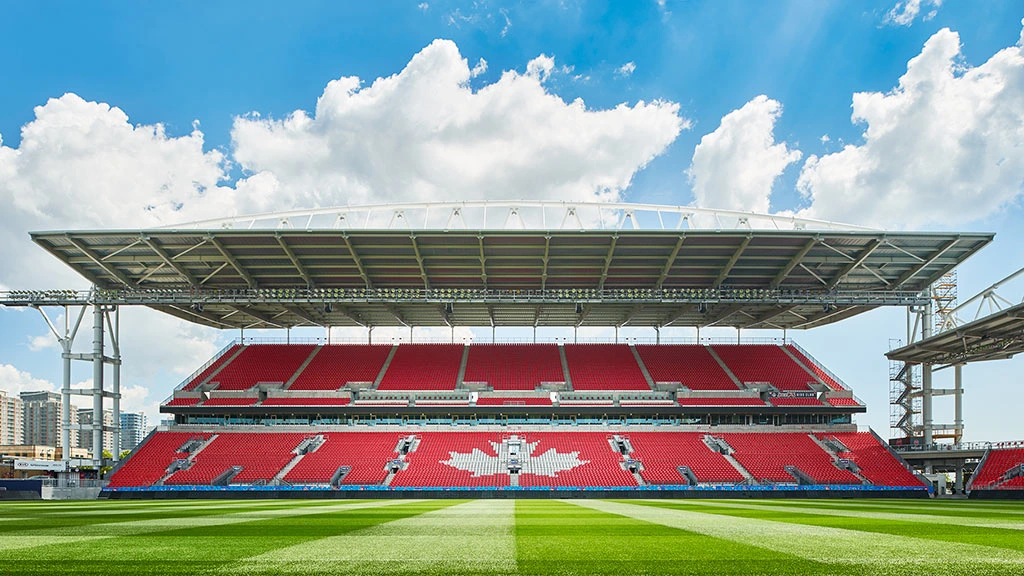
This is what America has been waiting for since 1994. A World Cup on home soil. A chance to do something more than show up and compete. Under Mauricio Pochettino, a generation of American players who grew up watching Landon Donovan and Clint Dempsey on fuzzy screens now have the chance to write their own chapter — on their own ground, in their own stadiums, in front of their own people.
But Group D FIFA World Cup 2026 will not hand them anything. Paraguay arrived here through grit. Türkiye arrived here through a 24-year wait and two of the most exciting young players on the planet. Australia arrived here through six straight World Cup appearances and a coach who reached the round of 16 as a player and wants to go further as a manager. This group will not be a coronation. It will be a test.
United States: The Weight of a Nation at SoFi
Mauricio Pochettino inherited a program in transition and has spent more than a year trying to impose an identity on a squad that was always talented but rarely cohesive. Recent results heading into the summer were sobering — a 5-2 defeat to Belgium and a 2-0 loss to Portugal in March left questions about the team’s ceiling against top-tier opposition. But those games were part of a deliberate preparation strategy, and Pochettino has consistently chosen his battles carefully.
SoFi Stadium in Inglewood will host both the opener against Paraguay and the final group-stage match against Türkiye, while Lumen Field in Seattle hosts the matchup against Australia. The venues matter. Lumen Field has long been recognized as one of the loudest soccer environments in North America, and SoFi represents the glamour and scale that American football has been building toward since 1994.
The squad revolves around Christian Pulisic. The AC Milan attacker is the face of this team, the name on the Sports Illustrated cover, and the player the country expects to deliver. He is in the worst form of his professional career, having amassed just one assist in 2026 for club and country — a fact that makes the next few weeks critical. He’s been in a slump and hasn’t scored for the USMNT since November 2024. The World Cup’s bright lights have a way of either reviving players or exposing them. For Pulisic, it will be one or the other.
Beyond him, the squad features Weston McKennie of Juventus, Tyler Adams of Bournemouth, Malik Tillman of Bayer Leverkusen, and striker Folarin Balogun of Monaco — a group with genuine quality at the club level. Pochettino has favored a 3-4-2-1 formation that gives wing-backs like Antonee Robinson and Sergino Dest license to push forward and overload wide areas. The system suits the personnel. Whether the personnel can handle the moment is the real question.
Verdict: The United States are the group favorites and should win it. But Pulisic’s form, a tentative defensive structure, and the unique psychological weight of a home World Cup make them less certain than the odds suggest.
Türkiye: 24 Years of Waiting, Two Prodigies, Zero Guarantees
Türkiye qualified for the 2026 FIFA World Cup via the UEFA playoffs in March 2026, ending a 24-year absence since 2002, with Vincenzo Montella’s side winning Path C with back-to-back 1-0 wins over Romania in the semi-final and Kosovo in the final. The Crescent-Stars are back. And they have brought a squad that is genuinely capable of causing chaos in this group.
Türkiye’s World Cup story is one of the quirkiest in world soccer — before 2026, the Crescent-Stars had only two previous appearances: 1954 and a stunning third-place finish in 2002 that left the world wondering if a new soccer powerhouse had arrived, only for Türkiye to vanish from the global stage afterward. This time, however, the roster is built for the moment.
The Grandest Stages on Earth: Every FIFA World Cup 2026 Stadium Ranked and Revealed
With 21-year-old duo Arda Güler and Kenan Yıldız leading the line, Türkiye are an exciting prospect and will certainly be a team worth watching during the summer’s tournament. Güler — the Real Madrid playmaker who compares favorably to Mesut Özil and has drawn Lionel Messi comparisons in the Turkish press — created 12 chances and made four assists in UEFA World Cup qualifying. Yıldız, his Juventus-based 21-year-old partner, has three vital goals in qualifying for this competition and has racked up 14 goals in all competitions for club and country this season.
Vincenzo Montella typically lines up in a 4-2-3-1. Without the ball, Türkiye is compact and hard-working, with every player willing to track back. In possession, with Hakan Çalhanoğlu controlling the tempo from midfield, the team is comfortable working the ball through tight spaces before striking at the right moment. Çalhanoğlu, the Inter Milan captain, is the experienced anchor around which Güler and Yıldız are free to roam and improvise.
Türkiye have been in excellent form recently, winning 4 of their last 5 matches, scoring 10 goals and conceding just 3 during that period. That form, combined with the individual brilliance available across the front line, makes them the most dangerous team in Group D on their best day.
Verdict: Türkiye are the group’s most exciting wildcard. If Güler and Yıldız fire in tandem, they can top the group. If they don’t, the lack of a specialist striker and tournament inexperience at this level could cost them.
Paraguay: The Grinders Who Never Know When to Quit
Paraguay have not been to a World Cup since 2010. Sixteen years is a long time. But the memories of that South Africa campaign — when they reached the quarterfinals before losing 1-0 to Spain — still define how this team sees itself. They are not a team built for beauty. They are a team built for survival, for structure, for making every game ugly enough that talent alone cannot defeat them.
Paraguay’s defensive structure and Miguel Almirón’s transition quality give them the tools to grind out a result if the game is managed on their terms, and their 2010 quarterfinal run remains a reminder that coach Eduardo Berizzo’s cautious approach can carry a side a long way in a short tournament. Almirón — the Newcastle United midfielder and one of South America’s most recognizable exports — brings verticality and energy in transition that can destabilize any organized defense when space opens up behind it.
Paraguay qualified through a punishing CONMEBOL qualifying campaign that separated the serious from the pretenders across 18 rounds of regional fixtures. They are not flashy. They do not press high or play possession football. What they do is defend with discipline, win second balls in midfield, and find Almirón when the moment arrives. In a tournament where margins are razor-thin, that formula is more viable than many neutrals would like to admit.
The teams have faced each other four times prior to the tournament, most recently in 2025, a 2-1 win for the United States in a friendly. That recent result suggests the USA have the edge — but Paraguay will not approach the opener the way they approached a November friendly. Nothing about their game plan suggests they will.
Verdict: Paraguay are the group’s most dangerous spoiler. They will not win it. But a draw against the United States or Türkiye is well within their tactical reach, and one stolen result could reshape the entire table.
Australia: The Quiet Achievers With a Point to Prove
Australia arrive at the 2026 World Cup ranked 27th in the FIFA rankings. Under Tony Popovic, who replaced Graham Arnold in September 2024 following a qualifying wobble, the Socceroos have rediscovered a clear identity and tactical structure. This is their sixth consecutive World Cup — a run of sustained continental consistency that rarely receives the credit it deserves outside of Australia.
Popovic won 58 caps for the Socceroos and enjoyed a career as a player that included reaching the round of 16 at the 2006 World Cup. In 2026, if Australia advances past the group stage, he will become the first Australian in history to participate in a World Cup both as a player and as a coach. That personal motivation runs through everything he does with this team.
The preferred setup is a 3-4-2-1 with wing-backs central to everything. Australia’s best football comes when the wing-backs are active, the press is coordinated across the front line and the transition from defense to attack is direct and quick. The back three of Harry Souttar, Cameron Burgess and Alessandro Circati is one of the most settled and reassuring parts of Popovic’s setup.
Young Nestory Irankunda, a pacy and unpredictable winger, has emerged as Australia’s most exciting creative force and represents the kind of burst-off-the-bench impact that can change a tight group-stage game. Goalkeeper Mathew Ryan — experienced at the highest European level — provides the calmness in goal that this team needs when it sits deep and absorbs pressure.
Australia won five, drew four, and lost just once in a genuinely competitive AFC qualifying group. They rarely blow teams away — but they almost never collapse. In a group stage where survival matters as much as dominance, that resilience is a real asset.
Verdict: Australia are the group’s longshots but are built for exactly this kind of tournament. A third-place finish that earns them a spot among the eight best third-placed teams is a realistic outcome — and Tony Popovic’s tactical discipline gives them the tools to make it uncomfortable for everyone above them.
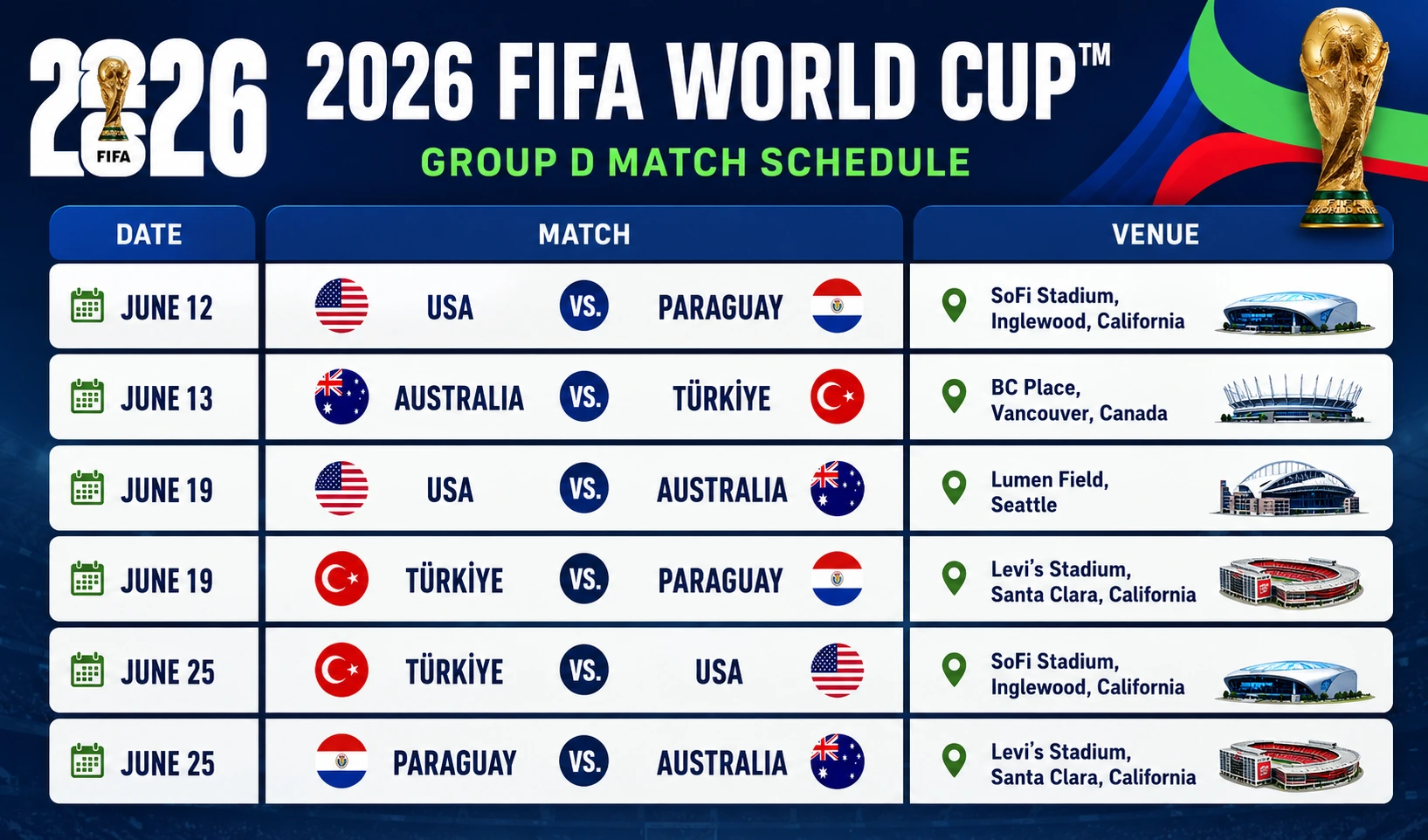
Group D Schedule
Head-to-Head History at a Glance
The history between these four nations adds important texture to what is coming. The USA and Paraguay have faced each other four times, most recently a 2-1 United States win in a 2025 friendly. Australia and Türkiye have only met once — a scoreless draw in 1995 — making their June 13 clash in Vancouver effectively uncharted territory for both teams. The USA and Türkiye have faced each other five times prior to the tournament, most recently in 2025, a 2-1 win for Türkiye in a friendly — a result the Americans will want to reverse on the biggest possible stage when they meet in the group finale on June 25. Australia and Paraguay have only met five times, most recently in 2010 — a 1-0 win for Australia in a friendly.
What the historical record tells us is that this group has a genuine open quality. None of these teams have a crushing head-to-head dominance over another. Every matchup, when it arrives in June, will feel like a genuine contest with a genuine result in doubt.
The Bigger Picture: What Does Group D Mean for This World Cup?
The 2026 FIFA World Cup expands to 48 teams for the first time, organized across 12 groups. The top two from each group advance automatically, and the eight best third-placed teams across all 12 groups also move on to the Round of 32. That format shift matters enormously in a group like this one.
A team that finishes third in Group D with five or six points — a result achievable by any of the four teams here — could still be alive heading into the knockout stages. That reality changes how every team approaches the last matchday. A team that has already secured second place has no incentive to risk losing third and jeopardizing the broader qualification math. A team in third might park the bus and grind for a draw knowing it could be enough to advance.
For the United States specifically, the format creates an unusual tension: winning the group keeps them on the West Coast for the early knockout rounds, with matches potentially in San Francisco, Seattle and Los Angeles. Finishing second sends them toward Dallas and Atlanta. The geography of their tournament path depends on the arithmetic of their group-stage results. According to current bracket projections, a first-place finish in Group D could keep the USMNT on the West Coast for the early knockout rounds. For a team drawing energy from its home crowd, that matters.
Final Prediction
🔸 Group Winner: United States 🔸 Runner-Up: Türkiye 🔸 Dark Horse: Paraguay 🔸 Wildcard Warning: Australia
SoFi Stadium will erupt on June 12 for a reason. The Americans have the squad, the system, the home support, and the motivation to win this group. But Türkiye’s Güler and Yıldız are the most exciting attacking pairing in Group D, and the June 13 clash in Vancouver between the Crescent-Stars and the Socceroos could be the match that sets the entire group’s narrative in motion. One result in that game — a Türkiye win, an Australian upset, a late equalizer, a red card — and the dominoes start to fall.
In Group D of the 2026 FIFA World Cup, the United States may be playing at home. But that doesn’t make it safe.
About the Author




2 thoughts on “Group D FIFA World Cup 2026: Can Anyone Stop the USMNT on Home Soil?”