 Champions League New Format 2024 Onwards: The League Phase Rules Explained
Gone are the familiar eight groups of four. Here’s exactly how the new Champions League Format works, from the 36-team league phase and eight matches per club to the knockout-stage qualification and seeding system.
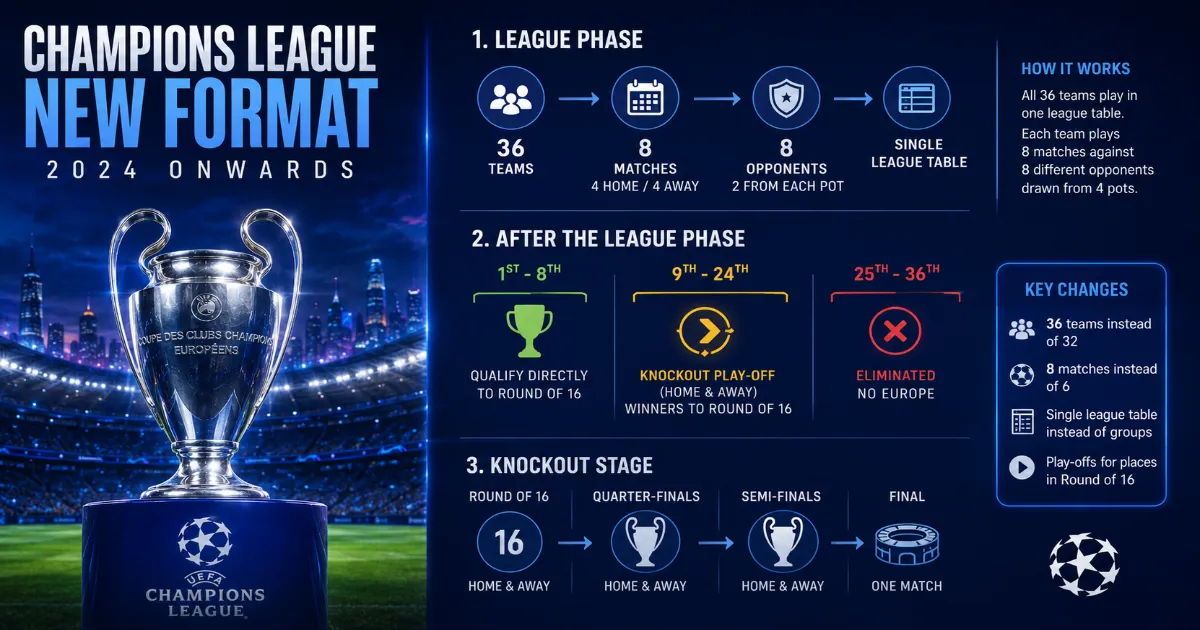
For decades, the Champions League followed a familiar rhythm: eight groups of four teams, a home-and-away round-robin, and the top two from each group advancing to a traditional knockout bracket. That format disappeared starting with the 2024-25 season, replaced by a genuinely different single league-phase structure that has fundamentally changed how the tournament’s opening months unfold. Here’s exactly how the new format works.
Why UEFA Changed the Format
UEFA’s decision to overhaul the Champions League format wasn’t made in isolation. The change arrived amid considerable pressure from Europe’s biggest clubs, several of whom had previously flirted with breakaway Super League proposals demanding more guaranteed high-profile fixtures and a larger overall competition. UEFA’s response was to expand the tournament from 32 to 36 teams while restructuring the group stage entirely into a single combined league table, a format designed to increase the total number of glamour fixtures between traditionally powerful clubs while still preserving the tournament’s overall competitive integrity and UEFA’s own institutional control over European club competition.
The Expanded Field: 36 Teams
The new format begins with 36 total teams competing in the league phase, up from the 32 that competed in the tournament’s previous group-stage era. Of those 36 spots, 29 are awarded directly based on qualification through domestic league performance and cup competition results, while the remaining seven places are determined through a qualifying and play-off process split between two separate pathways: the Champions Path, reserved for teams that won their domestic league title, and the League Path, for teams that qualified through finishing in their domestic league’s other European qualification places.
How the League Phase Actually Works
Rather than being divided into small groups, all 36 teams now compete within a single combined league table. Each club plays eight matches total during the league phase, four at home and four away, against eight different opponents drawn from four separate seeding pots based on UEFA coefficient rankings. This means no team plays every other team in the competition, but the specific opponents each club faces are determined through a computerized draw designed to ensure a broadly balanced spread of matchups across the full 36-team field, while still guaranteeing that Europe’s traditionally biggest and most valuable fixtures occur with reasonable regularity given the significantly larger number of total matches now being played compared to the tournament’s previous format.
What Happens After the League Phase
Once all eight rounds of league-phase fixtures conclude, the single combined table determines each team’s fate. The top eight clubs qualify automatically for the round of 16, bypassing any further preliminary knockout matches entirely. Teams finishing between ninth and twenty-fourth place enter a two-legged knockout play-off round specifically to determine the remaining spots in the last sixteen, with those play-off winners then joining the automatically qualified top eight teams in the traditional knockout bracket. Any club finishing between twenty-fifth and thirty-sixth place is eliminated from the competition entirely, without any parachute into a secondary tournament, a genuinely significant conclusion for clubs that fail to perform adequately across their eight league-phase matches.
The Knockout Stage Remains Familiar
Once the league phase and its associated play-off round conclude, the Champions League reverts to the traditional two-legged knockout format that fans have long been familiar with, running from the round of 16 through the quarterfinals and semifinals, before concluding with a single-match final at a pre-selected neutral venue. This preservation of the classic knockout structure for the tournament’s business end was a deliberate design choice by UEFA, intended to maintain the dramatic, high-stakes atmosphere of the competition’s most-watched matches even while fundamentally restructuring how clubs reach that stage in the first place.
How This Differs From the Old Group Stage
The most significant practical difference between the current format and the tournament’s previous group-stage structure lies in sheer match volume and matchup variety. Under the old system, each club played only six group-stage matches against the same three opponents, twice each, before a clear top-two-per-group cutoff determined advancement. The new format’s eight matches against eight different opponents means considerably more variety in a given season’s fixture list, while also meaningfully increasing the number of genuinely high-profile matches between Europe’s biggest clubs that occur during the tournament’s opening months, addressing one of the most frequently cited criticisms of the old format, that too many group-stage matches involved lopsided mismatches between clubs of considerably different overall quality.
The Financial Impact of More Matches
Beyond the competitive restructuring, the new format’s expanded match count carries significant financial implications for participating clubs, since more matches translate directly into additional broadcast revenue, matchday income, and UEFA prize money distributed across the competition. This financial dimension was a significant factor in UEFA’s original decision to expand the format, both as a direct revenue driver and as part of the broader strategic response to the financial demands that had originally fueled interest in a breakaway Super League among several of Europe’s wealthiest clubs.
Genuine Criticism of the New Format
Despite UEFA’s stated goals, the new league-phase format hasn’t been entirely free of criticism since its introduction. Some observers have pointed to genuine fixture congestion concerns, with players across Europe’s biggest clubs now facing an even more demanding overall match schedule when domestic league, domestic cup, and Champions League commitments are all considered together across a full season. Others have questioned whether the single combined table, while mathematically elegant, actually produces meaningfully different or more compelling storylines compared to the clearer, more easily understood structure of the old group-of-four format, particularly for casual fans trying to follow the tournament’s early rounds without close attention to the full 36-team standings table.
Three Seasons In: How the Format Has Performed
Now heading into its third season under this new structure for the 2026-27 campaign, the league-phase format has generally received a reasonably positive reception despite the initial skepticism that greeted its introduction. The increased frequency of genuinely high-profile matchups between traditionally powerful clubs during the competition’s opening months has been widely cited as a genuine improvement over the old group stage’s occasional mismatches, even as fixture congestion concerns and the format’s genuine complexity for casual fans remain persistent, unresolved critiques heading into the format’s third full season of operation.
Why Understanding the Format Matters
For fans following the Champions League today, understanding this structure is essential to making sense of how a club’s European campaign can unfold across a full season. A club sitting in the middle of the 36-team table after several matchdays isn’t necessarily in genuine danger the way a team finishing third in a four-team group under the old format would have been, since the current system’s play-off round gives clubs finishing as low as twenty-fourth place a genuine, if more difficult, pathway back into knockout contention. That structural nuance, a considerably wider margin for recovery built directly into the format itself, is one of the clearest ways the current league-phase system differs from the more binary, all-or-nothing group-stage format it replaced, and it’s a distinction worth keeping in mind whenever a big club’s slow start to the league phase generates outsized panic among supporters before the season’s full 36-team table has even been completed.
How the Seeding Pots Work in Practice
Understanding the format fully requires grasping how UEFA’s seeding pot system shapes each club’s specific set of eight opponents. Before the league-phase draw, all 36 qualified clubs are divided into four pots of nine teams each, based primarily on UEFA club coefficient rankings that reflect recent European performance. Each club then plays two opponents from each of the four pots, one at home and one away, ensuring that even the lowest-seeded clubs in the competition are guaranteed at least two matches against some of the tournament’s most historically successful and highest-coefficient institutions. This system replaced the more restrictive group-stage seeding that had previously prevented certain high-profile matchups from occurring until the knockout stage at the earliest, one of the specific structural changes UEFA cited as a direct response to fan and broadcaster demand for more frequent marquee fixtures earlier in the tournament calendar.
What a Typical League Phase Table Looks Like
With 36 teams playing only eight matches each rather than facing every other participant, the resulting league table naturally produces a wider spread of possible points totals and outcomes than a traditional round-robin league would generate. A club could theoretically finish with a strong points total built against a relatively favorable set of pot-based opponents, while another side with arguably similar overall quality might finish lower in the table after facing a tougher run of fixtures dictated by the draw. This inherent variability, a consequence of the format’s asymmetric fixture list compared to a true round-robin, is one of the more nuanced aspects of the system that pundits and analysts have had to account for when evaluating a club’s league-phase performance relative to their underlying quality, rather than simply comparing final points totals in isolation.
Looking Ahead to Future Format Discussions
Even as the league-phase format enters its third season, UEFA continues to face periodic pressure from various stakeholders, including broadcasters, participating clubs, and player unions concerned about fixture congestion, to further refine or adjust the competition’s structure in future seasons. Whether those discussions eventually produce meaningful changes to the current 36-team, eight-match system, or whether the format proves durable enough to remain largely unchanged for the foreseeable future, will likely depend considerably on how successfully this current structure continues balancing UEFA’s competing priorities: satisfying the continent’s biggest clubs’ demand for more high-profile fixtures and revenue, while still preserving a competition format that remains genuinely comprehensible and compelling to the tournament’s broader global fanbase.
🔹🔹 Follow us on Facebook 🔹🔹
Serie A 2025-26 Season in Review: Inter’s Redemption, Milan’s Collapse
About the Author