Group A | FIFA World Cup 2026 | Match 2 | Estadio Akron, Zapopan, Mexico
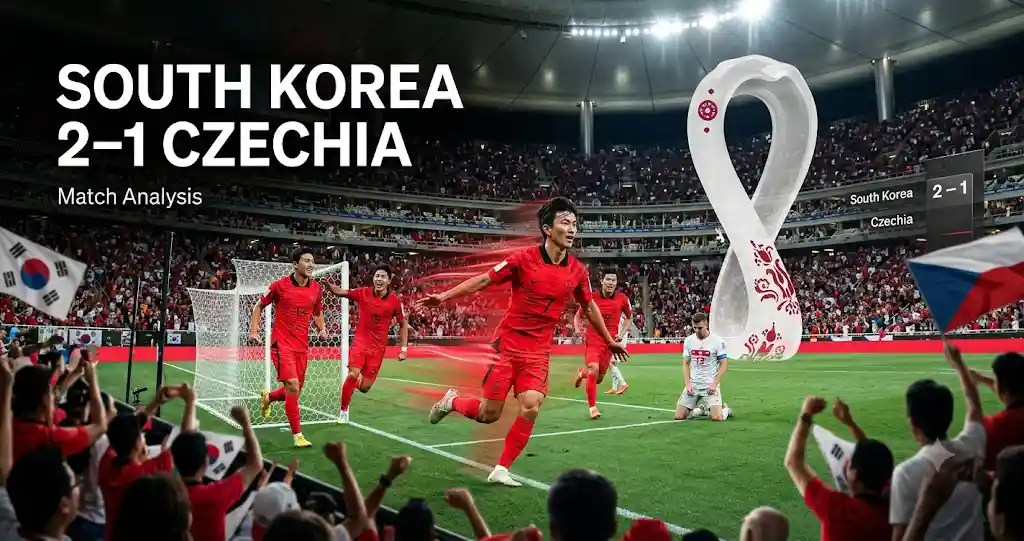
South Korea vs Czechia Analysis :
Result Summary
| South Korea | 2 – 1 | Czechia |
| Hwang In-beom 67′ | Krejčí 59′ | |
| Oh Hyeon-gyu 80′ |
| Detail | Info |
|---|---|
| Date | Thursday, June 11, 2026 |
| Venue | Estadio Akron, Zapopan, Mexico |
| Kick-off | 10:00 PM ET |
| Attendance | ~44,000 |
| Group | A |
The Match in One Sentence
South Korea out-possessed Czechia for 90 minutes, dominated in attack throughout, fell behind to a set-piece header they had absolutely no answer for — and then demonstrated precisely the character that Hong Myung-bo’s squad was built on by producing two composed goals in the final half-hour to win a match they never deserved to be losing.
Match Statistics
| Stat | South Korea | Czechia |
|---|---|---|
| Goals | 2 | 1 |
| Possession | 54.5% | 45.5% |
| Shots | 16 | 4 |
| Shots on Target | 4 | 3 |
| Touches in Opposition Box | 31 | 10 |
| Corners | 8 | 3 |
| Fouls Committed | 7 | 12 |
| Pass Accuracy | 83.5% | 75.1% |
| Total Passes | 412 | 353 |
| Hit Woodwork | 1 | 0 |
| Yellow Cards | 1 | 0 |
The numbers contain a story that is simultaneously flattering and alarming for South Korea. They dominated every attacking metric — 16 shots to Czechia’s 4, 31 touches in the opposition box to Czechia’s 10, 8 corners to 3. They hit the post. They had Kim Seung-gyu making a late, match-saving stop when the score was still 1-1. They were the better team by nearly every measurable dimension.
And yet they were losing at the 60-minute mark having allowed the most avoidable kind of goal: a set-piece header from a player who scores headers in tournaments. This is the tension at the heart of South Korea’s World Cup 2026 campaign — extraordinary attacking ambition paired with a defensive vulnerability on dead balls that Czechia exploited immediately and that Mexico will study very carefully before June 18.
Phase-by-Phase Analysis
First Half (0–45 minutes): South Korea’s Dominance Without Edge
Hong Myung-bo’s 3-4-3 did exactly what the formation was designed to do in the opening 45 minutes. Son Heung-min took up central positions between Czechia’s midfield and defence, drawing the attention of Soucek and Sadílek, while Lee Kang-in and Hwang Hee-chan attacked the width from the right and left flanks of the front three.
The wing-backs — Kim Moon-hwan and Cho Yu-min — pushed aggressively high, creating effective 5v3 overloads in Czechia’s defensive third when South Korea had possession. The pressing triggers were sharp: whenever Kovář played to either centre-back, South Korea’s front three compressed quickly, forcing the Czech defenders into longer passes under pressure.
What worked: The passing combinations were fluent. Lee Kang-in’s movement off the ball was consistently intelligent — he made seven runs behind Czechia’s defensive line in the first half, successfully pulling the Czech right side out of shape. By the 14th minute, FOX Sports had logged shots on goal from both Lee Kang-in and Son Heung-min, a combination of shot map pressure that anticipated where the goals would eventually come from.
What did not work: South Korea had 31 touches in Czechia’s box across 90 minutes, but converting those touches into shots on target proved persistently difficult in the first half. Kovář was excellent — his positioning was compact, his communication with his defensive line was clear, and he denied Hwang In-beom once in the first half with a reaction save that kept the score at 0-0. But South Korea’s inability to find the finish to match their approach play was the first-half frustration.
Czechia’s first-half plan: Miroslav Koubek deployed a compact 4-4-2 out of possession that deliberately narrowed the central channels, forcing South Korea wide. Soucek and Sadílek operated as a disciplined double pivot — neither pushed high, both stayed deep, giving Czechia a dense, physical barrier across the middle of the pitch.
The danger Czechia created almost entirely came from two sources: Coufal’s delivery from the right, and Soucek’s physical presence at corners. In the first half these were threats rather than problems. In the second half, they became a goal.
Second Half — Phase 1 (45–59 minutes): Czechia’s Set-Piece Sucker Punch
South Korea began the second half with renewed intensity. Hwang In-beom — whose ankle had been a concern before the match — began to assert himself more physically in the midfield battles, and South Korea’s pressing became more coordinated than it had been after the first 30 minutes.
The danger was building. The goal was imminent. And then Czechia scored.
Krejčí 59′ — How the Set-Piece Worked
The corner was Czechia’s fifth of the match. Vladimir Coufal delivered from the right side with his characteristic long-throw technique, bending the ball toward the near post. Ladislav Krejčí — Czechia’s captain, who had scored headers in each of his last two competitive matches for the national team entering the tournament — made his run from deep, arriving at the near post at full pace while Kim Min-jae was unable to track him efficiently.
The header was powerful, low, and directed toward the far post. It beat Kim Seung-gyu cleanly. It was, by any fair assessment, an excellent set-piece goal — well designed, well executed, and exactly the kind of threat that Czechia’s tall, physically aggressive lineup was always going to present.
South Korea’s Set-Piece Vulnerability — The Critical Analysis
The problem was not merely Krejčí’s quality. It was South Korea’s defensive organisation at this specific set-piece delivery zone. Their marking system at corners had been switching between zonal and man-to-man across the first half, creating ambiguity when Coufal’s delivery bent toward the near post.
This is a structural concern that Hong Myung-bo will have recognised immediately from the replay. The three-centre-back system gives South Korea physical depth against corners — Kim Min-jae at 6’3″ should be winning headers consistently — but the movement instructions for the near-post runner were evidently not tight enough. Krejčí exploited the gap between the zonal and man-marking responsibilities without significant resistance.
Czechia will not be the last team to study this weakness. Mexico in five days will have watched this goal six times before team selection on Thursday.
Second Half — Phase 2 (59–80 minutes): South Korea’s Response
The response to going behind showed something important about this South Korea squad. There was no panic. No structural collapse. No tactical abandonment of the pressing and combination game that had been working throughout.
What changed was intensity and directness. Hong Myung-bo made his first substitution at the 63rd minute — Lee Jae-sung replacing Paik Seung-ho, shifting South Korea’s midfield toward more progressive passing through the centre rather than around it. The message was clear: go directly through Czechia’s double pivot rather than around the outside.
Hwang In-beom 67′ — The Equaliser Dissected
This was the goal of the match, and it deserves detailed attention because it represents everything Hong Myung-bo’s system is designed to produce.
The move began with Kim Moon-hwan receiving from Kim Min-jae in the right-back zone. He played quickly to Lee Kang-in, who took one touch and drove into the half-space between Czechia’s right midfielder and right centre-back. As Lee Kang-in attracted two Czechia defenders, the cutback came — delivered to the edge of the area where Hwang In-beom, arriving late from deep, met the ball with a composed finish low to Kovář’s right.
The sequence took seven passes and 11 seconds. It bypassed Czechia’s double pivot entirely by moving the ball through the wider channels before Hwang’s late run cut inside. Soucek and Sadílek — the two players tasked with denying exactly this kind of central arrival — were both displaced by the time Hwang shot.
This is the goal that Hwang In-beom had been building toward all season at Feyenoord, where his late arrivals from midfield produced 8 goals in the Eredivisie. His ability to time those runs and finish with either foot makes him the most dangerous box-to-box midfielder South Korea have ever produced.
Hwang In-beom is now the third player in South Korean history to score and assist in the same World Cup match, after Choi Soon-ho against Italy in 1986 and Hong Myung-bo himself against Spain in 1994 — and the coach who is now on the touchline for South Korea was the last man to achieve the feat. There is something poetically appropriate about that.
Second Half — Phase 3 (80–90+5 minutes): Oh Hyeon-gyu and the Winner
The winner arrived from a source nobody quite expected before the match. Oh Hyeon-gyu had come on as a substitute shortly before the 80th minute, replacing Hwang Hee-chan on the left side of the attack. His brief was simple: offer a physical option and look for the opportunity.
Oh Hyeon-gyu 80′ — The Match Winner
The goal was a function of South Korea’s relentless forward momentum in the 75th to 80th minute. Five consecutive corners had kept Czechia pinned in their own half, and the Czechia defensive line — already tired and already reduced to a reactive posture — was compact but not sharp.
Hwang In-beom, now South Korea’s most dangerous attacking presence from midfield, drove into the right channel and cut back toward the six-yard box. Oh Hyeon-gyu read the delivery before it arrived — sliding in at the back post to convert from close range. Kovář had no time to set himself. The Besiktas striker had been on the pitch for approximately 12 minutes. He had just won South Korea’s opening match.
The celebration was notable. Oh Hyeon-gyu ran directly to the corner flag, pointed to the sky, and then sprinted back to embrace Hwang In-beom — the man whose cutback had made the goal. The partnership between the two, improvised in real time across a handful of minutes, worked precisely as it would have done on a training ground over weeks.
Czechia’s Late Response — Kim Seung-gyu’s Match-Winning Save
The most important moment in the final 10 minutes was not Oh’s goal. It was what came three minutes later.
Lovely build-up play from Czechia sees Hlozek bring the ball into the 18-yard box before shifting it to Chytil, whose immediate first-time ball back to the penalty spot is met by an unmarked Sadilek — with only the goalkeeper to beat, he looked to place his finish in the bottom corner, but Kim Seung-gyu somehow scrambled across his line and kept it out.
This save was, by any objective assessment, the moment that sealed South Korea’s three points. An unmarked Sadílek at the penalty spot with only the goalkeeper to beat is a position from which almost every professional footballer scores. Kim Seung-gyu’s reach, reflexes, and positioning in that moment were exceptional — and will be the decisive action of this match once the tactical analysis has been completed.
Kim Seung-gyu had replaced Jo Hyeon-woo in goal for this match, and his performance will make the goalkeeping selection discussion fascinating for the Mexico game.
Tactical Verdict: What Each Manager Got Right and Wrong
Hong Myung-bo — What He Got Right
1. The pressing system worked. South Korea’s 3-4-3 generated 16 shots from 31 box touches. The pressure was consistent, the transitions were sharp, and the combination play in the final third was aesthetically excellent.
2. The substitution of Oh Hyeon-gyu. Bringing on a physical, instinctive striker when the match was level and Czechia were tiring was the correct call at the correct time. Oh justified the decision in under 15 minutes.
3. Lee Jae-sung for Paik Seung-ho. The midfield adjustment after conceding gave South Korea more progressive centrality. The equaliser was a direct product of that structural shift.
Hong Myung-bo — What He Got Wrong
1. Set-piece organisation. The Krejčí goal was preventable. The near-post delivery zone was inadequately marked. This is a correctable problem but it needs to be corrected before June 18 against Mexico, who have headers from both Jimenez and Montes’s replacement.
2. Shot conversion in the first half. Sixteen shots, four on target. The quality of the final decision — choosing to shoot vs pass, choosing the corner vs the near post — needs to improve. Korea’s xG for the match exceeded 2.0. Their actual goals were 2. The efficiency was acceptable, but the waste in the first half was not.
Miroslav Koubek — What He Got Right
1. The set-piece system. Krejčí’s header was the product of preparation, not accident. The near-post run from deep against South Korea’s ambiguous marking was clearly a designed play that had been worked on in training. Koubek identified a weakness and exploited it.
2. Defensive compactness. Czechia allowed 16 shots but only 4 on target. Their defensive structure was fundamentally sound — they were not panicking, not open, and not exposed to quick combinations that South Korea excel at. The compactness limited South Korea’s efficiency.
Miroslav Koubek — What He Got Wrong
1. Attacking ambition was too limited. Four shots in a World Cup group match — even against a team as well-organised as South Korea — is insufficient. Schick was isolated, Šulc was well-contained by Kim Moon-hwan, and the creativity from Provod was smothered by Hwang In-beom’s pressing. Czechia created one chance from open play of genuine quality in 90 minutes.
2. The failure to manage the final 15 minutes. Leading 1-0 with 30 minutes to go, Czechia had the points in sight. They did not adjust their defensive block to account for South Korea’s increased pressure. The 80th-minute goal came from exactly the kind of second-phase attacking situation that a more experienced defensive unit in a lower block would have absorbed.
The Key Individuals — Analysis
Hwang In-beom — Man of the Match (Rating: 9.0)
The match-defining performance. One goal, one assist, a historic distinction in South Korean World Cup history, and 90 minutes of pressing, covering, and organising that underpinned everything the team produced. His ankle concern before the match made his performance even more remarkable. The 27-year-old Feyenoord midfielder is, after one game, the most important outfield player at this World Cup for South Korea.
His goal: A perfectly timed late run, both technically and physically — arriving through the gap between Czechia’s pressing and defensive lines in a moment when Kovář’s positioning was committed. Composure under the pressure of a World Cup equaliser.
His assist: The cutback for Oh’s winner required equal awareness — recognising where his striker was moving before the ball arrived, delivering precisely into that space despite two defenders closing.
Son Heung-min — The Patient Orchestrator (Rating: 7.5)
Son did not score. He was not the headline. But the number of defensive headaches he caused — drawing two markers from their positions with his movement, creating the space that Lee Kang-in exploited repeatedly, and providing the corners and set-piece delivery that kept Czechia under consistent pressure — was the invisible foundation of South Korea’s control.
His goal will come. The pursuit of Cha Bum-kun’s scoring record continues at the Azteca on June 18.
Ladislav Krejčí — Czechia’s Bright Light (Rating: 7.5)
The captain’s header was exactly what Czechia needed and he delivered it with composure and power. He had scored headers in each of his last two competitive matches for the national team before tonight — this is a man who knows how to arrive at the near post in the right moment. He was the best Czechia player on the pitch.
Kim Seung-gyu — The Unheralded Hero (Rating: 8.0)
His save from Sadílek in the 83rd minute will be forgotten in the match summary but remembered in the season review. An unmissable save at the most critical moment of the match. Without it, this analysis is about a 2-2 draw that cost South Korea enormously in the context of Group A qualification.
Group A Implications
| Team | Played | W | D | L | GF | GA | GD | Pts |
|---|---|---|---|---|---|---|---|---|
| Mexico | 1 | 1 | 0 | 0 | 2 | 0 | +2 | 3 |
| South Korea | 1 | 1 | 0 | 0 | 2 | 1 | +1 | 3 |
| South Africa | 1 | 0 | 0 | 1 | 0 | 2 | −2 | 0 |
| Czechia | 1 | 0 | 0 | 1 | 1 | 2 | −1 | 0 |
Both Mexico and South Korea have three points after Matchday 1. Both South Africa and Czechia have zero. The Matchday 2 scheduling creates an extraordinary dynamic: South Korea faces Mexico at the Azteca on June 18, while Czechia faces South Africa on the same day. Those two matches will effectively determine which of the four nations controls their own qualification destiny for the final group game on June 24.
For South Korea: Three points against Czechia gives them the platform to attack the Mexico match with confidence rather than necessity. A draw at the Azteca — while deeply difficult given the altitude, the crowd, and Mexico’s home advantage — secures qualification. A win makes them Group A winners with a game to spare.
For Czechia: The defeat is serious but not fatal. Beating South Africa on Matchday 2 restores them to three points and a competitive position heading into the final group game against Mexico. But they must win. A draw leaves them needing Mexico to lose or draw in the final game — a fragile and indirect path to the Round of 32.
Looking Ahead
South Korea vs Mexico — June 18, Estadio Akron, Guadalajara The altitude will be the same. The opposition will be better. And Mexico, having watched tonight’s match with the same analytical eye that produced Erik Lira’s World Cup assist in the opener, will know exactly which set-piece delivery zone Czechia used to silence South Korea for 20 minutes. Hong Myung-bo has six days to fix his near-post marking — and every reason to believe the rest of his system needs no fixing at all.
Czechia vs South Africa — June 17 South Africa arrive with two suspended players and a tactical challenge of their own. For Czechia, this is the match they must win. Koubek will be encouraged by the set-piece system that produced the Krejčí goal, and Schick’s quality in the air remains threatening against African defensive units that tend to defend aerially in man-marking systems.
The Final Assessment
This South Korea vs Czechia World Cup 2026 analysis reveals two teams that performed broadly according to expectation — and one team that showed the resilience to exceed those expectations when the match turned against them.
Czechia’s set-piece precision was a legitimate threat that resulted in a legitimate goal. South Korea’s attacking dominance was a legitimate foundation that eventually produced two legitimate goals. The better team won. The individual hero — Hwang In-beom — produced one of the great individual performances in South Korean World Cup history. And Kim Seung-gyu’s late save ensured that performance was rewarded.
For a tournament that started 90 minutes earlier with Mexico’s red-card drama in Mexico City, the South Korea vs Czechia match delivered a genuinely high-quality narrative: a team built to press, create, and dominate being forced to demonstrate they can also fight, adapt, and win.
They can. They did. And the Azteca awaits.
Also read :
South Korea vs Czechia Lineups CONFIRMED: Son Heung-min Starts in World Cup 2026 Group A
All 104 Matches — Dates, Stadium and Global Kickoff Time From June 11 to July 19
🔹🔹 Follow us on Facebook 🔹🔹
About the Author