 THE WORLD CUP GENERATION: HOW 2026 IS RESHAPING YOUTH SOCCER ACROSS AMERICA
StrikerReport.com | By strikerReport, Chief Tactical Correspondent
A Country on the Verge of Something It Has Never Quite Had
Every four years, a familiar conversation resurfaces in American sports media: is this the moment soccer finally “arrives” in the United States? For decades, the answer has been a polite, slightly embarrassed “not quite yet.” But in the summer of 2026, with the FIFA World Cup actually being played on American soil for the first time since 1994, that conversation has taken on a different texture entirely. This time, the infrastructure, the money, the data, and — perhaps most importantly — the kids are already there, waiting.
The Next Pulisics: 10 USMNT youth talent Who Could Star at the 2030 World Cup
Cristiano Ronaldo Jr.: Club, Lifestyle, Career and Future Prospects
Thiago Messi: Club Career, Playing Style, Lifestyle and Future Prospects
USA youth soccer World Cup 2026 is not a hypothetical anymore. It is a measurable, ongoing transformation, and the early numbers suggest it could be the most significant inflection point in the sport’s history in this country.
The 1994 Blueprint — And Why 2026 Could Be Bigger
To understand what’s happening now, you have to understand what happened then. MLS Commissioner Don Garber has repeatedly pointed to the 1994 World Cup as the catalyst that directly led to the creation of Major League Soccer — a league that, at the time, was little more than a promise written into FIFA’s hosting agreement. Thirty-two years later, that promise has become a 30-team professional league that has signed Lionel Messi, built academy systems across the country, and fundamentally changed what “soccer in America” looks like.
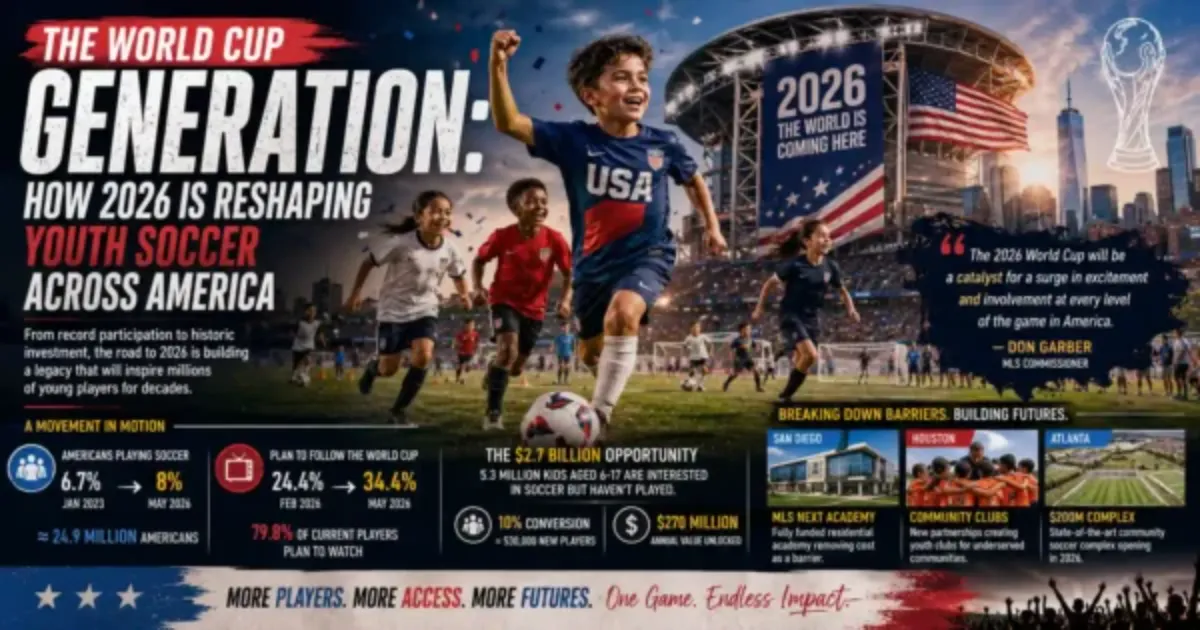
Garber believes the 2026 World Cup will serve as a similar catalyst — a surge in excitement and involvement at every level of the sport, from youth leagues all the way up to the professional game. But there’s a crucial difference between 1994 and 2026: in 1994, MLS didn’t exist yet. In 2026, the ecosystem that 1994 created is now mature enough to actually catch the wave this time, rather than simply being inspired to build something new from scratch.
The Numbers Behind the Moment
If you want to understand the scale of what’s happening, start with participation data. In January 2023, roughly 6.7% of Americans reported participating in indoor or outdoor soccer. By May 2026, that figure had grown to nearly 8% — representing approximately 24.9 million Americans playing the sport. That’s not a marginal increase. That’s millions of new participants in just over three years, with the tournament itself still to come.
The interest data tells an even more dramatic story about where momentum is heading. American interest in the World Cup grew steadily throughout 2026 — in February, 24.4% of the total population said they planned to follow the tournament. By May, that number had risen to 34.4%, meaning more than one in three Americans now plan to engage with the World Cup. Among people who already play soccer, a striking 79.8% plan to watch.
Put those two numbers together and you get a self-reinforcing cycle: more people playing leads to more people watching, and more people watching — especially during a home tournament — leads to more people wanting to play. The World Cup isn’t creating interest from nothing. It’s accelerating a trend that was already underway and giving it a deadline.
The $2.7 Billion Question Nobody Saw Coming
Perhaps the most eye-opening figure in the entire USA youth soccer World Cup 2026 conversation comes from a recent youth sports business analysis that quantified something rarely measured directly: latent demand. Across the United States, an estimated 5.3 million children aged 6 to 17 are interested in playing soccer but have not actually participated in the past 12 months. When translated into participation spend data, that represents a $2.7 billion annual opportunity.
The framing here matters enormously. This isn’t a projection about hypothetical future interest that the World Cup might create — it’s interest that already exists, right now, sitting dormant. If just 10% of those 5.3 million interested kids were converted into actual participants, that would unlock 530,000 new players and approximately $270 million in annual participation value. The World Cup’s role, in this framing, isn’t to manufacture demand. It’s to be the spark that finally converts demand that has been quietly building for years.
There’s also a sharper, more local version of this story. A similar 10% conversion of a 1.17 million local opportunity in specific markets could unlock more than $70 million annually in those communities alone. This is the part of the World Cup legacy conversation that rarely makes headlines — not stadiums, not broadcast deals, but local soccer clubs and community programs potentially doubling or tripling their rosters within a few short years.
Breaking Down the Walls: The Pay-to-Play Problem
For all the optimism, there’s an honest conversation happening within American soccer about who, exactly, gets to benefit from this moment. American youth soccer has long been criticized for its “pay-to-play” model — a system where access to elite coaching, travel teams, and development pathways is often determined less by talent than by a family’s ability to afford club fees, travel costs, and equipment. One of the most significant potential long-term impacts of the 2026 World Cup is addressing exactly these accessibility challenges, with the tournament bringing renewed focus on breaking down the pay-to-play barriers that have historically limited soccer’s growth in lower-income communities.
The response from the soccer establishment has been concrete rather than rhetorical. San Diego FC’s MLS NEXT Academy is launching its inaugural season as a fully funded, residential soccer school for the region’s youth — removing cost as a barrier entirely for the players selected. In Houston, new partnerships with Houston Dynamo FC are creating youth clubs specifically designed for underserved communities. And in Atlanta, a $200 million national training center is under construction, intended to serve as a permanent home for youth development long after the World Cup leaves town.
These aren’t symbolic gestures timed for good press during a World Cup year. They’re infrastructure — buildings, programs, and funded pathways that will exist in 2030, 2035, and beyond, regardless of how the tournament itself goes.
The Proof of Concept: Soccer for Success
Skeptics of “World Cup legacy” promises have good reason to be cautious — major tournaments around the world have a long history of producing white-elephant stadiums and inflated promises that quietly evaporate once the cameras leave. But American soccer already has at least one example of a program that has demonstrably worked, and it predates the 2026 buildup entirely.
The U.S. Soccer Foundation’s Soccer for Success program has achieved 39% average year-over-year growth — even during a period when national youth sports participation was declining in other areas. The program’s stated philosophy is disarmingly simple: making soccer “easy and affordable access to a quality soccer program that is fun and engaging.” No elite scouting networks, no expensive travel leagues — just access, removed of cost barriers, in communities that have historically been underserved by organized youth sports.
The significance of this program isn’t just its growth rate. It’s that it offers a tested template — proof that when cost and access barriers are removed, participation follows, even against a backdrop of broader decline. The Soccer Forward Foundation, U.S. Soccer’s flagship FIFA World Cup ’26 legacy initiative, is now scaling up these kinds of programs nationally, with further flagship legacy programs slated to be announced in the months around the tournament.
The MLS Pipeline: From Academy to National Team
While community-level access programs address the breadth of participation, the elite end of American soccer’s development pipeline has also undergone a quiet revolution over the past several years — one that’s now bearing fruit at exactly the right moment.
Across MLS, clubs invested more than $125 million in player development in 2025 alone, creating development pathways for over 58,000 youth players. Remarkably, 93% of U.S. youth national team players now come through the MLS NEXT pathway — a staggering concentration that would have been unthinkable a decade ago, when American youth talent more commonly funneled through college soccer or scattered private academies with no centralized standard.
Garber has specifically credited MLS’s maturity as a league to this focus on nurturing talent through extensive academy systems and youth leagues — pointing to teams like the Philadelphia Union, who won the league title with significant contributions from academy-developed players. The symbolism is hard to miss: a domestically-developed academy product helping win MLS Cup in the same year the country prepares to host the World Cup. That’s not a coincidence of timing so much as a demonstration of what a decade of academy investment can produce.
The Numbers FIFA and U.S. Soccer Are Betting On
The projections being made by U.S. Soccer itself give a sense of just how seriously the federation is taking this moment as a participation inflection point, not just a broadcast event. Hosting the World Cup is projected to drive a transformational spike in U.S. soccer fandom — from current levels to over 154 million people, a 48% increase compared to pre-tournament levels. Participation is expected to follow a similar trajectory, growing from a baseline of roughly 20 million in recent years to an estimated 29 million in 2026, and to 34 million by 2031.
That 2031 date is not arbitrary. It aligns with the United States’ bid to host the FIFA Women’s World Cup in 2031, alongside the Los Angeles 2028 Olympics — meaning American soccer’s growth strategy isn’t built around a single tournament as a one-off spike, but around a sustained five-year run of major events designed to keep the sport in the national conversation continuously, rather than allowing interest to spike and fade as it arguably did after 1994’s initial burst.
Demographics: A Genuinely Different Audience
One of the more striking findings buried in the participation data is who, exactly, is driving this growth. International soccer viewership among Americans has grown a remarkable 60% since 2018 — from 31.4 million to over 50.3 million viewers — and crucially, this growth represents systematic adoption across demographic segments that had previously been resistant to the sport, including significant penetration among older Americans, female audiences, and diverse ethnic communities.USMNT World Cup 2026: Pulisic, Pochettino and the Home-Soil Pressure That Could Define American Football Forever
Supporting data shows New Jersey ranks as the #1 state for soccer interest per capita, and 47% of Gen Z adults now identify as soccer fans — the highest percentage of any generation. The picture that emerges isn’t simply “soccer is becoming more popular.” It’s that soccer is becoming genuinely cross-generational and cross-demographic in the United States in a way that, historically, other major American sports have struggled to achieve outside their traditional bases.
The Messi Effect, Localized
No discussion of recent American soccer growth is complete without acknowledging the specific, almost laboratory-clean case study of Inter Miami’s signing of Lionel Messi in 2023. Inter Miami’s “Messi effect” has supercharged South Florida soccer interest specifically — providing a real-world demonstration of what happens to local participation and fandom when a global superstar becomes a fixture in a specific American community.
The implication for 2026 is significant: if a single player’s presence in one city can measurably shift participation data, what happens when the entire world’s best players — and the tournament itself — arrive simultaneously across 11 American host cities for over a month? The Messi effect in Miami may turn out to be a useful preview of the World Cup effect nationally, just compressed into dozens of cities at once rather than one.
The Risk: Will It Stick?
For all the optimism, there’s an honest question that hangs over every piece of this analysis, and U.S. Soccer’s own research seems to know it. The central, unresolved question is whether World Cup interest will convert into long-term participation — or whether, as has happened with other countries after hosting major tournaments, the spike proves temporary.
This is precisely why the infrastructure investments matter more than the tournament itself. A $200 million training center in Atlanta, a fully-funded residential academy in San Diego, an expanded Soccer for Success program with a proven 39% growth track record — these are things that exist independently of whether the USMNT wins, loses, or exits in the group stage. The larger win for the U.S. could ultimately be the sustained demand that follows — an increase in families choosing MLS, women’s soccer, youth clubs, and even international club friendlies long after the World Cup trophy has been handed out.
What Happens After July 19
When the World Cup final is played at MetLife Stadium on July 19, the immediate story will be about who lifted the trophy. But the more consequential story — the one that will take years, not weeks, to fully play out — will be measured in registration numbers at local soccer clubs across all 50 states, in whether that 5.3 million figure of “interested but not participating” kids starts meaningfully shrinking, and in whether the academy pipelines that produced 93% of the current youth national teams continue to expand or plateau once the spotlight moves on.
The 2026 World Cup, more than just stadium-building, has the potential to be about building an entire soccer economy for the United States — one where the tournament itself is remembered not as the destination, but as the moment an entire generation of American kids decided, for the first time in the sport’s history here, that soccer was simply what you did.
About the Author