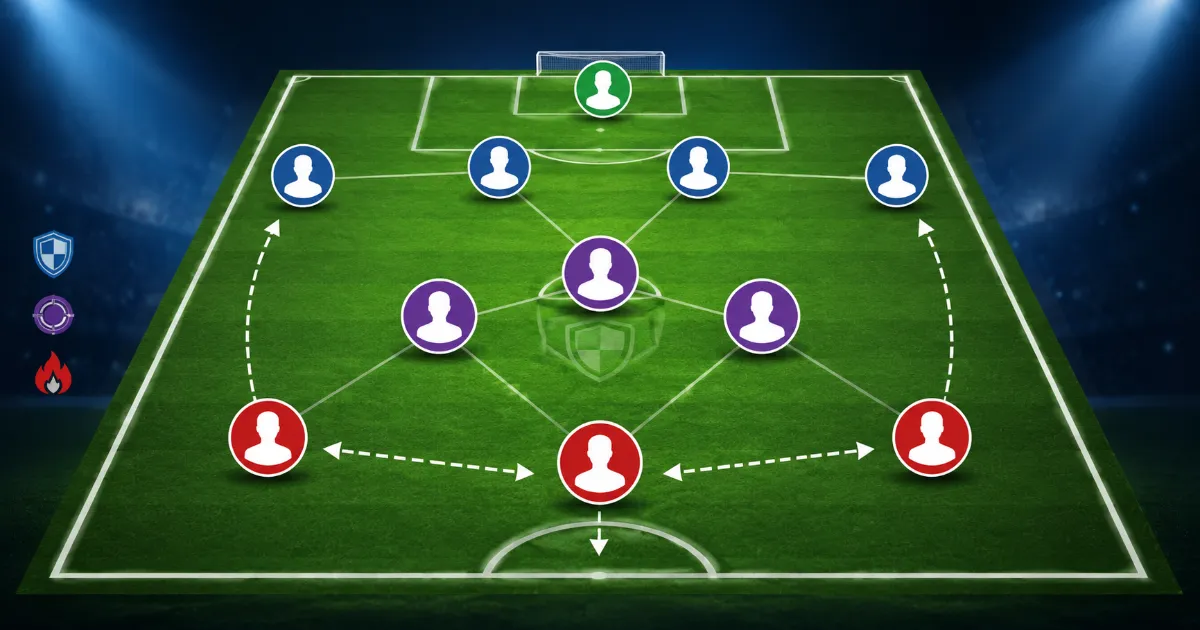
Look at the starting lineup for Spain, Brazil, Liverpool, or Manchester City and you will almost always find the same numerical shape: four defenders, three midfielders, three forwards. The 4-3-3 formation has become football’s most widely used tactical system at the elite level — and for reasons that go far deeper than aesthetic preference.
This guide explains exactly how the 4-3-3 works, what every player’s job is, why it produces so much attacking threat, and what its genuine weaknesses are. Whether you are a player trying to understand your role, a coach building a session, or a supporter trying to follow the tactical conversation, this is your complete breakdown.
VAR Decisions That Changed the Tournament: The Full Story
NBA Schedule 2026-27: Christmas Day Rivalries, Ring Night and the Games to Watch
PSG v Arsenal: How Paris Won the Champions League Final on Penalties
What Is the 4-3-3 Formation?
In the 4-3-3 formation, there are four defenders, three midfielders, and three forwards playing ahead of the goalkeeper. That is the short answer.
The longer answer: the 4-3-3 is more than a set of numbers on a tactics board. It guides how a team builds from the back, how midfielders help move the ball, how wingers make the field wider, how the striker starts the press, and how quickly everyone reacts when they lose the ball.
The 4-3-3 has four defenders, three midfielders, and three forwards. This setup is effective because it gives the team natural width, helps create passing triangles, supports the midfield, and makes pressing more organised.
         GK
  LB   CB  CB  RB
   CM    CM   CM
  LW    ST    RW
Role 1: The Goalkeeper
The goalkeeper in a 4-3-3 is not a passive last line. The formation’s press-and-pass philosophy requires a goalkeeper who can receive the ball from centre-backs under pressure, distribute accurately to wide areas, and serve as the team’s first playmaker when building from the back.
Manuel Neuer’s sweeper-keeper style at Bayern Munich was developed specifically to serve a 4-3-3 high-press system. Alisson at Liverpool, Ederson at Manchester City — both are chosen as much for their feet and distribution as their shot-stopping.
Key quality required: Composure on the ball, accurate long and short distribution, ability to play from the back under pressure.
Role 2: The Centre-Backs
The two centre-backs in a 4-3-3 must be capable of more than defending. Because the full-backs push high in this system, the centre-backs form the base of the build-up triangle with the deepest midfielder.
This means: ball-playing ability is not optional. A centre-back who cannot receive under pressure, turn, and play forward accurately will force the team to go long — which defeats the purpose of the entire system.
Key quality required: Comfortable in possession, good passing range, ability to carry the ball forward when the space opens.
Role 3: The Full-Backs — The Engine of the 4-3-3
In a 4-3-3, the full-backs are arguably the most important players in the system. They provide the width that allows the wingers to cut inside. They are the overlap runners that defenders cannot ignore. They are the delivery men for crosses and low cutbacks that create the formation’s most dangerous attacking positions.
Full-backs in a 4-3-3 spend significant time in the opposition’s half. Trent Alexander-Arnold at Liverpool is the modern archetype: his crossing, passing, and set-piece delivery from right-back has redefined what the position means. Andy Robertson on the left does the same from the opposite flank.
The biggest weakness of the 4-3-3 is often the space left around the single pivot, especially if the wingers or full-backs are slow to get back. When a full-back is high and wide, the space behind them — between their starting position and the centre-back — is a vulnerability. The deepest midfielder must cover that space when the ball is lost. If he is not positioned correctly, that gap becomes the opposition’s fastest route to goal on the counter.
Key quality required: Stamina to cover the full flank for 90 minutes, quality in delivery, defensive solidity when recovering.
Role 4: The Defensive Midfielder (The Pivot)
The single pivot in a 4-3-3 is the formation’s most critical midfield position. He sits in front of the back four, screens the defensive line from direct passes, and serves as the first receiver when the centre-backs play out from the back.
In most elite 4-3-3 systems, the pivot is not expected to score goals or provide assists. He is expected to win the ball, protect the space, and distribute simply to the two midfielders ahead of him.
Teams often use one defensive midfielder and two number eights in the midfield. The quality of that defensive midfielder — and his ability to cover the space left by advanced full-backs — determines how much freedom the wingers and full-backs have to attack.
Think Rodri at Manchester City. Fabinho at Liverpool in his peak years. Casemiro at Real Madrid. The pivot allows everyone else to express themselves.
Role 5 & 6: The Two Number Eights
The two central midfielders either side of the pivot are the formation’s connective tissue. They must be able to:
- Receive in tight spaces and play quickly
- Run forward and arrive in the box late (box-to-box)
- Press aggressively when the team is out of possession
- Cover the space between the defensive pivot and the attacking line
The best number eights in a 4-3-3 are complete footballers. Jude Bellingham at Real Madrid plays as a number eight in this formation — a position that requires defensive work, forward runs, and technical quality in equal measure. Kevin De Bruyne in his prime Manchester City role is another archetype.
Role 7 & 8: The Wingers
The wingers are the 4-3-3’s primary attacking weapons. They provide the width, the one-vs-one threat, and the diagonal runs that pull defenders out of position.
In the modern 4-3-3, wingers almost always invert — meaning a right-footed player plays on the left, cutting inside onto their stronger foot to shoot or pass centrally. This creates space on the outside for the attacking full-back to overlap.
Lamine Yamal on the right for Spain, Vinícius Jr. on the left for Brazil, Salah on the right for Liverpool — all inverted wingers who cut inside with pace and create the central overloads that produce the 4-3-3’s most dangerous attacking moments.
Role 9: The Centre-Forward
The centre-forward in a 4-3-3 is not always the team’s leading scorer. In possession-based 4-3-3 systems, the striker is first required to lead the press — closing down opposition centre-backs to force errors and trigger the team’s defensive shape.
In attacking transitions, the striker must be intelligent enough to stay central and create the spaces that arriving midfielders and wingers can exploit.
Two types work: the technical link-striker (Matheus Cunha, Roberto Firmino) who connects play with his back to goal, and the direct runner (Erling Haaland) who attacks the space that the team’s possession creates. Both can function in this formation with appropriate tactical adjustment.
Strengths of the 4-3-3
1. Natural Width Three forwards spread across the pitch force defensive lines to stretch horizontally. The result: space opens centrally for the midfield to exploit.
2. Pressing Structure The front three provides three simultaneous pressing triggers at the top of the pitch. When coordinated, a 4-3-3 press can trap opposition goalkeepers and centre-backs within their own half.
3. Fluid Passing Triangles The formation generates triangles at every line of the pitch — between the centre-backs and pivot, between the pivot and the eights, between the wingers and the full-backs. These triangles create short passing options in all directions.
4. Midfield Control Three midfielders against two creates numerical advantages in the centre. In deeper defensive phases, a 4-3-3 can compress into a 4-5-1 with wingers dropping, creating a wall across the pitch.
Weaknesses of the 4-3-3
1. The Pivot’s Space The deepest midfielder cannot be everywhere. When full-backs push high and wingers hold wide positions, the space in front of the back four is significant. A team with a fast, creative number 10 can expose this gap repeatedly.
2. Midfield Can Be Outnumbered Against a 4-4-2 or 4-2-3-1, three midfielders face four or five opponents in the centre. The pivot becomes overwhelmed and the two eights face a constant numerical disadvantage if they commit too high.
3. Wingers Must Defend In a 4-3-3, the full-backs cannot defend their flank alone when the ball is lost in transition. Wingers must track back to create a defensive four. If they do not — the 4-3-3 becomes a 4-1-3-2 out of possession, which is a deeply vulnerable shape.
Who Uses the 4-3-3?
| Team | Era | Key Feature |
|---|---|---|
| Ajax (Netherlands) | 1970s | Total Football — every player interchangeable |
| Barcelona (Cruyff) | 1988–94 | Dream Team — possession as control |
| Barcelona (Guardiola) | 2008–12 | Tiki-taka — passing tempo as a weapon |
| Liverpool (Klopp) | 2015–24 | Gegenpressing — winning the ball high |
| Manchester City (Guardiola) | 2016–present | positional play — dominating space, not just the ball |
| Brazil (Ancelotti) | 2025–26 | Vinícius-Raphinha width + Ancelotti’s knockout pedigree |
The 4-3-3 at World Cup 2026
The 4-3-3 formation is the single most common shape at the 2026 FIFA World Cup, used by Brazil, Spain, Germany, France, Norway, the Netherlands, and the United States, among others.
Spain’s Lamine Yamal and Nico Williams on the wings represent the formation’s most exciting current iteration. Germany’s Wirtz-Musiala combination gives the 4-3-3’s number eight roles their most talented partnership in years. Brazil’s Vinícius and Raphinha represent the inverted winger philosophy at its most athletic and direct.
The 4-3-3 formation is not simply popular. It is the dominant tactical language of modern football at the elite level — and the 2026 World Cup will be its most comprehensive global showcase.
All 104 Matches — Dates, Stadium and Global Kickoff Time From June 11 to July 19
🔹🔹 Follow us on Facebook 🔹🔹
About the Author




2 thoughts on “The 4-3-3 Formation Explained: Roles, Strengths, Weaknesses and Why It Dominates Modern Football”