Every World Cup tells a tactical story. Not just a story of goals and players and magic moments — but a story about how the game is being played, what its best coaches have decided works, and what the next four years of global football will look like in the tournament’s wake.
In 2010, Spain’s tiki-taka made the rest of the world reconsider possession. In 2014, Germany’s pressing-plus-width combination redefined how a tournament winner should look. In 2018, France’s defensive efficiency and devastating counter-attacking remade the debate about whether style or substance wins the biggest prize. In 2022, Morocco’s structured low-block showed that AFCON-level organisation could be competitive with the best teams in the world.
What Is Tiki-Taka? Spain’s Football Philosophy Explained Simply
Thiago Messi: Club Career, Playing Style, Lifestyle and Future Prospects
NBA Schedule 2026-27: Christmas Day Rivalries, Ring Night and the Games to Watch
The 2026 World Cup — the first with 48 teams, the first across three host nations, the first in a format where 32 teams advance to the knockout stage — will be decided not just by individual quality but by which systems most effectively survive 16 games of escalating intensity.
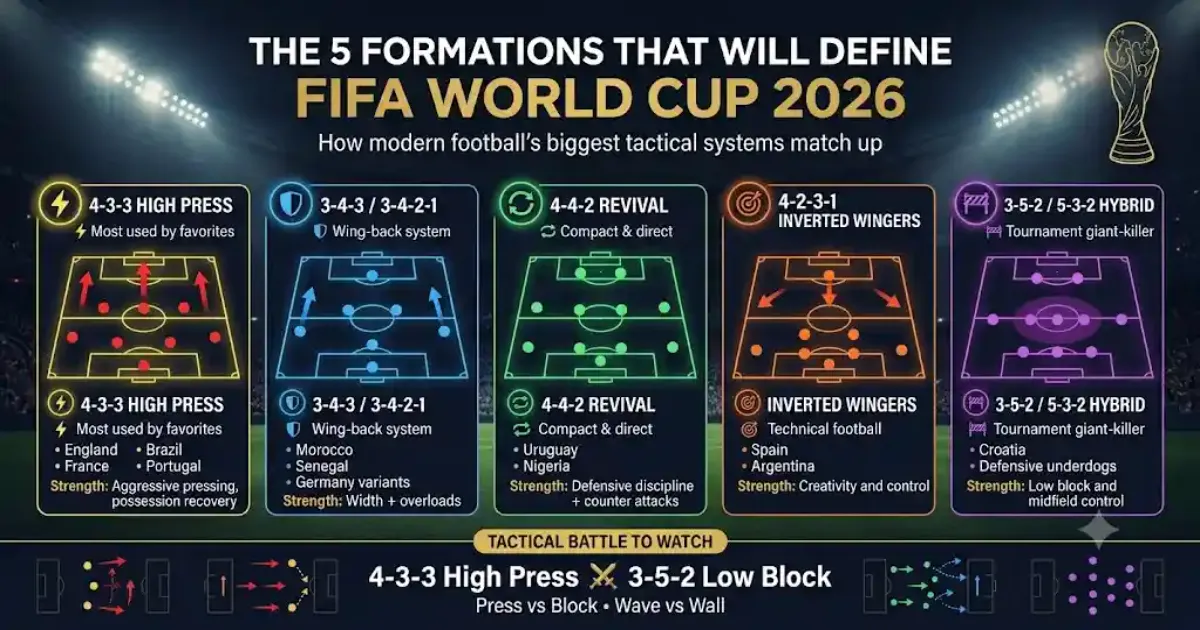
Here are the five tactical formations that will define it.
Formation 1: The 4-3-3 with High Press
Who uses it: England, France, Netherlands, Portugal, Brazil Why it will dominate: Because this is the foundational blueprint of modern elite international football — and every team likely to win the tournament is built on a variant of it
What It Is
The 4-3-3 is the game’s most widespread elite system: four defenders (two centre-backs, two full-backs), three central midfielders in a variety of configurations (single pivot + two eight positions, or a double pivot + one advanced midfielder), and three forwards (one central, two wide).
In its most effective 2026 form, the 4-3-3 is not a passive system. It is a machine designed to press aggressively — to prevent opponents from building from the back, to win possession in the opponent’s half, and to exploit the space that a disorganised defensive line leaves when it has been pressed into errors.
The pressing element transforms the 4-3-3 from an organisational blueprint into a philosophical statement: we are going to make you uncomfortable with the ball before you can threaten us without it.
The Mechanics
Out of possession: The front three press the opponent’s back four. The two wide forwards cut off passing lanes to the full-backs; the central forward presses the centre-back or goalkeeper in possession. Behind them, the three midfielders maintain a compact shape — close enough to press the next line if the ball is played out, organised enough to drop into a 4-3-3 defensive block if the press is beaten.
In possession: The two wide forwards stretch the defensive line horizontally. The full-backs push high into the spaces vacated by the wingers’ inside movements. The central striker — ideally a player comfortable holding the ball, linking play, and pulling defenders with their movement — creates space for arriving midfielders.
The key position: The central midfielder who most recently been called an “eight” — not the holding pivot, not the advanced number ten, but the player between them who covers both roles. In England’s system, this is the Bellingham position. In France’s, it was Kante before his decline and is now a similar profile. This player must press, must recover, must arrive late in the box, and must be technically fluent enough to build under pressure. Finding the right midfielder for this role is the tournament’s central selection puzzle for 70% of serious contenders.
Why It Works in 2026
The expanded format means that across the group stage, all teams play three matches in 11–12 days. Physical intensity from the high press is sustainable for those opening matches. Teams that can impose the press early — establishing momentum, taking quick leads, forcing psychological concessions from smaller nations — arrive at the knockout rounds with defensive records intact and collective confidence established.
France’s 2018 World Cup-winning system was a 4-3-3 variant. Spain’s complete system from 2008–2012 was a 4-3-3 foundation. The most technically complete squads heading into 2026 — England, France, Brazil, Portugal — are all 4-3-3 sides in their default shape. The formation doesn’t guarantee success. But every team likely to lift the trophy in Los Angeles will have variants of this shape available to them.
The risk: Against compact, organised opposition — the teams who sit in a 5-4-1 or 4-4-2 low block — the 4-3-3 high press has nothing to press. You can’t press what isn’t there. Teams designed to absorb 4-3-3 sides and counter on the break have consistently caused problems for pressing football. The 2026 tournament will contain numerous sides specifically set up to frustrate favourites in exactly this manner.
Formation 2: The 3-4-3 / 3-4-2-1
Who uses it: Belgium (historically), Morocco, Senegal, potential Germany variants Why it matters: The three-back system is the tournament’s most flexible and tactically nuanced structure — and the coaches willing to run it well will gain significant advantages
What It Is
Three centre-backs, three central defenders, forming the base of the structure. Two wing-backs — neither full-backs nor wingers but a hybrid position that covers the entire flank in both defensive and attacking phases. Four midfielders or a varied combination of two central midfielders plus two attacking midfielders. Then the front players: either three forwards (3-4-3) or two attacking midfielders supporting a lone striker (3-4-2-1).
Why It’s So Difficult to Defend Against
The 3-4-3 creates numerical advantages that are very difficult for opposition shape to resolve cleanly. The wing-backs, when attacking, effectively give the team five players across a defensive line — the three centre-backs providing security while both wing-backs push forward. This creates a five-against-four attacking overload down both flanks simultaneously.
When the wing-backs bomb forward and the three forwards stay high, the opponent’s back four has — in theory — five threats to deal with. If they push extra defenders wide to cover wing-backs, the central forwards are in a 3v2. If they stay compact, the wing-backs have the flank.
The central midfielder pairing becomes critically important: they must provide the horizontal protection when wing-backs have pushed high, covering the space behind them defensively while also supporting the attack vertically.From Roberto Carlos to Messi: Ranking the Best Free Kicks in History
Morocco’s 2022 Blueprint
Morocco’s extraordinary run to the semi-finals of the 2022 World Cup — beating Belgium, Spain (on penalties), and Portugal — was built on exactly this system. Walid Regragui’s Morocco used a 4-4-2 defensive structure that morphed into a 3-4-3 in possession, with the full-backs pushing so high they functionally became wing-backs.
The key figure was the defensive midfielder — Sofyan Amrabat — who was everywhere. Covering the spaces left by the wing-backs. Breaking up attacks. Distributing calmly under pressure from the world’s best midfielders. Amrabat’s tournament performance was the clearest single demonstration in 2022 of what the defensive pivot position in a three-back system demands from the individual who plays it.
In 2026, Morocco return as one of the tournament’s most respected sides and their three-back system will again be studied carefully by opponents. More importantly, the teams that watched Morocco in 2022 and learned from them have had four years to implement similar structures.
The Risk
Three-back systems are vulnerable to quick transitions if the wing-backs are caught high. A loss of possession with both wing-backs advanced leaves three centre-backs against two or three attacking players — a manageable but not comfortable defensive situation. Against teams with explosive pace on the counter-attack (Mbappé’s France, Vinicius Jr’s Brazil), the three-back system’s exposure in transition is a persistent concern.
Formation 3: The High-Energy 4-4-2
Who uses it: Atletico Madrid model adopted by Uruguay, Nigeria, various CONCACAF nations Why it will matter: The 4-4-2’s revival at international level is the most underreported tactical story heading into 2026
The Return of the Flat Back Four and Two Strikers
The 4-4-2 was considered extinct at elite level by approximately 2012. The dominance of possession-based football — which exploited the central spaces a flat midfield four leaves — appeared to render it permanently obsolete. The 4-2-3-1 and 4-3-3 replaced it everywhere from international football to domestic leagues.
But the 4-4-2 never died. It evolved.
Diego Simeone kept it alive at Atletico Madrid — the most successful deployment of the formation in the modern era. Simeone’s version is more sophisticated than its classic counterpart: the flat four midfield is intensely disciplined, maintaining their horizontal defensive line with mechanical precision. The two forwards press aggressively from the front, reducing the opponent’s time on the ball high up the pitch. Transition from defensive block to attack is direct and immediate — no patient possession build, just a quick vertical ball to the forwards as soon as the ball is won.
This Atletico model has influenced international football more than any single club tactical system of the last decade. Several national teams — particularly those without the technical depth to execute 4-3-3 possession football convincingly — have adopted variants of it.
Uruguay: The Clearest 2026 Example
Uruguay under their current coaching staff approach each World Cup with a clarity of identity that is almost refreshing in an era of tactical complexity. Two recognisable strikers — a physical presence and a technical runner — supported by a compact four-man midfield that defends hard, recovers quickly, and trusts the strikers to create and score from limited service.
Uruguay won zero tactical battles at the 2022 World Cup against possession sides but remained competitive throughout. Their 4-4-2 gave away nothing in the middle of the pitch, made every inch of space expensive to earn, and created moments of genuine danger from direct play into their forwards.
In 2026, with a refreshed squad and similar tactical clarity, Uruguay represent the clearest demonstration of what the 4-4-2 revival means at international level.
Why It Can Win Matches in 2026
The group stage in an expanded tournament includes matches between two similar-ranked nations where one team’s higher defensive organisation can be worth more than the other’s individual quality. Against possession-dominant sides, the 4-4-2 low-block plus quick transition is one of the most psychologically challenging systems to break down — particularly in the final 20 minutes, when time pressure makes possession sides more desperate and therefore more prone to the error that gifts a counter-attack.
Formation 4: The 4-2-3-1 With Inverted Wingers
Who uses it: Spain, Argentina, Colombia, Germany variants Why it will define the tournament: The 4-2-3-1 is the most technically demanding system in 2026 and the one most likely to produce genuinely beautiful football — and the one that wins tournaments when it has the right players
The Architecture
Four defenders. A double pivot of two central midfielders — one primarily defensive, one primarily progressive. A number ten who operates between midfield and attack. Two wide forwards who cut infield onto their stronger foot (inverted wingers). One central striker.
The inverted winger concept is the defining modern adaptation of the traditional 4-2-3-1. Instead of wide players who stay wide and cross, inverted wingers drift inside — a right-footed player on the left, cutting onto their right foot; a left-footed player on the right, cutting onto their left. This creates shooting angles from wide-central areas rather than crossing opportunities, and it allows the full-backs to overlap and provide width themselves.
The result: a system where the attacking width comes from the full-backs, and the forward threat comes from wide players moving inside. Defenders cannot simply push full-backs back to deal with width, because the real attacking threat is coming from inside.
Spain’s 2026 Application
Spain’s squad heading into the 2026 World Cup contains the perfect personnel for the inverted winger 4-2-3-1. Pedri and Gavi in the double pivot — two of the most technically complete midfielders in the world at their ages. Yamal on the right, cutting inside onto his left. A complementary talent on the left doing the opposite. A composed number ten linking everything.
Spain won Euro 2024 with this structure, playing football that at its peak rivalled the tiki-taka era in terms of fluency and control. If they arrive in 2026 with squad depth and form intact, the 4-2-3-1 inverted-winger system is the most aesthetically sophisticated tactical model in the tournament field.
The Risk
The double pivot creates a specific vulnerability: if either of the two central midfielders is unable to maintain their defensive discipline while the full-backs push forward, a large gap opens through the centre of the pitch. A fast opponent with a direct central midfielder can exploit this ruthlessly. Spain’s Euro 2024 campaign encountered this problem — several groups-stage matches saw them temporarily vulnerable to the exact central counter-attack their system’s geometry creates.
Formation 5: The Fluid 3-5-2 / 5-3-2 Hybrid
Who uses it: Italy (historically), Croatia, potential Asian nations, defensive World Cup outsiders Why it matters most of all: The 3-5-2 is the formation that stops possession football — and in a World Cup knockout match, stopping possession football can be worth more than playing it
The Shutdown System
The 3-5-2 begins from the same structural premise as the 3-4-3: three centre-backs providing defensive width and depth. The difference is in how it uses the midfield zone and the attack.
Where the 3-4-3 sends wing-backs high and creates attacking overloads, the 3-5-2 compresses the middle. Five players across the midfield line — three central midfielders plus two wing-backs positioned deeper than their 3-4-3 equivalents — creates a midfield block of extraordinary horizontal depth and width. The two forwards are isolated but serve a specific function: a physical presence to hold the ball during transition moments, and a runner to exploit the space behind a high defensive line.
The result is a formation that is almost impossible to play through centrally. The five-man midfield closes every passing lane between the lines. The only routes to goal are wide (where the wing-backs provide adequate coverage) or from distance (which the three-centre-back depth manages).
Why It Will Feature in 2026’s Biggest Knockout Matches
The knockout stage of a 48-team World Cup produces matches where the smaller team faces an existential challenge: how do you survive 90 minutes against a technically superior opponent? The 3-5-2 is the answer several coaches will reach for.
Italy’s 2022 World Cup absence and 2023 Nations League campaigns saw variants of this system keeping them competitive against opponents with superior individual quality. Croatia’s World Cup 2018 run — to the final — included adaptation toward a more compact midfield-heavy system when the pressure of knockout rounds increased. The 3-5-2’s value in a knockout World Cup context is specifically about its ability to neutralise one-match opponents you are not expected to beat.
The tactical duel everyone is waiting for: A 3-5-2 defensive structure versus a 4-3-3 high-pressing side in a knockout match will be the tactical encounter that defines World Cup 2026. The press against the block. The wave against the wall. If a smaller nation makes a quarter-final run with the 3-5-2 as their core structure — as Morocco did in 2022 with their variant — the conversation about what formations win tournaments will shift decisively.
How the Formations Match Up: A Visual Guide
FORMATION MATCHUP SUMMARY

4-3-3 High Press        vs    5-4-1 / 3-5-2
[Favourite]             vs    [Underdog Killer]
Best against: open,     vs    Best against: elite
  technical opponents          possession sides

3-4-3 Wing-backs        vs    4-4-2 Flat Block
[Width + depth]         vs    [Compact + direct]
Best against: narrow    vs    Best against: high
  formations                   press systems

4-2-3-1 Inverted Wingers  — The Chameleon
Adapts to opponent shape, highest skill ceiling,
most dependent on specific individual quality
in key positions (double pivot, #10, inverting wingers)
The Tactical Prediction: Which System Wins the World Cup?
History suggests that World Cup winners are rarely the most tactically innovative team in the field. They are usually the team that executes their chosen system most consistently — the team that plays their formation at the highest level of collective discipline across seven matches.
The 4-3-3 with high press will produce the highest number of victories across the group stage. Its goal-scoring capacity, its squad flexibility (multiple player types fit its positions), and its psychological momentum make it the default system of tournament favourites.
The 3-5-2 or 3-4-3 defensive variants will produce the tournament’s biggest upsets — the moments that change the bracket, eliminate a favourite in the last sixteen, create the chaos that every expanded World Cup historically generates.The 4-3-3 Formation Explained: Roles, Strengths, Weaknesses and Why It Dominates Modern Football
The 4-2-3-1 inverted winger will produce the best football — the moments of genuine elegance and sophistication that appear in tournament highlight reels for years after.
The formation that lifts the trophy will be a 4-3-3 variant. The formation that makes the tournament worth watching will be everything else.
Key Tactical Terms: Glossary
| Term | Meaning |
|---|---|
| High press | Aggressive collective pressure on the ball in the opponent’s half |
| Low block | Deep defensive shape, conceding possession and defending compactly |
| Wing-back | Hybrid wide player — wider than a midfielder, more defensive than a winger |
| Inverted winger | Wide forward who cuts inside rather than going to the byline |
| Double pivot | Two defensive/progressive midfielders playing alongside each other |
| False 9 | Centre-forward who drops deep to create rather than finish |
| Pressing triggers | Specific moments (back pass, poor touch) that signal the team to press |
| Transition | The phase of play immediately after possession changes |
| Gegenpressing | Immediate collective press the moment possession is lost |
Final Word
The greatest tactical formations are not systems in isolation. They are systems in the hands of specific coaches, with specific players, at specific moments in football’s constantly evolving conversation.
The World Cup 2026 will produce answers to questions we haven’t fully articulated yet. Which formation is most effective in a 48-team bracket where the group stage matters less and the knockout rounds are longer? Which pressing system survives the physical demand of more matches with less recovery time? Which defensive organisation is robust enough to handle three different opponents across a 48-hour turnaround?
Those questions will be answered on a grass pitch somewhere between Los Angeles, Mexico City, and Toronto. The formations above will be doing the answering.
Watch the third match of every group carefully. That is when fatigue, tactical adjustment, and psychological pressure combine — and when formations either hold or fracture.
That is when the tournament begins in earnest.
Bangladesh Create History in Darwin, Defeat Australia by Nine Wickets in Landmark Test Victory
Cristiano Ronaldo Jr.: Club, Lifestyle, Career and Future Prospects
▪️▪️ Follow us on Facebook▪️▪️
About the Author