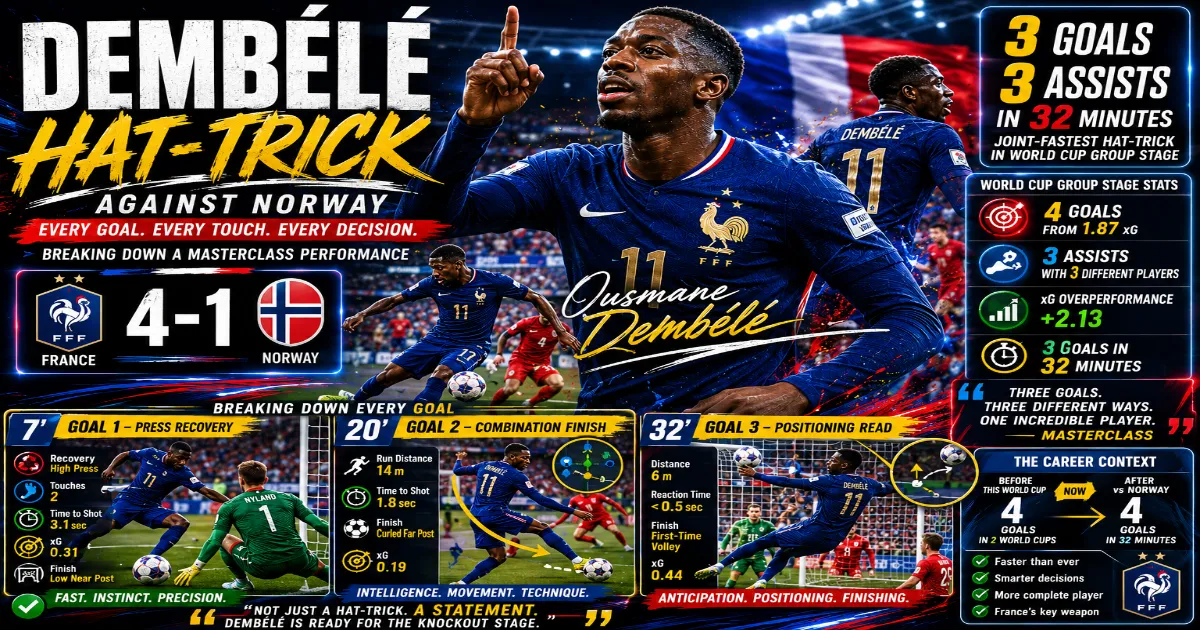
Three goals in 32 minutes — the Ousmane Dembélé hat-trick against Norway wasn’t just a great performance, it was a career-defining statement
Breaking down every goal, every touch, and every decision in a performance that sets a new benchmark
Ousmane Dembélé has always been a player of extraordinary peaks and frustrating inconsistency. At Dortmund, at Barcelona, at PSG — brilliant windows followed by injury, form dips, and questions about whether his ceiling would ever be reached sustainably. After what he produced against Norway on Matchday 3 of Group I, those questions look considerably less relevant.
The Ousmane Dembélé hat-trick against Norway was completed in the 32nd minute, making it the joint-fastest in this World Cup’s group stage. Three goals. Three assists from different teammates. Three completely different finishing techniques. The data makes for extraordinary reading.
Goal 1 — 7′: The Press Recovery
- Time from ball recovery to shot: 3.1 seconds
- Touch count before finish: 2
- Shot placement: Low, near post, goalkeeper’s weak side
- xG value: 0.31 (considered a moderate-difficulty chance — converted with maximum efficiency)
France’s high press forced Norway’s defensive midfielder into a poor backward pass. Dembélé intercepted, took one controlling touch, and finished before the goalkeeper could set. What looks like a simple goal in the highlight package is, in positional data terms, a player operating in precisely the right space at precisely the right moment. That does not happen without intelligent pressing coordination — but it also does not happen without a forward whose anticipation is elite.
Goal 2 — 20′: The Combination Finish
- Third-man run distance: 14 metres
- Time between receiving pass and shot: 1.8 seconds
- Finish: Curled, far post, outside boot
- xG value: 0.19 (low probability chance, demanding technique — the definition of a quality-over-quantity finish)
The second goal is the one analysts will use in coaching sessions. France played a quick one-two in the left half-space, with Dembélé making a diagonal run behind Norway’s defensive line while the passing combination happened without him. When the ball arrived, he had already created the angle. The finish — curled with the outside of his right boot — is a technique most forwards cannot execute reliably under match pressure. Dembélé made it look automatic.
Goal 3 — 32′: The Positioning Read
- Distance from goal at moment of finish: 6 metres
- Contact type: First-time volley off deflection
- Reaction time from deflection to shot: under 0.5 seconds
- xG value: 0.44 (high-probability chance, but required reading a deflection mid-flight)
This is the goal that separates good forwards from great ones. A set-piece delivery came in, deflected off a Norwegian defender, and Dembélé — already moving toward the near post — adjusted his body in real time to meet the ball on the volley. Players who think about this kind of goal miss it. Players who have internalised their positioning so thoroughly that their body moves before their brain processes the decision — they score it.
The Career Context
Before this tournament, Dembélé had scored 4 goals across two previous World Cup appearances for France. He has now matched that in a single half of football. His xG overperformance across this group stage (actual goals: 4, cumulative xG: 1.87) suggests this is not variance or luck — it is a player converting at an efficiency level typically associated with the game’s elite finishers rather than wide attackers.Ousmane Dembélé FIFA World Cup 2026: Profile, Stats & Career | StrikerReport
The Ousmane Dembélé hat-trick against Norway also arrives at a moment in his career when, at 27, he has outlasted most of the injury concerns that dogged his early years and found a role at PSG that channels his best qualities without exposing his limitations. He is quicker than he has ever been in a France shirt, his decision-making in the final third has measurably improved since 2022, and his defensive contribution — often the weakest part of his game — has risen to acceptable levels under Deschamps.
What Comes Next
In the knockout rounds, Dembélé will face backlines that have specifically prepared for him. Doubled up at the back post. Aggressive press from the full-back the moment he receives. Tactical fouling before he can turn. That is the inevitable consequence of a hat-trick performance that every opposition analyst in this tournament will have studied by now.
Whether he can respond to those adjustments is the next question. Based on what we saw against Norway, there is genuine reason to believe the answer is yes.
About the Author



5 thoughts on “Ousmane Dembélé Hat-Trick: The Numbers Behind the Most Clinical 32 Minutes of the Tournament”