 How Does the FIFA Rankings Work? Points, Calculations & Why It Matters
Every couple of months, a new set of numbers gets published, and football fans everywhere argue about it. Belgium spends years parked near the top despite an aging squad. A team that just lost a friendly somehow gains points. A neutral watching a World Cup draw wonders why a nation that looked ordinary throughout qualifying got seeded above a team that looked genuinely dangerous. All of this traces back to one system that most fans have heard of but few actually understand: the FIFA World Ranking. So let’s actually answer the question properly. How does the FIFA rankings work, in plain terms, without the jargon?
From Roberto Carlos to Messi: Ranking the Best Free Kicks in History
Where the Noise Never Stops: Ranking the Best Football Stadiums on Earth
Football’s Oldest Goalscorers Ever: The Complete Ranking
The Short Answer
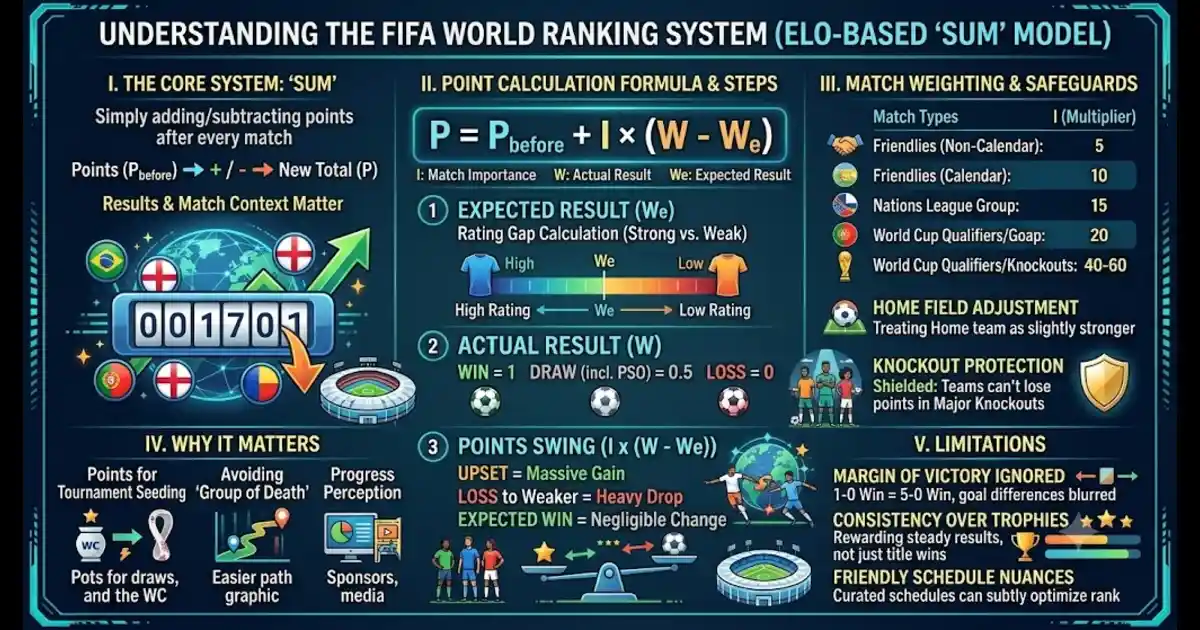
At its core, the FIFA World Ranking uses a modified version of the Elo rating system, the same mathematical framework originally developed for chess by Hungarian-American physicist Arpad Elo. Every national team starts with a rating number. After every FIFA-recognized international match, both teams’ numbers move up or down based on the result, how strong the opponent was, and how important the match was. Win, and you gain points. Lose, and you drop them. Beat a stronger team, and you gain more than you would beating a weaker one. Lose to a weaker team, and you lose more than you would losing to a stronger one. That’s the entire philosophy in a sentence: results matter, but context matters just as much.
A Quick History: Why FIFA Changed the System
FIFA has not always calculated its rankings this way. The original system, introduced back in December 1992, used a straightforward point-average model that generated regular criticism for producing rankings that didn’t reflect a team’s actual current form or quality. Nations complained for years that the calculation rewarded quantity of matches over quality of performance, and that friendlies could be gamed for ranking purposes ahead of major tournament draws.
After years of testing, FIFA adopted a new methodology in August 2018, switching to the Elo-based system that remains in place today. FIFA internally refers to this model as “SUM,” because rather than averaging results across a rolling time period like the old system did, it simply adds or subtracts points from each team’s running total after every match. The transition wasn’t retroactive chaos, either; FIFA anchored the changeover carefully, giving the top-ranked team at the time an Elo value of 1800, with each subsequent team receiving 4 points less in descending order, before the new match-by-match formula took over from there.
The Formula, Explained Without the Math Headache
If you want the full mathematical version, FIFA’s own methodology document lays it out with genuine rigor, but here’s the plain-English version of what actually happens after a match.
Step one: expected result. Before a match kicks off, the formula calculates an “expected result” for each team, based purely on the gap between their current rating numbers. If two teams have similar ratings, the expected result sits close to 50-50. If one team is rated far higher than the other, the formula expects that stronger team to win, and the “surprise value” of an upset gets baked into the following calculation.
Step two: actual result. A win counts as 1, a draw as 0.5, and a loss as 0. If a match is decided by a penalty shootout, it’s still scored as a draw for ranking purposes, since normal play ended level.
Step three: the points swing. The difference between the actual result and the expected result gets multiplied by a weighting for match importance, and that final number determines how many points shift between the two teams. Beat a much stronger opponent than expected, and the points swing is large. Beat a much weaker opponent exactly as expected, and the swing is small. Lose to a weaker opponent, and the swing works heavily against you.
Why Some Matches Are Worth More Than Others
This is the part that trips up most casual fans. Not every match carries the same weight in the calculation. FIFA assigns a multiplier based on the nature of the fixture, and it ranges quite dramatically. A meaningless late-stage friendly between two nations already eliminated from contention carries a low multiplier. A World Cup knockout match carries one of the highest multipliers in the entire system, since FIFA’s methodology explicitly builds in the logic that late-stage World Cup matches matter far more to a team’s overall standing than a pre-season friendly ever could.
This tiered weighting exists specifically to prevent the kind of manipulation that plagued the old averaging system, where a federation could schedule a string of easy friendlies against weak opposition purely to inflate its ranking ahead of a major seeding date. Under the current formula, beating a weak opponent in a low-stakes friendly simply doesn’t move the needle much, no matter how many times you repeat it.
Home Advantage and Other Adjustments
The formula also builds in a home-field adjustment, effectively treating the home team as slightly stronger than its raw rating suggests when calculating the expected result. This reflects the well-documented statistical reality that international teams perform somewhat better on home soil, and it prevents home nations from being unfairly punished for narrow results that a neutral-venue match might have produced differently.
There’s also a protective mechanic built specifically for knockout tournament football: teams competing in the knockout rounds of major competitions cannot lose ranking points if the underlying calculation would otherwise push them into a negative points swing for that stage, shielding teams that have already secured tournament qualification from being penalized purely for the mathematics of an unlikely result along the way.
Why Belgium (and Teams Like Them) Confuse Casual Fans
If you’ve ever wondered why Belgium spent years camped near the very top of the FIFA World Ranking despite a so-called “Golden Generation” that never quite delivered a major trophy, the ranking system itself explains most of the confusion. The Elo-based formula rewards consistent results across a long run of matches far more than it rewards a single spectacular tournament run or punishes a single disappointing one. A nation that wins its qualifying matches reliably, even against modest opposition, and avoids damaging losses, will hold a high ranking even without ever lifting a major trophy. Rankings measure consistency of results over time; they do not directly measure trophies, star power, or the eye test that fans naturally apply when judging a team’s quality.The Youngest Stars Dominating World Cup 2026
What the Rankings Are Actually Used For
It’s worth being precise here, because this is another area of common confusion: a high FIFA ranking does not guarantee World Cup qualification. Qualification is still earned through regional competitions run by each confederation, whether that’s UEFA, CONMEBOL, CAF, CONCACAF, AFC, or OFC. What the rankings actually determine is seeding. When FIFA draws the groups for World Cup qualifying rounds, or the finals draw itself, it uses the current world ranking to sort nations into seeding pots, ensuring the strongest teams, according to the ranking, are spread across different groups rather than clustering together in a single “group of death.” The same logic applies to seeding at other FIFA-run tournaments, including regional and youth competitions.
This means the rankings carry very real practical stakes even for teams with no realistic shot at winning anything. A nation ranked just inside the cutoff for a higher seeding pot rather than just outside it can end up with a significantly easier or harder path through an entire qualifying campaign, based purely on where the numbers land on publication day.
How Often Do the Rankings Update?
FIFA publishes updated rankings several times a year, generally following the conclusion of official international windows, when the bulk of that period’s fixtures have been played and the point calculations processed. FIFA has also introduced an unofficial live-ranking feature during major tournaments, letting fans track how a result would theoretically shift a team’s position in real time, even though the actual official ranking only updates on its scheduled dates. This live tracker is explicitly for comparative and entertainment purposes; the number that matters for seeding and official record-keeping is the one FIFA formally publishes on its calendar.
FIFA Rankings vs. Independent Elo Systems
One more source of confusion worth clearing up: FIFA’s official ranking is not the only Elo-style system tracking international football. Independent projects, most notably the World Football Elo Ratings maintained outside FIFA, apply their own modified Elo formulas that factor in things FIFA’s official system doesn’t, such as margin of victory. FIFA’s methodology treats a narrow one-goal win and a dominant five-goal win identically, while several independent Elo systems reward the larger margin of victory with a bigger points swing. Neither approach is objectively correct; they simply reflect different philosophies about what should count as evidence of a team’s underlying strength. But it’s why you’ll occasionally see a team ranked quite differently on an independent Elo site compared to FIFA’s own official list, even though both are technically “Elo-based” systems measuring the same matches.
Common Criticisms of the System
No ranking system pleases everyone, and FIFA’s is no exception. The most persistent complaint is one already touched on above: the formula treats every win identically regardless of margin, meaning a scrappy 1-0 win carries the same points value as a commanding 5-0 victory over the same opponent. Critics argue this discards genuinely useful information about the gap in quality between two teams, and several independent Elo implementations were partly built to address exactly this gap.
A second recurring criticism concerns friendlies. Even with the tiered weighting system in place to reduce their influence, friendlies still count, which means a federation with a favorable, carefully chosen friendly schedule can still nudge its ranking upward over time compared to a federation that consistently schedules tougher opposition. FIFA has adjusted the weighting formula more than once specifically in response to complaints along these lines, generally reducing the influence of friendlies further with each revision, but the underlying tension between wanting a comprehensive dataset and wanting to prevent schedule manipulation has never fully disappeared.
There’s also a long-running debate about historical inflation and cross-era comparison, a criticism more commonly leveled at independent Elo systems than at FIFA’s official rankings, but relevant to the broader conversation about what these numbers actually represent. Because ratings shift incrementally from a fixed starting point, comparing a team’s rating today to its rating a decade ago requires some caution, since the overall distribution of points across the full pool of national teams can drift over time in ways that complicate simple year-over-year comparisons.
Why It Matters Beyond the Numbers
Understanding how FIFA rankings work isn’t just trivia for football nerds. It shapes World Cup draws, continental tournament seedings, and even how governments and sponsors talk about a national team’s progress. A federation touting a rising ranking position in its own promotional materials is making a claim about consistency of results, not necessarily about star quality or trophy potential, and knowing the difference helps fans read those claims more critically.
It also explains some of the sport’s more persistent oddities, like why a team can lose a high-profile friendly and barely move in the rankings, while a routine qualifying win against a mid-tier opponent shifts the numbers more than expected. Once you understand that the formula is weighing match importance and opponent strength on every single result, rather than simply counting wins and losses, most of the system’s supposed quirks stop looking like quirks at all. They’re simply the math doing exactly what it was built to do.
NBA Schedule 2026-27: Christmas Day Rivalries, Ring Night and the Games to Watch
◾◾ follow us on facebook ◾◾
About the Author





1 thought on “How Does the FIFA Rankings Work? Points, Calculations & Why It Matters”