 Breaking down the shape, principles and personnel behind the most feared defensive system the sport has ever produced
Few tactical systems in football’s history have earned a reputation as fearsome, or as misunderstood, as catenaccio. Italian for “door-bolt,” the system turned Italian club and international football into a defensive fortress for the better part of three decades, prioritizing structural discipline and ruthless efficiency over expansive attacking football. To its critics, it represented everything negative and cynical about the sport. To the clubs who mastered it, it was simply the smartest way to win. Here’s a full breakdown of how catenaccio actually worked, who built it, and why its influence still lingers in the modern game.
LaLiga 2026/27 Schedule: Fixtures, Dates & Times
What Does a Football Manager Actually Do? The Job Behind the Tactics Board — A Full Week in the Life
15 Champions League Players to Watch in 2026/27: Superstars & Young Guns
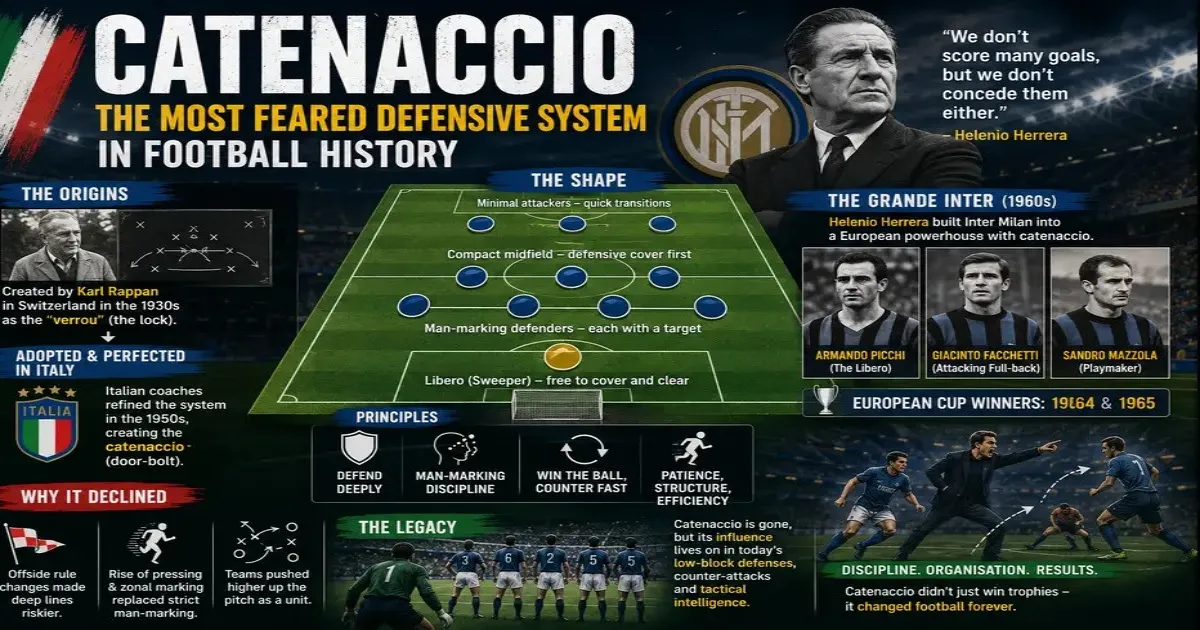
The Origins: A Swiss Idea, Not an Italian One
Despite becoming permanently associated with Italian football, catenaccio’s foundational concept didn’t originate in Italy at all. Credit generally goes to Karl Rappan, an Austrian coach working in Switzerland during the 1930s, who devised a system he called the “verrou” — French for “lock” or “bolt.” Rappan’s innovation was simple but effective: rather than deploying his back line in a straightforward man-marking setup with no cover, he stationed an additional defender behind the rest of the line, free to sweep up anything that got through and snuff out dangerous attacks before they reached goal.
Italian coaches adopted and refined this defensive blueprint during the 1950s, gradually building an entire footballing philosophy around it. The system’s core structural idea — a free defender operating behind a line of man-markers — became known in Italy as catenaccio, and by the following decade it had evolved into the single most dominant tactical approach in European club football.From Backyards to Academies: USA Youth Soccer World Cup 2026 and the Making of a New Generation
Breaking Down the Shape
At its structural core, catenaccio typically operated with a back four (or occasionally five) built around strict man-marking principles, with each defender assigned a specific opposition attacker to shadow for the full 90 minutes, regardless of where on the pitch that attacker moved. Behind that man-marking line sat the libero, or sweeper — the free defender whose entire job was to read danger, cover for teammates who had been dragged out of position, and clear anything that slipped through the cracks.
This defensive solidity was paired with an equally disciplined approach further forward. Midfields sat compact and narrow, prioritizing defensive cover over creative freedom, while full-backs were given license to push forward on the counter-attack once possession had been won — a tactical wrinkle popularized by Inter Milan’s Giacinto Facchetti, whose forward runs gave catenaccio sides an attacking outlet that pure defensive systems often lacked. Up front, teams generally committed minimal numbers to attack, relying instead on quick, direct transitions the moment the ball was regained, exploiting the space an opponent had left behind while pushing numbers forward against a team that had just been frustrated into carelessness.
The overall effect was a system built around patience and discipline: absorb pressure, force the opposition into low-percentage attempts, and strike decisively on the counter the instant the ball changed hands.The Tactical Case for Rafael Leão at World Cup 2026
The Grande Inter: Catenaccio’s Golden Era
No club did more to perfect catenaccio, or to prove its trophy-winning credentials, than Inter Milan under Argentine-born coach Helenio Herrera in the 1960s. Herrera’s “Grande Inter” side won back-to-back European Cups in 1964 and 1965, built on a defensive foundation that frustrated Europe’s best attacking teams before releasing devastating breaks in behind. Armando Picchi, Inter’s libero, became the position’s first true master, reading danger a half-step ahead of everyone else on the pitch, while Facchetti’s forward bursts down the flank gave the team a dimension few pure defensive systems of the era could match.
Herrera’s version of catenaccio was, in many ways, the system at its most complete: defensively suffocating, but with just enough attacking coordination to turn defensive solidity into genuine silverware rather than simply preventing defeat.
Beyond Inter: Catenaccio’s Wider Reach
While Inter’s Grande Inter remains the system’s most famous showcase, catenaccio’s influence extended well beyond one club. AC Milan under Nereo Rocco embraced similar defensive principles during the same era, winning European Cups of their own while building a reputation for pragmatic, results-oriented football. The Italian national team itself absorbed catenaccio’s core principles throughout the 1960s, 70s and into the 1980s, producing defenses built around legendary liberi like Gaetano Scirea, whose composure and reading of the game helped Italy win the 1982 World Cup while conceding remarkably few goals across the tournament.
The system’s reputation, fairly or not, also became a broader symbol of Italian football’s defensive-first identity for decades — a stereotype Italian teams have spent years since trying to shed, even as the underlying tactical intelligence catenaccio demanded from its defenders has remained a hallmark of Italian coaching to this day.
Why Catenaccio Eventually Declined
If catenaccio was so effective, why did it eventually fall out of favor at the top level of the sport? Several tactical and structural shifts conspired against it. The offside law changes introduced in the early 1990s made deep, passive defending considerably riskier, rewarding teams that pushed their entire back line higher up the pitch as a coordinated zonal unit rather than relying on strict individual man-marking assignments covered by a single free defender.
At the same time, the rise of pressing-based football — pioneered by coaches like Arrigo Sacchi at AC Milan in the late 1980s — demanded a fundamentally different defensive approach. Rather than sitting deep and inviting pressure, Sacchi’s Milan defended high up the pitch as a compact, zonally organized unit, closing down space collectively rather than relying on one player’s freedom to sweep up individual mistakes. That shift effectively phased out the traditional catenaccio structure even within Italian football itself, as zonal marking and coordinated pressing gradually replaced strict man-marking assignments across the sport.
By the early 2000s, the pure catenaccio system, with its rigid man-marking and dedicated sweeper, had all but disappeared from elite football, surviving mostly as a historical reference point rather than an active tactical blueprint.
Catenaccio’s Legacy in Modern Football
Though the system itself has faded, its underlying philosophy — that defensive discipline and structural intelligence can be just as decisive as attacking talent — remains deeply embedded in football’s tactical DNA. Modern low-block defensive systems, built around compact shape and disciplined counter-attacking transitions, owe an obvious debt to catenaccio’s core logic, even if the strict man-marking and dedicated libero have long since given way to zonal coverage and coordinated pressing triggers.
Italian football, in particular, has never fully abandoned the tactical intelligence catenaccio demanded of its practitioners. Modern Italian defenders are still widely regarded as among the best-organized and most tactically literate in the world, a reputation built directly on the coaching traditions catenaccio helped establish across multiple generations. Even the sport’s broader appreciation for disciplined, low-risk defensive football during counter-attacking setups — a staple of countless successful teams across every major league today — traces a direct tactical lineage back to Rappan’s original Swiss “verrou” and its Italian perfection.
Final Word
Catenaccio was never simply about parking the bus — at its best, under coaches like Helenio Herrera, it was a genuinely sophisticated system that turned defensive solidity into an attacking weapon in its own right, using patience and structure to set up devastating counter-attacks rather than treating defense and attack as separate concerns. From Karl Rappan’s original Swiss innovation to Inter Milan’s European Cup dynasty and Italy’s decades of defensive pedigree, catenaccio didn’t just win trophies — it fundamentally reshaped how football thinks about the relationship between defensive discipline and attacking opportunity, an influence that remains visible in the sport’s tactical fabric today, long after the system’s rigid original form has disappeared.
Cristiano Ronaldo Jr.: Club, Lifestyle, Career and Future Prospects
Thiago Messi: Club Career, Playing Style, Lifestyle and Future Prospects
◾◾ follow us on facebook ◾◾
About the Author