FIFA World Cup 2026 Group F Analysis: Can Anyone Stop the Flying Dutchmen?
NORTH AMERICA — When FIFA unveiled the complete group stage draw for the 2026 World Cup — the first ever expanded to 48 teams and co-hosted across the United States, Canada, and Mexico — Group F emerged as one of the tournament’s most quietly fascinating pools. On paper, it reads like a straightforward Dutch coronation. In practice, it may be anything but.
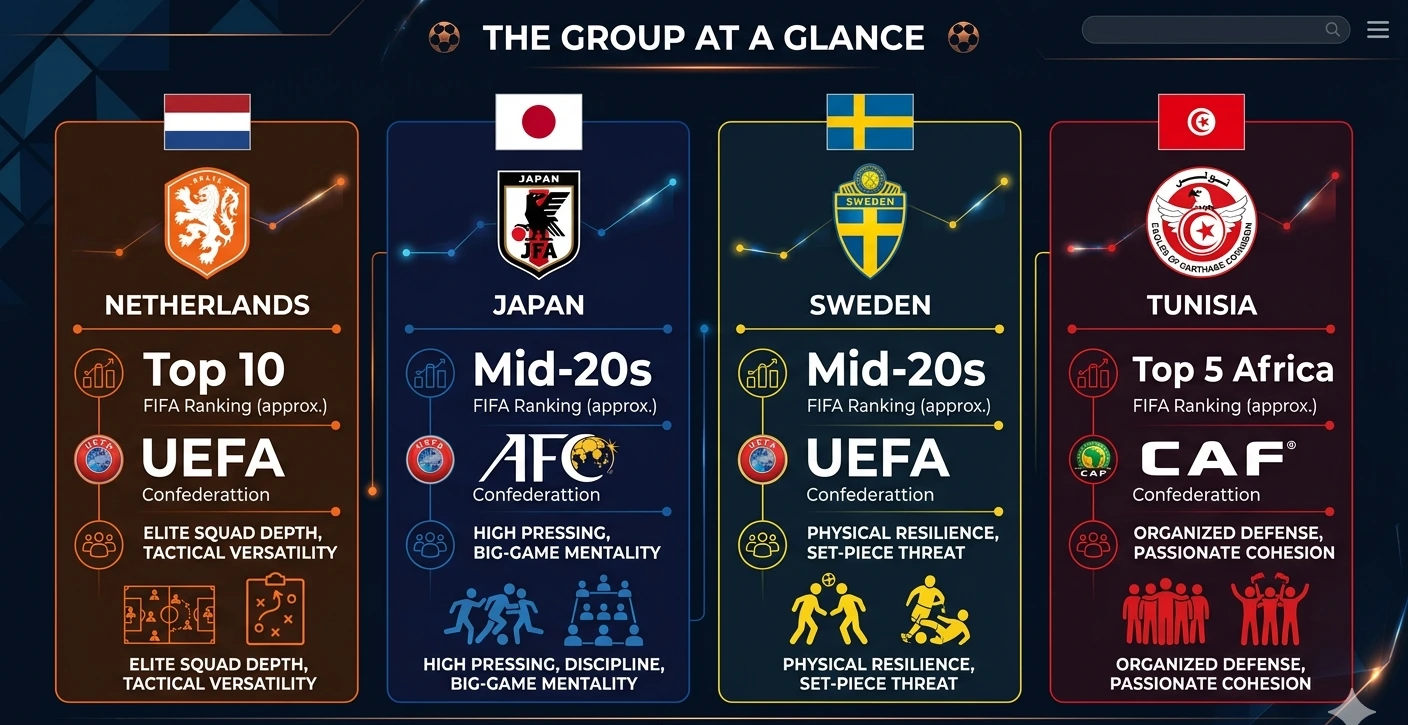
FIFA World Cup 2026 Group F brings together four nations representing four continents, four distinct footballing philosophies, and four very different stories of how they arrived at this moment. Netherlands (ranked 1st in the group) carry the weight of expectation. Japan (2nd) carry the momentum of a generation. Sweden (3rd) carry a proud tradition searching for renewal. And Tunisia (4th) carry the hopes of an entire continent once again.
Let’s break it all down.
Netherlands: The Clear Favorites — But History Haunts Them
There is no honest conversation about FIFA World Cup 2026 Group F that does not begin and end with the Netherlands. Ronald Koeman’s Oranje enter the tournament as one of Europe’s most complete national sides, boasting a generation of talent that arguably rivals the storied squads of 1974 and 1988.
The Dutch spine is formidable. In goal, they possess one of the safest pairs of hands in world football. Their midfield engine room — anchored by industrious ball-winners with the technical quality to transition from defense to attack in seconds — is the envy of most European nations. And up front, Netherlands carry genuine world-class threat: creative wide attackers capable of unlocking any defense, paired with a striker profile that gives opponents nightmares at set pieces and in open play.
Yet the Netherlands carry a peculiar burden: they are serial underperformers relative to expectation. Three World Cup final appearances, zero trophies. A 2022 Qatar exit in the quarterfinals at the hands of Argentina — a match they came agonizingly close to winning — still stings. The 2026 edition feels, in the eyes of Dutch football purists, like an almost-now-or-never moment for this particular generation.
Koeman’s system — typically a 4-3-3 with aggressive wing play and a high defensive line — will be tested in the knockout rounds. In Group F, however, it should be sufficient to secure comfortable passage.
Verdict: Virtually certain to advance as group winners. A stumble here would be a seismic upset.
Japan: The Blue Samurai Are No Longer a Surprise
Perhaps no national team in world football has elevated its standing more dramatically over the past four years than Japan. The Blue Samurai are no longer the plucky, well-organized underdog that earns polite admiration before bowing out. They are a legitimate threat, and every group stage opponent in FIFA World Cup 2026 Group F knows it.
Japan’s 2022 World Cup performance in Qatar was a watershed moment — dramatic victories over Germany and Spain announced to the planet that Asian football had arrived at a new plateau. The players who drove that charge are now seasoned veterans of Europe’s top leagues: Bundesliga, La Liga, Serie A, and the Premier League have all become regular destinations for Japanese talent. The result is a squad with elite-level technical training, embedded tactical discipline, and the psychological resilience to compete in pressure environments without wilting.
Manager Hajime Moriyasu — or his successor, depending on the state of the Japanese bench by tournament time — has consistently deployed a fluid, high-pressing 4-2-3-1 that suffocates opponents and turns turnovers into lightning transitions. Japan don’t need to dominate possession. They are perfectly content to absorb pressure, compress space, and strike with lethal efficiency.
Against Netherlands, Japan face their sternest test in the group stage. But a draw — or even a win — is not beyond the realm of possibility for a team that has slain Germany and Spain on the world stage. Against Sweden and Tunisia, Japan must be considered favorites for points, if not outright victories.Ronaldo’s Saudi Dream Is Complete: How CR7 Turned Al Nassr Into an Unstoppable Machine — and Why the World Can No Longer Look Away
Verdict: Serious second-place contenders. If they beat Netherlands, all bets are off.
Sweden: A Nation Rebuilding, With Tools Still in the Box
Sweden’s presence in FIFA World Cup 2026 Group F is a story of transition and resilience. The retirement of Zlatan Ibrahimović — officially, finally, definitively — closed one chapter of Swedish football history and forced the federation to ask a hard question: what comes next?
The answer, it turns out, is not as bleak as the doomsayers predicted. Sweden’s new generation, while lacking a singular transcendent talent of Ibrahimović’s magnitude, is a collection of capable, hard-working, technically sound professionals playing at a high level across European club football. Their Premier League and Bundesliga representatives bring genuine quality. Their domestic league continues to produce sturdy defensive units with excellent positional discipline.
Sweden’s footballing identity under recent management has leaned into physicality, aerial prowess, and set-piece danger — a combination that can frustrate technically superior opponents and steal points in tight matches. Their 4-4-2 or 4-5-1 shape in defensive transition is difficult to break down. And in the attacking third, they retain enough creativity and directness to punish any lapse in concentration.
The uncomfortable truth for Sweden, however, is that this group may have come at the wrong time in their generational rebuild. Netherlands is almost certainly out of reach. Japan will be a fierce contest. That may leave the Sweden vs. Tunisia match as the defining game for both nations’ tournament survival.
Verdict: Third place is the realistic ceiling barring exceptional performances. Sweden must win or draw against Tunisia to maintain any hope.
Tunisia: Africa’s Underdog With Concrete Ambitions
Tunisia enter FIFA World Cup 2026 Group F as the tournament’s statistical underdogs — but anyone who has watched African football closely in recent years knows that label undersells what the Carthage Eagles are capable of bringing to the pitch.
This will be Tunisia’s seventh World Cup appearance, a record for an African nation, and one that speaks to the consistency and organizational strength of their football federation. They are not here by accident. The Tunisian squad is built on a bedrock of defensive solidarity — they are among the hardest teams in African football to score against — combined with a direct, purposeful attacking style that can catch flat-footed opponents off-guard on the counter.
Their European-based contingent, primarily drawn from French Ligue 1, Belgium’s Pro League, and other mid-tier European competitions, provides professionalism and tactical familiarity with the demands of international football at this level. What Tunisia may lack in individual star power, they compensate for with collective organization and genuine team spirit — an intangible that, at a World Cup, counts for more than pundits tend to credit.
Tunisia’s path to the round of 16 is narrow but navigable. They likely need maximum points against Sweden and at least one point from either of their other two matches — a scenario that requires everything to go right, and for Sweden to be beatable, which at this level, they very much are.
Verdict: Long-shot third or fourth-place finishers. A win against Sweden could open the door to a historic run.
Key Matches to Watch
Netherlands vs. Japan — The marquee fixture of FIFA World Cup 2026 Group F. Japan’s high press against Netherlands’ technical quality. This match may effectively decide the group winner.
Sweden vs. Tunisia — The match that could define the bottom half of the group. Expect tactical caution, physical intensity, and set-piece danger from both sides. A must-watch for neutral fans who appreciate defensive grit.
Japan vs. Sweden — Japan’s ability to control tempo and press high will be tested against Sweden’s physicality and aerial strength. One of the more fascinating stylistic clashes of the group stage.
Group F Predicted Final Standings
🔹 Group Winner : Netherlands
🔹 Runner-Up : Japan
🔹 Dark Horse : Sweden
🔹 Wildcard Warning : Tunisia
The Bottom Line
FIFA World Cup 2026 Group F is not a group of death — but it is a group of consequence. Netherlands are the class of the field and should advance comfortably. The real drama lies in the battle for second, where Japan’s tactical evolution, Sweden’s physical resilience, and Tunisia’s organized defiance will collide across three matches that could produce genuinely unpredictable outcomes.
In a 48-team World Cup where the expanded format gives more nations a path to the knockout rounds, every point carries amplified weight. For Japan, this is a chance to prove Qatar 2022 was not a peak but a launchpad. For Sweden, it is a chance to announce a new identity. For Tunisia, it is a chance to write another chapter in Africa’s long march toward World Cup legitimacy.
And for Netherlands? It is, once again, a chance to finally close the deal.
This article reflects pre-tournament analysis and projections based on available squad information, recent form, and historical data as of May 2026. All standings predictions are editorial projections only.
About the Author




1 thought on “FIFA World Cup 2026 Group F: Netherlands Favored, But Japan, Sweden, and Tunisia Ready to Disrupt”