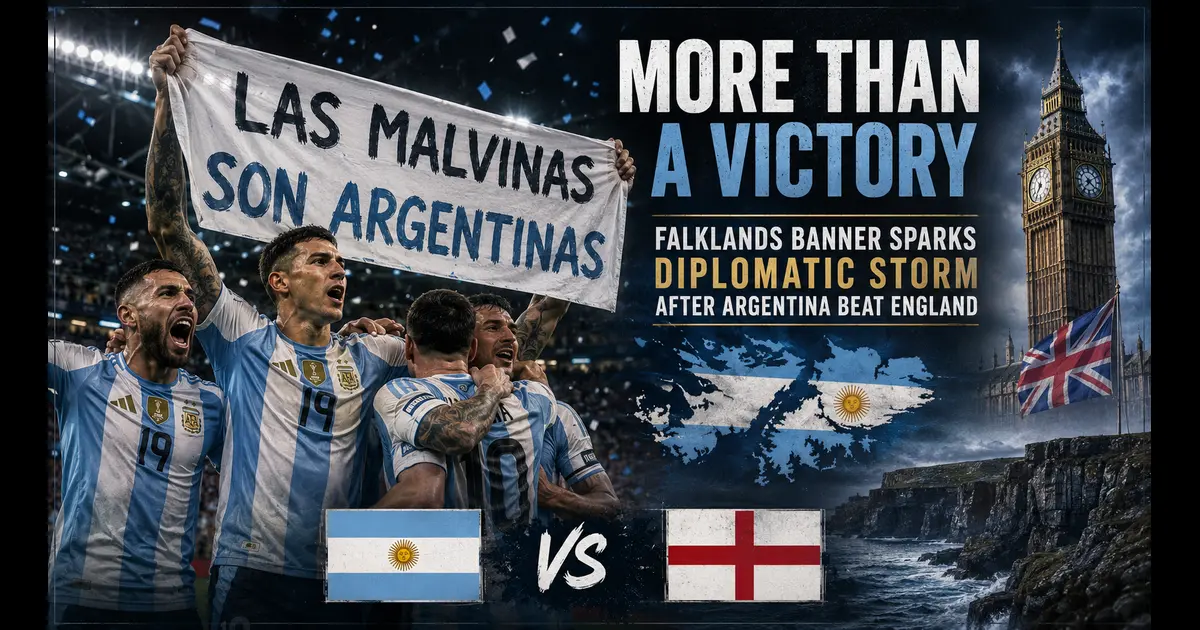
 Argentina’s win over England sent them into the World Cup final, but it’s a post-match banner referencing the Falklands that has dominated the conversation ever since
Argentina’s place in Sunday’s World Cup final was secured on the pitch in Atlanta, but the story dominating headlines in the days since has had almost nothing to do with the scoreline. When the final whistle confirmed a dramatic 2-1 comeback win over England on July 15, several Argentina players unfurled a white banner reading “Las Malvinas son Argentinas” — “The Malvinas are Argentine,” using Argentina’s name for the Falkland Islands — turning a football celebration into a genuine diplomatic flashpoint between two governments.
What Actually Happened on the Pitch
As Argentina’s squad celebrated their stoppage-time comeback in front of the traveling support at Mercedes-Benz Stadium, midfielder Giovani Lo Celso — who did not feature in the match itself — took hold of a banner that appeared to have first been displayed by fans in the stands, and held it aloft as teammates including Nicolas Otamendi gathered around him. Photographs of the moment spread rapidly across international media within hours, with several outlets noting the banner had seemingly been passed down from the crowd rather than brought onto the pitch by the players themselves.
The gesture put Argentina’s federation on a collision course with FIFA’s own regulations. FIFA’s Stadium Code of Conduct explicitly bans “banners, flags, flyers, apparel and other paraphernalia that are of a political, offensive, and/or discriminatory nature” inside tournament venues. As of the days immediately following the match, FIFA had not issued a public response to multiple media inquiries about the incident, though the episode is widely expected to result in some form of disciplinary action or fine against the Argentine Football Association.
The Historical Weight Behind Four Words
For anyone unfamiliar with the region’s history, the banner’s message might read as a curious non-sequitur at a football match. For Argentina and the United Kingdom, it references one of the most sensitive geopolitical disputes either nation carries: sovereignty over a small archipelago roughly 300 miles off Argentina’s southern coast, known to Britain as the Falkland Islands and to Argentina as the Islas Malvinas.
The dispute escalated into open warfare in 1982, when Argentina’s military government invaded the British-administered islands, triggering a 74-day conflict that claimed the lives of 649 Argentine service members, 255 British personnel, and three island residents. Britain retained control of the territory following its surrender, and the islands remain a British Overseas Territory today, with the UK maintaining that residents’ own 2013 referendum — in which the overwhelming majority voted to remain British — settles the question of self-determination. Argentina, meanwhile, has never renounced its claim, treating the islands’ return as a matter of ongoing national significance across the political spectrum.
The timing of that 1982 war adds another strange layer of history to this rivalry: the conflict was still technically underway when Argentina and England both competed in that summer’s World Cup in Spain, and British television networks at the time declined to broadcast Argentina’s opening match of the tournament out of sensitivity to the ongoing fighting.
Not the First Time — And Not Even the First Time This Cycle
This wasn’t an isolated moment of improvisation, either. The same banner and slogan were displayed by Argentina’s players before a pre-tournament warm-up friendly against Slovenia in Buenos Aires, months before this World Cup even began, in a match Argentina won 2-0. That earlier display already drew international attention given its proximity to the tournament, with reports at the time noting the banner is one Argentina’s squad has shown on various occasions over the years, extending back well before this specific World Cup cycle. Wednesday’s version, delivered in the direct afterglow of eliminating England from the tournament, simply landed with far greater force given the opponent and the stakes involved.
The Political Reaction
The response from Britain’s government arrived quickly and pointedly. A spokesperson for Prime Minister Keir Starmer told reporters, “The World Cup might not be ours, but the Falkland Islands definitely are,” while separately confirming the UK government was pushing FIFA to open a formal investigation into the incident. The comment was widely circulated across British media, framed as a rare instance of a sitting prime minister’s office wading directly into a football-adjacent controversy.
On the Argentine side, reaction leaned less toward diplomatic messaging and more toward emotional testimony. One veteran of the 1982 conflict was quoted reflecting on the moment in deeply personal terms: “As a veteran of the Malvinas, today I just want to thank these boys for the enormous joy and the immense caress to the soul that they gifted us.” The same veteran added a line that captured how many Argentines appear to view the episode: “Sports never change history, but sometimes it helps heal emotions that remain very [raw].” For a generation of Argentines with direct memories of the war, the banner was received less as provocation and more as an act of national remembrance delivered on an enormous global stage.
A Rivalry That Rarely Needs an Excuse
England and Argentina have never required much prompting to generate controversy on the football pitch, quite apart from the Falklands dispute itself. Their first World Cup meeting, in the 1966 quarterfinal, ended with England manager Alf Ramsey publicly describing Argentina’s players as “animals” after a bad-tempered match that saw Argentina’s captain sent off. Their most iconic meeting, the 1986 quarterfinal, produced both Diego Maradona’s infamous “Hand of God” goal and, minutes later, his mesmerizing “Goal of the Century” — a match that took on added significance given it arrived just four years after the war itself. Their 1998 meeting brought David Beckham’s red card and a dramatic penalty-shootout exit for England. Fan culture on the Argentine side has, for decades, included chants directly referencing the Falklands conflict, some of them considerably more provocative in tone than the banner itself, reflecting just how embedded the rivalry’s political undertones have become in supporter culture over multiple generations.
Where This Leaves Both FIFA and the Fixture Going Forward
FIFA now faces a genuinely awkward balancing act. The organization’s own rules are unambiguous about banning political messaging inside its venues, yet enforcing that rule against a jubilant national team celebrating a World Cup semifinal win — over a banner reportedly handed to players by their own supporters — presents obvious complications, both practical and diplomatic. Any fine, should one be issued, would likely be measured in the context of previous FIFA sanctions for similar political displays at past tournaments, which have generally resulted in financial penalties rather than sporting consequences such as point deductions or match bans.
For England and Argentina, the incident adds yet another chapter to a rivalry that has rarely needed additional fuel. Whatever happens in Sunday’s final against Spain, this week’s controversy is a reminder that for these two nations, football and unresolved national history remain almost impossible to fully separate — a reality that seems unlikely to change the next time these two sides meet on the pitch.
Final Word
Argentina’s win over England secured their place in a second consecutive World Cup final, but the banner that followed it has, for now, overshadowed the football itself. The episode is, at its core, a football story intersecting with a genuine, decades-old geopolitical dispute that neither side treats lightly — and however FIFA ultimately responds, it’s unlikely to be the last time “Las Malvinas son Argentinas” surfaces the next time these two nations share a pitch.
How Does the FIFA Rankings Work? Points, Calculations & Why It Matters
🔹🔹 follow us on facebook 🔹🔹
About the Author



1 thought on “Why Argentina’s Malvinas Banner Has FIFA and the UK Government on Alert”