Gillette Stadium World Cup 2026: From Foxborough to Faneuil Hall — Your Complete Boston Fan Guide
In the summer of 1775, Massachusetts fired the first shots of the American Revolution. In the summer of 2026, 22 miles southwest of Bunker Hill, Gillette Stadium fires the first whistle of football’s greatest tournament in New England.
Some cities have history. Boston is history.
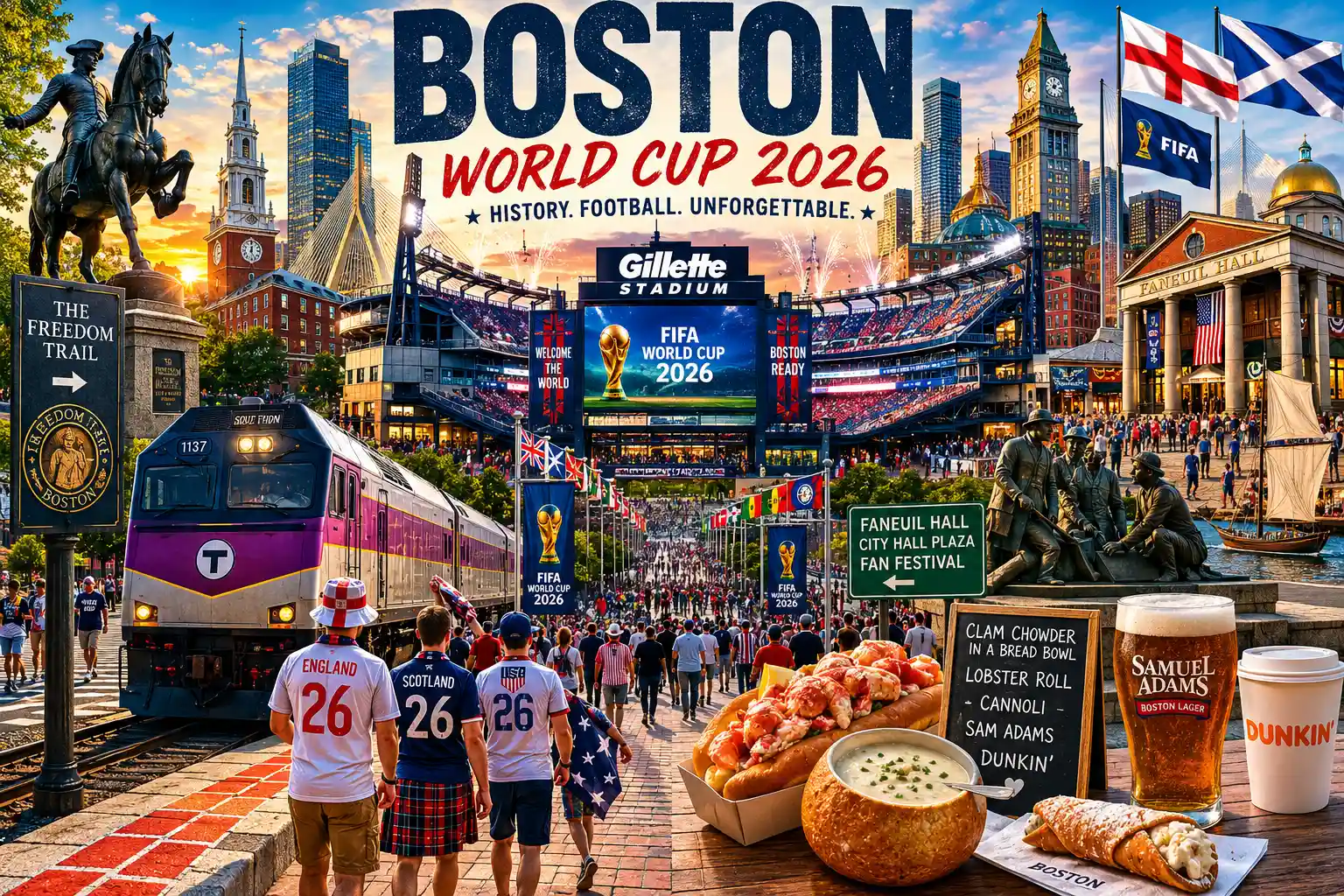
The City That Cannot Escape Its Past — And Doesn’t Try To
There is a peculiar quality to being in Boston during a major international event. The city is so saturated with its own history — the Freedom Trail threading through the financial district past colonial churches, burial grounds, and revolutionary battlefields — that every new event layers itself onto a foundation that pre-dates the United States itself.
Boston was settled in 1630. The American Revolution was planned in its taverns, fought in its streets, and won in its harbour. The first public school in America opened here in 1635. Harvard — the first university in America — was founded nearby in 1636. The Boston Marathon, the oldest annual marathon in the world, has been run through its streets since 1897.
And now, in the summer of 2026, Boston hosts seven FIFA World Cup matches — including fixtures involving England and Scotland — in a city where the residents have had complicated feelings about England for approximately 250 years.
The irony is historical. The atmosphere will be magnificent.
Stadium Snapshot
| Official FIFA Name | Boston Stadium |
| Commercial Name | Gillette Stadium |
| Location | 1 Patriot Place, Foxborough, MA 02035 (22 miles southwest of Boston) |
| Opened | 2002 (upgraded 2023) |
| Home Teams | New England Patriots (NFL), New England Revolution (MLS) |
| Standard Capacity | 65,878 |
| World Cup Capacity | 63,815 (FIFA tournament configuration) |
| World Cup Matches | 7 — five group stage + Round of 32 + Quarter-Final July 9 |
| England Match | England vs Ghana — Group L |
| Scotland Match | Scotland vs Haiti — Group C |
| MBTA Train | South Station → Foxboro Station (~1 hour, $80 return — buy in advance) |
| History Note | Foxboro Stadium hosted 1994 World Cup matches on this same site |
Foxborough Is Not Boston — But It Is Boston’s Stadium
The single most important logistical fact for every fan attending a World Cup match here: Gillette Stadium is in Foxborough, Massachusetts — 22 miles southwest of downtown Boston. FIFA brands it “Boston Stadium.” The city promotes it as a Boston venue. Logistically, you are travelling to Foxborough.
This matters for every decision you make: where to stay, how long to allow, and how to get home after the final whistle. Fans staying in downtown Boston face a 22-mile journey. Fans staying in Foxborough are a 10-minute walk from the gates.
The 1994 World Cup was also played on this site — the original Foxboro Stadium, replaced by Gillette Stadium in 2002, hosted six matches including a Round of 16. The Kraft Group has owned this venue for both tournaments. What was true in 1994 — that this is a New England institution hosting the world’s greatest sporting event — is true again in 2026.
The Match Schedule at Boston Stadium
Boston will host seven matches between June 13 and July 9, 2026.
| Round | Date | Time (ET) | Confirmed Match |
|---|---|---|---|
| Group E | June 13, 2026 | TBC | Germany vs Ivory Coast |
| Group L | June 16, 2026 | TBC | England vs Ghana |
| Group C | June 19, 2026 | TBC | Scotland vs Haiti |
| Group Stage | June 23, 2026 | TBC | TBC |
| Group Stage | June 26, 2026 | TBC | TBC |
| Round of 32 | June 29, 2026 | TBC | TBC |
| Quarter-Final | July 9, 2026 | TBC | TBC |
Seven matches. Germany opens Boston’s tournament. England plays Ghana. Scotland faces Haiti. And on July 9, one of the world’s eight best remaining teams plays a quarter-final at Gillette Stadium — the most significant match ever hosted on this site.
The English Dimension
England plays Ghana at Boston Stadium on June 16. The fixture carries a particular charge in New England — a region whose very name commemorates its English ancestry. Boston (Lincolnshire), Cambridge, Plymouth, Gloucester, Salisbury — the major cities of this region were named after English towns by settlers who left them.
And yet: Boston threw England’s tea into the harbour in 1773. It fought the British Army at Lexington, Concord, and Bunker Hill. The city has complex feelings about the old country that no sporting fixture can fully resolve.
When England walks out onto the Foxborough pitch on June 16, the Boston crowd — descended from those colonists — will make a noise that contains two hundred and fifty years of compressed history.
It will be extraordinary.
Getting There: The MBTA Train Is Non-Negotiable
The MBTA Boston Stadium Train service takes fans from Boston’s South Station to Foxboro station — approximately one hour. Return tickets cost $80 and must be purchased in advance. Fourteen trains will run on each Boston matchday and they will be the only direct local service for matches.
This is the defining logistical fact: the train sells out. Purchase return tickets the moment they go on sale. The station and stadium are a short walk apart; post-match service runs for up to 90 minutes after the final whistle.
From Providence, Rhode Island: Fans staying in Providence — a 20-minute drive from Foxborough, with significantly lower hotel rates — can drive or take the MBTA Commuter Rail from Providence Station. Providence is one of the smartest base-camp decisions for Boston World Cup matches.
From Boston Logan Airport (BOS): Logan International Airport has direct services from London, Dublin, Amsterdam, Frankfurt, Reykjavik, Lisbon, and Doha, among many others. From the airport: MBTA Silver Line to South Station → World Cup train to Foxborough.
By Car: Route 1, I-95, and I-495 all serve Foxborough. Parking at Gillette and surrounding lots available — purchase in advance. Post-match exit on Route 1 North can hold cars for 30–60 minutes.
Boston: A Walk Through American History
The Freedom Trail
A 2.5-mile red-brick path through 16 sites of American Revolutionary history — all walkable in an afternoon. It begins at Boston Common (the oldest public park in the United States, used as a British military encampment in 1775) and winds through the city to Bunker Hill in Charlestown.
Key stops include the Old South Meeting House (where the Boston Tea Party was planned in 1773), the Old State House (where the Declaration of Independence was first read to Massachusetts), Faneuil Hall (the “Cradle of Liberty”), and the Granary Burying Ground — where Samuel Adams, Paul Revere, John Hancock, and the victims of the Boston Massacre are buried.
For international fans from countries with their own complex colonial histories involving England, the Freedom Trail is not a tourist attraction. It is a conversation.
Harvard and Cambridge
Just across the Charles River: Harvard University (founded 1636 — the oldest university in the United States) and MIT. The campuses are accessible by the MBTA Red Line from downtown and free to explore on foot. The Harvard Museum of Natural History contains the Ware Collection of Blaschka Glass Models of Plants — impossibly intricate botanical models made entirely of glass by a 19th-century father-and-son team — that is inexplicably one of the most beautiful things in Massachusetts.
Fenway Park
The oldest Major League Baseball stadium in the United States (1912), home of the Boston Red Sox. The Green Monster — the iconic 37-foot left-field wall — and the intimate interior of the park represent a piece of American sporting heritage worth an hour of any visitor’s time. Stadium tours run daily in season.
The Museum of Fine Arts and Isabella Stewart Gardner Museum
Boston’s MFA is one of the great art museums of North America. The adjacent Isabella Stewart Gardner Museum is one of the most unusual museums in the world: a personal collection assembled by an eccentric Boston heiress, displayed exactly as she arranged it in a Venetian palazzo she built in the Fenway neighbourhood. When 13 of its works were stolen in 1990 — the largest art theft in history — Gardner’s will stipulated that nothing be moved. The empty frames still hang on the walls, waiting for a theft that has never been solved.
Boston Food: Cod, Lobster and the Bread Bowl
New England Clam Chowder The first commandment. A thick cream-based soup loaded with clams, potatoes, onions, and salt pork, served in a sourdough bread bowl. Legal Sea Foods has been the city’s reliable institution since 1950. At Quincy Market in Faneuil Hall, a bread-bowl chowder costs around $12 and can be eaten standing while watching the city pass.
Tyler Adams: USMNT Midfielder Stats, Career, Club & World Cup 2026 Profile
Lobster Roll Cold-water Atlantic lobster served cold with mayonnaise (Connecticut style) or warm with drawn butter (Maine style). James Hook & Co. on the Fort Point Channel has been selling lobster since 1925. The Barking Crab on the waterfront does justice to the whole creature.
Italian Food, The North End Boston’s North End — settled in the 1640s and the Italian immigrant heart of the city since the 1880s — is one of the finest concentrations of Italian-American cooking in the United States. Giacomo’s on Hanover Street has a permanent queue of locals for a reason. Modern Pastry and Mike’s Pastry maintain a decades-long neighbourhood rivalry for the best cannoli in Boston. Try both. Form an opinion.
Dunkin’ Donuts Massachusetts does not drink Starbucks. Massachusetts drinks Dunkin’. The chain, founded in Quincy, MA in 1950, is so embedded in Boston’s cultural identity that the city was once satirised as having a Dunkin’ on every corner. The regular coffee with cream and sugar is the city’s unofficial beverage.
Sam Adams Beer The Boston Beer Company, maker of Samuel Adams lager, was founded in 1984 in Boston. Sam Adams Boston Lager is the city’s house beer — available everywhere, reliably excellent, and named after one of the American Revolutionary leaders buried on the Freedom Trail.
Fan Zones: City Hall Plaza
The FIFA Fan Festival Boston is at City Hall Plaza — free and tournament-long, with match screenings, food and drink, and live entertainment. City Hall Plaza is in the heart of downtown Boston, steps from Faneuil Hall and the Freedom Trail. It is the most centrally located fan festival of any US host city — no transport required from most downtown hotels.
What to Wear in Boston
- Typical June/July temperatures: 68–82°F (20–28°C). Warm days, cool evenings.
- Rain: June can bring overcast days and showers. A compact waterproof jacket is worth packing.
- Match Day: Gillette is an open-air venue. Light clothing for day matches; a layer for evening games.
- English visitors note: Boston in June is approximately equivalent to a good English summer day. You will feel entirely at home. The locals will appreciate the historical irony of your being here.
🔹🔹 Follow us on Facebook 🔹🔹
About the Author