 Tactical Trends of World Cup 2026
Beyond the goals, the records and the eventual champions, this World Cup offered a genuine snapshot of where elite football tactics are actually heading. FIFA’s own Technical Study Group — a panel of experts assembled specifically to analyze tactical trends at the tournament — identified several clear shifts across the competition, and independent analysts tracking the data found even more. Here are the tactical innovations that actually defined World Cup 2026.Best Saves of FIFA World Cup 2026: The Goalkeepers Who Stole the Show
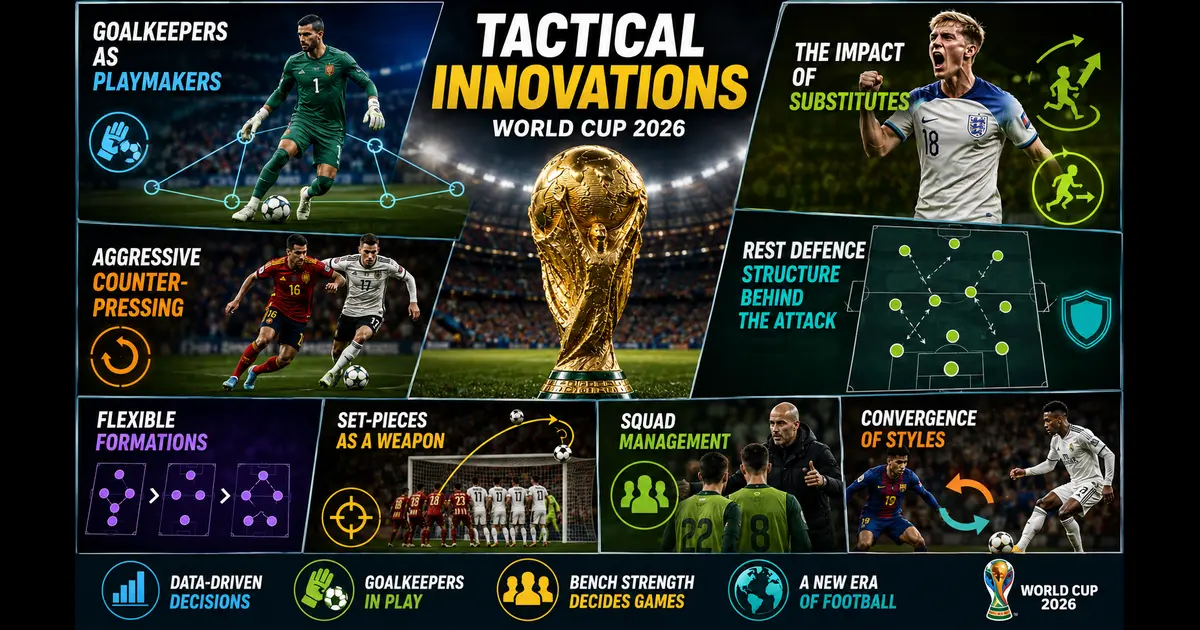
Goalkeepers as Genuine Playmakers
Perhaps the most striking statistical shift of the entire tournament happened between the posts rather than in front of them. The traditional image of a goalkeeper launching long clearances upfield has all but disappeared at the elite level: goalkeepers took every single goal kick short or medium-length back in 2018, a figure that fell to 91% by 2022, and dropped to just 52% at this World Cup. Instead, defenders increasingly received the ball first and circulated it before working it back to their goalkeeper, who now regularly functions as an additional outfield player in possession — helping build attacks and bypass an opponent’s first line of pressure entirely, rather than surrendering the ball back to them with a long punt forward.
The knock-on effect of that shift shows up elsewhere in the data too: the number of forward passes played beyond the defensive line more than doubled compared with the 2022 tournament, a direct consequence of teams building patiently from deep rather than skipping the construction phase altogether. Spain’s Unai Simón, the tournament’s Golden Glove winner, was among the clearest examples of this trend in practice — as comfortable initiating attacks with his feet as he was making saves, and central to how Spain circulated the ball through their own defensive third under pressure.
The Growing Influence of Substitutes
FIFA’s Technical Study Group identified the impact of players coming off the bench as the single biggest trend of the group stage alone, with substitutes contributing 43 goals in just the first 72 matches of the tournament — an unusually high figure that reflects how modern international squads are being managed as genuinely interchangeable units rather than a fixed best XI with backup options. This World Cup produced no better example of the trend than Anthony Gordon’s tournament for England: introduced from the bench against Congo DR in the round of 32, he produced two assists in twelve minutes to turn a losing match around, then went on to start and shine in every subsequent knockout fixture. Spain’s own run to the title leaned on the same principle — Mikel Merino’s stoppage-time winner off the bench against Austria and Ferran Torres’ extra-time winner in the final itself were both, fundamentally, examples of a manager’s bench depth deciding a match as much as the starting XI did.From Tunisia to Spain: Every World Cup 2026 Team Ranked
Aggressive, Calculated Counter-Pressing
Counter-pressing — the tactic of immediately hunting to win the ball back within seconds of losing it, rather than retreating into a defensive shape — was flagged repeatedly by analysts as one of the tournament’s defining stylistic trends. But the more sophisticated version of the tactic seen at this World Cup wasn’t simply about pressing constantly; it was about pressing in calculated bursts, tailored specifically to squad fitness and match context across a longer, more physically demanding 104-match tournament than any previous edition. Teams that tried to sustain a high press for the full 90 minutes across seven or eight matches in summer conditions across three countries generally found themselves fading badly by the tournament’s closing stages — while teams that deployed pressing selectively, in short, high-intensity bursts at moments designed to disrupt an opponent’s rhythm, sustained that intensity far more effectively into the knockout rounds.
Rest Defence: Structure Behind the Attack
Spain’s title-winning campaign popularized, more than any other side at this tournament, the concept of “rest defence” — the deliberate positioning of players not directly involved in an attacking phase, arranged specifically so the team can win the ball back immediately if possession is lost in a dangerous area. It’s a structural innovation that allowed Spain to commit numbers forward with real confidence throughout the tournament, without suffering the kind of transition-based defensive exposure that toppled several other possession-heavy sides. Rodri’s positioning as a lone pivot was central to making the system work, screening exactly the space Spain’s advancing full-backs and wingers left behind them.
Flexible, Hybrid Formations
Few of the tournament’s leading sides stuck rigidly to a single formation for the full 90 minutes of every match. Analysts repeatedly noted that the best teams shifted their defensive shape, build-up structure and attacking width within the same game, blurring the traditional boundaries between what used to be described as distinct possession-based or counter-attacking identities. Argentina’s approach against England in the semifinal was a clear example — sitting deeper and inviting pressure for large stretches before shifting into a more direct, transition-focused shape once Messi and the front line sensed an opening in the closing stages, a fluidity that proved decisive in their late comeback.
Set-Pieces as a Calculated Weapon
With squad fatigue setting in and open-play creativity harder to sustain deep into a longer tournament, set-piece efficiency became an increasingly decisive factor in the knockout rounds specifically. Several of the tournament’s pivotal goals — Mikel Oyarzabal’s penalty against France in the semifinal, Belgium’s 118th-minute penalty against Senegal — came from dead-ball situations rather than open play, reinforcing a broader trend across the sport in recent years of elite teams treating set-piece routines as a specifically coached, heavily drilled component of their tactical approach rather than an afterthought.
Squad Management as a Tactical Discipline in Its Own Right
The jump from 32 to 48 teams didn’t just add more matches — it added an entire extra knockout round, extending the maximum path to the final from six matches to eight. That structural change turned squad rotation and physical management into a genuinely tactical consideration in its own right, not simply a fitness or medical one. Managers who treated their full 23 or 26-man squads as tactical instruments — deploying different personnel for different match situations rather than simply resting starters when comfortably ahead — generally fared better across the tournament’s longer, more demanding format than those who leaned too heavily on a fixed first-choice XI.
The Convergence of Playing Styles
One of the more subtle trends noted by analysts tracking the tournament was the growing convergence between tactical philosophies that used to be treated as fundamentally opposed. Teams historically associated with pure counter-attacking football began blending in patient possession principles, while traditionally possession-dominant sides — Spain chief among them — incorporated far more direct verticality than their footballing reputation might suggest. Brazil under Carlo Ancelotti offered one of the clearest examples: a side that combined greater positional control in build-up than previous Brazilian squads with quicker progression into the final third once possession had been established, a genuine hybrid approach rather than a pure expression of either extreme. That convergence reflects a broader shift across the sport at club level too, where the sharp stylistic boundaries between “possession teams” and “counter-attacking teams” have been eroding for years — this World Cup simply confirmed that the trend has fully arrived at international level as well.
The Bigger Picture
Taken together, these trends point toward a version of international football that’s converging with the tactical sophistication long associated primarily with elite club football — data-informed pressing triggers, goalkeepers integrated fully into possession structures, and bench strength treated as a core tactical asset rather than a last resort. For a 48-team, 104-match tournament that many worried would dilute quality across a larger field, the tactical evidence suggests something closer to the opposite: a World Cup that pushed elite coaching staffs to innovate harder than ever, simply to survive the format’s new physical and structural demands.
🔹🔹 follow us on facebook 🔹🔹
About the Author




1 thought on “The Tactical Trends That Defined World Cup 2026”