 FIFA World Cup Bidding Process: How Host Countries Are Chosen
 FIFA World Cup Bidding Process: How Host Countries Are Chosen
Every four years, one of the most valuable prizes in global sport gets handed to a new country or group of countries — and the process behind that decision has changed dramatically over the past decade. What was once a closed-door vote among a small committee, later exposed as riddled with corruption, is now a multi-stage evaluation process involving technical scoring, human rights risk assessments, and a public vote open to all of FIFA’s 211 member associations. Here’s exactly how a country actually becomes a FIFA World Cup host.The Tactical Trends That Defined World Cup 2026
Why the Process Changed
To understand today’s bidding system, it helps to understand what it replaced. For decades, the decision on where to stage the World Cup rested with FIFA’s Executive Committee, a body of just over 20 senior officials who voted by secret ballot behind closed doors. That system came under intense scrutiny after the controversial simultaneous awarding of the 2018 and 2022 World Cups to Russia and Qatar in December 2010 — decisions that triggered years of allegations surrounding vote-buying and improper influence. The fallout culminated in a sprawling US Department of Justice investigation and a 2015 corruption scandal that saw multiple senior FIFA officials indicted, and ultimately led to the resignation of long-serving FIFA president Sepp Blatter.
In the aftermath, FIFA overhauled its entire approach to selecting hosts. The current bidding framework, formally known as the FIFA Bidding Regulations, was approved by the FIFA Council in Kolkata on October 27, 2017. Gianni Infantino, who took over as FIFA president in the wake of the scandal, has been open about the fact that the previous system had been “heavily criticised,” and the reforms were explicitly designed to make the process more transparent, more rigorous, and considerably harder to manipulate.
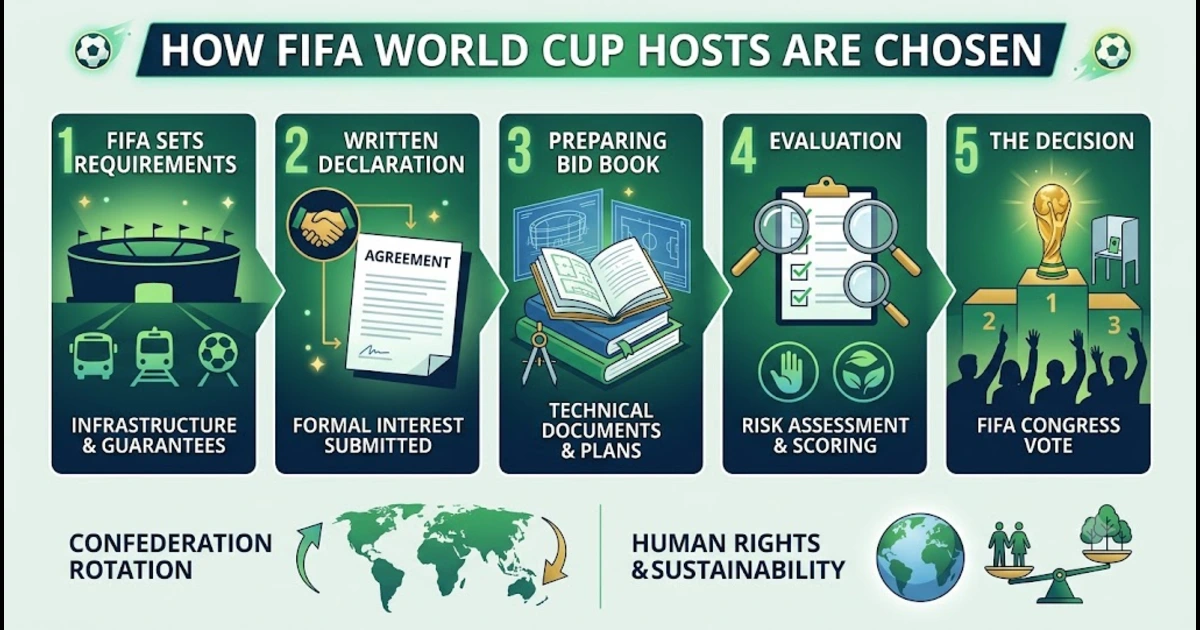
Step One: FIFA Sets the Requirements
The modern bidding process begins with FIFA itself, rather than with interested countries. Ahead of each hosting cycle, FIFA publishes a detailed set of high-level hosting requirements covering everything a prospective host would need to deliver: stadium infrastructure, transportation networks, accommodation capacity, security arrangements, commercial and broadcasting infrastructure, legal guarantees from national governments, and sustainability commitments. Any country — or group of countries pursuing a joint bid — that cannot realistically meet these baseline requirements risks disqualification before the process even properly begins.
Step Two: Written Declaration of Interest
Countries that believe they can meet FIFA’s requirements formally submit a Written Declaration of Interest, the official first step in entering the bidding process. At this stage, FIFA provides prospective bidders with a template agreement laying out, in detail, exactly what obligations a winning host would be signing up for — financial commitments, legal guarantees, and operational responsibilities that extend well beyond simply building stadiums.
Step Three: Preparing the Bid Book
Once a country has formally declared its interest, it moves into the bid preparation phase, compiling what’s commonly referred to as a “bid book” — an extensive technical document outlining proposed stadiums, host cities, transport plans, accommodation strategy, security arrangements, and projected economic impact. FIFA offers guidance and support to bidding nations throughout this phase, and bids involving multiple countries — as with the United States, Canada and Mexico’s joint 2026 bid, or Morocco, Portugal and Spain’s joint 2030 bid — must coordinate a single, unified submission covering all participating nations.
Funding rules apply at this stage too. FIFA permits bidding nations to raise funding from both public and private sources, and donations toward a bid are allowed, provided that donors take “all reasonable steps” to ensure no public reference is made to the fact or nature of their contribution. Critically, a bid itself cannot be commercially sponsored — no company or organization is permitted to publicly attach itself to a nation’s candidacy the way a brand might sponsor a stadium or a kit.
Step Four: Evaluation
This is where FIFA’s reformed process differs most significantly from the pre-2017 system. Rather than a single subjective judgment by a small committee, each bid now passes through three distinct evaluation stages, each producing its own published report before any vote takes place.
Compliance check: FIFA first verifies that a bid meets all mandatory entry requirements. Bids that fail this initial check are eliminated before further evaluation.
Risk assessment: Each remaining bid is then assessed for risk across several categories, most notably human rights and environmental sustainability — additions made directly in response to the criticism FIFA faced over Qatar’s 2022 hosting. Independent external bodies and auditing firms are involved in this stage specifically to add a layer of oversight that didn’t exist under the old system.
Technical evaluation: Finally, bids are scored against weighted criteria spanning five main categories: infrastructure (stadium quality, training facilities, transport links), sustainability and human rights, commercial potential (projected revenue and broadcasting value), legal considerations (government guarantees and legal protections for the tournament), and hosting vision and legacy — including a bid’s contribution to football’s development in the region, the depth of political support behind it, and stakeholder engagement across the bidding nation’s political spectrum. Each criterion is scored on a scale of 0.0 to 5.0, producing an overall technical evaluation report that becomes part of the public record before any final vote.
Step Five: The Decision
Once evaluation is complete, the FIFA Council — a smaller body than the full Congress, though considerably more constrained in its powers than the old Executive Committee — reviews the reports and can put forward up to three bids for a final vote. Those shortlisted bids then go to the FIFA Congress, the organization’s supreme legislative body, where every one of FIFA’s 211 member associations gets a single vote, conducted publicly rather than by secret ballot.
If three bids reach this stage, the voting process works in rounds. In the first ballot, each member votes for one of the three candidates, and a bid needs more than 50% of the vote to win outright. If no bid crosses that threshold, the option with the fewest votes is eliminated, and a runoff between the remaining two candidates is decided by a simple majority. In practice, recent hosting decisions have often arrived at the Congress stage with only a single viable bid remaining, allowing the vote to be conducted by acclamation rather than a contested ballot — as was the case for both the 2030 and 2034 tournaments, decided together at the same Extraordinary FIFA Congress in December 2024.
The Confederation Rotation Policy
Alongside the formal bidding regulations, FIFA also operates a rotation policy intended to prevent any single confederation from hosting the tournament too frequently. The policy doesn’t fix an exact, rigid order for which confederation hosts next, but it does restrict eligibility to bid based on which regions have hosted recently. This is precisely the mechanism that shaped the 2034 selection: with the 2026 tournament held in North America (CONCACAF) and 2030 awarded to a Europe-Africa bid (UEFA and CAF), FIFA opened the 2034 bidding process specifically to nations within the Asian Football Confederation (AFC) and the Oceania Football Confederation (OFC), a restriction that effectively narrowed the realistic field of bidders considerably before a single declaration of interest had even been filed.
Human Rights and Sustainability: The Post-Qatar Additions
Perhaps the most consequential change to emerge from FIFA’s reform process is the formal inclusion of human rights and environmental sustainability as scored evaluation criteria, rather than an informal or reputational consideration handled outside the bidding process entirely. In principle, this gives FIFA a structured mechanism to weigh a bidding nation’s labor laws, treatment of migrant workers, press freedoms, and broader human rights record as part of the same technical scoring system used for stadium capacity or transport infrastructure.
In practice, critics have argued the reforms haven’t gone far enough. Both the 2022 Qatar bid and the 2034 Saudi Arabia bid faced substantial criticism from international human rights organizations despite passing through FIFA’s own risk assessment process, with groups including Amnesty International and Human Rights Watch arguing that FIFA’s evaluation criteria identified genuine risks without those risks translating into binding conditions attached to the hosting award itself. FIFA’s own pre-bid evaluation report for Saudi Arabia’s 2034 bid, for instance, explicitly acknowledged the country’s human rights record as a factor of concern — a finding that didn’t prevent the bid from ultimately being approved, since Saudi Arabia’s bid was the only one submitted for that cycle in any case.
Does the Reformed Process Actually Increase Competition?
One of the more persistent criticisms of FIFA’s post-2017 bidding system is that, despite the additional transparency and scoring rigor, recent hosting cycles have still frequently ended up with only one realistic bid by the time a formal vote occurs. The 2034 Saudi Arabia bid became uncontested after Australia — the only other nation to publicly express interest — withdrew before the submission deadline. The 2030 hosting decision, while more competitive earlier in its process, ultimately resolved into a single-bid outcome for the main hosting slot by the time it reached its final stage, with a rival South American concept folded into a smaller centenary-match arrangement rather than continuing as a genuine competing host bid. Whether that pattern reflects a natural consequence of the rotation policy narrowing the field of eligible bidders, or a deeper structural issue that limits genuine competition even under reformed rules, remains a live debate among governance experts who follow FIFA’s decision-making closely.
What Financial Guarantees Are Actually Required
Beyond stadiums and transport plans, a significant portion of any successful World Cup bid involves legal and financial guarantees from the host government itself, submitted as binding commitments rather than aspirational promises. These typically include tax exemptions for FIFA and its commercial partners during the tournament period, guarantees around work permits and visa arrangements for players, officials, media and traveling fans, security guarantees involving national law enforcement and military cooperation where necessary, and currency and customs guarantees allowing FIFA to move commercial goods and revenue in and out of the host country without the standard restrictions that might otherwise apply. These government guarantees are considered so central to a bid’s viability that FIFA’s evaluation process treats their absence, or any ambiguity in how a government commits to them, as a serious red flag capable of sinking an otherwise strong technical bid.
How Joint and Multi-Nation Bids Are Assessed
The last three hosting decisions — 2026, 2030 and 2034 — illustrate just how much the format of World Cup bids has evolved even within FIFA’s own reformed process. The United States, Canada and Mexico’s successful 2026 bid was the first three-nation joint hosting arrangement in the tournament’s history, beating a rival bid from Morocco alone in a June 2018 vote at the FIFA Congress in Moscow. That vote is instructive precisely because it was genuinely competitive: 134 votes went to the North American bid against 65 for Morocco, a clear but not unanimous result that demonstrated the reformed public voting system could still produce real competitive tension when more than one credible bid existed.
Morocco, Portugal and Spain’s 2030 bid took a similar three-nation joint approach, while also demonstrating how FIFA can fold multiple national interests into a single hosting award through the centenary match mechanism — allowing Uruguay, Argentina and Paraguay to receive automatic qualification and hosting duties for a single match each, without those nations needing to mount and win a full competing bid of their own. It’s a creative solution that let FIFA honor the World Cup’s history while still awarding the bulk of hosting responsibility to a single joint bid capable of meeting the tournament’s full infrastructure demands.
Evaluating a multi-nation bid technically is considerably more complex than assessing a single host country, since FIFA’s technical evaluation team must assess infrastructure, legal guarantees, and logistics consistently across every participating nation, while also evaluating how well the bid’s proposed cross-border transport and broadcasting plans would actually function in practice. That complexity is part of why joint bids typically take longer to prepare and submit than single-nation bids, and why the bid book for a multi-nation candidacy tends to run considerably longer than a comparable single-host submission.
The Role of Continental Confederations in the Process
While FIFA Congress holds the final vote, the six continental confederations — UEFA, CONMEBOL, CONCACAF, CAF, the AFC, and the OFC — play a meaningful behind-the-scenes role throughout the bidding process, often coordinating informally to avoid multiple bids from within the same confederation competing against each other simultaneously. This informal coordination doesn’t override FIFA’s formal rules, but it does shape which nations ultimately choose to submit a Written Declaration of Interest in the first place, since a bid facing internal competition from within its own confederation is generally considered less likely to succeed than one that has consolidated regional support beforehand. This dynamic was visible ahead of the 2034 bidding window: with the rotation policy already restricting eligibility to the AFC and OFC, informal confederation-level coordination within Asian football likely contributed to Saudi Arabia emerging as the region’s consolidated candidate well before the formal bidding deadline arrived.
Criticism From Governance and Transparency Advocates
Beyond the specific human rights concerns raised around individual hosts, broader governance watchdogs have continued to question whether FIFA’s reformed bidding process has fully addressed the underlying incentives that produced the pre-2017 scandal in the first place. Transparency International and similar organizations have pointed out that while the technical evaluation and risk assessment reports are now published, FIFA itself retains considerable discretion over which bids the Council chooses to advance to Congress, and the criteria weighting used to score bids hasn’t always been made fully public in granular detail. Some governance experts have also noted that FIFA’s continued reliance on a rotation policy that isn’t rigidly codified gives the organization meaningful flexibility to shape which confederations are even eligible to compete for a given hosting cycle — a structural lever that, critics argue, could theoretically be used to favor certain outcomes well before the formal evaluation process ever begins, even under the reformed rules.
The Bigger Picture
FIFA’s bidding process today is unquestionably more structured, more transparent, and more heavily scrutinized than the system that produced the 2010 vote awarding Russia and Qatar back-to-back tournaments. Published technical evaluation reports, formal risk assessments, and a public vote open to all 211 member associations represent genuine, measurable reform. But the underlying tension the reforms were meant to resolve — balancing FIFA’s commercial interest in maximizing bids and revenue against genuine, competitive scrutiny of where the tournament actually goes — hasn’t disappeared entirely. As the World Cup continues expanding in scale, format, and global reach, how rigorously FIFA applies its own bidding rules will remain one of the most closely watched aspects of how the sport’s biggest event continues to be governed.
🔹🔹 follow us on facebook 🔹🔹
About the Author





1 thought on “FIFA World Cup Bidding Process: How Host Countries Are Chosen”