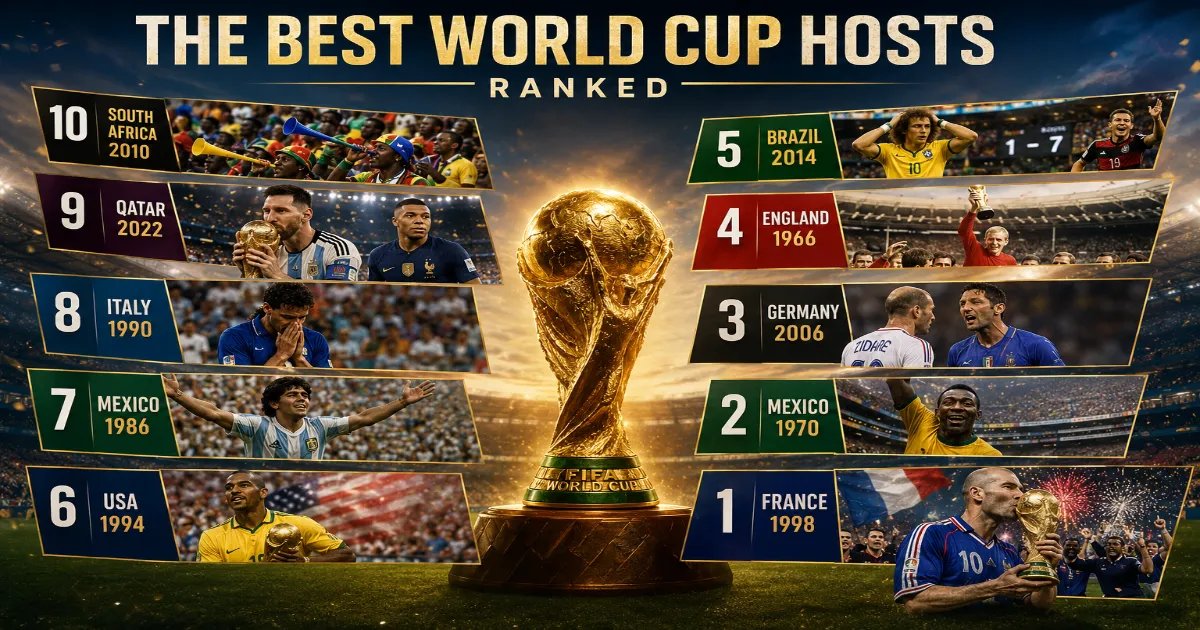
 Judged on the quality of football produced and the lasting cultural mark left behind, these are history’s best World Cup host Nations
Not every World Cup host leaves the same mark on the tournament’s history. Some deliver spectacular football but forgettable organization. Others run a flawless tournament that somehow fails to produce a single truly iconic footballing moment. This ranking weighs both factors together, the actual quality and drama of the football produced, and the lasting cultural and footballing legacy the tournament left behind, to determine which nations delivered the greatest World Cups the sport has ever seen.
The Man Who Invented the World Cup: The Jules Rimet Story 1930
FIFA World Cup Bidding Process: How Host Countries Are Chosen
2034 FIFA World Cup: Saudi Arabia’s Hosting, Explained
10. South Africa (2010)
South Africa’s tournament held genuine historic significance as the first World Cup held on African soil, and the host nation delivered a summer of colorful matchday atmosphere, most memorably captured by the buzzing, controversial soundtrack of thousands of vuvuzela horns that became the tournament’s inescapable sonic signature. The football itself, however, proved comparatively unmemorable, with a relatively low-scoring, cautious tournament that concluded with Spain’s own patient, defensively secure 1-0 extra-time win over the Netherlands in the final, a match remembered as much for its physical, occasionally combative tone as for any moment of attacking brilliance.
9. Qatar (2022)
Qatar’s tournament arrived amid genuine, sustained controversy over migrant worker treatment during stadium construction and the host nation’s human rights record more broadly, criticism that shaped much of the discourse surrounding the event both before and during the competition itself. Once underway, however, the football delivered was genuinely exceptional, capped by what many observers consider the greatest World Cup final ever played, Argentina’s dramatic penalty shootout win over France after a stunning 3-3 draw that included a Kylian Mbappé hat-trick and Lionel Messi finally securing the trophy that had eluded him throughout his career. The tournament’s controversial backdrop keeps it from ranking higher on pure legacy grounds, even as the football itself ranks among the sport’s very best.
8. Italy (1990)
Italy’s tournament, remembered fondly in Italian football culture as “Notti Magiche,” or “Magic Nights,” produced one of the lowest-scoring World Cups in the modern era, a defensively cautious tournament that stood in contrast to the country’s reputation for stylish, technically accomplished football. What the tournament lacked in open attacking football, it made up for in genuine emotional drama, most memorably Roberto Baggio’s tears following Italy’s semifinal exit on penalties to Argentina, an image that remains one of the most poignant in World Cup history, alongside Toto Schillaci’s improbable emergence as the tournament’s top scorer.
7. Mexico (1986)
Mexico’s second World Cup hosting, stepping in after original hosts Colombia withdrew due to financial difficulties, is remembered almost entirely through the singular brilliance of Diego Maradona, whose “Hand of God” goal and subsequent “Goal of the Century,” scored within four minutes of each other in the same quarterfinal against England, remain among the most replayed and debated individual moments in World Cup history. Maradona’s virtuoso tournament, culminating in Argentina’s title triumph, cemented Mexico 1986 as one of the definitive individual-brilliance-driven World Cups, even if the tournament’s broader footballing quality outside Maradona’s own performances proved less consistently memorable.
6. United States (1994)
America’s tournament remains historically significant primarily for what it built rather than the specific football on display, setting an all-time World Cup attendance record that still stands more than three decades later and directly launching the creation of Major League Soccer. The football itself proved a more mixed bag, capped by a genuinely underwhelming, goalless final between Brazil and Italy decided on penalties, the first World Cup final ever settled that way, alongside the genuine tragedy of Andrés Escobar’s murder following Colombia’s shock group-stage exit. The tournament’s institutional and commercial legacy, ultimately reflected decades later in the 2026 tournament’s return to American co-hosting, ranks considerably higher than the specific quality of matches played across the summer of 1994 itself.
5. Brazil (2014)
Brazil’s tournament delivered one of the most dramatic single results in World Cup history, the host nation’s stunning 7-1 semifinal collapse against Germany, a result so shocking it remains a permanent reference point whenever football discusses total footballing catastrophe. That devastating result sits alongside genuine footballing quality elsewhere in the tournament, including Mario Götze’s brilliantly taken extra-time winner in the final itself, and passionate, colorful matchday atmosphere throughout, reflecting Brazil’s status as football’s most historically significant nation. The gulf between the tournament’s emotional extremes, a home nation’s total psychological collapse alongside a genuinely world-class winning goal in the final, is exactly what secures Brazil 2014’s place among the sport’s most memorable host tournaments.
4. England (1966)
England’s only World Cup triumph as hosts remains a landmark moment in the tournament’s broader history, not simply for the result itself but for the significant expansion in global broadcast coverage the tournament achieved, helping establish football’s growing television audience during a pivotal decade for the medium’s global reach. The final itself, England’s 4-2 extra-time win over West Germany, remains one of the most analyzed matches in World Cup history, particularly Geoff Hurst’s controversial second goal, which appeared to strike the underside of the crossbar and bounce on or near the goal line, a decision that remains debated by football historians to this day despite England’s clear overall superiority across the match.
3. Germany (2006)
Germany’s tournament is widely remembered as one of the best-organized World Cups in the competition’s history, a genuinely seamless logistical achievement that also produced a summer of joyful, welcoming national celebration widely nicknamed the “Sommermärchen,” or “summer fairytale,” within Germany itself. The football on display proved consistently excellent throughout the tournament, capped by Italy’s triumph over France in a final remembered as much for Zinedine Zidane’s infamous headbutt on Marco Materazzi as for the genuinely tense, well-contested football that preceded it. Germany’s ability to combine flawless organizational execution with a tournament atmosphere that fundamentally reshaped global perceptions of the host nation’s own national character and hospitality secures its place near the very top of this ranking.
2. Mexico (1970)
Mexico’s first World Cup hosting arrived at a pivotal technological moment, becoming the first tournament broadcast in color to a genuinely global television audience, a shift that dramatically expanded the competition’s visual and cultural impact worldwide. The football itself delivered arguably the greatest single team performance in World Cup history, with Pelé’s Brazil squad widely regarded as the finest side ever assembled, playing a spectacular, free-flowing attacking style that culminated in one of the sport’s most celebrated single goals, Carlos Alberto’s thunderous first-time finish capping a mesmerizing full-team move in the final itself. The combination of genuinely transformative broadcast technology and what remains, more than five decades later, most football historians’ choice for the greatest team performance the World Cup has ever produced places Mexico 1970 at the very top tier of this ranking.
1. France (1998)
France’s home triumph combined nearly every element that makes for a truly complete World Cup host: genuinely dramatic football throughout the tournament, a home nation’s emotional, historically significant first title, and a broader cultural legacy that extended well beyond football itself. Zinedine Zidane’s coronation as a global superstar through his two headers in the final, the tournament’s near-flawless organization across a country with deep existing football infrastructure, and the powerful, still-debated “Black-Blanc-Beur” narrative surrounding the multicultural French squad’s victory combined to produce a tournament whose cultural impact reached considerably further than most World Cups manage. Few host nations have delivered such a complete package of footballing drama, home-nation triumph, and lasting social significance, which is precisely why France 1998 sits at the very top of this ranking.
What Makes a Truly Great World Cup Host
Looking across this ranking, the clearest pattern separating the very best World Cup hosts from merely good ones is the combination of genuine footballing drama with a broader cultural or institutional legacy extending beyond the tournament itself. Germany’s flawless organization, Mexico 1970’s broadcast transformation, and France’s social significance each represent a different kind of lasting impact layered on top of genuinely excellent football, while tournaments ranking lower on this list, however well-run or historically significant in isolated ways, generally lack that same complete combination of footballing quality and broader cultural resonance.
Where Does 2026 Fit?
The 2026 tournament, co-hosted across the United States, Mexico, and Canada as the first-ever 48-team World Cup, arrives too recently to be definitively ranked alongside these more historically settled entries, though its early legacy indicators are genuinely promising. Record CONCACAF representation, all three co-hosts advancing to the knockout stage, Mbappé’s historic second Golden Boot and new all-time scoring record, and Spain’s hard-fought final triumph over Argentina all suggest a tournament with genuine claims to a high ranking once enough time has passed to properly weigh its full footballing and cultural legacy against the tournaments that came before it. For now, 2026 stands as football’s newest chapter still being written, one that will likely take years of historical perspective to fully place alongside the sport’s other great host nation tournaments.
Host Nations That Fell Short
Not every World Cup host managed to deliver a tournament worthy of this ranking’s upper tiers, and it’s worth briefly acknowledging a few notable disappointments for context. Argentina’s 1978 tournament, while producing a genuine home triumph, remains permanently overshadowed by the fact that the country was under the control of a brutal military dictatorship at the time, with credible allegations that the regime used the tournament’s success for propaganda purposes while human rights abuses continued largely out of the international spotlight, a legacy that complicates any straightforward celebration of the football itself no matter how it might otherwise be judged on pure sporting merit. South Korea and Japan’s shared 2002 hosting duties, despite producing genuine footballing quality and South Korea’s own historic semifinal run, faced lingering questions about the format’s split-nation logistics and several controversial refereeing decisions that took some shine off what was otherwise a genuinely significant tournament for expanding the World Cup’s presence in Asia.
Judging Legacy Takes Time
One of the more difficult aspects of ranking World Cup hosts is that a tournament’s true legacy often only becomes fully clear years, sometimes decades, after the final whistle blows. The 1994 United States tournament, for instance, wasn’t widely recognized as a genuinely transformative moment for American soccer until Major League Soccer had matured into a stable, growing league many years later, and Germany 2006’s reputation as a model of tournament organization and hospitality similarly solidified gradually over the years that followed rather than being immediately obvious in real time. This lag between a tournament’s immediate reception and its eventual settled historical reputation is worth keeping firmly in mind whenever more recent hosts, Qatar and eventually the 2026 co-hosts included, are compared directly against the more historically established entries elsewhere on this list, since the fullest measure of any host’s actual legacy typically requires considerably more distance and perspective than can be fully assessed in the immediate aftermath of a single tournament’s closing ceremony.
A Ranking That Will Keep Evolving
Ultimately, ranking the best World Cup hosts is as much an ongoing conversation as it is a settled, permanent list, one that shifts as new tournaments add fresh entries and as historical perspective continues to reshape how older tournaments are remembered and evaluated. What remains constant across every entry on this list, however, is the same basic combination that separates a merely well-organized tournament from a truly great one: genuinely compelling football, paired with a broader cultural or institutional legacy substantial enough to be remembered and referenced by the sport for decades after the final whistle has long since blown.
That standard, admittedly subjective and always open to reasonable debate, is precisely what makes this kind of ranking such an enduring source of discussion among football fans and historians alike, since reasonable people can and do disagree about how much weight to assign pure footballing drama versus a tournament’s broader cultural footprint. What’s far less debatable is that the World Cup’s greatest hosts, whichever specific order fans might ultimately settle on, have consistently proven capable of using football’s biggest stage to produce something that resonates considerably beyond the sport itself, a standard every future host nation, including whichever countries eventually host the tournament well beyond 2026, will inevitably be measured against, whether that measurement comes from a stadium packed with roaring fans or, decades later, from exactly this kind of retrospective ranking.
▪️▪️ Follow us on Facebook ▪️▪️
Cristiano Ronaldo Jr.: Club, Lifestyle, Career and Future Prospects
About the Author