 From record-breaking thrashings to total team collapse, these are the worst World Cup teams the tournament has ever produced.
Not every World Cup story ends in glory. For every underdog run that captures the world’s imagination, there’s a squad on the other end of a historic thrashing, or a team that arrived with genuine ambition and left with nothing but embarrassment. This is a catalog of the worst World Cup campaigns in the tournament’s history, ranked by a mix of scoreline severity, sheer dysfunction, and the sheer scale of the disappointment involved.
Lille vs Paris Saint-Germain Ends 2-2 as PSG Stage Incredible Stoppage-Time Comeback
LaLiga 2026/27 Schedule: Fixtures, Dates & Times
The History of Asian Teams at the Fifa World Cup — From South Korea 2002 to a Record 2026
15 Champions League Players to Watch in 2026/27: Superstars & Young Guns
Panama (2018)
Panama’s first-ever World Cup appearance should have been a source of pure celebration for a nation with no prior tournament history to live up to, and in some ways it was, right up until the football started. Drawn into a difficult group alongside Belgium, England, and Tunisia, Panama conceded eleven goals across their three matches without managing a single win, including a six-goal defeat to England. The lone bright spot came against England themselves, when Felipe Baloy’s consolation goal, Panama’s first-ever World Cup goal, sparked scenes of pure, unrestrained national celebration back home, a reminder that even a genuinely dreadful campaign can still produce a moment of real joy for a footballing nation experiencing the World Cup for the very first time.
China (2002)
China’s only World Cup appearance to date remains a case study in total attacking failure. Despite qualifying with a talented squad led by veteran playmaker Hao Haidong and coached by the experienced Bora Milutinović, China lost all three group matches, against Costa Rica, Brazil, and Turkey, without scoring a single goal across the entire tournament. Conceding nine goals while managing zero of their own left China with one of the most one-sided goal differentials of any team in modern World Cup history, and more than two decades later, the nation still hasn’t managed to qualify for a second appearance, making that goalless 2002 campaign an unusually lonely entry in the country’s football history.
North Korea (2010)
North Korea’s return to the World Cup after a 44-year absence began with genuine promise, a narrow 2-1 defeat to Brazil that suggested the team, built around a disciplined defensive structure, might spring an upset or two. Instead, their remaining two matches collapsed entirely, including a 7-0 thrashing by Portugal that remains one of the most one-sided defeats of the modern tournament era. The scale of the collapse was particularly jarring given how competitive North Korea had looked just days earlier against Brazil, a reminder of just how quickly a promising tournament debut can unravel once a team’s underlying limitations are fully exposed by stronger opposition.
Cameroon (2014)
Cameroon’s 2014 campaign stands out less for the scorelines themselves, though the team did lose all three group matches, and more for the sheer internal dysfunction that defined it. Reports of players threatening to boycott training over unpaid bonuses emerged in the days before the tournament even began, an embarrassing distraction that set the tone for what followed. On the pitch, the chaos culminated in one of the most bizarre moments in World Cup history, when Cameroon midfielder Alex Song was sent off for elbowing his own teammate, Joel Matip, during their final group match against Brazil, a moment that seemed to perfectly encapsulate a squad that had fallen apart from the inside well before a ball was even kicked.
Haiti (1974)
Haiti’s 1974 campaign began with a genuine moment of history, Emmanuel Sanon’s opening goal against defending champions Italy ended a run of over a thousand minutes without Italy conceding in the World Cup, a stunning shock that briefly had Haiti leading one of the tournament’s most storied footballing nations. What followed, however, descended into one of the most chaotic campaigns in tournament history. Haiti lost their remaining matches by a combined score of 12-2, including a 7-0 defeat to Poland, but the team’s lasting notoriety came off the pitch entirely, when defender Ernst Jean-Joseph failed a doping test after the Italy match and was expelled from the tournament in disgrace, a scandal that overshadowed the rest of Haiti’s campaign and the promising shock result that had briefly made the team a genuine talking point of the tournament.
Zaire (1974)
Few World Cup campaigns combine footballing humiliation with genuinely bizarre moments quite like Zaire’s 1974 tournament. Representing Africa for the first time at a World Cup, Zaire lost all three group matches, conceding fourteen goals in the process, including a 9-0 defeat to Yugoslavia that stood for years as one of the heaviest losses in tournament history. Zaire’s most enduring moment of infamy, however, came during their final match against Brazil, when defender Mwepu Ilunga charged out of the defensive wall to hoof the ball upfield before Brazil could even take a free kick, a moment often misremembered as simple confusion about the rules but which Ilunga later explained was actually a deliberate, if futile, attempt to run down the clock in a match his team had no realistic hope of competing in. It remains one of the most replayed clips in World Cup history, a strange mix of comedy and genuine tournament despair.
Saudi Arabia (2002)
Saudi Arabia arrived at the 2002 World Cup as reigning Asian champions with genuine continental pedigree, only to suffer one of the most one-sided defeats ever inflicted on a team with that level of prior success. A 8-0 demolition at the hands of Germany remains, more than two decades later, one of the largest margins of defeat by a team with legitimate credentials heading into the tournament, a result that stunned observers given Saudi Arabia’s status as one of Asia’s strongest footballing nations at the time. The team went on to lose their remaining matches as well, completing a group-stage exit that took years for Saudi football’s reputation to fully recover from.
El Salvador (1982)
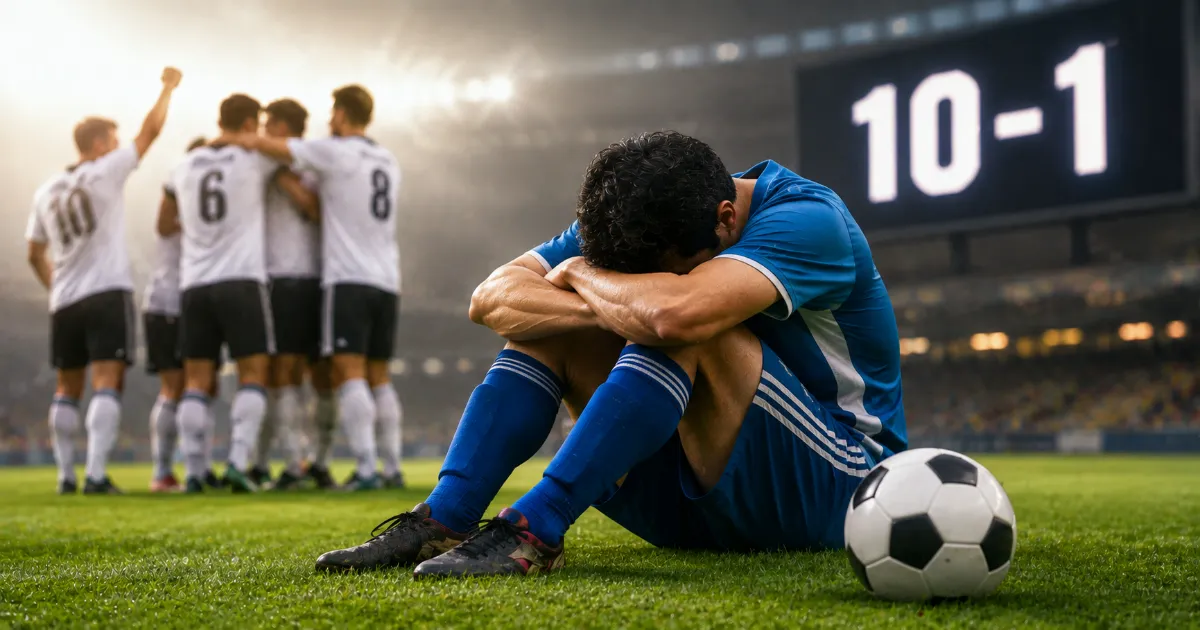
If there’s a single campaign that stands as the definitive answer to “worst World Cup team of all time,” it’s El Salvador’s disastrous 1982 tournament. Already facing an uphill battle simply reaching the finals, the team’s campaign in Spain became defined almost entirely by a single result: a 10-1 defeat to Hungary that remains, over four decades later, the largest margin of victory in World Cup history. Hungary led just 3-0 at halftime before completely overwhelming El Salvador’s exhausted, overmatched defense in the second half, scoring seven further goals in a collapse so total that it remains a reference point whenever football writers discuss the concept of a team being utterly outclassed on the sport’s biggest stage.
El Salvador’s campaign didn’t improve from there, with further defeats to Belgium and Hungary’s fellow group opponents, leaving the team having conceded thirteen goals while scoring just a single one across the entire tournament, one of the most lopsided overall goal differentials any team has ever produced at a World Cup. More than forty years on, the 10-1 scoreline against Hungary remains the single most cited example whenever the phrase “worst World Cup team in history” comes up in football discussion, a record so extreme that even decades of subsequent tournaments, including several other genuinely dreadful campaigns, have never come close to matching it.
Australia (1974)
Australia’s first-ever World Cup appearance in 1974 offers a somewhat gentler entry on this list, a team that lost all three group matches without ever being truly humiliated on the scoreline. Facing East Germany, West Germany, and Chile, Australia lost narrowly each time and even managed a scoreless draw against Chile, avoiding the kind of historic blowout that defines several other entries here. What earns Australia a spot regardless is the context surrounding the campaign: a team with minimal international experience and a largely part-time domestic playing pool facing considerably more organized, professionalized opposition, a mismatch in preparation and resources that, while not producing a single embarrassing scoreline, meant Australia never seriously threatened to compete for points across the entire tournament.
Spain’s Group of Death Disaster Isn’t Here, But Tunisia’s Almost Was
It’s worth briefly addressing a common misconception in these kinds of rankings: not every early exit or heavy defeat belongs on a list of the worst teams in World Cup history. Tunisia’s 1978 campaign, for instance, is sometimes lumped in with weaker African debutants of the era, yet the team actually recorded Africa’s first-ever World Cup win, defeating Mexico 3-1, before narrowly losing to West Germany and drawing with Poland. It’s a reminder that context matters enormously when compiling a list like this one: a heavy defeat or an early group-stage exit alone doesn’t automatically qualify a team for inclusion among football’s genuine World Cup disasters. The entries that make this list combine either a truly historic scoreline, deep internal dysfunction, or a total inability to compete at any point across the tournament, rather than simply a disappointing final placing.
What These Campaigns Have in Common
Looking across this catalog of footballing disasters, a few recurring themes emerge. Several of the worst campaigns in World Cup history involved teams that qualified largely on the strength of a weaker regional confederation rather than genuine world-class quality, a gap that becomes brutally apparent once those teams face the concentrated talent of Europe’s or South America’s strongest nations. Internal dysfunction, whether Cameroon’s bonus disputes or Haiti’s doping scandal, also appears repeatedly, a reminder that a team’s off-field cohesion can be just as decisive as its on-field talent when it comes to determining whether a World Cup campaign ends in respectable defeat or total humiliation.
Physical and mental fatigue also plays a recurring role, particularly in the more historic entries on this list. El Salvador’s second-half collapse against Hungary and Zaire’s total defensive breakdown against Yugoslavia both point to teams that, whatever tactical plan they arrived with, simply couldn’t sustain the physical and mental intensity required to compete with elite opposition across a full ninety minutes, especially once the score began to snowball against them.
There’s also a clear pattern around squad preparation and tournament experience. Several of the teams on this list, Zaire and Haiti in particular, were making their first-ever World Cup appearances with minimal exposure to the intensity of top-level international competition, a gap in tournament-specific experience that no amount of raw talent could fully compensate for once matches kicked off against considerably more battle-tested opposition. Even Saudi Arabia, despite genuine continental pedigree heading into 2002, had comparatively little experience facing European sides of Germany’s caliber under the unique pressure of a World Cup stage, a mismatch in high-stakes experience that likely contributed as much to the scale of their defeat as any gap in pure footballing talent.
Why These Disasters Still Matter
It might seem unkind to keep revisiting these campaigns decades after the fact, but there’s genuine value in remembering football’s most embarrassing tournament performances alongside its greatest triumphs. These campaigns serve as a reminder of just how enormous the gap in footballing infrastructure, depth, and elite-level experience can be between the World Cup’s traditional powers and nations still building their programs, a gap that, while narrowing in some regions over the decades, clearly hasn’t disappeared entirely even in the modern, considerably more globalized version of the sport. They’re also, in their own strange way, part of what makes the World Cup’s underdog stories so compelling when they do succeed, since campaigns like El Salvador’s or Zaire’s illustrate exactly the kind of outcome that nations without deep footballing infrastructure are constantly trying to avoid, and that makes it all the more remarkable whenever a smaller footballing nation manages to pull off a genuine shock instead.
For El Salvador, Zaire, Haiti, and the other teams on this list, their World Cup campaigns will likely never be remembered for footballing quality. But more than four decades on for some of these entries, they remain permanently etched into the tournament’s history all the same, a reminder that the World Cup’s story has always been written by its lowest moments just as much as its highest ones.
Could Any of These Records Ever Be Broken?
With the World Cup now expanded to 48 teams as of 2026, a natural question arises: does a larger tournament field increase the risk of another historically lopsided result like El Salvador’s 10-1 defeat? The evidence so far suggests the answer is more complicated than it might first appear. While the expanded format has brought in a wider range of nations with varying levels of footballing infrastructure, including several genuine World Cup debutants in recent cycles, modern defensive coaching, sports science, and video analysis have collectively made it considerably harder for even significant talent gaps to translate into the kind of open, unrestrained scoring rout that defined matches in the 1970s and 1980s. Teams facing a clear quality mismatch today are far more likely to set up defensively compact and absorb pressure than the more loosely organized sides of earlier tournament eras, a shift in tactical culture that makes a repeat of El Salvador’s specific level of collapse considerably less likely, even against vastly superior opposition.
That said, the increasing number of debutant nations at recent tournaments does raise the theoretical possibility of a new entry eventually joining this list. Modern debutants have generally avoided historic blowouts even in difficult groups, a reflection of how thoroughly modern football culture has absorbed defensive organization even at nations with comparatively limited top-level experience, but the underlying gap in resources and depth between the World Cup’s traditional powers and its newest arrivals hasn’t disappeared entirely. Whether that gap ever produces another result to rival El Salvador’s remains to be seen, but for now, more than four decades on, the 1982 tournament in Spain still holds a record that has proven remarkably resistant to being broken, even as the World Cup itself has grown larger and more globally inclusive than ever before.
The History of Asian Teams at the Fifa World Cup — From South Korea 2002 to a Record 2026
Haaland’s New Haircut Shocks Fans Before Season Opener
🔹🔹 Follow us on Facebook 🔹🔹
About the Author