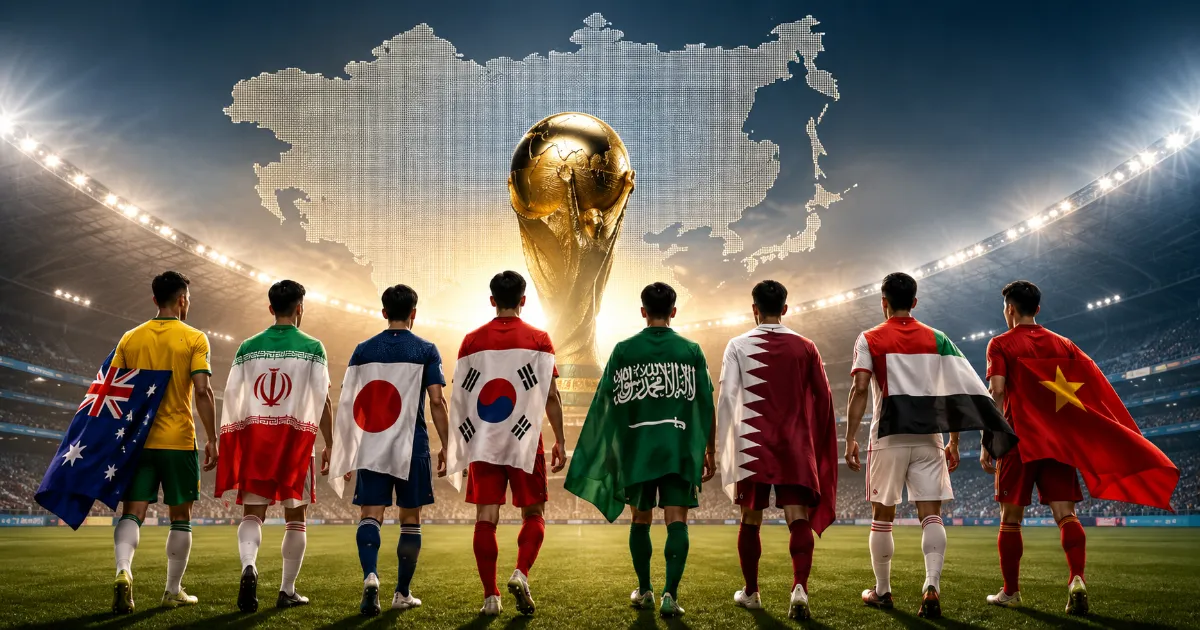
 Tracing the rise of Asian teams at the Fifa World Cup, from decades on the periphery to a record eight nations at the 2026 tournament.
Asian football’s relationship with the World Cup has always been defined by a strange tension: steadily increasing representation on one hand, and a persistent struggle to convert that representation into deep tournament runs on the other. From a single qualifying spot in the tournament’s early decades to a record eight nations at the expanded 2026 World Cup, Asia’s presence on football’s biggest stage has grown enormously. Yet more than two decades after the continent’s greatest World Cup moment, the story of Asian football at the World Cup remains one of gradual progress rather than sustained dominance.
ASEAN Championship 2026 Preview: A 30th Anniversary Like No Other
2034 FIFA World Cup: Saudi Arabia’s Hosting, Explained
FIFA World Cup Bidding Process: How Host Countries Are Chosen
The Early Decades: A Continent on the Periphery
For most of the twentieth century, Asian representation at the World Cup was minimal to nonexistent. North Korea’s run to the quarterfinals in 1966, upsetting Italy along the way in one of the tournament’s most famous shocks, stood for decades as the clear high-water mark for Asian football on the global stage, a genuinely remarkable achievement given how little international exposure Asian teams typically had at the time. Beyond that isolated moment, Asian teams that did qualify across the 1970s, 1980s, and early 1990s, including Kuwait, Iraq, South Korea, and Saudi Arabia, typically exited at the group stage, often without winning a single match, reflecting a significant gap in professional infrastructure, coaching quality, and top-level competitive experience compared to the European and South American nations that dominated the tournament.
Japan didn’t even qualify for its first World Cup until 1998, a reminder of just how recently the continent’s most successful football nations began their World Cup journeys in earnest. That absence changed dramatically once Japan and South Korea were awarded co-hosting rights for the 2002 tournament, a decision that would go on to reshape the trajectory of Asian football at the World Cup for years to come.
2002: The Breakthrough That Still Stands Alone
Co-hosting the 2002 World Cup gave both Japan and South Korea an enormous structural advantage, avoiding the qualification process entirely while investing heavily in facilities, coaching, and domestic football infrastructure in preparation for hosting duties. Japan reached the round of 16 in their first tournament as co-hosts, a respectable result, but it was South Korea’s run that truly redefined what Asian football could achieve at a World Cup.
Managed by Dutch coach Guus Hiddink, South Korea eliminated Portugal, Italy, and Spain en route to a semifinal appearance, an almost unthinkable sequence of results for a nation that had never previously won a single World Cup match. Their eventual fourth-place finish, following a semifinal defeat to Germany and a third-place playoff loss to Turkey, remains, more than two decades and multiple subsequent World Cups later, the single best result any Asian nation has ever achieved at the tournament. The run wasn’t without controversy, with several refereeing decisions in South Korea’s knockout matches against Italy and Spain drawing lasting criticism from those nations’ football communities, but the achievement itself has never been matched, let alone surpassed, by any Asian team since.
The Post-2002 Plateau
In the years immediately following the 2002 tournament, Asian football struggled to build on that momentum in the way many observers expected. Both Japan and South Korea continued to qualify consistently, becoming fixtures of the tournament, but neither replicated anything close to their 2002 form for a considerable stretch, typically exiting at the group stage or round of 16 across the 2006, 2010, and 2014 tournaments. South Korea did reach the round of 16 in 2010, their best showing on foreign soil at the time, but the deep knockout runs that had defined 2002 remained elusive.
This period also saw the gradual emergence of other Asian footballing nations onto the World Cup stage, including Australia, who joined the Asian Football Confederation in 2006 after previously competing in Oceania qualifying, immediately adding a genuinely competitive new nation to Asia’s World Cup pool. Saudi Arabia, Iran, and eventually Qatar as tournament hosts also became increasingly regular fixtures, gradually expanding the depth of nations Asia could call upon, even as none managed to consistently threaten the knockout stages in the way South Korea briefly had in 2002.
2018 and 2022: Signs of Genuine Progress
The 2018 and 2022 World Cups brought renewed optimism about Asian football’s trajectory, even without another result matching 2002’s heights. At the 2022 tournament in Qatar, both Japan and South Korea advanced from the group stage, with Japan producing one of the tournament’s most memorable storylines by defeating both Germany and Spain in the group phase, two former World Cup champions, a result that suggested genuine tactical and technical progress rather than a single fortunate cup run. South Korea also advanced from a difficult group featuring Uruguay and Portugal, with Son Heung-min playing a leading role for a team that had shown steady, if unspectacular, improvement in the years since 2002.
Saudi Arabia added their own headline moment at the 2022 tournament, defeating eventual champions Argentina in the group stage in one of the biggest upsets in modern World Cup history, further reinforcing the sense that Asian football’s competitive floor was rising, even if a genuine deep tournament run remained just out of reach for the continent as a whole.
2026: Record Representation, Familiar Frustrations
The 2026 World Cup, expanded to 48 teams across the United States, Mexico, and Canada, gave Asian football its largest-ever representation, with a record eight nations qualifying directly: Japan, South Korea, Australia, Iran, Saudi Arabia, Qatar, and World Cup debutants Jordan and Uzbekistan, both securing qualification for the first time in their history. Iraq also returned to the tournament for the first time in roughly four decades, adding to a genuinely historic level of Asian representation at a single World Cup.
The results, however, told a familiar story. Japan reached the knockout stage yet again, extending an increasingly consistent pattern of advancing from the group phase, before eventually losing to Brazil in the round of 32. Australia also advanced to the knockout rounds, meaning only two of the continent’s eight representatives progressed beyond the group stage, a modest return given the record number of nations involved. South Korea’s tournament proved particularly disappointing, opening with a spirited comeback win over Czechia before losing their remaining group matches, a result that triggered significant criticism of the team’s tactical setup and preparation back home. Debutants Jordan and Uzbekistan both exited without a win, though each produced a genuinely memorable highlight, Jordan scoring against Argentina and Uzbekistan finding the net against Colombia, moments that, while not enough to secure results, offered a glimpse of the growing competitiveness even newer Asian nations can bring to the sport’s biggest stage. Iraq, drawn into an especially difficult group alongside France, Senegal, and Norway, exited without a win, a tough introduction back to World Cup football after such a long absence. Qatar and Saudi Arabia both earned respectable draws against stronger European opposition without progressing further.
Why South Korea’s 2002 Run Remains Unmatched
More than two decades and several tournaments later, football analysts and journalists covering Asian football continue to point to the same fundamental question raised by the 2026 tournament’s results: why hasn’t any Asian nation managed to replicate, let alone surpass, South Korea’s 2002 semifinal run, despite the continent’s football infrastructure, coaching quality, and player development having visibly improved in the years since? Several explanations tend to recur in this ongoing discussion. Asian domestic leagues, even the strongest ones in Japan, South Korea, and Saudi Arabia, still generally lack the consistent, week-to-week elite competitive intensity of Europe’s top leagues, meaning even Asia’s best players often develop their sharpest tournament instincts abroad rather than domestically. Squad depth also remains a persistent issue, with several Asian nations still relying heavily on a small handful of Europe-based stars, leaving them more vulnerable than deeper-squadded nations when key players underperform or pick up injuries during a tournament’s most demanding stretch.
What Comes Next for Asian Football at the World Cup
Despite the mixed results of 2026, there’s a reasonable case that Asian football’s overall trajectory remains a positive one, even if progress has been gradual rather than dramatic. Japan’s consistent ability to reach the knockout stage across recent tournaments, and their group-stage upsets of major European nations, suggest a genuine baseline of competitive quality that didn’t exist for the continent a generation ago. The continued expansion of Asian representation, driven by an increasing number of automatic qualification slots as the World Cup itself has grown, also means more nations than ever are gaining valuable tournament experience, experience that South Korea’s golden generation didn’t have the benefit of before their own breakthrough in 2002.
Whether that steadily broadening base of experience eventually produces another deep run to match or exceed South Korea’s semifinal appearance remains an open question, one that will likely continue to define conversations about Asian football at the World Cup until it finally happens. For now, more than two decades on and even after a historic, record-setting eight-team representation in 2026, that single, remarkable run in 2002 remains the standard every subsequent Asian World Cup campaign is still measured against.
The Rise of the Europe-Based Asian Player
One of the clearest structural shifts underpinning Asia’s gradual World Cup progress has been the steady increase in Asian players plying their trade at top European clubs. Where Asian national teams once relied almost entirely on domestically based players with limited exposure to elite European tactics and intensity, recent squads from Japan, South Korea, and increasingly Iran and Saudi Arabia now regularly feature a core of players competing week-to-week in the Premier League, Bundesliga, La Liga, and other major European leagues. Japan’s 2022 and 2026 squads in particular were built around a significant contingent of Europe-based talent, a structural shift widely credited with the team’s increasingly composed, tactically flexible performances against traditionally stronger European opposition.
This pathway hasn’t been universally available across the continent, however, which helps explain some of the disparity in results between Asia’s more established football nations and newer or smaller ones. Countries like Jordan and Uzbekistan, both making their World Cup debuts in 2026, still rely far more heavily on domestically based squads, a gap in international playing experience that likely contributed to their winless group-stage campaigns, even as both nations produced moments that hinted at a promising trajectory for the future.
How AFC Qualification Has Transformed Over Two Decades
The qualification pathway itself has also evolved considerably since South Korea and Japan’s co-hosting arrangement in 2002. Asia’s automatic World Cup allocation has expanded significantly over the years, growing from just a handful of guaranteed slots in earlier tournament cycles to eight direct qualification places by 2026, plus additional access to inter-confederation playoff opportunities. This expansion, driven largely by FIFA’s broader decision to grow the World Cup itself to 48 teams, has given considerably more Asian nations a realistic pathway to qualification than existed for previous generations of players, a structural change that’s likely to keep reshaping the competitive picture across the continent in tournaments still to come.
That expanded access cuts both ways, however. While more nations now reach the World Cup than ever before, the sheer increase in Asian representation has also meant a wider spread of results, from Japan and Australia’s continued knockout-stage consistency to the winless campaigns of newer qualifiers still building the infrastructure and tournament experience needed to compete at the deepest levels of the competition.
A Different Story on the Women’s Side
It’s worth noting that Asia’s World Cup story looks meaningfully different when it comes to the women’s game, where Japan in particular has already achieved what the men’s team has yet to manage. Japan’s women’s national team won the Women’s World Cup outright in 2011, defeating the United States on penalties in the final, a result that remains the single greatest World Cup achievement by any Asian football program, men’s or women’s, and one that arrived over a decade before the men’s side’s own strongest showings against traditional European powers.
That contrast is frequently raised in discussions about the developmental gap between men’s and women’s football investment across parts of Asia, since Japan’s women’s success came despite historically receiving a fraction of the resources, media attention, and domestic league infrastructure available to the men’s game. It’s a reminder that any full accounting of Asian football’s World Cup history has to include both sides of the game, and that on at least one measure, a nation from the continent has already climbed to the very top of the sport.
The Road Ahead
Looking beyond 2026, there’s reason to believe Asian football’s World Cup representation will only continue to grow, both in terms of raw qualification numbers and in the overall competitiveness of the nations involved. Continued investment in youth academies across Japan, South Korea, and the Gulf states, combined with an increasing pipeline of players moving to Europe at a younger age, suggests the structural gap between Asia’s leading football nations and the traditional European and South American powers will likely keep narrowing in the years ahead. Whether that narrowing gap finally produces a run to match or surpass South Korea’s extraordinary 2002 campaign remains football’s most persistent open question about the continent, one that fans, coaches, and administrators across Asia will keep chasing at every World Cup until it’s finally answered.
🔹🔹 Follow us on Facebook 🔹🔹
Saudi Arabia Gears Up to Host AFC Asian Cup 2027 With Massive Football Ambitions
About the Author