 The Definitive Final Order: Every World Cup 2026 Team Ranked From Bottom to Top
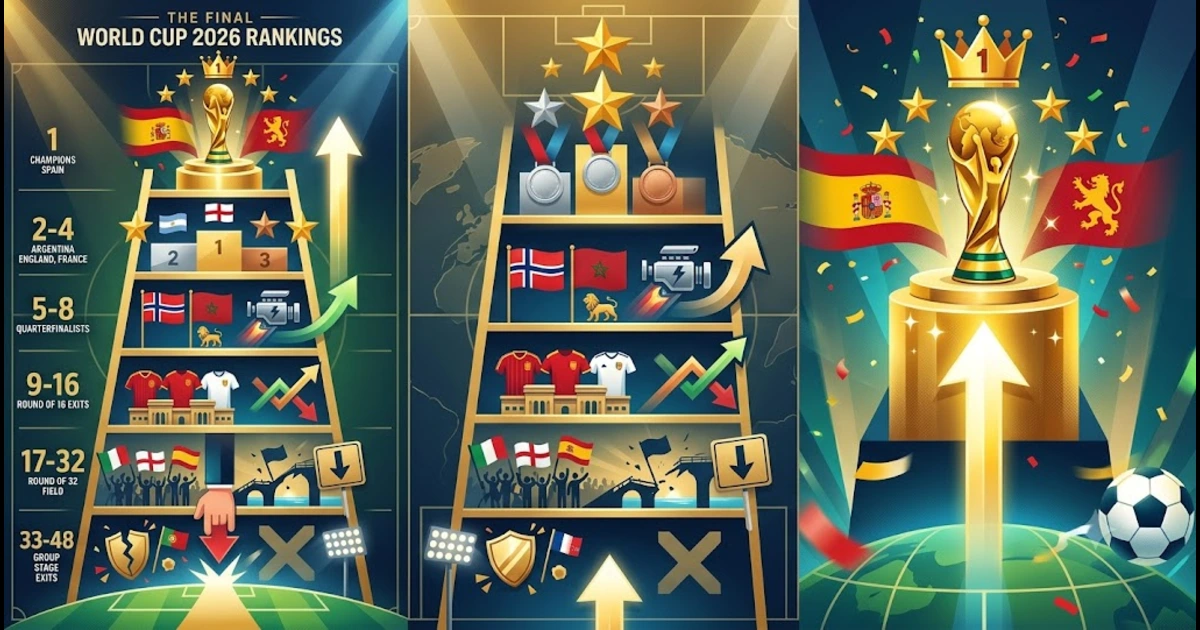
With the tournament complete, ranking all 48 teams based on how they actually performed — rather than how they were expected to — tells its own story about a World Cup full of surprises at every level of the bracket. Here’s the full field, ranked from champions down to the team that exited earliest.
LaLiga 2026/27 Schedule: Fixtures, Dates & Times
Premier League 2026/27 Schedule: This Week and Next Week
We Called It: How Our Spain World Cup Prediction Came True
The Full Ranking
| Rank | Team | Final Stage Reached |
|---|---|---|
| 1 | Spain | Champions |
| 2 | Argentina | Runners-up |
| 3 | England | Third place |
| 4 | France | Fourth place |
| 5-8 | Belgium, Norway, Morocco, Switzerland | Quarterfinals |
| 9-16 | Mexico, Paraguay, Colombia, Brazil, USA, Egypt, Portugal, Canada | Round of 16 |
| 17-32 | Germany, Netherlands, Croatia, Ivory Coast, Japan, Austria, Cape Verde, Congo DR, Senegal, Ghana, Ecuador, Sweden, Algeria, Bosnia and Herzegovina, South Africa, Australia | Round of 32 |
| 33-48 | Uruguay, Scotland, IR Iran, Korea Republic, Czechia, Qatar, Haiti, Turkiye, Curacao, New Zealand, Saudi Arabia, Iraq, Jordan, Uzbekistan, Panama, Tunisia | Group Stage |
1. Spain: Champions
Spain’s ranking at the top needs little explanation — an unbeaten run through eight matches, a single goal conceded across the entire tournament, and a hard-fought extra-time win over Argentina in the final. It’s a campaign that will be remembered as one of the most defensively complete title runs in the competition’s history.
2-4: Argentina, England and France
Argentina’s run to a second consecutive final, built on dramatic late comebacks against Egypt and England, secures second place despite the eventual defeat. England’s third-place finish, capped by a wild 6-4 win over France in Saturday’s playoff, represented their best World Cup showing since 1966, while France’s fourth-place finish — with Mbappé’s individual brilliance the standout feature of an otherwise disappointing final week — rounds out the podium places.
5-8: The Quarterfinalists
Norway’s run stands out above the other three quarterfinal losers, given they arrived as one of the tournament’s biggest surprises and pushed England all the way in the last eight after eliminating Brazil in the round before. Morocco’s run through the newly created round of 32 — eliminating the Netherlands on penalties before beating Canada in the round of 16 — kept them in the conversation until France finally ended their run in the quarterfinal. Belgium’s quarterfinal defeat to Spain stands out for one specific reason: Charles De Ketelaere’s goal remains the only one Spain conceded across the entire tournament outside the final, meaning Belgium can rightfully claim to have found the one crack in an otherwise flawless defensive campaign. Switzerland round out this tier, undone partly by a contentious Breel Embolo red card that turned their quarterfinal against Argentina.
9-16: The Round of 16 Exits
This tier includes some of the tournament’s most eye-catching individual campaigns that still ended a round short of the quarterfinals. Mexico’s co-host run ended in a five-goal thriller against England. Brazil’s shock exit to Norway remains the single biggest upset of the entire tournament. Portugal, Colombia, Egypt, Paraguay, Canada and the USA round out this group, each eliminated in matches that, in several cases, could easily have gone the other way with a different bounce or a converted chance.
17-32: The Round of 32 Field
The newly introduced round of 32 claimed several notable scalps, and the teams eliminated there occupy this entire tier. Germany’s exit on penalties to Paraguay remains one of the tournament’s genuine shocks — a four-time champion eliminated in the very first knockout round. The Netherlands suffered an almost identical fate against Morocco. Cape Verde, playing in their first-ever World Cup, earned considerable respect for taking Argentina to extra time before finally being eliminated, while Senegal, Ghana, Congo DR, Ivory Coast, Croatia, Japan, Austria, Ecuador, Sweden, Algeria, Bosnia and Herzegovina, South Africa and Australia complete a tier that includes several teams who exceeded pre-tournament expectations just to reach this stage of an expanded, more difficult format.
33-48: The Group Stage Exits
The bottom sixteen includes both disappointing campaigns from teams with higher expectations and gutsy, respectable showings from tournament debutants and lower-ranked nations. Uruguay, Scotland and South Korea were all widely viewed as underachievers relative to their squad quality, failing to advance from groups many expected them to escape. Iran were desperately unlucky, missing out on goal difference after a tightly contested group. Haiti, playing in their first World Cup since 1974, earned considerable praise for their competitiveness in an especially difficult group featuring Brazil. New Zealand, Panama and Curacao were all singled out by analysts for punching above their weight relative to expectations, even in defeat. Tunisia, winless and without a goal scored across their three group matches, finished as the tournament’s lowest-ranked team by result.
The Biggest Overachievers
Ranking every team by result alone doesn’t capture the full story of who exceeded expectations relative to how they were regarded heading into the tournament. By that measure, Norway’s run to the quarterfinals stands clearly above the rest of the field — a nation with no recent history of deep World Cup runs, built around Erling Haaland’s individual brilliance but ultimately succeeding through genuine collective organization, not just one player carrying the team. Morocco’s run through the newly created knockout rounds, eliminating a European heavyweight in the Netherlands along the way, continued the promise shown by their run to the semifinals in Qatar four years earlier. And Cape Verde’s journey from World Cup debutants to a side that pushed Argentina to extra time in the round of 32 remains, statistically and emotionally, one of the great underdog stories the format has produced.NBA Schedule 2026-27: Christmas Day Rivalries, Ring Night and the Games to Watch
PSG v Arsenal: How Paris Won the Champions League Final on Penalties
The Biggest Underachievers
At the other end of that same measure, several results stand out as genuine disappointments relative to pre-tournament expectations. Germany’s exit to Paraguay in the very first knockout round, as a four-time champion with genuine title aspirations heading into the tournament, ranks among the most stunning underachievements in the nation’s World Cup history. Brazil’s exit to Norway in the round of 16 carries similar weight — a five-time champion eliminated by a team with no comparable tournament pedigree. Uruguay, Scotland and South Korea, all sides many pundits expected to escape their groups comfortably, instead exited without reaching the knockout rounds at all, leaving considerable underlying quality on the table relative to how they actually performed.
How Continental Confederations Fared
Looking at this ranking through a confederation lens adds another layer of context. UEFA sides dominated the top of the table, with Spain, England and France all finishing in the top four, and Belgium, Norway, Switzerland, Portugal and Croatia all reaching at least the round of 16 or beyond. CONMEBOL’s representation was smaller in number but punched well above its weight relative to team count — Argentina’s run to the final and Colombia and Paraguay’s knockout-stage showings meant every South American qualifier beyond the group stage made a genuine impact. CAF nations Morocco and Egypt both reached the knockout rounds and acquitted themselves well, continuing African football’s gradual rise in tournament credibility first signaled by Morocco’s 2022 semifinal run. host confederation CONCACAF saw the USA, Mexico and Canada all reach at least the round of 32, a reasonable return for the three co-hosts given the pressure and scrutiny that came with home advantage across the tournament.
What This Ranking Reveals
Look past the individual placements, and a clear pattern emerges: this expanded, 48-team format rewarded genuine tactical organization over reputation more consistently than previous tournaments. Germany and the Netherlands, both historically among the competition’s biggest names, were eliminated in a round that didn’t exist at previous World Cups, while Norway, Morocco and Cape Verde — none traditionally considered genuine contenders — all outperformed expectations by a considerable margin. The correlation between pre-tournament reputation and final ranking was real, but it was looser than at almost any previous World Cup, a direct consequence of an extra knockout round adding one more opportunity for an in-form underdog to catch a favourite on the wrong day.
The Bottom Line
Champions Spain, runners-up Argentina, and a top four rounded out by England and France reflects a tournament that, broadly, rewarded the teams pundits expected to go furthest. But the tiers below that — Norway’s stunning run to the quarterfinals, Germany and the Netherlands both falling in the round of 32, and a bottom sixteen full of both disappointments and pleasant surprises — is where this expanded format’s real character showed through, producing a genuinely unpredictable ranking from top to bottom.
15 Champions League Players to Watch in 2026/27: Superstars & Young Guns
Every Penalty Miss at FIFA World Cup 2026, Explained
🔹🔹 follow us on facebook 🔹🔹
About the Author