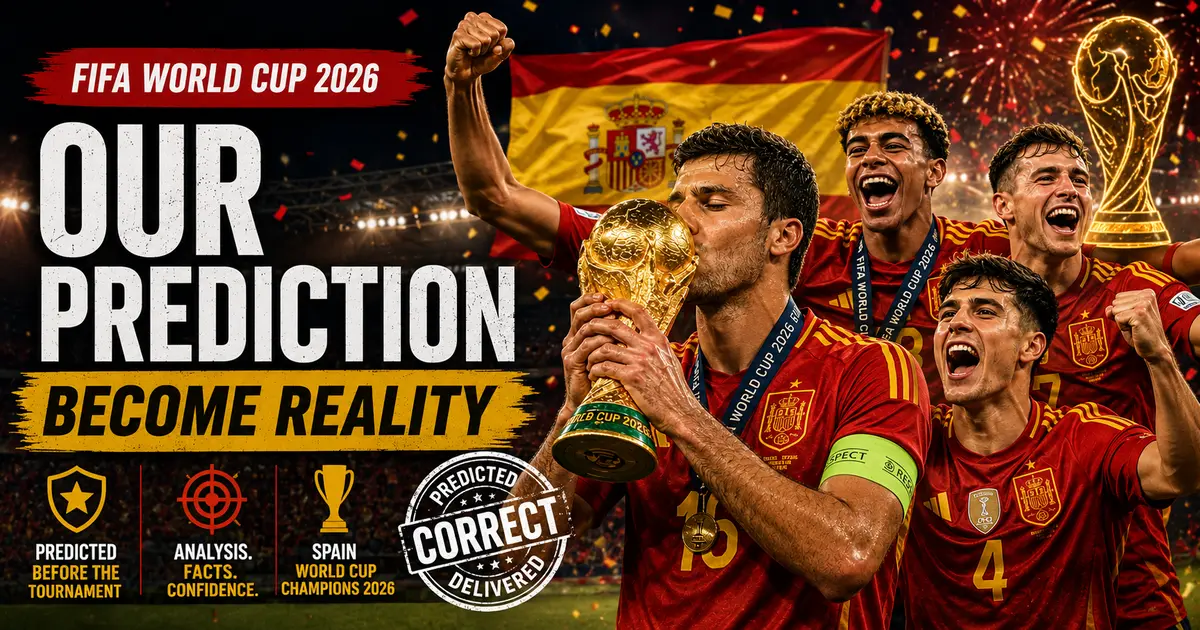
Before a ball had been kicked at this World Cup, Striker Report’s pre-tournament analysis landed on a single conclusion: Spain were the team best equipped to win it. Sunday night, in front of more than 80,000 fans at New York New Jersey Stadium, that prediction was confirmed in the most dramatic way possible — a 1-0 extra-time win over Argentina that delivered Spain their second World Cup title and closed the loop on a call we made months before the draw was even made.
This isn’t a victory lap for its own sake. It’s worth walking back through exactly why that prediction held up, because the reasoning behind it — not just the result itself — is what should shape how neutral observers think about international tournament football going forward.
FIFA World Cup 2026 Winner Prediction: Why Spain Will Lift the Trophy
Kylian Mbappé Golden Boot Prediction: Can Anyone Stop Him in 2026?
The Case We Made Before Kickoff
Our pre-tournament winner prediction wasn’t a hunch. It was built on a specific set of factors that, together, made Spain the most complete side heading into a 48-team field for the first time in World Cup history.
The starting point was recent form at the very highest level. Spain arrived at this World Cup as reigning European champions, having won Euro 2024 playing a faster, more direct version of their traditional possession game under Luis de la Fuente. That wasn’t a fluke tournament win — it was the clearest evidence yet that De la Fuente had solved the exact problem that had haunted Spain at the 2018 and 2022 World Cups: the inability to convert overwhelming possession into actual goals against teams that sat deep and compact. Spain went out on penalties in the round of 16 at both of those tournaments despite dominating possession in both games by wide margins. The Euro 2024 triumph proved the fix was real, not theoretical.
Then there was the qualifying campaign itself. Spain went unbeaten through World Cup qualifying, and reached the 2025 UEFA Nations League final, where it took a penalty shootout for Portugal to finally stop them. Rodri, the reigning Ballon d’Or winner, was back to full fitness and set to captain the side after injury had disrupted parts of his previous season — a detail that mattered enormously given how central his role as a defensive midfield platform is to everything Spain does with the ball. Add in a golden generation of attacking talent arriving at precisely the right moment — Lamine Yamal already a Ballon d’Or-calibre talent at 18, Ferran Torres coming off a title-winning season at Barcelona, Mikel Oyarzabal and Mikel Merino both in career-best form heading into the tournament — and the underlying quality case for Spain was as strong as any side in the field.
Statistical models backed the same conclusion. Opta’s pre-tournament supercomputer simulations, running the tournament 25,000 times before a ball was kicked, had Spain as clear favourites at 16.1% — ahead of France, England and Argentina, all of whom followed close behind in the 10-13% range. It wasn’t a landslide prediction in raw percentage terms, in a 48-team field that guaranteed no single favourite would dominate the model outright, but it was a clear edge, and it was consistent with what our own analysis had already concluded independently.
The Doubts Along the Way
None of that means the prediction looked bulletproof throughout the tournament. Spain opened their campaign with a 0-0 draw against World Cup debutants Cape Verde, a result that on the surface looked like exactly the kind of stumble that invites second-guessing a pre-tournament pick. But the underlying numbers from that match told a different story: Spain dominated expected goals and shot volume against a well-organized Cape Verde side and a goalkeeper, Vozinho, who produced an outstanding individual performance. It was a signal to trust the process rather than the scoreline, and it’s exactly the kind of match that separates surface-level analysis from a deeper read on tournament form.
From there, the case only strengthened. Spain routed Saudi Arabia 4-0, ground out a professional 1-0 win over Uruguay, and moved into the knockout rounds having won Group H comfortably. What followed was as close to statistical perfection as a World Cup campaign gets: wins over Austria, Portugal, Belgium and France, conceding just a single goal across all four matches — a Charles De Ketelaere strike in the quarterfinal against Belgium that remains, to this day, the only blemish on an otherwise flawless defensive campaign. By the time Spain beat France 2-0 in the semifinal to reach the final, they had extended an unbeaten run to a mark that equaled an all-time international record previously held by Italy.
The Final: Vindication Under the Toughest Possible Test
If there was one match capable of exposing a flaw in the pre-tournament case for Spain, it was the final itself — a matchup against an Argentina side built on an entirely different footballing philosophy, one rooted in resilience, individual brilliance, and a knack for producing late, dramatic moments precisely when a match looked beyond saving. Argentina had needed a rescue act in every single one of their four knockout matches heading into the final. If any team was built to expose Spain’s one theoretical weakness — a lack of killer instinct against a well-organized, deep-sitting defensive block — it was this Argentina side.
Instead, Sunday’s final played out as close to a validation of our original thesis as it’s possible to script. Spain dominated territory and chances from kickoff, finishing with an expected goals total near 1.94 from 20 shots to Argentina’s 0.2 from just two attempts. Only a heroic performance from Emiliano Martínez — a men’s World Cup final record of ten saves — kept the match level deep into the second half. When Enzo Fernández was sent off for a second yellow card in second-half stoppage time, reducing Argentina to ten men, it simply accelerated the inevitable. Spain finally broke through 39 seconds into the second period of extra time, Nico Williams heading a cross into the path of substitute Ferran Torres, who fired home the winner that settled the tournament.
It was, in other words, exactly the kind of match our pre-tournament analysis said Spain were best equipped to win — not through an early knockout blow, but through sustained control, defensive discipline, and the depth to eventually find a moment of quality even against the most resistant opponent left in the competition.
The Individual Awards Confirmed the Team-First Thesis
Perhaps the clearest endorsement of the case we made before the tournament came in how FIFA’s individual awards were ultimately distributed. Our prediction was never built around a single standout superstar carrying Spain to the trophy — it was built on the idea that Spain’s structural depth and defensive organization, not one player’s brilliance, would be the deciding factor. That’s precisely what the awards reflected. Rodri won the Golden Ball as the tournament’s outstanding player, edging out Lionel Messi despite Messi’s Argentina reaching the final with the Argentine legend directly involved in the decisive goals of their semifinal win over England. Unai Simón won the Golden Glove having conceded just once in eight matches, and Pau Cubarsí, a 19-year-old centre-back, beat out his own teammate Lamine Yamal for Best Young Player — a defender winning an award many assumed would go to Yamal, in itself a small but telling confirmation of where Spain’s real strength lay all tournament.
The Moments That Almost Proved Us Wrong
It’s worth being honest about how close this prediction came to looking foolish at multiple points along the way, because that’s part of what makes the final vindication meaningful rather than simply convenient hindsight. Spain’s opening goalless draw against Cape Verde generated real scrutiny in the immediate aftermath, with plenty of pundits pointing to it as evidence that a 48-team World Cup, with its expanded field of unpredictable opponents, might not reward the kind of favourite-heavy model that had backed Spain so strongly beforehand. A shock exit to a lower-ranked side wasn’t out of the question in a format this large, and Spain would have needed to navigate exactly that kind of trap match at some point in the tournament.
The quarterfinal against Belgium provided the next moment of genuine tension. Charles De Ketelaere’s goal broke what had been a flawless defensive run, and for a period of that match, Spain looked less comfortable than at any other point in the competition. Had Belgium found a second goal in that spell, the entire complexion of the tournament — and the validity of our pre-tournament case — would have looked very different heading into the semifinal and final. It didn’t happen, but it’s worth acknowledging how thin that margin actually was rather than pretending the run was untroubled from start to finish.
And the final itself, despite the eventual dominance in underlying numbers, spent long stretches looking like it might not go Spain’s way at all. Emiliano Martínez’s ten-save performance kept Argentina level for 90 minutes and deep into extra time, and a shootout — a format in which Spain’s recent World Cup history (eliminations on penalties in 2018 and 2022) offered no particular reassurance — remained a live possibility until Ferran Torres’ goal settled it. A different bounce in any one of those moments, and this piece would be reflecting on a prediction that came agonisingly close rather than one that was ultimately proven right.
Why the Prediction Still Held
None of those close calls actually undermine the reasoning behind the original prediction — if anything, they reinforce it. Our case for Spain was never that they would win every match comfortably or avoid moments of real jeopardy in a 48-team field designed to produce upsets. It was that their combination of tactical evolution, squad depth, and a defensive structure built to withstand exactly the kind of pressure a knockout tournament applies would be enough to get them through those moments when it mattered most. That’s precisely what happened in each case: the Cape Verde draw was backed by dominant underlying numbers even without a goal to show for it, the Belgium scare was contained to a single goal rather than a genuine turnaround, and the final was decided by exactly the kind of squad depth — a difference-making run from substitutes Yamal, Williams and Torres — that had been central to the case for Spain from the very beginning.
That’s the real lesson from a successful pre-tournament prediction: it isn’t about calling a flawless run without any moments of doubt. It’s about identifying the specific structural advantages that make a team likeliest to navigate whatever moments of doubt inevitably arrive along the way — and having the conviction to stick with that reasoning even when a goalless draw or a nervy final made it look, briefly, like it might not hold up.
What This Means Going Forward
Predicting a 48-team World Cup winner months in advance is, by nature, an exercise in probability rather than certainty — no model or analyst piece should claim otherwise, and plenty of reasonable cases could have been made for France, England or Argentina all reaching the same outcome under slightly different circumstances. But the specific reasoning behind our Spain prediction — recent major-tournament pedigree, a coaching system that had already solved the team’s historical weakness, a fit and available Rodri, and a golden generation of attacking talent peaking at exactly the right moment — held up match after match, all the way through the toughest test the format could offer.
For a football nation that spent much of the 2010s and early 2020s being labelled tournament underachievers relative to their technical quality, this second World Cup title, won playing a more complete, more clinical version of Spanish football than even the 2010-winning generation managed, is the clearest possible confirmation that the underlying case for backing them was correct all along.
Thiago Messi: Club Career, Playing Style, Lifestyle and Future Prospects
Cristiano Ronaldo Jr.: Club, Lifestyle, Career and Future Prospects
About the Author



6 thoughts on “We Called It! Our Spain World Cup Prediction Came True”