Spain’s Destiny Awaits in North America
The betting markets agree. The experts agree. We agree. But here’s the full picture — squad depth, tactical edge, bracket analysis, and the data behind our bold prediction.
Our Pick: Spain
Forty-eight nations. Sixteen stadiums. One trophy. The 2026 FIFA World Cup is the biggest, most expanded edition in the tournament’s history — and for Spain, it could be the setting of a historic second world title that has been building since their Euro 2024 triumph in Berlin.
Every four years, the football world demands an answer to the same impossible question: who will lift the World Cup? In 2026, the question is harder than ever. With 48 teams competing across three co-host nations — the United States, Mexico, and Canada — the margin for error is greater, the bracket is deeper, and the path to glory is longer. Yet when you cut through the noise, one team stands head and shoulders above every competitor: Spain.France 0-2 Spain Match Report: Oyarzabal Penalty and Porro Strike Send La Roja into World Cup 2026 Final
This is not a casual prediction. Over the following sections, StrikerReport has examined betting market probability models, squad depth, tactical blueprints, expert forecasts, historical patterns, draw analysis, and the very human factors that define tournament football. The case for La Roja is, frankly, overwhelming.Mikel Merino Profile: From Pamplona to Ending Ronaldo’s World Cup
The Numbers Don’t Lie: What the Markets Say
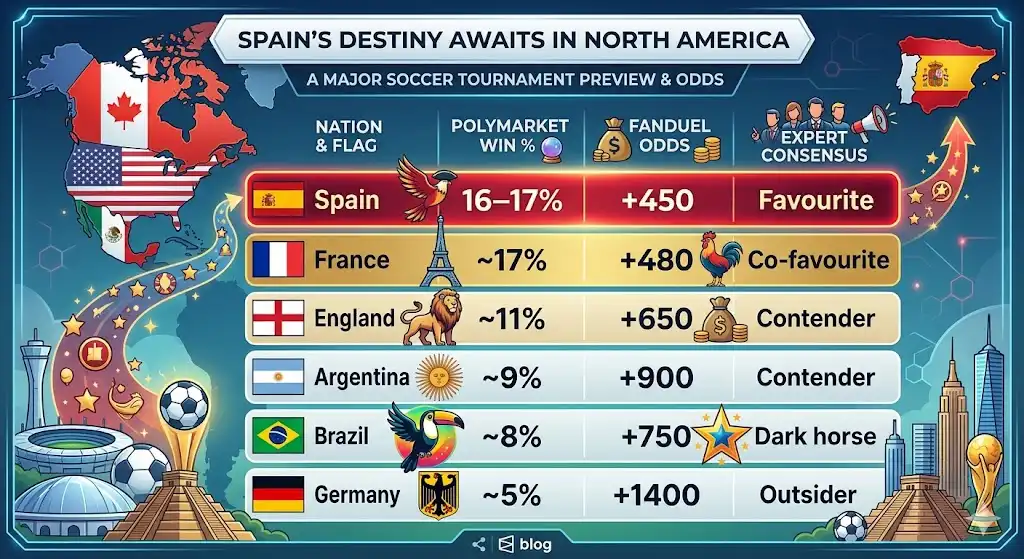
Before we make any case from the heart, let the market speak. Polymarket — the world’s largest prediction market, with over $1.6 billion in trading volume — currently assigns a 16% chance to Spain winning the trophy. France and Spain are essentially co-favourites across prediction markets, each hovering around 17%, with defending champions Argentina, England, Brazil, and Portugal sharing the remaining probability.
The bookmakers tell the same story. Spain are priced at +450 on FanDuel Sportsbook — the outright market leader — just ahead of France (+480), England (+650), and Brazil (+750). Reigning champions Argentina, despite Messi’s emotional pull, sit at +900. When sharp money and public sentiment align this cleanly on a single nation, it demands attention.Spain World Cup Quiz: Test Your 2018 & 2026 Knowledge
For context: in a 48-team tournament, a 16–17% win probability for a single side is remarkably dominant. No team will ever carry an overwhelming mathematical edge in a field this large — but Spain’s edge is real, consistent across every serious measure, and backed by qualitative evidence to match.
| # | Nation | Polymarket Win % | FanDuel Odds | Expert Consensus |
|---|---|---|---|---|
| 1 | Spain | 16–17% | +450 | Favourite |
| 2 | France | ~17% | +480 | Co-favourite |
| 3 | England | ~11% | +650 | Contender |
| 4 | Argentina | ~9% | +900 | Contender |
| 5 | Brazil | ~8% | +750 | Dark horse |
| 6 | Germany | ~5% | +1400 | Outsider |
Spain’s Case: A Perfect Storm of Talent and Timing
There are years when a team simply looks ready — when the stars align, the squad peaks, and the draw cooperates. This is Spain’s year. Spain enter the 2026 FIFA World Cup as the long-time betting favourite to win the tournament, with a talented squad that claimed the 2024 European Championship and features some of the best young players in the world.
Spain won six of their last eight matches in all competitions in qualification, finishing top of Group E to secure their spot in North America. But the numbers barely tell the story. Luis de la Fuente has constructed something rarer than a good squad — he has built a footballing machine that is simultaneously producing its greatest generation of players while maintaining the tactical discipline of veteran title-winners.
~17% – Polymarket Win Probability
2024 – Euro Champions
18 – Lamine Yamal’s Age
4-3-3 – Fluid System
Lamine Yamal: The Generational Wildcard
No World Cup prediction for Spain can be made without addressing the phenomenon that is Lamine Yamal. Yamal has been Spain’s marvel since his memorable breakthrough as a 16-year-old at Euro 2024, since adding two La Liga titles and two individual Laureus awards to his accolades. Now 18 years old and entering his first World Cup, he is arguably the most exciting player in global football — the kind of talent that doesn’t just win games, but defines tournaments.
His pace, dribbling, and capacity for the unexpected make him virtually unplayable in one-on-one situations. Alongside Nico Williams — his dynamic counterpart on the opposite flank — Spain’s attacking width is the most lethal in the competition. Opposing coaches cannot nullify both simultaneously without sacrificing their own attacking intent.
Rodri: The Engine That Changes Everything
The Spanish midfield is bursting with quality, anchored by 2024 Ballon d’Or winner Rodri, who is aiming to return to full fitness ahead of the tournament. Pedri will also be key, the 23-year-old maestro closing in on half a century of caps.
Rodri’s importance to Spain cannot be overstated. When he is fit and operating at his peak, Spain are a different proposition entirely — more patient, more controlled, harder to press. He is the game’s finest defensive midfielder, and his ability to dictate tempo from deep gives Spain an anchor that no other team in the world can match. Rodri is the heartbeat of the team, dictating tempo from deep with his world-class passing range, while Lamine Yamal has emerged as a generational talent, providing creativity and goal threat from the right wing.
The Squad: No Real Madrid, No Problem
For the first time ever, Spain’s squad does not feature any Real Madrid players. Pedri has been completely rejuvenated under Hansi Flick at Barcelona, and the midfield is stacked with world-class options. De la Fuente’s ability to leave out Galactico-level talent — including Dean Huijsen — and still produce arguably the strongest squad Spain have ever assembled speaks to the embarrassing depth available to him.
De la Fuente employs a fluid 4-3-3 formation that can shift to a 4-2-3-1 in attack. Pedri and Fabián Ruiz provide creativity and energy, while the front three of Yamal, Morata, and Williams offer pace and goal threat. Spain’s ability to control possession while maintaining attacking penetration is their key strength.
✓ Spain’s Strengths
- Generational talent in Yamal (18) and Williams (22)
- Ballon d’Or winner Rodri anchoring midfield
- Reigning European Champions — peak form
- Tactical flexibility under De la Fuente
- Extraordinarily deep squad at every position
- Favourable group draw (Cape Verde, Saudi Arabia, Uruguay)
- No Real Madrid players — no club politics
✗ Spain’s Risks
- Rodri fitness concerns pre-tournament
- Pressure of being favourites from day one
- No reliable penalty specialist identified
- Limited World Cup experience for young core
The Challengers: Why Each Rival Falls Short
To understand Spain’s supremacy, we must be brutally honest about the field. France, England, Argentina, and Brazil all possess genuine trophy-winning quality — but each carries a critical flaw that, under tournament pressure, is likely to be exposed.
France: The Nearly Men (Again?)
Didier Deschamps’ France have reached four of the last five major tournament finals — a record of consistency unmatched in modern international football. Their squad depth allows heavy rotation in the group stage without sacrificing results, keeping key players fresh for knockout football.
France’s case is compelling. Kylian Mbappé, now thriving as a central striker, gives them a goal threat that Spain lack in the same individualistic sense. Despite the tough group, nobody would be shocked if Les Bleus went undefeated. That’s how good Didier Deschamps’ France is — they are widely regarded as the world’s best team at the moment, and the 2022 World Cup finalists and 2018 champions exited Euro 2024 only in the semi-finals.
Yet France’s undoing, tournament after tournament, has been a failure to translate squad quality into cohesive team performance when it matters most. Their Euro 2024 exit — a semi-final defeat to Spain — demonstrated that even with Mbappé, Griezmann, and a cast of stars, they can look brittle against a team with genuine collective identity. France are Spain’s most dangerous opponent in this tournament, and a potential final between the two is both probable and mouth-watering. But we believe Spain have their number.
England: Coming of Age, But Not Quite There Yet
England sit third in the outright betting markets at +650 — a genuine price, not a courtesy nod. Thomas Tuchel has brought structural discipline to a squad laden with Premier League quality, and the combination of Harry Kane’s goalscoring and Declan Rice’s engine-room presence gives England a backbone they have historically lacked.
Expert analysis suggests Tuchel made strong choices and the team is well-balanced with a mature squad led by Kane and Rice, who are in the form of their lives. England are genuine contenders, not dark horses. But their knockout football record — one final loss, multiple penalty exits — and the absence of a genuinely world-class creator in midfield makes their path harder than Spain’s or France’s. They can reach the final. Winning it against either European giant is a step too far in 2026.
Argentina: Dynasty or Decline?
Argentina enter as defending champions. This will be Lionel Messi’s last tournament appearance, and the extra incentive to win again — something no team has achieved in more than 60 years since Brazil’s back-to-back titles in 1958 and 1962 — adds enormous emotional weight to their campaign.
There is magic in an ageing great’s final bow. Messi inspired Argentina to a World Cup in 2022 through sheer will and brilliance. Could he do it again at 38? The good news for Argentina is that the squad is becoming less dependent on Messi, as they thrillingly underlined by routing Brazil in qualifying without their injured skipper, with Julián Álvarez and Lautaro Martínez providing ample goal threat. But beyond their established starting XI, the rest of the squad presents more unknowns than certainties — particularly at full-back — and several promising forwards who have not yet guaranteed starting spots represent a depth concern for Scaloni.
Our assessment: Argentina will be dangerous, emotional, and hard to beat. But Spain are better equipped at every position across the pitch, and a clash in the later rounds would likely go to La Roja.
Brazil: Talent Without A Trophy Path
The rise of a new Brazilian vanguard featuring Vinícius Júnior, Rodrygo, and the teenage sensation Endrick provides the Seleção with a frightening capacity to dismantle any backline. But Brazil have not won a World Cup since 2002, and the structural questions around their defensive shape and midfield screen have not been convincingly answered in qualification. In a wide-open 48-team draw, they are a quarter-final threat — but not a champion.
Spain
France
England
Argentina
The Draw: Spain’s Road to the Final
Spain will take on Cape Verde, Saudi Arabia, and Uruguay in Group H — and would be fair to say La Roja are expected to be serious challengers to emerge from what is a manageable opening section. Spain are placed in one of the tournament’s weakest groups and should be on relative cruise control in the first three games, with their toughest group opponent being Uruguay in their final group match.
Beyond the group stage, Spain’s projected bracket avoids the nightmare early-round clashes with Brazil and Argentina that have ended European title bids in recent history. The expanded 48-team format means more matches, but it also rewards squad depth — and no team in this tournament has more quality distributed across their 26-man roster than Spain.
A semi-final against France, and a final against either England or Argentina, represents our projected route for De la Fuente’s side. It is not the easiest road. But given the form, the talent, and the cohesion Spain possess, it is one they are fully equipped to navigate.
Historical Patterns: The European Cycle Favours Spain
History does not determine outcomes, but it provides context. The World Cup has a documented European cycle — eight of the last ten tournaments have been won by a European nation. Of those eight, five have gone to a nation that had either won the European Championship or reached the final within the preceding two years. Spain won Euro 2024. The pattern is clear.
Furthermore, Spain have won every major tournament in which Rodri has been fit and available over the past three years. The 2024 Euros — won with Rodri at his imperious best — demonstrated what this team looks like when everything clicks. There is every reason to believe it will click again, on the biggest stage of all.
“Spain were outstanding at Euro 2024 — but they could be even better at the 2026 World Cup.”— Goal.com World Cup Power Rankings, 2026
“I have Spain down to win this year’s edition of the World Cup. Fresh off their European Championship success two years ago, I think they will be able to repeat their success on the global stage.”— Dan Tracey, Sports Data Analyst, Real Football Filter (via European Gaming)
The X-Factors: What Could Derail Spain?
No prediction is complete without honest risk assessment. Spain’s vulnerabilities are few but real.
Rodri’s fitness is the single most significant risk factor. The Spanish midfield is anchored by the 2024 Ballon d’Or winner, who is aiming to return to full fitness ahead of the tournament. A fully fit Rodri makes Spain virtually unstoppable at this level. A Spain without Rodri — while still outstanding — would lose their single greatest tactical asset, and the odds would shift materially towards France.
Tournament fatigue and expectation is another genuine concern. Spain are the favourites. Everyone is targeting them. Every opponent will set up deep, press aggressively, and attempt to provoke errors from young players who have never carried this weight of expectation before. Yamal and Williams are brilliant — but they are still teenagers in a first World Cup. Moments of inexperience are possible.
Penalty shootouts remain football’s great equaliser. In a knockout tournament of this size, Spain could face four or five elimination rounds. The statistical probability of avoiding at least one shootout is low. Spain’s record from the spot is decent but not flawless — and in the cruellest moments of tournament football, fine margins decide everything.
None of these risks, individually or collectively, are enough to overturn the fundamental analysis. Spain remain, by every metric available, the most likely champions.
The Verdict: La Roja All The Way
StrikerReport’s Official World Cup 2026 Prediction
World Cup 2026 Winner: Spain
Runners-Up: France · Semi-Finals: England, Argentina
Based on Polymarket odds, FanDuel betting markets, squad analysis, draw assessment, tactical review, historical patterns, and expert consensus. Published June 5, 2026.
Spain are not merely this World Cup’s statistical favourites. They are a team in the full bloom of a generational golden period — the kind that comes along once every fifteen or twenty years in international football. They have the best young player on earth in Lamine Yamal. They have the best defensive midfielder on earth in Rodri. They have the chemistry of a side that has spent two years growing together, winning together, and suffering together.
Spain are the +450 outright betting market leader. Polymarket’s crowd — over $1.6 billion in trading volume — assigns them the highest single-nation win probability in the tournament. When the sportsbooks, the prediction markets, and the expert consensus all converge on the same answer, the burden of proof for dissenting falls on those who argue otherwise.
On July 19, 2026, in East Rutherford, New Jersey — where FIFA chief Gianni Infantino will present the winning country with the trophy — we believe Luis de la Fuente will lift his arms to the sky, Lamine Yamal will dance on the turf, and Spain will be crowned world champions for the second time in their history.
Not because the script demands it. Because the evidence demands it.
La Roja. World Champions. 2026.
Lamine Yamal FIFA World Cup 2026: Profile, Stats & Career | StrikerReport
Rodri FIFA World Cup 2026 — Spain’s Ballon d’Or Warrior Profile, Stats & Preview
About the Author

1 thought on “FIFA World Cup 2026 Winner Prediction: Why Spain Will Lift the Trophy”