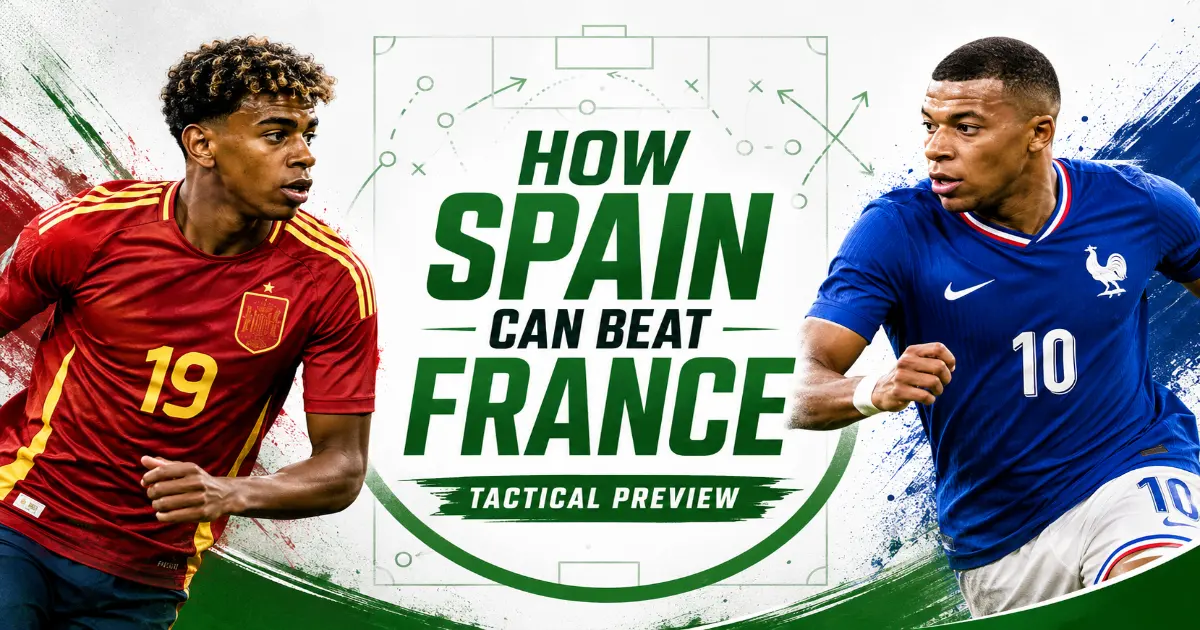
 Most Discussed question was -How Spain Can Beat France
Every tactical preview of this fixture starts from the same premise: France have the more explosive individuals, and Spain have the more coherent system. That framing is accurate, but it is also incomplete, because systems beat individuals often enough in football that reducing this to “star power versus structure” undersells exactly what Spain need to get right. Here is a genuine tactical breakdown of how Spain can beat France in Dallas.NBA Schedule 2026-27: Christmas Day Rivalries, Ring Night and the Games to Watch
Cristiano Ronaldo Jr.: Club, Lifestyle, Career and Future Prospects
Start With What Spain Does Well
Unlike France, who are a highly attacking side, Spain have opted for a controlled approach this tournament. La Roja’s tight defence has conceded just once — against Belgium in the quarterfinals — while Rodri, Pedri and Dani Olmo rarely cede control in midfield. That is the foundation everything else has to be built on. Spain are not going to out-athlete France, and pretending otherwise would be tactically naive. Their route through this match has to run through the middle of the pitch, where their possession control can slow the game to a tempo France’s transition-based attack is far less comfortable playing at.
Spain, the reigning European champions, has allowed very little defensively across this tournament, and that defensive record is not an accident of schedule — it is the direct product of a midfield that refuses to concede transitions in the first place. If Rodri and Pedri can consistently win the ball back within five seconds of losing it — the classic Spanish “five-second rule” pressing trigger — France never get the space in behind that their front line is built to exploit.
Neutralize the Transition Before It Starts
This is the single most important tactical instruction for Spain: do not let this become an end-to-end game. France has scored 16 goals this tournament, second only to Argentina, largely by playing with pace and directness once possession is won. Every time Spain gives the ball away in a advanced position, they are inviting exactly the kind of transition football that plays to Mbappé’s strengths.
The tactical answer is patient, low-risk possession in the buildup phase — short combinations through Pedri and Rodri rather than ambitious line-breaking passes that, if intercepted, hand France the ball in space. It will look conservative at times, and Spanish fans expecting the free-flowing tiki-taka of a decade ago may find it frustrating to watch. But Spain’s path to this semifinal — a 2-1 win over Belgium in the quarters — was built on exactly this kind of controlled, patient approach rather than an open, high-event match.
Use Yamal and Olmo as Direct Outlets, Not Just Wide Players
Where Spain can genuinely hurt France is by using Yamal not purely as a touchline winger but as a player who drifts inside to combine with Olmo and Pedri in the half-spaces. Olmo has been a key part of De la Fuente’s tactics so far in the tournament — he strings creative passes that break down defences easily, his partnership with Yamal is genuinely excellent, and the way he links with Oyarzabal in the final third consistently creates space for himself and his teammates.
The tactical logic here is simple: France’s back line, for all its individual quality, is at its most vulnerable when forced to defend rotations rather than straight, predictable width. If Yamal stays glued to the touchline all game, Spain make life easy for whichever full-back France selects. If he and Olmo interchange positions constantly in the final third, Spain create the kind of defensive confusion that has produced goals against every side France has faced so far.
Exploit Set Pieces and Game States Late
Two of Spain’s match-winning goals at this tournament have arrived later than the 85th minute, with the most recent coming in stoppage time against Portugal — a pattern built on both squad depth and genuine composure in tight moments. This is not incidental to the tactical plan; it should be central to it. If Spain can keep the match goalless or level into the final 20 minutes by executing the patient, low-risk approach outlined above, their track record suggests they are more likely than most teams to find a winner in exactly that window.
Mikel Merino’s impact off the bench has already been decisive once this tournament, in the quarterfinal win over Belgium, and De la Fuente has repeatedly shown he trusts his substitutes to change games rather than simply protect a lead. Against a France side that has been dominant for long stretches but has occasionally shown fatigue late in matches this tournament, that late-game trust could be the deciding tactical factor.
The Midfield Numbers Game
France’s own midfield picture remains complicated, with Aurélien Tchouaméni having missed recent matches through injury, even as reports suggest he may return for the semifinal. If Tchouaméni is even slightly below full sharpness, Spain’s front-foot midfield press becomes significantly more dangerous, because it removes one of the two players France typically relies on to break lines under pressure.
Spain’s tactical staff will have clocked this. Expect Rodri specifically to probe that zone directly and repeatedly in the opening exchanges — not through aggressive dribbling, but through quick one-touch combinations designed to draw France’s double pivot out of position and create the passing lanes Pedri and Olmo need to operate in behind it.
Discipline Is Non-Negotiable
None of the above works if Spain concede possession cheaply in dangerous areas. Spain’s tight defensive record this tournament — conceding only once — has been built as much on positional discipline as on individual quality, and against a France attack this dangerous, even a handful of loose moments in the middle third could be fatal. Cucurella and Porro, Spain’s likely full-backs, will need to resist the urge to overcommit going forward, because the space behind them is exactly where Mbappé and Olise have done their damage all tournament.
The Verdict
Spain’s path to victory is not about matching France’s fireworks. It is about denying France the conditions those fireworks need to go off — chaotic transitions, isolated one-on-one duels in space, and a game that opens up before either side has established control. Win the midfield battle patiently, use Yamal and Olmo as interior combination players rather than isolated wide threats, stay defensively disciplined through the middle 70 minutes, and trust the bench to find a moment late.
This would be only Spain’s second-ever World Cup semifinal, with their only previous appearance in 2010 ending in the trophy itself.The blueprint above is exactly the kind of patient, structurally disciplined performance that carried them to that title fifteen years ago. Whether this current generation can execute it against the most in-form French side in a generation is the question Dallas will answer.
🔹🔹 follow us on facebook 🔹🔹
About the Author




1 thought on “How Spain Can Beat France | StrikerReport”