Every World Cup produces a handful of moments that outlive the tournament itself — the ones replayed for years, referenced in arguments, and remembered long after the final whistle. The 2026 edition, the biggest and most sprawling in the competition’s history, delivered an unusually rich supply of them. Here are the moments that defined it.
Ferran Torres Ends Spain’s 16-Year Wait
Nothing else this tournament will be remembered as vividly as the final’s decisive moment. Thirty-nine seconds into the second period of extra time, with Spain having dominated possession for well over 100 minutes without a breakthrough, Nico Williams headed a cross into the path of substitute Ferran Torres, who fired home to win the World Cup. Torres — a player some outlets described afterward as “the $90 million-rated star” — went from impact substitute to the man who ended Spain’s 16-year wait for a second title, in as dramatic a fashion as a final could possibly produce.
The Halftime Show That Broke the Rules
Football finals don’t typically come with an actual halftime concert, and the decision to stage one at this World Cup final — featuring Madonna, Shakira, BTS and Justin Bieber, curated by Coldplay’s Chris Martin — became a story in its own right. It reportedly ran into procedural issues serious enough to draw scrutiny over whether it violated broadcast or scheduling rules, and it produced one of the stranger crossover moments in recent sports memory: a cameo appearance from the fictional Ted Lasso alongside Bieber, blending scripted television with the biggest live sporting event on the planet, live in front of a global audience mid-match.
Egypt’s Disallowed Goal and Argentina’s Great Escape
Few single decisions this tournament generated as much lingering debate as the review that overturned Egypt’s second goal against Argentina in the round of 16. Egypt led 2-0 with the goal on the board, only for VAR to chalk it off over an incident that had happened nearly a minute earlier and 80 metres away. Argentina responded by scoring three times in the closing stages to win 3-2, turning what looked like one of the great World Cup upsets into the first chapter of Argentina’s dramatic run to the final itself.
Cape Verde’s Fairytale Run
No team captured neutral hearts quite like Cape Verde, playing in their first-ever World Cup. Kevin Pina’s 30-yard free kick against Uruguay delivered the tiny island nation’s first-ever win and first-ever goal in the same moment, and their run continued deep into the round of 32, where 40-year-old goalkeeper Vozinha produced eight saves — five of them to deny Lionel Messi directly — before Cape Verde were finally eliminated in extra time. It remains one of the tournament’s most purely joyful storylines, regardless of the eventual result.2030 FIFA World Cup: Hosts, Format, Stadiums and Full Details
Norway’s Stunning Win Over Brazil
Brazil’s exit to Norway in the round of 16 stands as the single biggest shock of the tournament. Norway didn’t just survive a five-time champion — they controlled large stretches of the match and were the more organized, clinical side over 90 minutes, sending Brazil home earlier than almost anyone predicted and announcing themselves as a genuine knockout contender in the process.
Argentina’s Semifinal Comeback Against England
Argentina’s run to the final produced more than one signature moment, but their semifinal win over England may be the most complete. Trailing 1-0 for the better part of half an hour after an Anthony Gordon goal, Argentina scored twice in the final six minutes — Enzo Fernández and Lautaro Martínez both converting chances created by Lionel Messi — to complete one of the tournament’s most dramatic turnarounds and send Argentina into their second consecutive final.
The Final’s Chaotic Ending
Sunday’s final didn’t end quietly even after Torres’ winner settled the match. Argentina’s Enzo Fernández had already been sent off for a second yellow card in stoppage time, and substitute Leandro Paredes was shown a straight red after the full-time whistle for his reaction to the result — described by one outlet simply as “how daft is that?” It was an unusually chaotic coda for a final that had otherwise been defined by patience and control rather than indiscipline.
Mbappé’s Record-Breaking Tournament
Kylian Mbappé’s individual campaign became one of the defining threads of the entire World Cup. His 10 goals made him the first player in history to win the Golden Boot at consecutive World Cups, and his tally across three tournaments took him past Miroslav Klose as the competition’s all-time leading scorer with 22 career goals — a record that had stood since 2014, broken in the same summer France fell short of a place in the final itself.
The 40-Somethings Who Refused to Fade
This tournament featured more players aged 40 or older than any previous World Cup — seven in total, including Cristiano Ronaldo, Luka Modrić, Edin Džeko, and goalkeepers Manuel Neuer and Fernando Muslera, on top of Vozinha’s own heroics for Cape Verde. That’s double the number of 40-plus appearances recorded across every previous World Cup combined, a reminder that elite-level fitness and longevity have shifted meaningfully even at the very highest level of international football.
Balogun’s Suspension and a Presidential Phone Call
Few individual incidents this tournament crossed as far into the political sphere as USA striker Folarin Balogun’s overturned suspension. After being sent off against Bosnia and Herzegovina, Balogun’s one-match ban was placed on a year-long probation and effectively lifted — a decision that followed U.S. President Donald Trump publicly confirming he had discussed the case directly with FIFA president Gianni Infantino, calling the original red card “very unfair.” It remains one of the more unusual off-field storylines in the tournament’s history.
Wilson Isidor and Haiti’s Emotional Return
Haiti’s return to the World Cup after a 52-year absence produced one of the tournament’s most spontaneously emotional scenes. Wilson Isidor’s rocket of a strike against Morocco — smashed through a crowd of defenders from outside the box — was Haiti’s only goal scored by an outfield player across the entire tournament, and the celebration that followed, from players and travelling fans alike, was one of the purest moments of joy the competition produced, regardless of the result that followed.
The Round of 32’s Shock Factor
The newly introduced round of 32 — an entirely new stage of the competition made possible by the expansion to 48 teams — produced two of the tournament’s most significant shocks within days of each other. Germany, four-time champions, were eliminated on penalties by Paraguay after a 1-1 draw, while the Netherlands suffered an almost identical fate against Morocco. Both results reshaped the shape of the knockout bracket entirely, and both became lasting symbols of exactly what the expanded format was capable of producing: an extra hurdle that gave less-fancied sides one more chance to catch a favourite on the wrong day.
Messi’s Bittersweet Farewell
Even in defeat, Lionel Messi’s tournament produced moments that will be replayed for years. His opening hat-trick against Algeria recalled the Messi of a decade earlier, and his two assists in the semifinal comeback against England — both converted in the space of six second-half minutes — were among the purest examples of his continued influence at 39 years old. That his professional World Cup career very likely ended in a losing final, calmly watching Ferran Torres wheel away in celebration at the other end of the pitch, only added to the bittersweet nature of what was, statistically, one of his most productive World Cup campaigns.
A Tournament of Record-Breaking Numbers
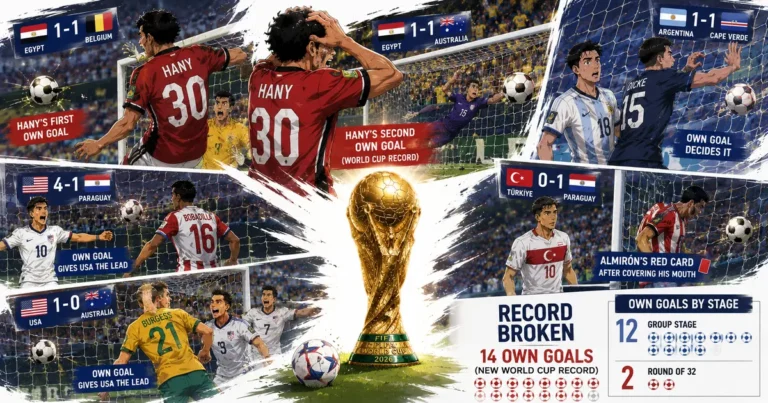
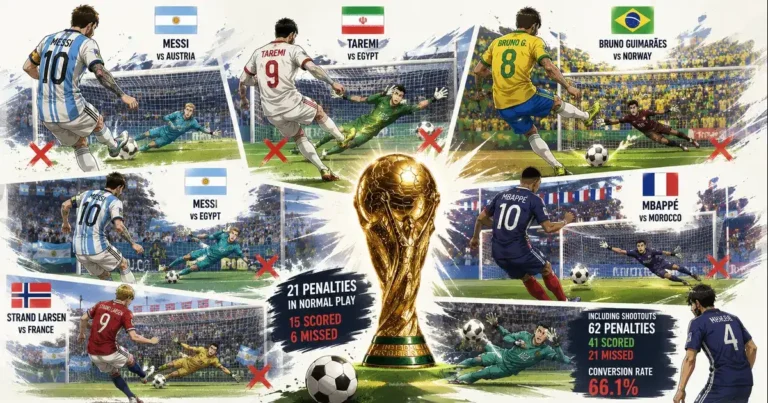
Beyond any single moment, this World Cup will be remembered for just how many records fell across its 104 matches. A total of 308 goals were scored — the most in tournament history — at a rate of 2.96 per game, the best scoring rate since 1970. Fourteen own goals broke the previous record of 12, set at the 2018 tournament. Thirteen red cards were shown, more than the last three World Cups combined. And penalty conversion fell to just 66.1%, the lowest rate recorded since detailed record-keeping began in 1966. Individually, few tournaments have produced as many age-defying performances either — seven players aged 40 or older featured, doubling the number recorded across every previous World Cup combined.
The Bigger Picture
What ties these moments together is how differently they’ll each be remembered depending on who’s doing the remembering. Spanish fans will talk about Torres’ extra-time winner for decades; Egyptian fans will still be arguing about that VAR review years from now; and neutral viewers everywhere will likely remember Cape Verde’s run, or Norway’s shock win over Brazil, as the moments that made this expanded, 48-team World Cup feel genuinely different from anything that came before it. A tournament this large was always going to produce an unusually crowded highlight reel — and 2026 delivered exactly that.
🔹🔹 follow us on facebook 🔹🔹
About the Author