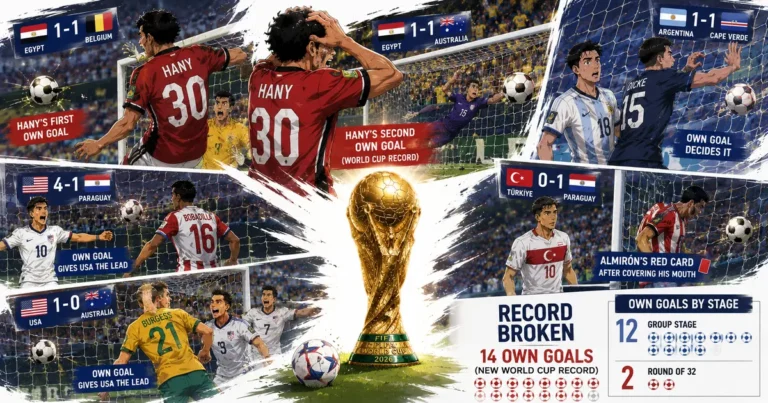
World Cup 2026 own goals set an all-time record with 14 in total, and the USA benefited from two of them in the same tournament.
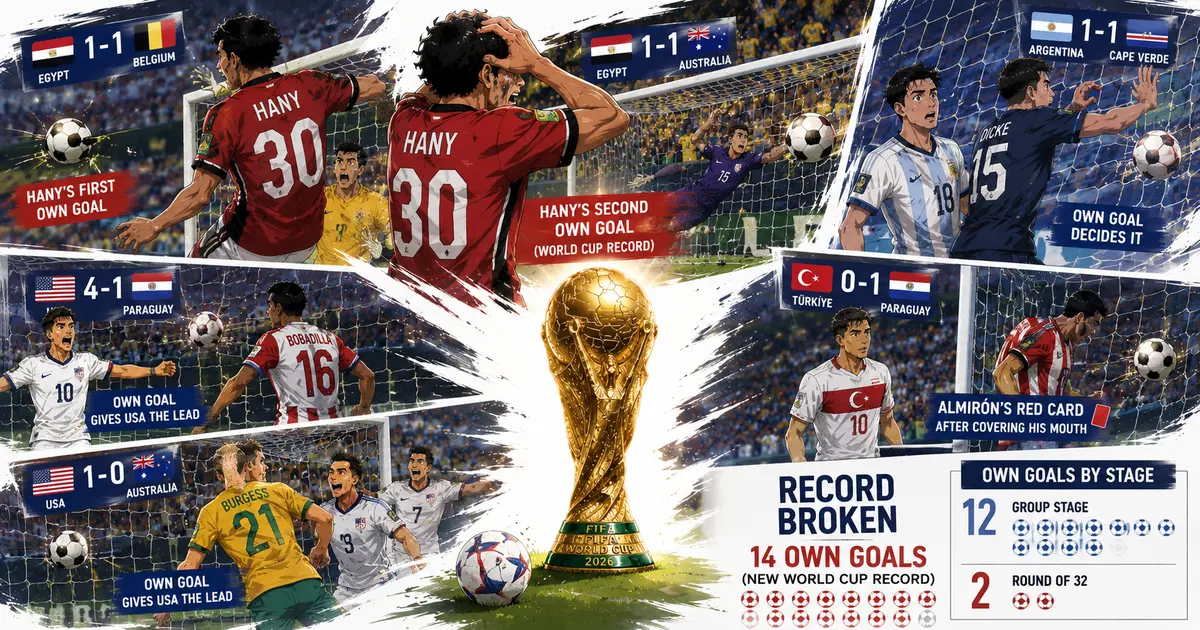 World Cup 2026 own goals set an all-time record with 14 in total, and the USA benefited from two of them in the same tournament.
Own goals are one of football’s cruelest quirks — a moment of pure misfortune for one player that hands an unearned goal to the opposition. This World Cup produced more of them than any tournament in history: 14 own goals across the competition, surpassing the previous record of 12 set at the 2018 World Cup, and dwarfing the mere two recorded at Qatar 2022. Here’s the full story of how this record was set, and who was involved.
Best Goals of FIFA World Cup 2026: The Full Countdown
A Record Set in the Group Stage, Broken Again in the Knockouts
Twelve of the tournament’s eventual 14 own goals came during the group stage alone — already matching the all-time single-tournament record before the knockout rounds had even begun. Two further own goals arrived in the round of 32, pushing the total past the previous record and setting the final mark that stood for the rest of the competition.
Mohamed Hany: The Only Player to Score Two Own Goals in a Single World Cup
The individual story of this record belongs to Egyptian defender Mohamed Hany, who became the first player in World Cup history to score two own goals in the same tournament. His first came in Egypt’s 1-1 draw with Belgium at the very start of the group stage. His second arrived in the round of 32 against Australia, when Hany was the last touch on a Socceroos free kick that leveled the scores. That second own goal forced the match to penalties, which Egypt went on to win comfortably despite Hany’s unwanted piece of history.
The USA: Benefiting Twice From Other Teams’ Misfortune
While Hany’s own goals worked against his team, the USA found themselves on the fortunate end of the same statistical trend not once but twice. Paraguay’s Damián Bobadilla put through his own net during the USA’s emphatic 4-1 win to open the group stage, and in the USA’s very next match, against Australia, Socceroos defender Cameron Burgess did the same, gifting the Americans an early goal. That made the USA only the second team in World Cup history to benefit from two separate own goals in a single tournament, joining France’s 2014 campaign as the only other side to manage the feat.
Argentina’s Own-Goal-Assisted Escape Against Cape Verde
Not every own goal happened in the group stage. In the round of 32, Argentina’s narrow escape against a spirited Cape Verde side came down, in the end, to an own goal — the decisive strike in a match Argentina were fortunate to win at all, given how competitive Cape Verde had been throughout. It’s a detail that adds an unusual footnote to Argentina’s eventual run to the final: their toughest knockout match of the entire tournament was ultimately settled not by Messi, Álvarez, or any of Argentina’s recognized attacking talent, but by a defensive error at the other end.
Why This Tournament Produced So Many
The most obvious explanation is the simplest one: an expanded 48-team field meant more matches, more players on the pitch across the tournament, and statistically more opportunities for the kind of freak deflection or defensive miscommunication that produces an own goal. The format change also increased the number of significantly mismatched fixtures between traditional powers and lower-ranked debutant nations, and own goals have historically clustered in exactly those kinds of games — high-pressure defending against sustained attacking pressure creates more scrambled situations in the box, and more chances for the ball to deflect in off the wrong player entirely.
How This Compares to World Cup History
Prior to the 2018 tournament, most World Cups recorded somewhere between three and six own goals in total — a number that had stayed fairly consistent for decades. The 2018 World Cup in Russia broke that pattern with 12, a jump widely attributed at the time to the introduction of VAR, which caught marginal touches and deflections that might previously have been credited to the attacking side instead. Qatar 2022 reversed that trend almost entirely, producing just two own goals across 64 matches — proof that the statistic doesn’t necessarily climb in a straight line. This tournament’s 14 own goals, then, represents both a continuation of the post-2018 trend and a fresh record in its own right, driven as much by the sheer scale of the expanded format as by any single identifiable cause.
The Anatomy of an Own Goal
Own goals typically fall into a few recognizable categories, and this tournament’s 14 covered most of them. Some, like Mohamed Hany’s deflection off an Australian free kick, come from a defender simply being the last, unlucky touch on a ball already heading toward danger — barely a mistake at all in the traditional sense, but scored against his own team regardless under the sport’s rules. Others come from genuine defensive miscommunication under pressure, the kind of scrambled six-yard-box situation that becomes statistically more likely as attacking pressure and crowding in the penalty area increases. And a smaller number come from more clear-cut individual errors — a poor clearance, a misjudged header, or a slip at the worst possible moment. Without match-by-match video review of all 14, it’s not possible to categorize each one definitively, but the pattern across football more broadly suggests this tournament’s total was split fairly evenly between misfortune and mistake, rather than dominated by one or the other.
The Statistical Oddity of Repeat Own Goals
Mohamed Hany’s double own goal and the USA’s own-goal-assisted start to the tournament both stand out precisely because they defy ordinary probability. If own goals were evenly and randomly distributed across a 48-team, 104-match tournament, the odds of any single player scoring two in the same competition — or any single team benefiting from two separate own goals — would be considerably lower than either event actually occurring twice in the same summer. That statistical improbability is part of why both stories became genuine talking points rather than mere footnotes: Hany’s case marked the first time in World Cup history a player had managed the unwanted feat, while the USA joined France’s 2014 side as the only other team in tournament history to have benefited from the same rare double.
What This Means for the Expanded Format Going Forward
If own goals really are a byproduct of a bigger, more mismatched tournament field, this record may not stand for long. FIFA’s 48-team format is here to stay for future editions, meaning the conditions that helped produce this tournament’s record-breaking 14 own goals — more total matches, more lopsided fixtures between traditional powers and first-time qualifiers, and more high-pressure defending in unfamiliar territory for smaller nations — aren’t going away either. Whether that means own goals become a permanent, elevated fixture of the modern World Cup, or whether this tournament simply caught an unusual statistical cluster, is something only future editions will be able to answer.
The Bigger Picture
Own goals rarely get remembered the way a spectacular strike does, but they shape results just as directly — sometimes more dramatically, given how demoralizing they can be for the team that concedes one. Mohamed Hany’s unwanted double, the USA’s own-goal-assisted start to the tournament, and Argentina’s own-goal-decided escape against Cape Verde all became part of the story of this World Cup, whether or not the players directly responsible would want to be remembered for them. With 14 own goals across 104 matches — a rate of roughly one every 7.4 games — this tournament confirmed that as the World Cup keeps expanding, its capacity for this particular kind of misfortune keeps expanding right along with it.
Every Red Card at FIFA World Cup 2026, Explained
Why So Much of the World Wanted Argentina to Fail
🔹🔹 follow us on facebook 🔹🔹
About the Author