The Real Reasons So Many Wanted Argentina to Fail in the World Cup Final
 The Real Reasons So Many Wanted Argentina to Fail in the World Cup Final
Let’s deal with the obvious exaggeration first: the “entire world” did not want Argentina to fail on Sunday. Messi remains one of the most beloved athletes on the planet, Argentina’s traveling support is among the most passionate in world football, and plenty of neutrals were genuinely rooting for a fairytale second title for a 39-year-old playing what’s widely assumed to be his final World Cup. That said, the sentiment behind the question is real, and it didn’t materialize out of thin air. Here’s an honest look at why so much of the world wanted Argentina to fail in this specific final, and whether the reputation driving that sentiment is actually fair.VAR Decisions That Changed the Tournament: The Full Story
The Match Itself Gave Neutrals Plenty of Ammunition
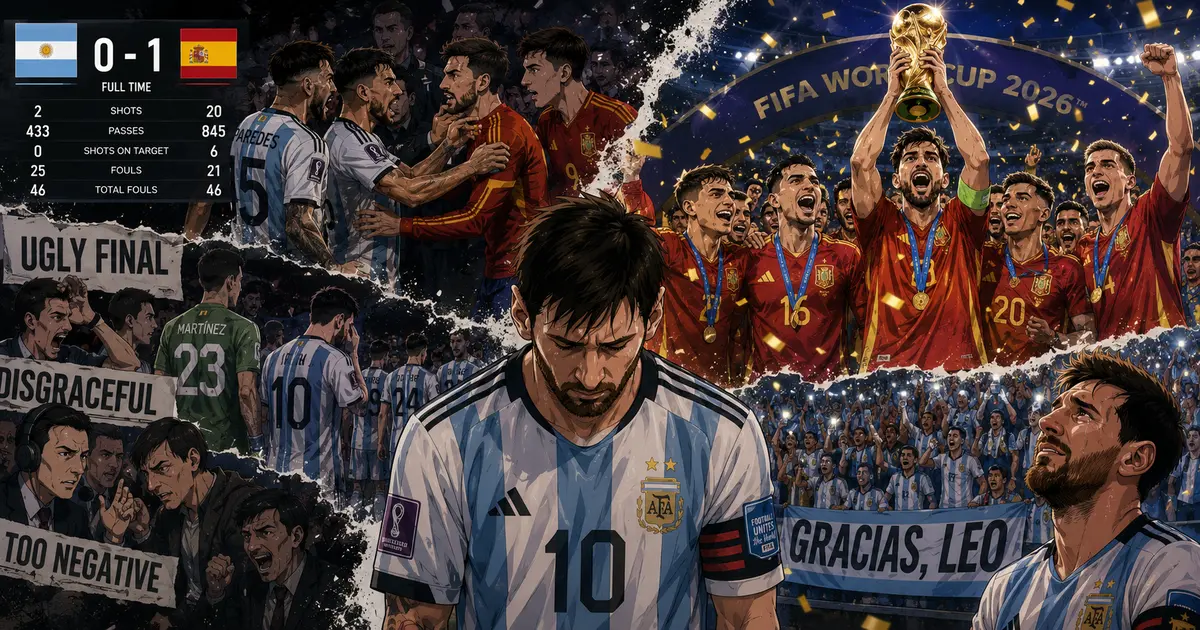
Start with the numbers, because they tell an unusually stark story. Spain out-shot Argentina 20-2 and out-passed them 845-433, and Argentina failed to register a single shot across the entire 90 minutes of normal time — a first in modern World Cup final history. Whatever your view of Argentina’s broader approach to this tournament, a team producing zero shots in a World Cup final is going to generate exactly the kind of “how is this team even in the final” reaction that fuels neutral resentment, particularly against a Spain side playing genuinely attractive, front-footed football in the same match.
Some commentators went further, describing Argentina’s approach across the tournament as fundamentally defensive and disruption-focused rather than built on genuine attacking ambition. That’s a defensible tactical read given the underlying numbers, even if it’s also worth noting Argentina reached this final specifically because that approach had worked in four consecutive knockout matches beforehand. Fans generally reserve their harshest judgment for a team’s tactics when that team ends up losing; had Argentina found a way to win 1-0 on the counter, this same performance would likely be remembered as gritty and resourceful rather than cynical.
The Post-Match Scenes Did Real Damage
Whatever sympathy Argentina retained heading into the final whistle took a serious hit in the minutes that followed it. Leandro Paredes was shown a red card after the match for a physical confrontation with Spain’s Gavi and Eric García, one that involved kicking, shoving and grabbing at García’s neck before teammates and staff separated the players. The match had already been bad-tempered throughout — 46 total fouls, 25 of them committed by Argentina — but the post-final scenes pushed the conversation from “physical, competitive final” into territory that prominent former players and broadcasters, including Gary Neville and Alan Shearer, publicly condemned as disgraceful.
Argentina compounded the damage by declining to properly participate in Spain’s trophy celebration, turning their backs as the newly crowned champions lifted the trophy, having earlier received a guard of honor from Spain themselves. Rodri, Spain’s Golden Ball winner, summed up the neutral reaction simply afterward: “It was an ugly way for a World Cup final to end.” Moments like these tend to linger in the public memory considerably longer than any single tactical decision, and they gave neutral fans a very specific, very visual reason to feel their instinct to root against Argentina had been vindicated.
A Pattern, Not an Isolated Incident
None of this happened in a vacuum. Argentina’s reputation for combative, occasionally needling conduct on the biggest stages has built up over multiple tournament cycles — a run of incidents and controversies that has followed the squad through multiple Copa Américas and World Cups. Whether that reputation is entirely deserved or partly the product of a broader “everyone loves an underdog until the underdog starts trash-talking” dynamic is a genuinely debatable question. But reputations in football, like reputations anywhere else, tend to calcify once a pattern becomes recognizable, and neutral fans who had already formed an opinion about Argentina’s on-field conduct before Sunday’s final were unlikely to have that opinion softened by a match that produced a post-final brawl.
The Messi Factor Cuts Both Ways
Here’s where the “entire world wanted Argentina to fail” framing runs into its most obvious contradiction: an enormous number of neutral fans specifically wanted Argentina to succeed, precisely because of Messi. The stadium crowd itself reportedly skewed toward hoping for what commentators called a “recoronation” of Messi as a two-time champion, and his emotional reaction after the final whistle — visibly fighting back tears before being serenaded one last time by traveling Argentine fans — moved plenty of viewers who have no particular allegiance to Argentina as a footballing nation. Any honest account of neutral sentiment heading into this final has to acknowledge that Messi’s presence was, for a huge segment of the global audience, the single biggest reason to want Argentina to win, not lose.
So Was It Really “the World,” or Something Narrower?
The honest answer is that this sentiment was likely concentrated in specific pockets rather than universal: fans of Spain and its individual players, neutrals who had grown tired of Argentina’s gamesmanship reputation across previous tournaments, and viewers reacting in real time to a genuinely ugly set of post-match scenes that made the moral framing of the match feel unusually clear-cut. That’s a meaningfully large and vocal group, particularly online, where negative sentiment tends to spread faster and louder than measured neutrality. But it’s a considerable distance from “the entire world,” and it existed alongside an equally large, equally passionate contingent that was desperate to see one more moment of Messi magic before his international career potentially ends.
This Isn’t the First Time a Champion Has Played the Villain
There’s useful historical context worth adding here too. Plenty of dominant international teams throughout football history have found themselves cast as the neutral’s least-favorite side at some point in their run, often precisely because of a reputation for physical or combative play that developed alongside their success. It’s a familiar dynamic — success bred through resilience and physicality rather than pure aesthetic quality tends to generate exactly this kind of neutral resentment, particularly when it comes up against a side playing more expansive, crowd-pleasing football in the same match. Argentina’s specific version of this dynamic this summer was amplified by the post-match scenes, but the underlying pattern of “efficient but unloved” teams drawing neutral resentment is not new to this final, or to this sport.
The Fair Conclusion
Argentina’s reputation problem heading into and immediately following this final wasn’t manufactured by a hostile media narrative — it was built on real incidents, from the tactical approach that produced zero shots in a World Cup final to the post-match confrontation that overshadowed Spain’s achievement. That reputation is fair to discuss, and the backlash it generated was a predictable response to genuinely poor conduct in the sport’s biggest moment. But reducing an entire nation’s fanbase, and the millions of neutrals still moved by Messi’s story, down to a monolithic desire to see them fail overstates a real but narrower sentiment into something it never actually was.
About the Author