Four players etched their names into World Cup history this summer — the most since 1986. Here’s the story behind each one
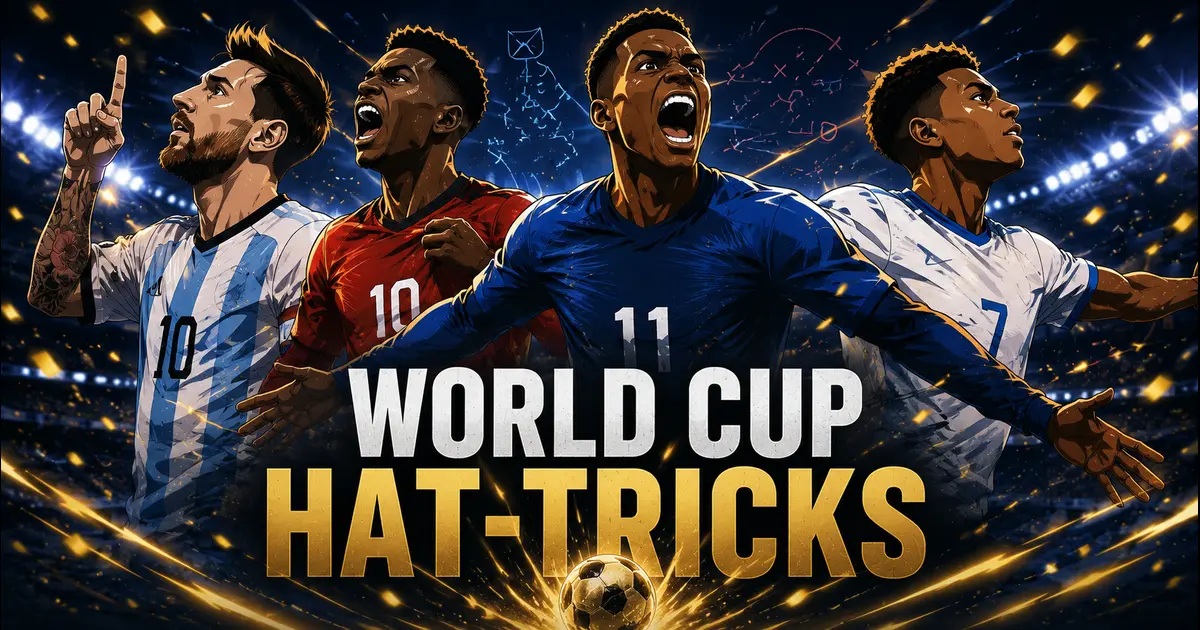 Four players etched their names into World Cup history this summer — the most since 1986. Here’s the story behind each one
A hat-trick at the World Cup is one of football’s rarest individual accomplishments — across nearly a century of the tournament’s history, only a small handful of players have ever managed it, and only four men have ever scored more than one across their careers. Every hat-trick at FIFA World Cup 2026 carries its own story, and this year’s tournament produced four of them, the most in a single edition since Mexico 1986. Here’s the complete list, in chronological order, along with the context behind each historic treble.
1. Lionel Messi vs. Algeria — June 16, 2026 (Group Stage, 3-0)
The tournament’s first hat-trick arrived on opening weekend, and it belonged to the sport’s most decorated active player. Lionel Messi scored in the 17th, 60th and 76th minutes as Argentina cruised to a 3-0 win over Algeria in their Group J opener, instantly setting the tone for the defending champions’ title defense.Football After Messi and Ronaldo: Inside the End of an Era
What made the moment especially significant was what it represented in Messi’s own career ledger. It was the first hat-trick of his entire World Cup career, arriving in his sixth and, by his own admission, likely final tournament appearance. The three goals also pulled him level with Germany’s Miroslav Klose on 16 career World Cup goals, a mark that was then the all-time record. At 38 years and 357 days old, Messi became the oldest player in tournament history to score a hat-trick, surpassing the previous record held by Cristiano Ronaldo, who had scored his own famous treble against Spain at the 2018 World Cup. It was a statement opening act for a player many assumed might be entering his final tournament on the downswing of his powers — instead, he was rewriting the record books before the group stage had even finished its first round of fixtures.
2. Jonathan David vs. Qatar — June 18, 2026 (Group Stage, 6-0)
Two days later, Canada’s Jonathan David delivered the tournament’s second hat-trick, leading the co-hosts to a commanding 6-0 win over Qatar in Vancouver. Playing in front of a home crowd at BC Place Stadium, David’s treble was a significant personal and national moment — a co-host nation delivering one of the most emphatic scorelines of the entire group stage, with its captain and leading forward at the center of the celebration. For a Canadian program still building its World Cup pedigree on home soil, David’s performance offered an early highlight that set expectations for the rest of the co-hosts’ campaign.
3. Ousmane Dembele vs. Norway — June 26, 2026 (Group Stage, 4-1)
If Messi’s hat-trick was about longevity and history, Dembele’s was about pure, explosive speed. The France winger scored in the 7th, 20th and 32nd minutes as Les Bleus defeated Norway 4-1, completing his treble before the first half had even finished. It was one of the fastest hat-tricks ever recorded by a French player at a World Cup, and it confirmed Dembele’s status as a genuine secondary scoring threat behind Kylian Mbappe heading into the knockout rounds — a partnership that would go on to power France all the way to a third-place finish. The performance also extended France’s perfect group-stage record, part of a run that would eventually see them reach the tournament’s final four.Ousmane Dembélé Hat-Trick: The Numbers Behind the Most Clinical 32 Minutes of the Tournament
4. Bukayo Saka vs. France — July 18, 2026 (Third-Place Playoff, 6-4)
The tournament’s fourth and final hat-trick arrived in its most unexpected setting: the third-place playoff, a fixture usually associated with muted stakes and rotated squads rather than individual fireworks. Instead, England and France produced one of the highest-scoring matches of the entire tournament, with England winning 6-4 in Miami. Bukayo Saka’s hat-trick was the standout individual performance of a genuinely wild afternoon, though it came in a match that also featured a decisive individual moment from the opposition: Kylian Mbappe scored twice himself, taking his tournament tally to ten goals and his career total to 22 — enough to clinch the Golden Boot outright and move him past Messi as the all-time leading World Cup goal scorer in men’s history. Saka’s treble, in a match with combined implications for both the scoreline and the individual awards race, gave the third-place playoff a level of drama rarely associated with the fixture. [link to: The Golden Boot race at FIFA World Cup 2026]
Why Four Hat-Tricks Is a Genuinely Notable Number
Context matters enormously here. Every World Cup between 1990 and 2022 produced either one or two hat-tricks — the 1998 tournament in France and the 2010 edition in South Africa each saw just a single treble, while most other editions in that stretch saw two. The 2006 World Cup in Germany remains the only edition in tournament history where no hat-trick was scored at all. Against that backdrop, four hat-tricks in a single tournament represents the most since the 1986 World Cup in Mexico, and it arrives at a moment when elite international defenses are generally considered more organized and tactically disciplined than in decades past — making this uptick in individual scoring bursts all the more statistically significant.
How This Tournament’s Hat-Tricks Compare Historically
The all-time record for hat-tricks in a single World Cup remains the eight scored during the 1954 tournament in Switzerland, a wide-open, high-scoring era of the sport’s history that modern tactical football is unlikely to ever fully replicate. Hungary’s Sandor Kocsis scored two hat-tricks in that single tournament alone — a feat matched only by France’s Just Fontaine (1958), West Germany’s Gerd Muller (1970 alone) and Gabriel Batistuta, who scored hat-tricks in both the 1994 and 1998 editions, making him the only player to record multiple World Cup hat-tricks across separate tournaments. This year’s four hat-tricks, spread across two different rounds and involving players from four different confederations, reflects a different kind of historical moment — not the free-scoring chaos of the 1950s, but a reminder that individual brilliance can still puncture even the most well-organized modern defensive systems.
The Common Thread: A Tournament of Genuine Depth
What’s notable about this specific quartet of hat-tricks is how evenly distributed they were, both by team and by stage of the tournament. Messi’s came from the eventual runners-up, Dembele’s from the eventual third-place finishers, David’s from a co-host nation making the most of a home-soil moment, and Saka’s from the team that ultimately beat France to that third-place finish. Rather than clustering around one dominant team’s group-stage demolitions, as has sometimes been the case in past editions, this year’s hat-tricks were spread across the entire arc of the tournament — from the second matchday of the group stage all the way to the very last fixture played before the final itself.
Final Word
Four hat-tricks, four entirely different contexts, and four players whose treble each meant something distinct for their own personal legacy or their nation’s tournament story. Messi’s record-breaking treble opened the tournament with a reminder of his enduring brilliance even in his mid-to-late thirties. Jonathan David gave Canada an unforgettable home moment. Dembele’s blistering burst announced France’s attacking depth beyond Mbappe. And Saka’s third-place playoff hat-trick closed the book on the tournament’s individual scoring storylines in the most unexpected venue imaginable. Together, they made FIFA World Cup 2026 the most prolific tournament for hat-tricks in nearly forty years.
🔹🔹 follow us on facebook 🔹🔹
About the Author