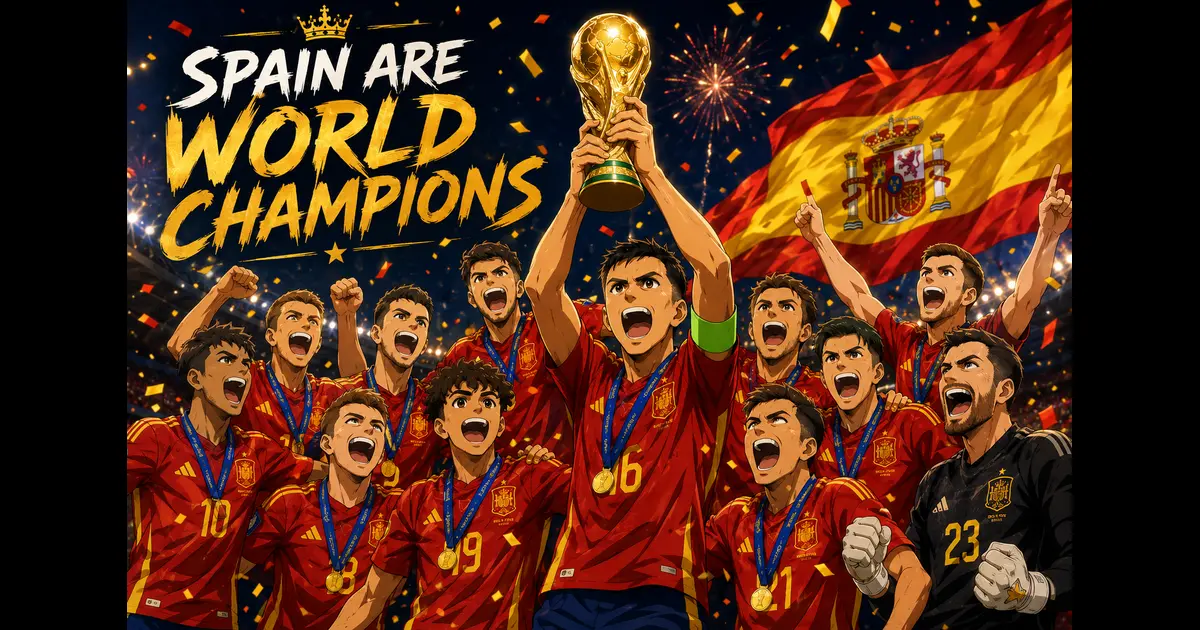
 Spain’s FIFA World Cup Winning Squad, Player by Player, Rated
Spain are world champions for the second time, beating Argentina 1-0 after extra time to win an undefeated tournament built on the meanest defensive record in FIFA World Cup history. Every member of Luis de la Fuente’s 26-man squad played some part in that story. Here’s how Spain’s World Cup winning squad graded out, position by position.
We Called It: How Our Spain World Cup Prediction Came True
Goalkeepers
Unai Simón — 9.5/10. Won the Golden Glove with seven clean sheets in eight matches, conceding only once all tournament, against Belgium in the quarterfinal. His 90.9% save percentage was the platform Spain’s entire campaign was built on, and his calm distribution under pressure never wavered even in the white-knuckle final.
David Raya — N/A. Spain’s number two never featured, but his presence as a genuine Premier League-level backup gave De la Fuente total confidence to rotate without risk if needed.
Joan García — N/A. Barcelona’s rising goalkeeper rounded out the group as third choice, gaining invaluable tournament experience without playing a minute.
Defenders
Pedro Porro — 8.5/10. The breakout full-back of the tournament, Porro scored the crucial second goal in the semifinal win over France and was a constant attacking outlet from right-back all summer, adding genuine goal threat to a position Spain has historically used more conservatively.
Pau Cubarsí — 9/10. Named the tournament’s Best Young Player at just 19, edging out teammate Lamine Yamal for the honor. Cubarsí anchored a Spanish defense that faced only ten shots on target across the entire tournament, showing a level of maturity and composure defensively that belied his age at every stage of the knockout rounds.
Aymeric Laporte — 8/10. The experienced head in Spain’s back line, Laporte’s positional discipline and aerial dominance were central to a defense that conceded just once in eight matches. His partnership with the younger Cubarsí blended experience with fearlessness perfectly.
Marc Cucurella — 7.5/10. Solid throughout at left-back, contributing defensively while occasionally pushing forward to support Spain’s wide attacking overloads. His shot from distance in the final, narrowly wide, was Spain’s best chance of open play before extra time.
Eric García — 7/10. A reliable squad rotation option across the back line, García’s versatility allowed De la Fuente to manage minutes without any drop in defensive quality.
Marc Pubill — 7/10. A World Cup debutant who impressed in limited minutes, offering De la Fuente a genuine alternative at full-back when needed.
Alejandro Grimaldo — 7/10. Provided quality depth at left-back, with his set-piece delivery a valuable option even in a squad not short on attacking talent.
Marcos Llorente — 7/10. Used sparingly but effective in his appearances, Llorente’s versatility across multiple defensive and midfield positions made him a valuable squad piece throughout the tournament.
Midfielders
Rodri — 10/10. The Golden Ball winner as the tournament’s outstanding player, completing 753 passes at 94% accuracy across eight matches. Rodri’s influence on Spain’s ability to control games was, in the words of pundits throughout the tournament, undeniable even when his individual statistics weren’t the most eye-catching — a true captain’s performance across the full campaign.
Martín Zubimendi — 8/10. Rodri’s understudy and occasional partner in a double pivot, Zubimendi’s composure on the ball allowed Spain to rotate their deepest midfield role without any drop-off in control, including a key second-half shift in the final itself.
Pedri — 8/10. Pushed hard for a recall throughout the knockout rounds after starting behind Fabián Ruiz in the pecking order, and his technical quality remained one of Spain’s most reliable sources of progressive passing whenever called upon.
Fabián Ruiz — 8/10. Scored the opener in the tense quarterfinal win over Belgium and started ahead of Pedri in Spain’s biggest matches, rewarding De la Fuente’s faith with composed, high-level performances in midfield throughout the knockout stage.
Mikel Merino — 9/10. Spain’s designated closer off the bench, scoring the winning goal in back-to-back knockout matches against Portugal and Belgium. Few players in the tournament had a bigger impact relative to their minutes played than Merino, who repeatedly delivered in the moments Spain needed him most.
Gavi — 7.5/10. A dynamic, energetic presence in midfield whenever selected, Gavi’s tenacity and press-resistance gave Spain another layer of control in the middle of the park.
Alex Baena — 8/10. Scored the only goal of the group-stage decider against Uruguay and provided genuine width and creativity as Nico Williams’ replacement for large stretches of the tournament.
Forwards
Mikel Oyarzabal — 9/10. Spain’s top scorer with five goals, including braces against Saudi Arabia and Austria and the crucial opening penalty against France in the semifinal. Substituted in the final as De la Fuente rang the changes, but his tournament-long finishing was central to Spain’s attacking output.
Lamine Yamal — 9/10. At 19, already one of the most talked-about teenagers in World Cup history. Scored on his first start of the tournament, drew the penalty that opened the scoring in the semifinal against France, and set up Ferran Torres’ extra-time header attempt in the final before Torres eventually won it moments later. Missed out on the Young Player Award to teammate Pau Cubarsí, but his overall body of work across the tournament suggests his individual trophy case is only a matter of time.
Ferran Torres — 9.5/10. The ultimate impact substitute, scoring the goal that won Spain the World Cup — a close-range finish in the 106th minute, assisted by fellow substitute Nico Williams. Only the second substitute in history to score a World Cup final’s winning goal, instantly writing his name into Spanish football folklore.
Nico Williams — 8.5/10. Recovered from the injury that had threatened his tournament to deliver the decisive assist in the final itself, combining with fellow substitute Ferran Torres for the goal that won Spain the World Cup. A reminder of exactly why he was considered undroppable before his injury setback.
Dani Olmo — 9.5/10. Widely regarded by pundits as deserving serious consideration for the Golden Ball that ultimately went to Rodri, Olmo’s tournament combined relentless defensive work rate with genuine creative quality in the final third, assisting Porro’s semifinal goal among a string of standout performances.
Yeremy Pino — 7/10. A useful attacking option off the bench, Pino’s directness and pace gave De la Fuente another wide alternative when games needed fresh legs late on.
Borja Iglesias — 7/10. The senior statesman of the squad at 33, Iglesias offered a physical, target-man alternative in attack, even if his minutes were understandably limited behind Oyarzabal and Torres.
Víctor Muñoz — 7/10. A World Cup debutant who provided energetic depth in the final third whenever called upon during the tournament.
The Squad’s Defining Trait
What stands out most reviewing this squad top to bottom isn’t any single individual performance — it’s the sheer depth of players who made genuine, tournament-defining contributions despite limited minutes. Merino and Torres, both frequently used as substitutes rather than starters, combined to produce three of Spain’s most decisive knockout-stage goals, including the World Cup-winning strike itself. That is not an accident. It’s the direct product of a squad De la Fuente built with rotation and impact in mind from the very start, and it’s arguably the single biggest reason Spain are lifting the trophy for the second time in their history.
About the Author


2 thoughts on “Spain’s FIFA World Cup Winning Squad: Every Player Rated”