 Picking the standout performers from a title-winning campaign built on defensive discipline, midfield control and depth from the bench
Choosing Spain’s Best XI from a World Cup-winning campaign is a genuinely difficult exercise, precisely because so few individual performers were allowed to look ordinary across eight matches. Luis de la Fuente’s squad won the tournament on the strength of collective structure as much as individual brilliance, which makes ranking standout performances a matter of separating genuine tournament-defining excellence from simply being part of a well-drilled system. Here’s our best XI from Spain’s triumphant run to a second World Cup title.
Goalkeeper: Unai Simon
Simon’s case is close to unimpeachable. Seven clean sheets across eight matches, the most by any goalkeeper in a single World Cup, backed by 14 saves and a calm, rarely-tested composure whenever called upon. His Golden Glove award as the tournament’s outstanding goalkeeper reflects a campaign in which he was required to make only one meaningful mistake-adjacent moment all tournament — and even that, Belgium’s goal in the quarterfinal, arrived from a moment of genuine quality from Charles De Ketelaere rather than any error of his own.
Right-Back: Pedro Porro
Porro’s attacking output set him apart from most defenders at this World Cup. He became just the fifth defender in 60 years to score multiple goals in the knockout stage of a single tournament, adding a genuine goal threat to his defensive responsibilities down the right flank. His semifinal performance against France, in which he scored Spain’s second goal in the 2-0 win, was among the most complete individual defensive-and-attacking displays of the entire tournament. [link to: Spain vs Argentina predicted lineups]
Center-Back: Pau Cubarsi
At 19 years old, Cubarsi played every single minute of Spain’s tournament, an extraordinary display of both fitness and trust from his manager for a player his age at the sport’s biggest event. His reading of the game repeatedly defused danger before it fully materialized, and his composure on the ball — 121 completed passes in the final alone — reflected a defender comfortable both destroying attacks and building them. His Best Young Player award, won ahead of teammate Lamine Yamal, was a fitting recognition of a tournament that instantly established him as one of the sport’s most promising center-backs.
Center-Back: Aymeric Laporte
The senior partner in Spain’s central defensive pairing, Laporte’s experience and physical presence complemented Cubarsi’s more progressive instincts perfectly. His performance in the semifinal against France was particularly notable, cutting out a dangerous Michael Olise through-ball intended for Kylian Mbappe and generally ensuring France’s most dangerous attacking players found little space to operate in behind Spain’s high defensive line.
Left-Back: Marc Cucurella
Cucurella’s tournament combined defensive discipline with genuine attacking output, finishing among Spain’s joint-leading assist providers with two across the competition. His semifinal display against France was a statement performance, rendering the right side of France’s attack “practically irrelevant,” according to match analysts, while consistently pushing forward to add an extra attacking outlet down the left.
Midfield: Rodri
The tournament’s Golden Ball winner and the single most statistically dominant player in the competition, Rodri’s case for inclusion requires little elaboration. A record 655 accurate passes, the most ground covered of any player in the tournament, and defensive numbers — 22 tackles, 34 possessions won — that matched his creative output. His comeback from a ruptured ACL to the sport’s individual player-of-the-tournament honor is one of the defining stories of this entire World Cup. [link to: Rodri’s World Cup performance and Golden Ball win]
Midfield: Fabian Ruiz
Ruiz’s rise to the starting XI ahead of Pedri for the tournament’s biggest matches — the quarterfinal, semifinal and final — reflected his growing importance to Spain’s balance between defensive solidity and progressive passing. Though his semifinal performance against France drew praise as one of his best of the tournament, his final display was more understated by necessity, operating in a match with considerably less space and time to pick incisive passes against a deep, disciplined Argentina defense.
Midfield: Dani Olmo
Olmo’s tournament output — two assists and a share of Spain’s Fabregas-matching combined major-tournament assist record — undersells his overall importance to the team’s attacking rhythm. Increasingly used as a hybrid creative-and-defensive presence in the middle of the pitch as the tournament progressed, Olmo’s willingness to sacrifice some individual creative freedom for the team’s broader defensive solidity was a quietly significant factor in Spain’s ability to control matches for such long stretches.We Called It: How Our Spain World Cup Prediction Came True
Right Wing: Lamine Yamal
Yamal’s tournament didn’t hit the electric individual heights of his 2024 European Championship breakthrough, arriving at the World Cup managing a hamstring issue from the back end of his Barcelona season and never quite finding his most explosive form. Even so, his contribution to Spain’s semifinal win over France — drawing the penalty that opened the scoring — and his continued threat throughout the knockout rounds were enough to justify his inclusion, even in a tournament where he finished as Best Young Player runner-up rather than winner. His long-term trajectory, still only 19, remains extraordinary regardless of this specific tournament’s relatively muted individual numbers.
Center-Forward: Mikel Oyarzabal
Spain’s leading scorer with five goals, Oyarzabal became just the third Spanish player in history to reach that tally in a single World Cup, joining David Villa and Emilio Butragueño. His 30th international goal moved him to sixth on Spain’s all-time scoring list, and his composure from the penalty spot — including the opener in the semifinal win over France — made him the most reliable source of goals in a Spain side that otherwise spread its scoring unusually evenly across the squad.
Left Wing: Alex Baena
Baena’s emergence as Spain’s first-choice left-sided attacker, ahead of a returning-from-injury Nico Williams, was one of the tournament’s more understated selection stories. His willingness to combine centrally and support Oyarzabal, rather than simply hug the touchline, gave Spain’s front line a fluid, interchangeable quality that opposition defenses repeatedly struggled to track throughout the knockout rounds.
Impact Substitute Honorable Mention: Ferran Torres and Mikel Merino
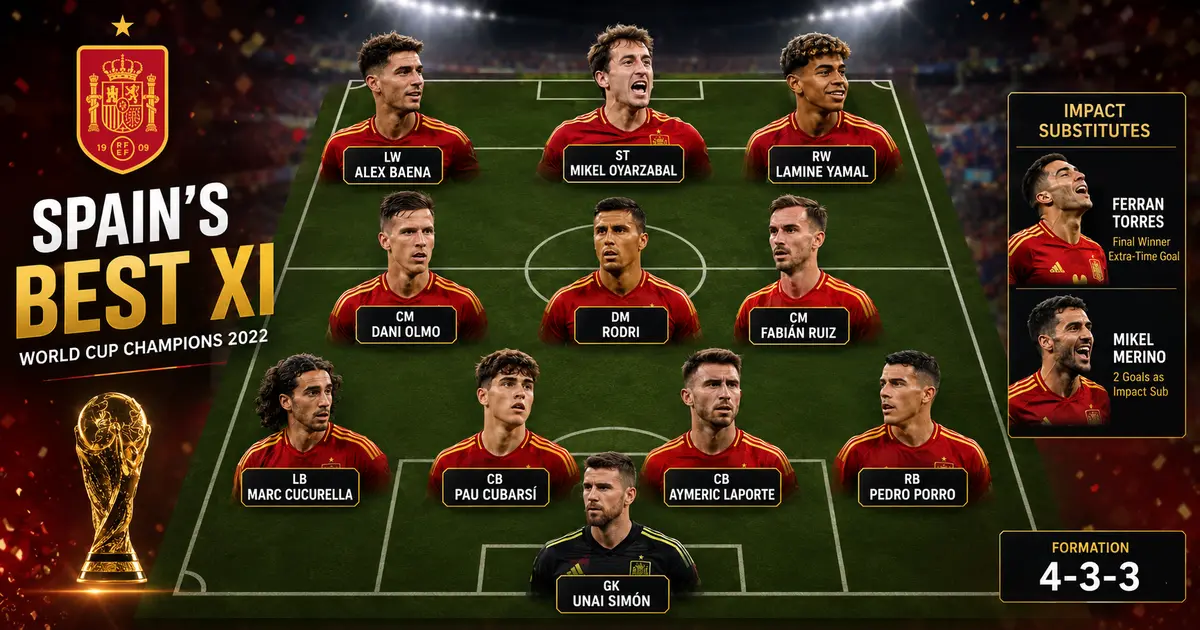
No best XI built purely around starting personnel could fully capture Spain’s tournament without acknowledging its bench. Mikel Merino scored twice as a substitute, including the stoppage-time winner against Portugal, while Ferran Torres delivered the single most important goal of the entire competition — Spain’s extra-time winner in the final itself, his first goal of the tournament arriving at the most consequential possible moment. Their combined impact is a reminder that Spain’s title was built on genuine squad depth, not just its first-choice eleven.
The Best XI in Full
Formation (4-3-3): Unai Simon; Pedro Porro, Pau Cubarsi, Aymeric Laporte, Marc Cucurella; Rodri, Fabian Ruiz, Dani Olmo; Lamine Yamal, Mikel Oyarzabal, Alex Baena
Why This XI Tells Spain’s Whole Story
What’s striking about assembling this list is how few genuinely poor individual performances there were to exclude. Spain’s title was won through remarkable positional and tactical coherence rather than a handful of standout stars carrying a supporting cast — the exact opposite model to Argentina’s Messi-centric run to the same final. Every player in this XI, and several more who didn’t make the final cut, contributed meaningfully to a campaign that conceded once in eight matches and produced the tournament’s outstanding individual player, its best young player, and its best goalkeeper. [link to: Spain World Cup 2026 stats in full]
Final Word
Spain’s best XI from this World Cup reads less like a collection of individual superstars and more like a genuinely complete team — a defense that conceded almost nothing, a midfield anchored by the tournament’s best player, and an attack that spread its goals across five different scorers rather than leaning on one talisman. That balance, more than any single performance, is the reason Spain lifted the trophy for the second time in their history.
About the Author