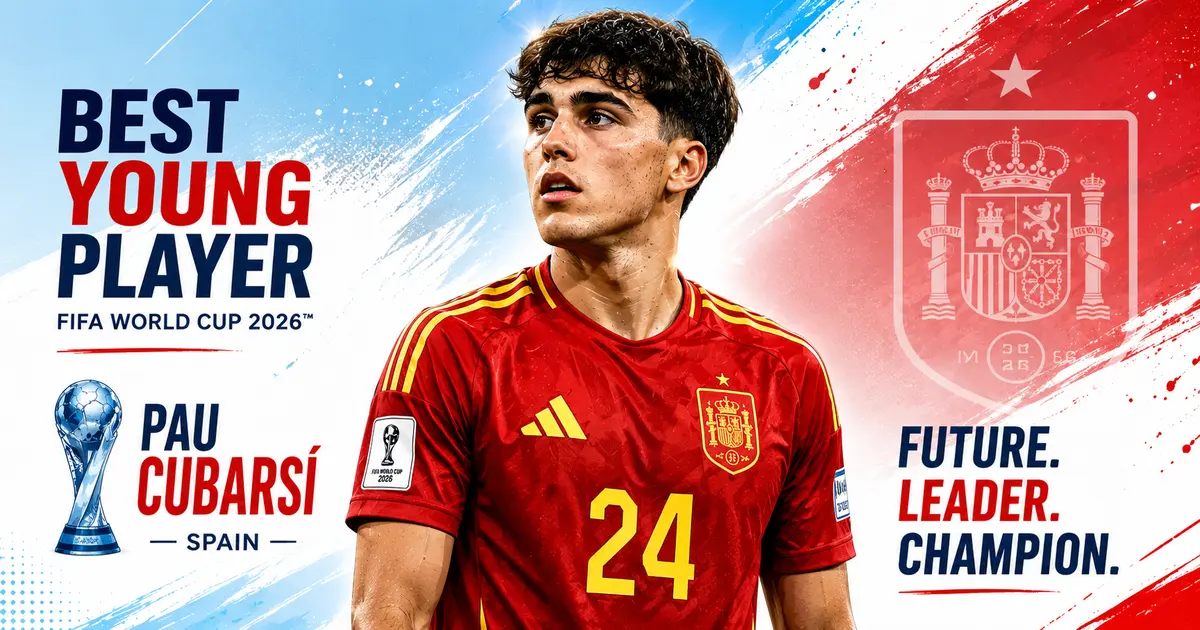
 At just 19, Pau Cubarsi anchored the tightest defense in tournament history as the Best Young Player FIFA World Cup 2026.
Nineteen years old, playing center-back in the biggest matches of his career, against attacking talent that included Cristiano Ronaldo, Kylian Mbappé, and Lionel Messi, and Pau Cubarsí didn’t just survive the experience. He thrived in it, anchoring a Spanish defense that conceded a single goal across the entire tournament on the way to a World Cup title. The Best Young Player of FIFA World Cup 2026 award recognizes exactly that achievement, and unlike some previous editions where the honor has occasionally felt like a consolation prize for a promising but ultimately unproven talent, Cubarsí’s case arrives with a genuinely dominant tournament and a winner’s medal to back it up.
Ousmane Dembélé Hat-Trick: The Numbers Behind the Most Clinical 32 Minutes of the Tournament
Golden Ball Winner Rodri: The Case for Football’s Quietest Superstar
A Rare Kind of Winner for This Award
The FIFA Young Player Award, presented to the best player born on or after January 1, 2005, has previously gone to names like Kylian Mbappé, Thomas Müller, Paul Pogba, and Enzo Fernández, a list dominated almost entirely by attacking players whose breakout tournaments were built on goals and decisive attacking contributions. Cubarsí’s win breaks that pattern in a genuinely notable way; he’s the first center-back to claim this specific award in recent tournament history, and his selection reflects a defender’s tournament being recognized purely on defensive merit rather than any secondary attacking contribution padding his case.
That distinction matters because defensive performances, much like Rodri’s Golden Ball-winning midfield campaign, resist the kind of easy statistical framing that makes attacking talent easier to sell to a voting panel. Cubarsí didn’t score. He didn’t produce a highlight-reel assist. What he did was start every knockout match at the heart of a defense that shut down four fundamentally different attacking systems in succession, and do so with a calmness that belied his age at every turn.We Called It: How Our Spain World Cup Prediction Came True
FIFA World Cup 2026 Winner Prediction: Why Spain Will Lift the Trophy
The Partnership That Made Spain’s Defense Work
Cubarsí’s tournament can’t be fully separated from his partnership with the more experienced Aymeric Laporte at the heart of Spain’s back four, a pairing that remained settled and unchanged throughout the knockout rounds. What made the teenager’s contribution so remarkable wasn’t that he simply avoided mistakes alongside a more seasoned partner; it was the genuine authority he showed in directing that partnership, frequently the one organizing Spain’s defensive line, stepping out to intercept passes at exactly the right moment, and reading dangerous situations before they fully developed.Golden Glove Winner Unai Simon: The Historic World Cup Goalkeeping Masterclass
Against Portugal in the Round of 16, Cubarsí’s positioning repeatedly nullified space for Cristiano Ronaldo in what proved to be the veteran’s final World Cup match. Against Belgium in the quarterfinal, he helped absorb the one genuinely creative spell Belgium’s golden generation produced all tournament, conceding only the single goal that ultimately stood as Spain’s sole blemish of the entire competition. And in the final itself, against an Argentina side that spent long stretches of extra time searching increasingly desperately for an equalizer, Cubarsí’s composure never wavered, even as the match ran deep into its most pressure-filled stretch.
Handling Elite Attackers at an Age Most Defenders Are Still Learning the Position
What separates a genuinely elite teenage defensive performance from a merely promising one is usually the ability to handle the specific, varied threats posed by world-class attackers rather than simply performing well against generic opposition. Cubarsí’s tournament checked that box repeatedly. Ronaldo’s aerial threat and movement in the box, Mbappé’s searing pace in behind, Messi’s dropping movement into pockets between the lines, each posed an entirely different tactical problem, and Cubarsí adjusted his individual approach match to match rather than relying on a single defensive method regardless of opponent.
That adaptability is precisely what makes scouts and coaches confident this performance reflects genuine defensive intelligence rather than a fortunate run of matches against attackers who simply had off days. Elite defenders are defined by their ability to solve different problems differently; Cubarsí solved four distinct ones across four knockout matches, at an age when most defenders are still being eased into senior football gradually.
A Rapid Rise Through Barcelona’s Ranks
Cubarsí’s path to this individual honor has moved remarkably quickly. Having broken into Barcelona’s first team as a teenager, he established himself as a first-choice center-back for one of Europe’s biggest clubs well before most defenders his age would typically be trusted with regular senior minutes, let alone the responsibility of marshaling a national team’s defense at a World Cup. That rapid trajectory reflects both his individual quality and the trust his coaches at both club and international level have consistently placed in his tactical maturity, a trust the 2026 World Cup fully validated on the sport’s biggest possible stage.
Why This Award Matters for Spain’s Long-Term Outlook
Beyond the individual recognition, Cubarsí’s award carries real significance for how Spanish football thinks about its next generation. Luis de la Fuente’s World Cup-winning squad blended proven veterans like Rodri and Laporte with genuinely young, still-developing talent in Cubarsí and Lamine Yamal, and the fact that a 19-year-old defender could anchor the tightest defensive record in World Cup history suggests Spain’s next cycle of players is arriving with a level of readiness that goes well beyond typical development timelines. Spanish football has built its reputation over the past two decades on precisely this kind of academy-driven technical development, and Cubarsí’s tournament stands as some of the clearest evidence yet that the pipeline remains as strong as ever.
Comparing Cubarsí to Past Winners
Measuring Cubarsí against previous Best Young Player recipients requires some care, given how different a defensive contribution looks from an attacking one on a highlight reel. But judged purely on tournament impact relative to team success, his case compares favorably even to some of the award’s most celebrated past winners. Mbappé’s 2018 win came alongside a French title, giving his attacking exploits the same kind of winner’s context Cubarsí now shares. Enzo Fernández’s 2022 recognition came as a deep-lying midfielder for the eventual champions, a role with slightly more attacking license than Cubarsí’s pure center-back position. Among recent winners, Cubarsí’s award may represent the single most purely defensive-minded recognition the honor has produced in years, a reflection of just how statistically dominant Spain’s backline was throughout the tournament.
The Verdict
Pau Cubarsí’s Best Young Player award isn’t a projection of future potential the way some previous recipients’ honors have arguably been; it’s recognition of a tournament he’s already completed, at the heart of the stingiest defense a World Cup-winning team has ever fielded. Handling Ronaldo, Mbappé, and Messi in three separate knockout rounds, at 19 years old, while helping his side concede a single goal across the entire competition, is not a promising sign of things to come. It’s already the finished product, delivered months ahead of when most defenders his age would even be trusted with the responsibility. Spanish football’s next great center-back has already announced himself, and he did it with a World Cup medal to prove it.
About the Author