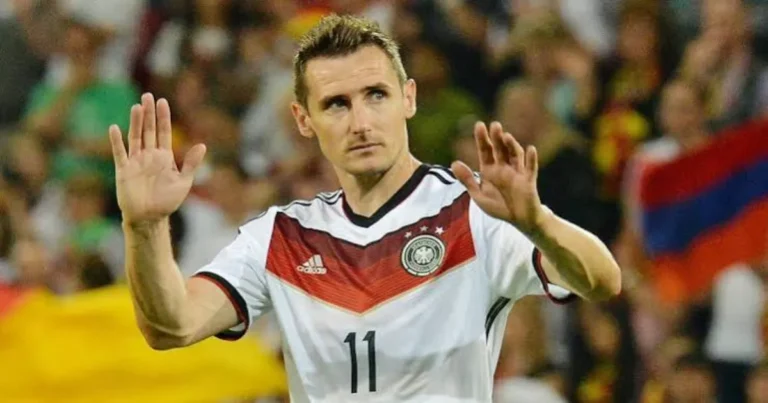
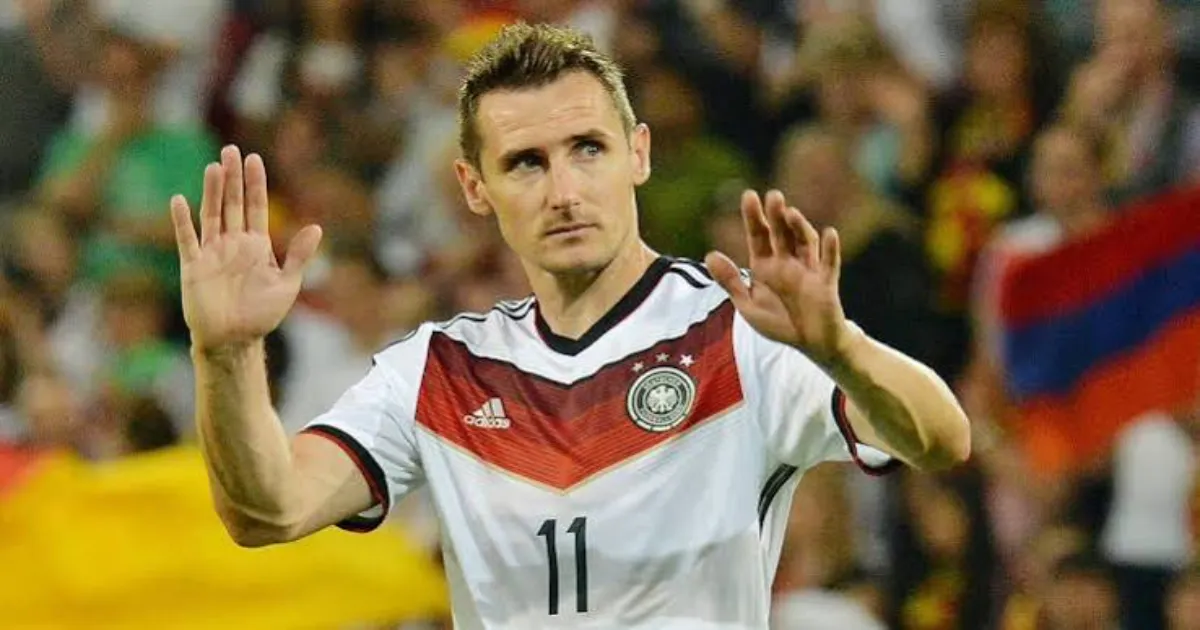
 No player in history has scored more World Cup goals than Miroslav Klose, a record built quietly, tournament after tournament, header after header.
Some records get broken almost as soon as they’re set. Miroslav Klose’s tally of sixteen career World Cup goals, accumulated across four separate tournaments between 2002 and 2014, has now stood for over a decade, and given how genuinely difficult it is to sustain elite goalscoring form across sixteen years and four separate World Cup cycles, it may well stand for a great deal longer still. Klose’s path to that record, however, looked nothing like the typical trajectory of a future footballing icon.
Biggest Wins in Football History: The Most One-Sided Results Ever
MLS Best Players 2026: The 15 Stars Defining the Post-World Cup Era
A Late Start to Professional Football
Klose was born in Opole, Poland, to a Polish father and German mother, and his family relocated to Germany when he was still a child, part of a broader wave of ethnic German migration from Poland during this period. Unlike many elite footballers who join professional academies as young children, Klose’s path to the professional game developed considerably later, spending his teenage years playing amateur and semi-professional football while simultaneously training as a carpenter, a genuinely ordinary working life that stood in stark contrast to the elite youth academy pathways that produced most of his eventual international teammates.
Klose didn’t turn fully professional until his early twenties, joining Kaiserslautern in 1999 and using the club’s second-tier status at the time as a genuine springboard rather than a limitation, scoring prolifically enough to earn promotion back to the Bundesliga and, remarkably, a call-up to Germany’s senior national team within just a few years of first breaking into professional football at all.
An Explosive International Debut
Klose’s rise to international prominence accelerated with startling speed once he broke into Germany’s national team setup, and his performance at the 2002 World Cup in South Korea and Japan announced him as a genuine global talent almost overnight. He finished that tournament with five goals, every single one scored with his head, a genuinely remarkable statistical pattern that highlighted his exceptional aerial ability and positioning inside the penalty area. Germany reached the final that year, eventually losing to Brazil, but Klose’s individual breakout performance established him as one of the most exciting young strikers in world football, a considerable achievement for a player who had been playing second-tier German football just a couple of seasons earlier.
Building a Career Across Germany’s Biggest Clubs
Klose’s club career took him through several of German football’s most significant institutions, including a lengthy and productive spell at Werder Bremen, where he continued developing into one of the Bundesliga’s most reliable and clinical finishers. His subsequent move to Bayern Munich further cemented his status among Germany’s footballing elite, adding domestic silverware to a career that had already delivered considerable individual recognition on the international stage. Unlike several of his more flamboyant contemporaries, Klose’s game was never built on dazzling technical skill moves or highlight-reel individual brilliance; instead, his effectiveness stemmed from exceptional positioning, intelligent movement to find space inside the penalty area, and a genuinely predatory instinct for being in exactly the right place at exactly the right moment.
Golden Boot Glory on Home Soil
Klose’s individual excellence reached a new peak at the 2006 World Cup, hosted on home soil in Germany, where he finished as the tournament’s top scorer with five goals, claiming the Golden Boot and playing a central role in Germany’s run to the semifinals during a tournament widely remembered for the genuinely joyful, celebratory national atmosphere that surrounded the host nation’s campaign, often referred to within Germany as the “Sommermärchen,” or summer fairytale. That individual Golden Boot triumph, delivered in front of adoring home crowds, remains one of the definitive highlights of his entire international career, a genuine personal and national celebration arriving simultaneously.
Continued Excellence Through 2010
Klose’s World Cup scoring continued at the 2010 tournament in South Africa, where he added a further four goals to his career tally as Germany once again reached the semifinal stage, this time falling to Spain’s eventual champions. That continued productivity across three separate tournaments, spanning nearly a decade of sustained international excellence, demonstrated a level of consistency at football’s biggest stage that few strikers in the sport’s history have managed to replicate, his combination of positioning and finishing ability proving durable even as he moved into his thirties and faced increasingly younger, more athletically explosive defensive opposition.
Breaking the All-Time Record in 2014
Klose’s crowning achievement arrived at the 2014 World Cup in Brazil, where, already Germany’s all-time leading international goalscorer, he needed just two more goals to surpass Brazilian legend Ronaldo’s previous World Cup record of fifteen career goals. He achieved that milestone during the tournament’s semifinal against host nation Brazil, scoring the goal that formally broke the record during a match that would go on to become one of the most infamous and one-sided results in World Cup history, Germany’s stunning 7-1 demolition of the host nation. That his record-breaking goal arrived during such a historically significant and dramatic match added an extra layer of narrative weight to an already remarkable individual achievement, cementing his status as the World Cup’s all-time leading scorer during the very same match that delivered one of the tournament’s most shocking collective results.
Germany went on to win that 2014 tournament outright, defeating Argentina in the final, giving Klose a World Cup winner’s medal to finally accompany his all-time scoring record, a fitting conclusion to what would prove to be his final World Cup appearance before his eventual international retirement.
A Career Built on Substance Over Style
What makes Klose’s achievement so genuinely remarkable is how consistently understated his playing style remained even as his statistical achievements grew increasingly historic. He was never the kind of player who dominated highlight reels with dazzling dribbles or spectacular long-range strikes; his goals were overwhelmingly the product of intelligent positioning, precise timing, and clinical finishing from close range, the kind of unglamorous, fundamentally sound striker’s instincts that don’t always receive the same level of public celebration as more visually spectacular attacking talents, even when they produce genuinely historic statistical results.
Life After Playing
Following his retirement, Klose transitioned into coaching, taking on various roles within the German football system, including work with the national team’s coaching staff and later positions with Bayern Munich’s coaching setup. His continued involvement in the sport reflects the same quiet, professional dedication that characterized his playing career, a figure more comfortable working diligently behind the scenes than commanding the kind of sustained media spotlight that follows many of his more outwardly flamboyant contemporaries.
Why His Record May Never Be Broken
Klose’s sixteen career World Cup goals represent an achievement that becomes more statistically remarkable the more closely it’s examined. Scoring consistently across four separate tournaments requires not just sustained individual quality but genuine longevity, staying fit, in form, and selected for the national team across sixteen years and four separate four-year cycles, a combination of durability and consistency that very few strikers in football history have managed to sustain. With the World Cup’s own scoring patterns increasingly shaped by more sophisticated defensive tactics and considerably more physically conditioned opposition than existed even during the early stages of Klose’s own career, matching his specific combination of longevity and consistent output looks like an increasingly difficult proposition for any future striker to replicate.
A Legacy Measured in Quiet Consistency
Miroslav Klose’s story offers a genuinely compelling reminder that football’s greatest individual achievements aren’t always built on singular moments of dazzling brilliance. His path from carpenter’s apprentice to the World Cup’s all-time leading goalscorer was built instead on sustained excellence, intelligent positioning, and a genuinely rare combination of longevity and consistency across sixteen years of international football. For a player whose game was never built around flashy individual skill, Klose’s ultimate legacy as the most prolific World Cup goalscorer in the tournament’s history stands as one of the most statistically significant, and quietly remarkable, achievements the sport has ever produced.
The Header That Defined His Game
Klose’s aerial ability deserves particular attention as the single most defining technical attribute of his entire career, a skill honed to such precision that a remarkable proportion of his most significant international goals, including several of his 2002 World Cup tally, came from headers rather than shots struck with his feet. That specific ability, built on exceptional timing, spatial awareness, and raw jumping ability, made him a uniquely difficult opponent for centre-backs to mark from set pieces and crosses, a genuinely specialized skill that few strikers throughout football history have developed to quite the same devastating, consistent level across such an extended international career.
A Final Farewell to International Football
Klose’s decision to retire from international duty following Germany’s 2014 World Cup triumph offered a genuinely fitting conclusion to his national team career, walking away at the absolute peak of both individual and collective achievement rather than lingering through a slower decline in form or influence. That timing, retiring immediately after finally adding a World Cup winner’s medal to his all-time scoring record, gave his international story a rare sense of complete narrative closure, a player whose sixteen-year international journey concluded at precisely the moment his personal and team accomplishments reached their fullest possible expression simultaneously.
The Broader Context of German Football’s Golden Generation
Klose’s later career years overlapped directly with the emergence of a genuinely golden generation of German talent, including Thomas Müller, Mesut Özil, Toni Kroos, and Manuel Neuer, players who would go on to form the core of Germany’s 2014 World Cup-winning squad. His experienced, veteran presence within that increasingly youthful squad provided a valuable link between Germany’s earlier tournament disappointments and the eventual triumph that concluded his own international career, his sustained quality and professionalism offering a steadying influence for a talented but still relatively inexperienced core of players during their own first sustained taste of genuine tournament pressure.
A Model Professional Both On and Off the Pitch
Beyond his statistical achievements, Klose became widely respected throughout German football for his consistent professionalism and genuine sportsmanship, including a particularly notable moment during a 2005 Bundesliga match when he voluntarily informed the referee that a goal he had just scored should not count, having handled the ball in the buildup, an act of honesty that drew widespread praise across German football culture and reinforced his reputation as a player whose character matched the quiet consistency of his on-field performances. That reputation for genuine integrity, unusual in a sport not always associated with such voluntary self-reporting, added a further dimension to how he was regarded by fans, teammates, and opponents alike throughout his lengthy career.
Why His Story Resonates Beyond the Statistics
Klose’s journey from a carpenter’s apprentice playing amateur football in his late teens to becoming the single most prolific goalscorer in World Cup history offers a genuinely compelling underdog narrative that stands in contrast to the more traditional academy-to-superstar pathways that define many of his contemporaries’ careers. That unconventional route to the top of international football, combined with his consistently understated playing style and off-field character, makes his ultimate record all the more remarkable, a testament to the idea that sustained excellence, intelligent positioning, and genuine professional dedication can produce achievements every bit as historically significant as the more conventionally celebrated brilliance of the sport’s most naturally gifted individual talents.
🔹🔹 Follow us on Facebook 🔹🔹
13 Best Korean Dramas Ever Made — From Romance to Revenge Thriller
About the Author