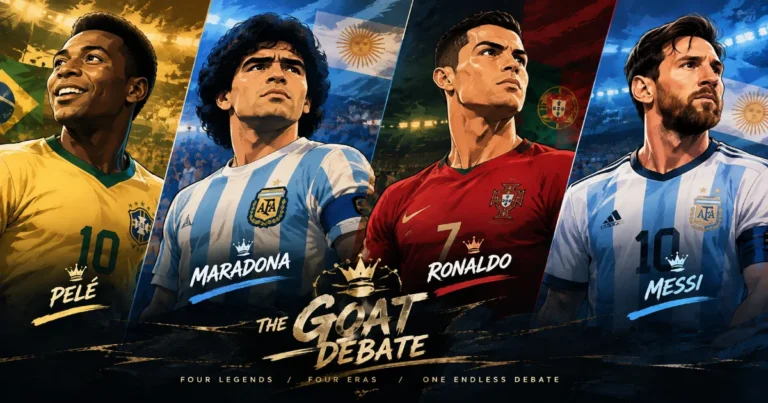
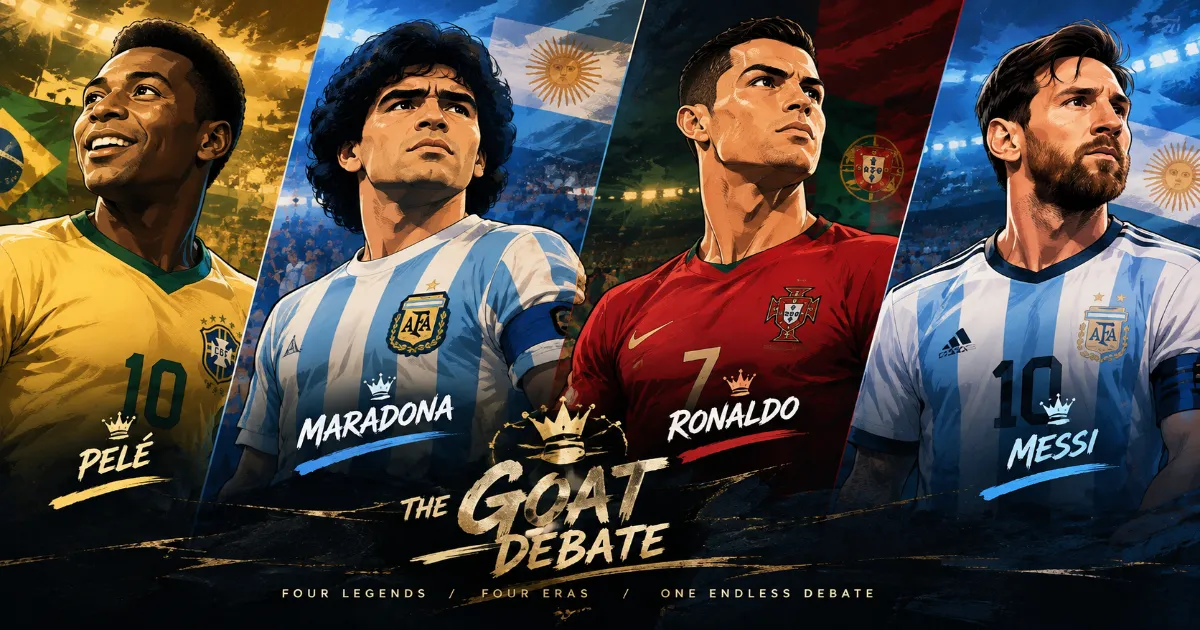
 Ronaldo vs Messi vs Maradona vs Pele: The GOAT Debate — A Data-Driven Verdict
Four players, four eras, four entirely different statistical and historical cases. Here’s what the numbers actually tell us.
No debate in football generates quite as much passionate disagreement as the question of who deserves to be called the greatest player of all time. Four names inevitably dominate the conversation: Pelé, Diego Maradona, Cristiano Ronaldo, and Lionel Messi. Each has a compelling statistical and historical case, but Messi’s story has now entered a new phase following his retirement from international football in August 2026.
Messi Retires: Inside the Rise, Falls, and Redemption of a Legend
What Cristiano Ronaldo Doesn’t Have: The One World Cup Trophy That Couldn’t Define His Greatness
At 39, Messi has closed the Argentina chapter of his career after more than two decades with the national team. He leaves as Argentina’s record appearance holder and leading scorer, with 207 caps and 125 goals, while also retiring as a World Cup winner, two-time Copa América champion and the men’s all-time leading World Cup scorer with 21 goals.
Yet Messi has not retired from football altogether. His professional career continues with Inter Miami, where he remains under contract through the end of the 2028 MLS season. That distinction is crucial when assessing where his career—and the GOAT debate—stands today.
Pelé: The Statistical Outlier
Pelé’s career statistics remain the subject of genuine debate because record-keeping standards during his 1950s and 1960s peak were very different from modern statistical tracking. His often-cited total of more than 1,000 goals includes unofficial matches, friendlies and exhibition games, while narrower official-match counts produce a lower figure.
What remains beyond serious dispute is his extraordinary international record. Pelé won three FIFA World Cups with Brazil, in 1958, 1962 and 1970, a record no other male player has matched.
His importance to Brazil’s golden generation cannot be reduced to numbers. Pelé was a teenage World Cup sensation in 1958 and a central figure in the legendary 1970 team. He became football’s first truly global superstar and helped establish the sport as a worldwide cultural phenomenon.
His three World Cup medals remain the strongest single argument for placing him above every other player in a World Cup-weighted GOAT ranking.
Diego Maradona: Individual Transcendence
Maradona’s statistical output does not match the enormous numbers accumulated by Messi and Ronaldo, but statistics alone have never adequately captured his case.
His greatest argument rests on extraordinary individual influence.
At Napoli, Maradona transformed a club that had never won Serie A into a two-time Italian champion. He also led Argentina to the 1986 World Cup, producing one of the most iconic individual tournament performances in football history.
The quarterfinal against England encapsulated the contradiction of Maradona’s genius. Within minutes, he produced both the infamous “Hand of God” and the breathtaking “Goal of the Century.”
Maradona’s case is therefore primarily about peak influence. He could take a team and a footballing culture and make them believe that almost anything was possible.
That intangible quality remains one of the strongest reasons he continues to occupy a place at the top table of the GOAT debate.
Cristiano Ronaldo: Statistical Dominance Across Decades
Cristiano Ronaldo’s case remains built around extraordinary longevity, goalscoring consistency and success across multiple footballing environments.
He has scored more than 900 senior career goals and remains one of the most prolific goalscorers football has ever produced. His career has included major success with Manchester United, Real Madrid and Juventus, while his five Champions League titles remain a defining part of his club résumé.
Ronaldo also became the first male player to score at six different World Cups, extending an international longevity record that seemed almost unimaginable when he made his tournament debut in 2006.
His international career also includes Portugal’s Euro 2016 triumph and the 2019 UEFA Nations League title.
The biggest missing piece remains a World Cup.
Unlike Pelé, Maradona and Messi, Ronaldo never lifted football’s biggest international trophy. That does not diminish his extraordinary career, but it remains an unavoidable consideration whenever the four are compared directly.
His continued production deep into his late thirties and beyond, however, has strengthened the argument that longevity itself should be treated as a major component of greatness.
Lionel Messi: The Modern Complete Package
Messi’s GOAT case changed dramatically during the final years of his Argentina career.
For much of his career, his critics focused on one apparent weakness: he had not won a major senior international trophy with Argentina.
That argument no longer exists.
Messi won the 2021 Copa América, the 2022 Finalissima, the 2022 FIFA World Cup and the 2024 Copa América.
He then took Argentina to the 2026 World Cup final before Spain defeated them 1-0.
His international career ended with 207 appearances and 125 goals, making him both Argentina’s most-capped player and all-time leading scorer.
His World Cup résumé is even more remarkable.
Messi played at six World Cups, appeared in 34 World Cup matches, reached three finals and scored 21 goals, making him the all-time leading men’s World Cup scorer. He also recorded 12 assists and became the first player to score in the group stage, round of 16, quarterfinal, semifinal and final of the tournament.
He won the World Cup Golden Ball twice, in 2014 and 2022, another record unmatched by any other player.
His eight Ballon d’Or awards remain another major advantage in the individual-award category.
Messi’s final Argentina chapter therefore did not weaken his GOAT argument. If anything, it made it substantially stronger.
Messi’s 2026 World Cup: One Final Record-Breaking Run
Messi entered the 2026 World Cup knowing it was almost certainly his final appearance at the tournament.
Instead of merely making up the numbers, he produced another extraordinary campaign.
He scored a hat-trick against Algeria, scored twice against Austria and contributed goals and assists during Argentina’s run to the final.
By the end of the tournament, Messi had scored eight goals and four assists, helping Argentina reach its third World Cup final of his career.
He also broke the men’s World Cup goalscoring record.
Messi’s two goals against Austria took him to 18 World Cup goals, moving him beyond Miroslav Klose’s previous record of 16 at that stage of the tournament. He ultimately finished the competition with 21 World Cup goals, according to post-tournament records.
The final against Spain ended in disappointment, but it added another remarkable statistic to Messi’s World Cup story: three World Cup final appearances across three different stages of his career.
Messi’s Argentina Career Ends With 125 Goals
Messi’s international scoring record is now complete.
He finished with 125 goals in 207 appearances for Argentina, both records for the national team.
Perhaps more remarkable is how dramatically his international scoring rate improved during the final phase of his career.
According to analysis published following his retirement, Messi scored 50 goals in his final 57 appearances for Argentina, meaning almost half of his international goals arrived during the final six years of his national-team career.
That late-career explosion is an important part of understanding Messi’s international legacy.
He did not simply survive into his late thirties.
He became even more decisive.
Comparing Eras: Why Direct Statistical Comparison Remains Flawed
Any serious attempt to compare these four players purely through statistics encounters significant methodological problems.
Pelé played in an era when official statistical databases were far less comprehensive. Maradona played in a period when football was increasingly tactical but considerably more physical than today’s game.
Messi and Ronaldo benefited from modern sports science, nutrition, medical support and data-driven training methods that have helped elite players maintain extraordinary levels of performance into their late thirties.
At the same time, modern defenders are tactically sophisticated, physically conditioned and supported by detailed video and analytical preparation.
Consequently, raw numbers should provide evidence rather than serve as an automatic verdict.
The GOAT debate requires context.
What the Trophy Cabinets Actually Show
A comparison of the most significant achievements reveals four very different résumés.
| Player | World Cups | Champions League | Ballon d’Or | Major International Titles |
|---|---|---|---|---|
| Pelé | 3 | — | — | 3 World Cups |
| Maradona | 1 | — | 1 | 1 World Cup |
| Cristiano Ronaldo | 0 | 5 | 5 | Euro 2016, Nations League |
| Lionel Messi | 1 | 4 | 8 | World Cup, 2 Copa América, Finalissima |
The table cannot capture everything, but it highlights why Messi’s case has become so difficult to challenge.
He combines elite club success, unprecedented individual recognition, a World Cup, continental international titles and extraordinary statistical longevity.
Pelé still has the unmatched three-World-Cup argument.
Ronaldo remains the Champions League and longevity specialist.
Maradona remains the ultimate example of individual influence.
Messi increasingly has the broadest overall résumé.
The Subjective Element That Statistics Can’t Resolve
Statistics cannot measure everything.
Maradona’s emotional connection with Argentina and Naples is almost impossible to quantify.
Pelé’s historical importance as football’s first global icon extends beyond conventional statistics.
Ronaldo’s physical transformation and extraordinary commitment to longevity represent another dimension of greatness.
Messi’s influence is similarly difficult to measure.
His greatest contribution was often not the final pass or goal but the way he could control the rhythm of an entire match.
That is why the GOAT debate will remain subjective even after Messi’s international retirement.
Why the Debate Will Never Truly End
Messi’s retirement from Argentina has closed one chapter, but it has not ended the GOAT debate.
If anything, it gives analysts a clearer opportunity to assess his complete career.
There are no more World Cups to add.
No more Copa América campaigns.
No more Argentina qualifying matches.
His international résumé is now fixed.
The remaining question is how much further his club career can extend his legacy.
Messi is still playing for Inter Miami and remains one of the most productive players in MLS.
A Verdict With Messi’s International Career Now Complete
If the question is simply who has won the most World Cups, Pelé remains the answer.
If the question is who produced perhaps the most extraordinary individual World Cup performance, Maradona remains a compelling choice.
If the question is who combined goalscoring, longevity and Champions League success at the highest level, Ronaldo has an exceptional argument.
But if the question is who has the most complete overall résumé, Messi now has perhaps the strongest case.
Eight Ballon d’Or awards.
Four Champions League titles.
A World Cup.
Two Copa América titles.
A Finalissima.
125 Argentina goals.
207 Argentina appearances.
21 World Cup goals.
Six World Cup appearances.
Two World Cup Golden Balls.
And more than two decades of elite football.
The argument is no longer based on what Messi might still accomplish.
His Argentina career is finished, and the record is complete.
The Case for Weighting World Cup Success More Heavily
A World Cup-heavy evaluation naturally elevates Pelé, Maradona and Messi.
Pelé has three titles.
Maradona has one, earned through perhaps the greatest individual World Cup campaign ever produced.
Messi has one title and three final appearances.
Ronaldo’s absence from a World Cup final remains the clearest weakness in his GOAT case under this framework.
However, Messi’s 2022 victory and 2026 final appearance significantly strengthened his international résumé.
His 21 World Cup goals and 34 appearances also give him an extraordinary statistical footprint on football’s biggest stage.
The Case for Weighting Club Consistency More Heavily
A club-focused evaluation produces a more complicated picture.
Ronaldo’s five Champions League titles give him an enormous advantage over most of the field.
Messi’s four Champions League victories, combined with his Barcelona dominance, individual awards and extraordinary statistical production, provide an equally powerful counterargument.
The key distinction is stylistic.
Ronaldo became perhaps football’s greatest elite penalty-box goalscorer and physical athlete.
Messi combined goalscoring with playmaking, dribbling and chance creation at an extraordinary level.
Their rivalry remains one of the defining sporting competitions of the 21st century.
What Messi Does Next: Inter Miami and Beyond
This is the most important new part of Messi’s story.
Messi is not retiring from professional football.
He remains an Inter Miami player.
Inter Miami officially extended his contract through the end of the 2028 MLS season, meaning Messi could remain in Miami into his early forties.
The decision to continue at club level gives Messi a different challenge.
Instead of carrying Argentina’s expectations, he can concentrate on Inter Miami, MLS and the club’s ambitions at the continental level.
The club is also entering a new era at Miami Freedom Park, a project Messi has publicly expressed excitement about playing in.
For Inter Miami, retaining Messi through 2028 is about much more than his goals.
He is the centerpiece of the club’s sporting project, commercial growth and global identity.
Messi’s Immediate Future With Inter Miami
Messi’s form immediately after the World Cup demonstrated that retirement from international football does not mean a dramatic decline in his club influence.
On August 29, 2026, Messi scored four goals and supplied an assist in Inter Miami’s 7-1 demolition of CF Montréal.
It was his first four-goal performance in MLS and earned him MLS Player of the Matchday honors. He reached 18 goals in 19 MLS appearances at that point and led the league’s Golden Boot race.
The performance also pushed his reported senior career goal total to 926, leaving him 74 goals short of the symbolic 1,000-goal milestone.
That gives Messi a remarkable personal target for the final stage of his playing career.
The 1,000-Goal Chase
The 1,000-goal milestone could become one of the defining statistical storylines of Messi’s remaining career.
Following his four-goal performance against Montréal, reports placed his career tally at 926 goals.
That leaves 74 goals to reach 1,000.
Whether he reaches that figure will depend on his health, playing schedule, minutes and ultimately how long he chooses to continue.
But the possibility adds another fascinating dimension to the final years of his career.
Messi no longer needs another trophy to validate his legacy.
He is now chasing history.
A New Role for Messi After Argentina
International retirement also gives Messi an opportunity to manage his workload differently.
For years, international breaks meant transcontinental travel, competitive matches and the physical demands of playing for Argentina.
That chapter has ended.
Messi can now devote his calendar almost entirely to Inter Miami.
This could potentially help him preserve his body and extend his club career.
At 39, longevity will increasingly depend on workload management rather than simply technical ability.
And technically, Messi remains extraordinary.
His four-goal performance against Montréal demonstrated that the magic has not disappeared.
What Could Come After Playing?
Messi’s future beyond his playing career remains less certain.
He has not announced a specific retirement date from club football, nor has he formally committed to a coaching or executive career.
What is clear is that his commercial and sporting influence will extend well beyond his final match.
Inter Miami’s long-term relationship with Messi could eventually evolve into an ambassadorial or institutional role, but that should be regarded as a possibility rather than a confirmed career plan.
For now, Messi’s priority remains playing.
And his contract gives him the opportunity to do that through 2028.
What Contemporary Football Now Looks Like Without Messi and Argentina
Argentina will eventually have to learn how to operate without its number 10.
That transition will be one of the most fascinating stories in international football.
Messi’s retirement means Argentina’s next generation will no longer have the world’s most famous Argentine footballer occupying the central creative role.
But his final years demonstrated that the team had already evolved.
The 2026 Argentina side was not simply Messi plus ten others.
It was a mature, tactically sophisticated team capable of reaching another World Cup final.
That may ultimately be one of Messi’s most important legacies.
He did not leave Argentina dependent on him forever.
He left behind a winning culture.
A Debate That Reflects the Sport’s Own Evolution
The GOAT debate has changed because football itself has changed.
Pelé represented football’s global emergence.
Maradona represented individual rebellion and genius.
Ronaldo represented physical excellence, obsessive professionalism and statistical longevity.
Messi represented the fusion of playmaking artistry, goalscoring, tactical intelligence and extraordinary consistency.
The fact that all four could dominate their respective eras demonstrates that greatness cannot be reduced to one formula.
Perhaps that is why the argument has survived for so long.
Messi’s Legacy Is Now Complete at International Level
There is an important difference between saying Messi’s career is over and saying his Argentina career is complete.
The latter is now true.
He has played his final World Cup.
He has played his final Copa América.
He has scored his final Argentina goal.
He has made his final Argentina appearance.
And he has officially retired from international football.
His final numbers—207 caps and 125 goals—are now part of Argentina’s permanent football history.
His international trophy collection is equally secure.
World Cup.
Two Copa América titles.
Finalissima.
The Olympic gold medal from 2008 also remains part of his broader international résumé.
There is nothing left for Messi to prove with Argentina.
A Verdict Without Pretending the Debate Is Over
The fairest conclusion is not that Messi has made every other argument irrelevant.
Pelé’s three World Cups remain extraordinary.
Maradona’s 1986 peak remains almost mythical.
Ronaldo’s goalscoring longevity and five Champions League titles are unprecedented achievements.
But Messi’s case has now reached its final international form.
He combined extraordinary individual statistics with club dominance and international success.
He won the World Cup.
He won Copa América twice.
He won the Finalissima.
He won eight Ballon d’Or awards.
He became Argentina’s most-capped player and leading scorer.
He became the men’s all-time leading World Cup scorer.
And he did all of it across more than two decades.
If the GOAT debate requires one player who combines peak ability, longevity, individual awards, club success, playmaking, goalscoring and international achievement, Messi has perhaps the most complete résumé of them all.
That does not make the debate objectively finished.
It makes Messi’s case exceptionally difficult to dismiss.
The Next Chapter: Messi in Miami
The final chapter of Messi’s playing career will now be written in Miami.
He remains under contract with Inter Miami through 2028, giving him the chance to continue competing for MLS and continental honors.
He is still producing at an elite level.
He is still scoring.
He is still creating.
And he still has a realistic opportunity to add to his enormous career goal total.
The 1,000-goal milestone could become the defining statistical target of his final years.
Beyond that, Messi’s presence at Miami Freedom Park could become one of the defining images of the final stage of his career.
The Legacy of Lionel Messi
Messi’s story is no longer about whether he eventually won enough.
He did.
It is no longer about whether he could deliver for Argentina.
He did.
It is no longer about whether he could perform on the biggest stage.
He did that repeatedly.
His career is now about what future generations will make of what he achieved.
A boy from Rosario became Barcelona’s greatest player.
He became Argentina’s greatest goalscorer.
He became a World Cup champion.
He became an eight-time Ballon d’Or winner.
He became the leading men’s scorer in World Cup history.
And now, at 39, he has stepped away from international football while continuing his professional career in Miami.
The GOAT debate will continue.
It should.
Football is too subjective, too historical and too emotional for one statistical table to settle it permanently.
But Messi’s retirement from Argentina has given the debate something it never previously had: a completed international résumé.
And when the entire body of work is placed on the table, Lionel Messi’s claim to the title of football’s greatest player is stronger than it has ever been.
🔹🔹 Follow us on Facebook 🔹🔹
The Indian Super League Story: A Football Revolution in South Asia
13 Best Korean Dramas Ever Made — From Romance to Revenge Thriller
About the Author