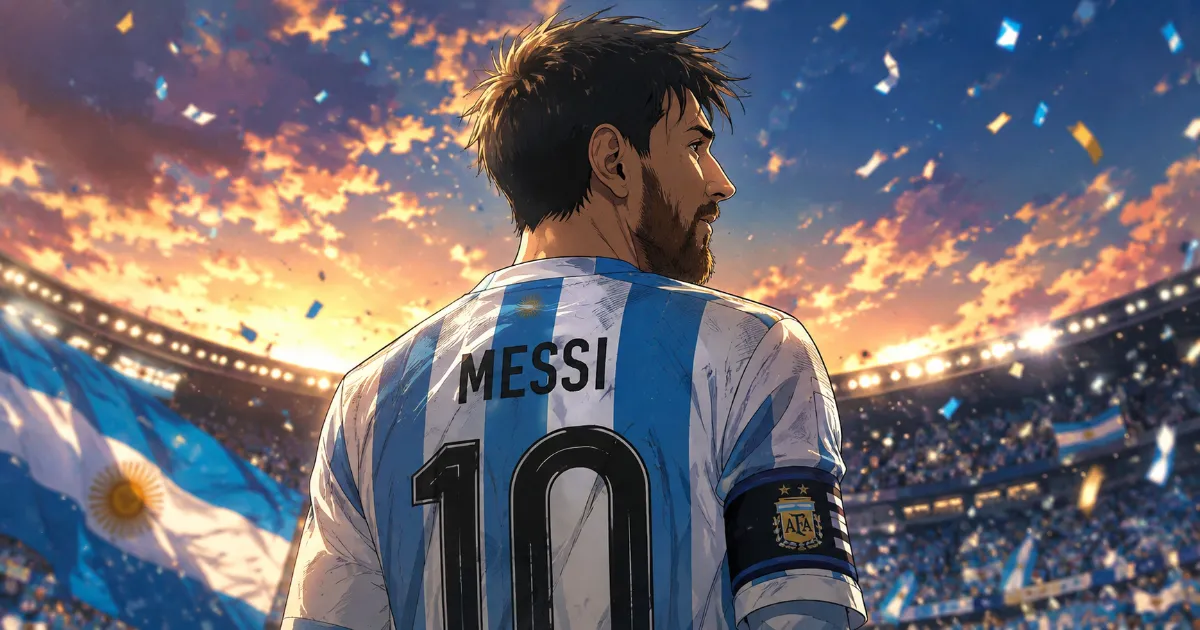
 Messi Retires from Argentina, Legend Ends 21-Year International Career
From a teenage debut in 2005 to a World Cup final defeat in 2026, Lionel Messi’s Argentina story closes with 207 caps, 125 goals, and a legacy few in football history can match
Lionel Messi has played his final match for Argentina. On Monday, the 39-year-old announced his retirement from international football in a heartfelt Instagram post showing a handwritten notebook entry, closing the book on a 21-year national team career that began when he was still a teenager and ended with him standing as the most decorated player in Argentine football history.
Thiago Messi: Club Career, Playing Style, Lifestyle and Future Prospects
Cristiano Ronaldo Jr.: Club, Lifestyle, Career and Future Prospects
The Announcement
Messi revealed that he had actually written the retirement message weeks earlier, on July 21 — two days after Argentina’s 2026 World Cup final defeat to Spain. He held off publishing it, but a family tragedy changed his mind. His father and longtime agent, Jorge Messi, passed away on August 8 at a hospital in Rosario at age 68. In a footnote added to the post, Messi said his father’s death left him even more certain of the decision than before.
The timing traces back to a summer of extremes. Argentina reached the 2026 World Cup final in July, only to lose 1-0 in extra time to Spain — agonizingly close to a second consecutive world title. Weeks later, Messi lost his father, the man who had guided his career since childhood and represented him professionally for decades. Against that backdrop, stepping away from the national team became less a football decision and more a deeply personal one.
In his message, Messi said he left with pride in the moments he and his teammates had given the country, moments once thought impossible. It was an emotional but measured farewell from a player who had spent two decades carrying the weight of a nation’s football expectations.
The Rise: Building Toward Greatness
Messi’s international story started quietly. He debuted for Argentina’s senior team in 2005 as a teenager freshly established at Barcelona, having moved to Spain’s La Masia academy as a 13-year-old after Newell’s Old Boys in Rosario could no longer support the medical costs of his growth hormone treatment. What followed at club level was one of the most extraordinary rises in football history — a slight, left-footed forward who would go on to redefine the sport’s record books.
By his early twenties, Messi was already collecting Ballon d’Or trophies and inspiring Barcelona to their historic 2009 sextuple, sweeping every major trophy available to a club side in a single calendar year. His individual brilliance during this stretch was so overwhelming that debates over the greatest player of all time became a fixture of football conversation for the next fifteen years.
But international success proved far more elusive than club glory, and that gap became the defining tension of the first half of his Argentina career.
The Downs: Heartbreak Before Redemption
For much of his twenties, Messi carried the frustrating label of a player who conquered everything at club level but couldn’t deliver for his country. Argentina lost three major finals in three years between 2014 and 2016 — the 2014 World Cup final to Germany, followed by back-to-back Copa América final defeats to Chile in 2015 and 2016, the second decided on penalties.
The 2016 loss broke something in him, at least temporarily. Devastated after missing a penalty in the shootout, Messi announced his international retirement on the spot in an emotional interview, declaring his time with the national team over. The decision didn’t stick — weeks later, following a nationwide public campaign and personal appeals from fans, he reversed course and rejoined the squad for World Cup qualifying.
Off the pitch, Messi also weathered a tax fraud case in Spain in 2013 alongside his father, a legal battle that shadowed his early thirties even as his on-field numbers continued climbing. At Barcelona, painful Champions League collapses — most notably a stunning comeback loss to Roma in 2018 and an 8-2 humiliation against Bayern Munich in 2020 — chipped away at the aura of invincibility that had surrounded the club during his prime years.
The lowest institutional point came in 2021. Barcelona’s financial crisis, compounded by La Liga’s spending regulations, made it impossible for the club to re-register Messi despite his willingness to take a pay cut and stay. He left in tears at a press conference, ending a 21-year association with the only club he had ever known as a professional, having finished as Barcelona’s all-time leading scorer with 672 goals.
His subsequent move to Paris Saint-Germain never fully clicked. Messi won two Ligue 1 titles in Paris, but his first season was statistically his quietest in over a decade, and he faced whistles from a section of PSG’s own fanbase during a difficult 2021-22 campaign — an almost unthinkable sight for a player of his stature.
Redemption: The Trophies Finally Arrive
Everything turned in 2021. Amid the COVID-19 pandemic, Messi captained Argentina to the Copa América title, defeating host nation Brazil 1-0 in the Maracanã — the same stadium where Argentina had suffered painful losses in the past. Ángel Di María scored the only goal, and Messi wept on the pitch afterward, finally a champion in Argentina’s colors after so many near-misses. It ended a 28-year trophy drought for the national team.
The following year brought the moment his entire career had been building toward. Messi led Argentina to the 2022 World Cup title in Qatar, scoring seven goals across the tournament, including a decisive performance in the final against France that ended in a penalty shootout win after a 3-3 draw. He won the Golden Ball as the tournament’s best player for the second time in his career, having also won it in 2014. It was the one trophy that had eluded him, and it silenced two decades of debate about his legacy at international level.
Messi added a second Copa América title in 2024, cementing Argentina’s position as the dominant force in South American football during his final competitive years. Even at 38, during World Cup qualifying for the 2026 tournament, he finished as the competition’s leading scorer with eight goals — a modest total by his own historic standards, but enough to top the qualifying charts one final time.
The Final Chapter: Miami, One Last World Cup, and Loss
Messi joined Inter Miami in July 2023, sparking a wave of interest in Major League Soccer rarely seen in the league’s history. He won the Leagues Cup almost immediately upon arrival, followed by an MLS Supporters’ Shield in 2024 and the club’s first-ever MLS Cup title in 2025. By August 2026, he had surpassed 100 appearances for the club and become the all-time leading scorer in Leagues Cup history.
He carried that club form into a sixth World Cup appearance in 2026, a feat no outfield player his age had previously achieved at that level. Messi briefly became the all-time leading World Cup goal scorer during the tournament with 21 career goals, only for France’s Kylian Mbappé to later surpass him with 22. Argentina reached the final once again, but this time the story didn’t end in celebration — Spain won 1-0 in extra time, denying Messi a chance to defend the title and add a second World Cup to his collection.
Six weeks after that final whistle, and three weeks after burying his father, Messi confirmed what many had quietly expected: his international career was over.
Career Records: The Numbers Behind the Legend
Messi retires from international duty as Argentina’s all-time leading scorer and most-capped player by an enormous margin. His final tally stands at 125 goals in 207 appearances, obliterating the previous national scoring record of 54 goals held by Gabriel Batistuta and the previous caps record of 147 held by Javier Mascherano. He is the only outfield player to have appeared in six World Cups, captaining Argentina in five of them.
His individual honors at international level include two FIFA World Cup Golden Balls (2014, 2022), a Silver Ball (2026), and a Silver Boot (2022) — a collection of tournament awards without real precedent in the modern game.
Across his entire career, spanning Barcelona, Paris Saint-Germain, Inter Miami, and Argentina, Messi has scored 927 goals in 1,171 official matches as of late August 2026 — 802 for his clubs and 125 for his country — while contributing roughly 460 career assists, putting his combined goal involvement above 1,380. He is an eight-time Ballon d’Or winner, the most in football history, and a six-time European Golden Shoe winner as the continent’s top league scorer.
Journey Through the Leagues
La Liga and Barcelona (2004-2021). Messi’s club career began and largely defined itself at Barcelona, where he made 778 appearances and scored 672 goals across all competitions — both club records that may never be broken. In La Liga specifically, he finished as the competition’s all-time leading scorer with 474 goals. During his 17 seasons as a first-team player, Barcelona won 10 La Liga titles, four Champions League trophies, and seven Copa del Rey titles, with Messi as the attacking focal point for almost the entire span. Individual peaks included a 45-goal domestic haul in 2017-18 and 51 goals across all competitions in 2018-19, seasons that helped fuel six of his eventual eight Ballon d’Or wins during his Barcelona years.
Ligue 1 and Paris Saint-Germain (2021-2023). Messi’s two seasons in France were statistically solid but never carried the same aura as his Barcelona peak. He won two Ligue 1 titles with PSG, forming a high-profile attacking trio alongside Neymar and Kylian Mbappé, though the collective never delivered the Champions League success the club had hoped his arrival would bring. It was, by most accounts, a transitional period — professionally productive but short of the standard he had set for nearly two decades in Spain.
MLS and Inter Miami (2023-present). Messi’s move to Major League Soccer reset expectations for what the league could achieve commercially and competitively. His debut season delivered an immediate Leagues Cup title, followed by continued success including a Supporters’ Shield in 2024 and the franchise’s first MLS Cup title in 2025. By August 2026, playing out of Inter Miami’s new home stadium, he remained the league’s most dangerous attacking threat well into his late thirties, highlighted by a four-goal, one-assist performance in a 7-1 win over CF Montréal just days before his international retirement announcement — a reminder that while his Argentina career has ended, his club career shows no sign of slowing down yet.
The Messi-Ronaldo Era
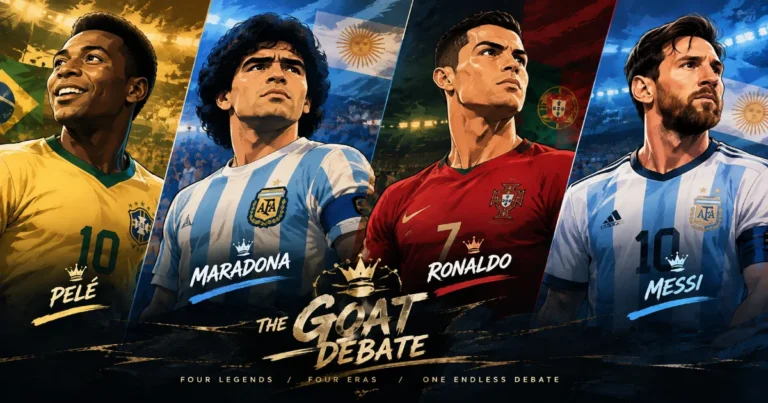
No account of Messi’s career is complete without acknowledging the parallel rise of Cristiano Ronaldo, whose competing brilliance at Real Madrid and Manchester United helped define nearly two decades of football discourse. The two players traded Ballon d’Or trophies for most of the 2010s, pushed each other’s numbers to previously unthinkable heights, and turned El Clásico into appointment viewing across the football world. Ronaldo remains ahead of Messi on the all-time international goal-scoring charts and holds the outright record for most World Cup goals following the 2026 tournament, but the two are now widely regarded as the standard against which every subsequent generation of attacking players will be measured. Messi’s international retirement effectively closes that chapter for good, even as both players continue extending their club careers into their late thirties.
Awards Timeline: A Career Measured in Trophies
Messi’s individual honors roll call reads like a history of modern football’s biggest prizes. His first Ballon d’Or arrived in 2009, the same year as Barcelona’s historic sextuple, and he added consecutive wins in 2010, 2011, and 2012 to become the first player to win it four times running. After a gap during Ronaldo’s peak years, Messi reclaimed the award in 2015, then again in 2019, before adding an eighth and record-extending trophy in 2023 on the back of his World Cup-winning heroics in Qatar. Alongside those eight Ballon d’Or wins sit six European Golden Shoe awards as the continent’s top league scorer — a record no other player has matched — plus two FIFA World Cup Golden Balls, a World Cup Silver Ball, a World Cup Silver Boot, and countless domestic Player of the Season honors across Spain, France, and the United States.
What Comes Next
Messi’s retirement is specific to international duty — he has given no indication that his club career with Inter Miami is coming to an end anytime soon, and his continued scoring output well into his late thirties suggests he still has meaningful football left to play at MLS level. For Argentina, the immediate question turns to succession: head coach Lionel Scaloni now faces the task of building toward the next World Cup cycle without the player who has anchored the national team’s attack for two decades. Enzo Fernández, Julián Álvarez, and Alejandro Garnacho are among the young core expected to carry Argentina’s ambitions forward, though replacing Messi’s individual output and leadership is a challenge no single successor is likely to fully answer.
For now, Argentina’s football federation and fans are left to process the end of an era that delivered the country’s third World Cup title and elevated Messi from a generational talent still chasing international validation to a player whose combination of longevity, statistical dominance, and clutch tournament performances places him at the very top of the sport’s all-time conversation.
A Legacy Without Real Comparison
Messi’s Argentina career traces a complete arc: prodigious teenage promise, years of heartbreak and unmet expectations, a redemptive stretch that delivered every trophy that had once seemed out of reach, and a final World Cup campaign that came agonizingly close to one more chapter of glory. Few careers in any sport combine that much longevity with that much sustained excellence — 21 years at the top level, six World Cups, two continental titles, and a World Cup trophy that transformed his legacy from generational talent to undisputed great.
With his international story now closed, attention turns to how much longer Messi continues at Inter Miami, where his numbers suggest he still has plenty left to give at club level, even as one of football’s longest and most decorated international careers officially comes to an end.
▪️▪️ Follow us on Facebook ▪️▪️
About the Author


9 thoughts on “Messi Retires: Inside the Rise, Falls, and Redemption of a Legend”