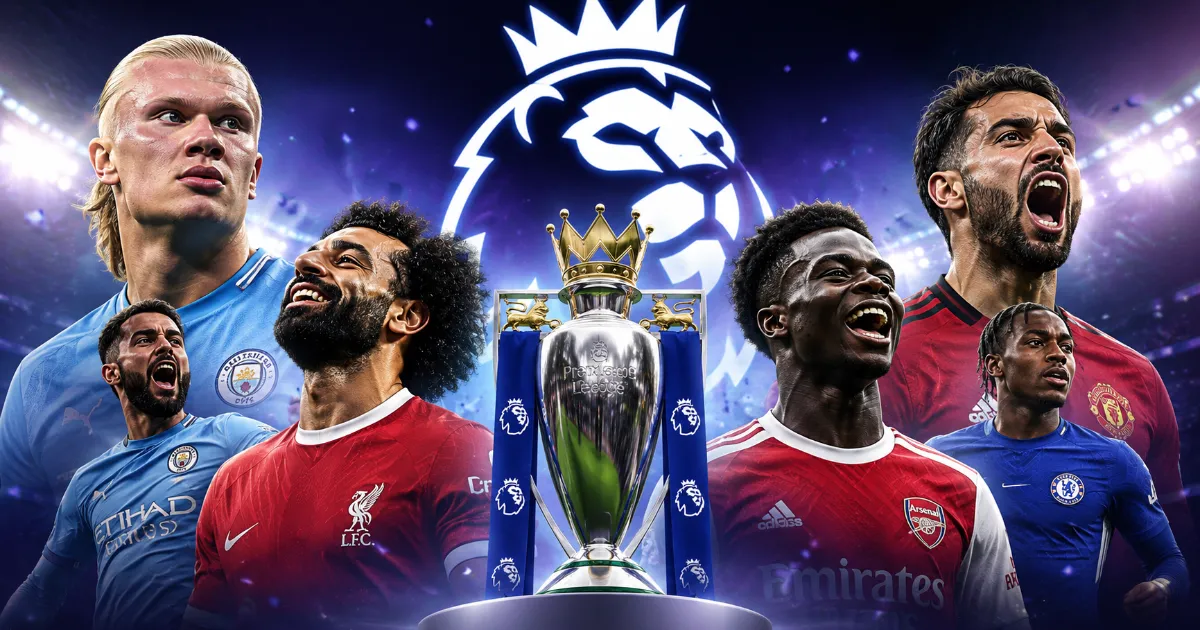
 From a breakaway TV deal in 1992 to Arsenal’s 2025-26 triumph, this is the complete history of how the Premier League became the world’s biggest domestic competition.
The History of the Premier League: 34 Years of the World’s Biggest Domestic League
Few sporting competitions have transformed as dramatically over three and a half decades as the Premier League. What began in 1992 as a breakaway television deal among England’s top clubs has grown into the most-watched domestic football league on Earth, broadcast to hundreds of millions of viewers across nearly every country in the world. This is the complete history of the Premier League, from its contentious founding through to Arsenal’s title-winning 2025-26 campaign, its 34th season.
Premier League vs MLS vs Saudi Pro League vs ISL 2026: Full Comparison of Fans, Tickets & Streaming
A Breakaway Built on Television Money
The Premier League wasn’t created out of footballing necessity, it was created out of a commercial opportunity. By the early 1990s, England’s top division, then known as the Football League First Division, was operating under a revenue-sharing model that distributed television income relatively evenly across all 92 professional clubs in the English football pyramid. The country’s biggest clubs, increasingly frustrated by what they saw as an unfair split given their far greater commercial drawing power, saw an opportunity to break away entirely and negotiate their own broadcast deal.
In 1992, the top division’s clubs formally split from the Football League to form the FA Premier League, immediately negotiating a landmark broadcast deal with the fledgling satellite broadcaster BSkyB, a partnership that would prove transformative for both parties. Sky’s willingness to invest heavily in exclusive Premier League coverage, at a time when satellite television itself was still an emerging technology in most British households, gave the newly formed league a financial foundation dramatically larger than what English football’s top clubs had ever previously enjoyed, setting the template for a commercial growth trajectory that would continue, largely uninterrupted, for the following three decades.
The Ferguson Era
Manchester United’s Alex Ferguson emerged as the dominant figure of the Premier League’s first two decades, guiding the club to the inaugural title in the 1992-93 season and going on to win an extraordinary 13 titles before his retirement in 2013. That level of sustained dominance, spanning multiple generations of players from Eric Cantona and the “Class of ’92” youth graduates through to Cristiano Ronaldo and Wayne Rooney, gave the league’s formative decades a clear central narrative, even as challengers like Arsenal, Chelsea, and Blackburn Rovers occasionally interrupted United’s grip on the title.
Arsenal’s own contribution to this era proved historically significant in its own right. Arsène Wenger’s 2003-04 squad completed an entire 38-match league season unbeaten, a feat that earned the team the nickname “The Invincibles” and remains, more than two decades later, one of the most celebrated single-season achievements in the competition’s history, a record that stood untouched until Arsenal’s own return to the summit over twenty years later.
The Financial Revolution
The mid-2000s brought a fundamental shift in the Premier League’s competitive landscape, driven by a new wave of enormously wealthy club ownership. Russian billionaire Roman Abramovich’s takeover of Chelsea in 2003 injected unprecedented financial resources into a mid-table club, funding a spending spree that quickly transformed Chelsea into genuine title contenders and, within a few seasons, back-to-back champions under José Mourinho. That transformation offered an early glimpse of how quickly a single wealthy owner could reshape a club’s competitive standing, a template that other investors would go on to replicate elsewhere in English football.
Manchester City’s 2008 takeover by the Abu Dhabi United Group represented an even more dramatic version of that same financial disruption, eventually turning a club with a modest recent trophy history into the league’s most dominant force of the following decade and a half. Under manager Pep Guardiola, who arrived in 2016, City built a squad and playing philosophy that delivered multiple Premier League titles, including a historic treble in the 2022-23 season, cementing the club’s transformation from perennial underachiever to the benchmark every other Premier League side was forced to measure itself against.
The Miracle of Leicester City
Amid this backdrop of increasingly concentrated financial power among a handful of super-wealthy clubs, the Premier League produced what remains, by wide consensus, the single greatest underdog story in its history. Leicester City, priced by bookmakers at 5,000-to-1 odds to win the title before the 2015-16 season began, defied every reasonable expectation to claim the championship under manager Claudio Ranieri, built around inspired performances from Riyad Mahrez, Jamie Vardy, and N’Golo Kanté. The achievement remains a frequently cited reminder that, despite the league’s growing financial concentration among a small handful of super-clubs, genuine sporting unpredictability had not been entirely engineered out of English football’s top flight.
Liverpool’s Long-Awaited Returns
Liverpool’s own Premier League story has been defined by a mixture of near misses and eventual triumph. Despite being one of English football’s most decorated clubs historically, Liverpool went three full decades without a top-flight league title before finally ending that drought in the 2019-20 season under manager Jürgen Klopp, a campaign built on the attacking trio of Mohamed Salah, Sadio Mané, and Roberto Firmino alongside a historically dominant defense. Following Klopp’s eventual departure, Liverpool returned to the summit again in the 2024-25 season under new manager Arne Slot, securing the club’s 20th English top-flight title overall and second specifically under the Premier League era, a triumph that briefly restored Liverpool to the position of the Premier League’s most successful club by total English championships won.
Arsenal’s Long-Awaited Coronation
That Liverpool triumph, however, set the stage for arguably the most emotionally significant title win of the league’s recent history. Arsenal, who had finished as Premier League runners-up in three consecutive seasons, including an agonizing two-point defeat to Manchester City in 2023-24, finally ended a 22-year wait for the English top-flight championship by winning the 2025-26 season under manager Mikel Arteta. The triumph, secured with a game to spare after Manchester City’s draw at Bournemouth eliminated any remaining mathematical possibility of catching the Gunners, marked Arsenal’s fourth Premier League title and 14th English championship overall, placing the club just one behind Chelsea and two ahead of Liverpool in the all-time English title standings. Built on a formidable defensive record, including 19 clean sheets and a third consecutive Golden Glove award for goalkeeper David Raya, Arsenal’s triumph was widely seen as validation of Arteta’s multi-year rebuilding project, one that had repeatedly fallen agonizingly short in the preceding seasons before finally delivering the club’s first title since Wenger’s Invincibles squad of 2003-04.
A Truly Global Product
Beyond the individual title races, the Premier League’s most consequential transformation over its 34-year history has arguably been its evolution into a genuinely global media product. Broadcast to an estimated audience across more than 190 countries, the league now generates the vast majority of its enormous broadcast revenue from international rather than domestic television deals, a reversal from the league’s early years that reflects just how far its commercial reach has expanded beyond England’s own borders. That global audience has, in turn, fueled the increasingly international makeup of Premier League squads and coaching staffs, with the competition now featuring players and managers from every populated continent, a far cry from the overwhelmingly domestic playing rosters of the league’s earliest seasons in the early 1990s.
Financial Regulation and Its Growing Pains
The Premier League’s enormous financial growth hasn’t come without its own institutional tensions, particularly around how the league regulates spending among its increasingly wealthy member clubs. Profit and Sustainability Rules, designed to prevent clubs from spending beyond what their actual revenue can sustainably support, have produced genuine controversy in recent seasons, including high-profile points deductions for clubs found in breach of the regulations. These disputes reflect an ongoing tension at the heart of the modern Premier League: a competition built from its very founding on maximizing commercial revenue, now grappling with how to fairly regulate the spending of increasingly wealthy ownership groups without undermining the competitive balance that made the league compelling to its global audience in the first place.
Why the Premier League’s Story Keeps Evolving
Looking back across 34 seasons, the Premier League’s history reads less like a single continuous narrative and more like a series of distinct eras, Ferguson’s long dominance, the financial disruption brought by Chelsea and Manchester City’s wealthy new owners, Leicester’s inexplicable fairytale, and the recent, emotionally charged title returns for both Liverpool and Arsenal after decades of relative frustration. That constant evolution, commercial, competitive, and cultural, is precisely what has allowed the league to remain the most-watched domestic football competition in the world more than three decades after that original, contentious breakaway from the Football League, and it’s a trajectory that shows little sign of slowing as the competition heads toward its fourth full decade of existence.
The Managerial Merry-Go-Round
One of the more understated storylines running throughout Premier League history has been the league’s uniquely intense managerial pressure, a dynamic considerably more pronounced than in most other major European leagues. Ferguson and Wenger’s multi-decade tenures at Manchester United and Arsenal respectively now stand as historical outliers rather than the norm, with the modern Premier League characterized by significantly shorter managerial cycles, even at clubs enjoying sustained success. Chelsea alone has cycled through more than a dozen permanent managers since Abramovich’s 2003 takeover, a churn rate that reflects the extraordinary financial stakes involved in Premier League survival and success, where a handful of poor results can trigger swift ownership intervention regardless of a manager’s longer-term project.
This managerial instability has become such a defining feature of the competition that it’s frequently cited by football analysts as one of the clearest structural differences between the Premier League and continental leagues like Spain’s La Liga or Germany’s Bundesliga, where longer managerial tenures have historically been more common at the very top clubs. Guardiola’s extended spell at Manchester City and Arteta’s own multi-year rebuilding project at Arsenal, culminating in the 2025-26 title, both stand out as increasingly rare exceptions to a broader Premier League pattern of managerial turnover driven by the sheer financial and competitive pressure the league’s success has generated.
Youth Development and the Academy Question
The Premier League’s enormous broadcast revenue has also reshaped how English football approaches youth development, another significant but often overlooked strand of the league’s broader history. The introduction of the Elite Player Performance Plan in 2012 restructured how academies across the country operate, aiming to produce more technically proficient homegrown talent capable of competing with the increasingly cosmopolitan, internationally recruited squads that Premier League clubs’ financial resources allow them to assemble. The debate over whether English football’s growing wealth has helped or hindered homegrown player development remains a persistent, unresolved thread throughout the league’s history, particularly as clubs increasingly look overseas for teenage talent given the global scouting networks their broadcast revenue has made possible.
Competitive Balance in an Age of Financial Concentration
Perhaps the most consequential ongoing debate in modern Premier League history concerns competitive balance itself. With the gap in resources between the league’s wealthiest clubs and its smaller, more traditionally run counterparts growing wider with each new broadcast cycle, questions about whether genuine title-winning surprises like Leicester’s 2015-16 triumph remain realistically possible have become a recurring subject of debate among pundits, fans, and football administrators alike. Arsenal’s own recent title win, following three consecutive runner-up finishes built through a patient, methodical rebuild under Arteta rather than a single dramatic ownership-driven spending spree, offers one recent counterpoint to the narrative of an increasingly closed competition, even as Manchester City’s continued financial dominance under City Football Group ownership suggests the underlying tension between football romance and financial reality remains far from resolved as the Premier League moves into its next chapter.
The Broadcast Revolution Within the Broadcast Revolution
It’s worth remembering that the Premier League’s relationship with television hasn’t remained static since that original 1992 Sky deal, and the league’s ongoing adaptation to shifting media consumption habits represents its own significant chapter in the broader history. Successive broadcast rights cycles have seen rights fees climb dramatically, with international broadcast revenue eventually overtaking domestic income as the league’s single largest source of television-related revenue, a reflection of the sport’s growing popularity across Asia, North America, and Africa in particular. Streaming platforms have increasingly entered the bidding process alongside traditional satellite and cable broadcasters in recent rights cycles, adding a new layer of competition to a broadcast marketplace that, three decades ago, existed in a form barely recognizable compared to today’s fragmented, increasingly digital media landscape.
This ongoing broadcast evolution has direct consequences for how clubs experience the competition financially, since a Premier League club’s broadcast revenue share now typically dwarfs the total operating budget of clubs playing in England’s lower professional divisions, a financial gulf considerably wider than existed in the league’s earlier decades. That widening gap between the Premier League and the rest of English football’s pyramid remains one of the more persistent structural critiques of the competition’s long-term trajectory, even as it has directly enabled the enormous global growth that has made the Premier League the most-watched domestic football league on the planet, a status that shows no obvious signs of changing as the competition continues into its 35th season and looks ahead to still more chapters in its long, still-unfolding history.
▪️▪️ Follow us on Facebook ▪️▪️
About the Author