 The Real Reasons Football Became a Truly Global Game
Simplicity, empire, and broadcast technology all played a role in turning a Victorian schoolyard game into the world’s most popular sport.
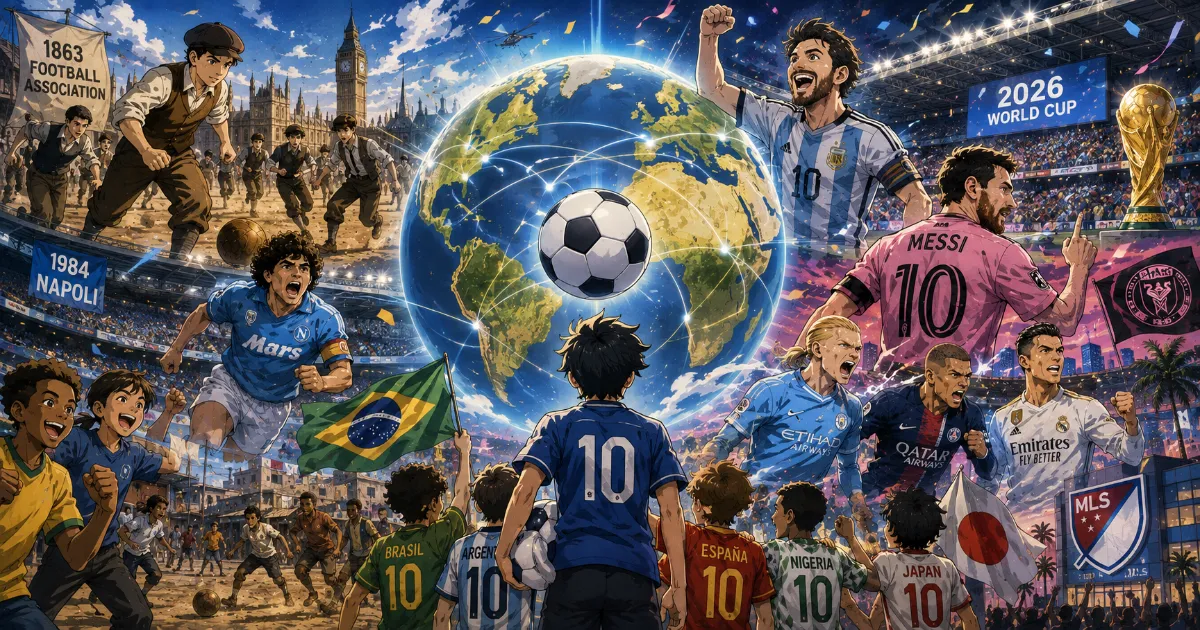
No other sport comes close to football’s genuine global reach. It’s the most widely played and watched sport on every populated continent, followed by an estimated audience of billions worldwide, and governed by a confederation structure spanning more member nations than the United Nations itself. Understanding how a game formalized in Victorian England grew into this genuinely universal phenomenon requires looking at several distinct forces working together across more than a century, from the sport’s inherent simplicity to the deliberate mechanics of imperial expansion and, eventually, the transformative power of global broadcast technology.
Messi Retires: Inside the Rise, Falls, and Redemption of a Legend
10 Football Documentaries Every Fan Needs to Watch at Least Once
The 10 Best Football Books Ever Written — The Ultimate Fan Reading List
A Game Built for Almost Nothing
Football’s single greatest structural advantage over nearly every other major global sport is its extraordinarily low barrier to entry. Unlike sports requiring specialized equipment, expensive facilities, or considerable technical infrastructure, football requires, at its most basic level, nothing more than a ball and an open space, conditions achievable in almost any community on Earth regardless of local economic conditions. That simplicity meant football could take root in wealthy European capitals and impoverished rural villages alike, played on manicured grass pitches or improvised dirt lots, with a rolled-up bundle of rags standing in for an actual ball in communities without access to proper equipment.
This accessibility gave football a structural advantage that sports like cricket, American football, or ice hockey, each requiring considerably more specialized equipment, training, or climate conditions, simply couldn’t match when it came to genuine global grassroots adoption. A child anywhere in the world could begin playing football with minimal resources and immediately grasp the sport’s essential objective, scoring more goals than the opposition, without needing to understand a complex rulebook before meaningful participation became possible.
Codified by the British, Spread by the Empire
While informal ball-kicking games existed across many cultures throughout history, the specific, formally codified version of football that would eventually conquer the globe was standardized in England during the mid-nineteenth century, with the formation of the Football Association in 1863 establishing a unified rulebook that had previously varied considerably between different schools and regions. That codification proved historically significant not just for organizing the sport domestically, but because it happened to occur at the exact moment the British Empire was near the height of its global territorial and commercial reach.
British sailors, merchants, engineers, and colonial administrators carried the newly codified sport with them as they traveled and worked across the empire’s vast global network, introducing football to communities across South America, Africa, and Asia often years or even decades before those regions developed their own comparably formalized domestic sporting institutions. Argentina and Uruguay’s early football cultures, for instance, trace directly back to British railway workers and traders active in the region during the late nineteenth century, a pattern repeated with variations across numerous other countries that would go on to develop some of the sport’s most passionate football cultures.
This colonial-era spread gave football an enormous head start over potential rival sports in establishing itself as the default, most accessible organized sporting option across huge swaths of the developing world, an advantage that largely persisted and compounded over subsequent generations even as formal colonial relationships themselves eventually dissolved through the twentieth century’s broader wave of decolonization.
Independent From Any Single National Sporting Culture
A crucial, often underappreciated factor in football’s global rise involves what the sport wasn’t tied to as tightly as some of its rivals. Unlike baseball, which remained closely associated with specifically American cultural identity even as it spread to parts of East Asia and the Caribbean, or cricket, which retained a strong specific association with British imperial administration and colonial-era class structures in the regions where it took hold, football managed to shed much of its specifically English cultural association relatively quickly once it spread internationally. Nations across South America, continental Europe, and eventually Africa and Asia rapidly developed their own distinctly local footballing identities, styles, and domestic institutions, allowing the sport to feel genuinely native rather than perpetually foreign in the vast majority of countries where it eventually became dominant.
This localization process meant football could simultaneously represent working-class British industrial culture, Argentine national pride, West African postcolonial identity, and Southern European regional politics, often within the very same historical era, without any single one of those associations undermining the sport’s broader claim to universal appeal elsewhere in the world. Few other major global sports have managed that same degree of successful cultural localization across such a genuinely diverse range of national and regional contexts.
FIFA and the Institutional Framework for Global Growth
Football’s global spread also benefited enormously from having a single, genuinely global governing institution capable of coordinating the sport’s growth and establishing consistent rules and competitive structures across every participating nation. FIFA’s founding in 1904, and Jules Rimet’s subsequent creation of the World Cup in 1930, gave football an institutional framework considerably more centralized and coordinated than existed for many rival sports during the same era, allowing the sport to establish consistent international competition structures that could grow in tandem with the sport’s expanding global footprint.
That institutional coordination proved particularly valuable as decolonization accelerated through the mid-twentieth century, with FIFA’s confederation structure providing newly independent nations across Africa and Asia with an immediate, ready-made pathway to establish their own national football programs and gain access to established international competition, a considerably faster route to genuine global sporting participation than many alternative sports could offer during that same critical postcolonial period of nation-building.
The Television Era Transformed Everything
If football’s early spread depended on simplicity and colonial-era person-to-person transmission, its later transformation into a genuinely mass-consumed global phenomenon depended almost entirely on the rise of television broadcasting through the mid-to-late twentieth century. The World Cup’s growing broadcast reach, combined with the increasing international television coverage of Europe’s biggest domestic leagues and clubs from the 1960s onward, allowed football fandom to spread to audiences who might never have direct contact with the sport’s earlier colonial-era transmission networks at all.
This broadcast-driven expansion accelerated dramatically from the 1990s onward, as satellite and cable television technology made live coverage of top European leagues increasingly accessible across Asia, Africa, and the Americas, creating genuinely global fan bases for individual clubs like Manchester United, Real Madrid, and Barcelona that extended far beyond those clubs’ original domestic or even continental audiences. The more recent rise of internet streaming and social media has only intensified this trend, allowing highlight clips, individual player content, and full match broadcasts to reach fans in even the most remote corners of the globe almost instantaneously, a level of accessible global reach that would have seemed entirely unimaginable during football’s earliest colonial-era spread over a century earlier.
A Sport That Keeps Finding New Audiences
Football’s global growth hasn’t been a purely historical phenomenon confined to the sport’s colonial-era origins or the broadcast-driven expansion of the late twentieth century. The sport continues to actively expand into new markets even today, with significant recent investment in growing football’s profile and infrastructure across the United States, Saudi Arabia, and other markets historically dominated by different sporting cultures. The 1994 and 2026 World Cups in the United States, along with the continued growth of Major League Soccer, represent one such ongoing expansion effort, while Saudi Arabia’s substantial recent investment in attracting global superstars to its domestic league reflects a similarly deliberate strategy to grow football’s cultural relevance within a market that has historically favored other sports.
Women’s football has also experienced a particularly significant recent surge in global popularity and institutional investment, with tournaments like the Women’s World Cup drawing rapidly growing broadcast audiences and increased domestic league investment across multiple continents, representing perhaps the most significant frontier for football’s continued global growth in the years immediately ahead, an expansion story still very much being written even as the men’s game’s own global dominance remains firmly established.
Why No Other Sport Has Matched It
Taken together, these overlapping factors, football’s near-zero barrier to entry, its historically fortunate timing alongside British imperial expansion, its unusual capacity for genuine local cultural adaptation, FIFA’s coordinated global institutional structure, and the sport’s particularly effective exploitation of successive broadcast technology revolutions, help explain why football achieved a level of genuine global reach that no rival sport has managed to fully replicate. Basketball and cricket have each achieved significant regional or even multi-continental popularity, but neither has matched football’s combination of near-universal grassroots participation and truly global elite-level broadcast audience. Understanding this layered, multi-causal history helps explain not just how football became the world’s most popular sport, but why that position appears likely to remain remarkably secure for the foreseeable future, even as the specific mechanisms driving the sport’s continued global growth keep evolving with each new generation of technology and each newly emerging football market around the world.
Why Football’s Closest Rivals Fell Short
It’s worth examining more closely why football’s most significant potential rivals for the title of world’s most popular sport ultimately fell short of matching its truly universal reach. Cricket, despite an enormous and passionate following across South Asia, Australia, and parts of Africa and the Caribbean, remained closely tied to specifically British imperial administrative culture in a way that limited its adoption in regions without direct historical ties to that colonial framework, and the sport’s considerably longer match formats, even in the shortened Twenty20 variant, created a higher barrier to casual global engagement than football’s comparatively brisk ninety-minute structure. Basketball, invented considerably later than football in 1891, has achieved genuine global popularity particularly across parts of Europe, East Asia, and increasingly Africa, but its requirement for specialized indoor courts and hoops in many competitive contexts has historically limited its grassroots accessibility compared to football’s ability to be played almost anywhere with minimal equipment.
American football and baseball, meanwhile, despite achieving deep cultural saturation within the United States specifically, never developed the kind of broad multi-continental institutional infrastructure that football’s early FIFA-coordinated global expansion achieved, remaining largely confined to American cultural export markets rather than establishing genuinely independent domestic institutions and passionate local fan cultures across dozens of countries the way football managed to achieve across South America, Europe, Africa, and increasingly Asia throughout the twentieth century.
The Role of Simplicity in Fan Comprehension
Beyond the practical accessibility of actually playing football with minimal equipment, the sport’s rules also proved unusually easy for new fans to grasp quickly, a factor that mattered enormously as the sport spread to audiences with no prior exposure to organized Western sporting culture at all. Football’s core objective, scoring more goals than the opposition within a fixed time period, requires none of the specialized scoring knowledge needed to follow cricket’s complex over-by-over run calculations or American football’s intricate down-and-distance system. This relative simplicity of comprehension meant football could be picked up and understood by an entirely new audience within minutes of watching a single match, a considerable advantage when the sport began reaching genuinely global broadcast audiences with limited prior context or explanation available to them.
A Genuinely Self-Reinforcing Cycle
Perhaps the most important dynamic in football’s sustained global dominance is how thoroughly self-reinforcing its popularity has become over time. As football’s broadcast reach and grassroots participation grew across successive generations, the sport’s talent pool expanded correspondingly, producing an increasingly deep well of genuinely world-class players from an ever-widening range of countries, a talent depth that in turn made the sport’s biggest tournaments and leagues considerably more competitively compelling to a global audience than they might otherwise have been. This created a genuinely self-reinforcing cycle: broader global participation produced deeper talent pools, which produced more compelling elite-level competition, which in turn drove even greater broadcast interest and grassroots participation in the sport’s newest and fastest-growing markets. Few sports have managed to establish that same kind of mutually reinforcing growth cycle across such a genuinely global scale, and it’s precisely that cycle, rather than any single historical factor alone, that has kept football’s position as the world’s most popular sport so remarkably durable across more than a century of continued global expansion.
What Sustained Dominance Looks Like Going Forward
Looking ahead, football’s continued global dominance seems likely to depend on the same underlying combination of factors that built it in the first place: accessibility, cultural adaptability, institutional coordination, and effective use of whatever broadcast or distribution technology happens to define a given era. The sport’s ongoing expansion into markets like the United States and Saudi Arabia demonstrates that even a genuinely dominant global sport still requires active, deliberate investment to grow its presence in regions with strong existing rival sporting cultures, a reminder that football’s current status, however secure it may currently appear, was never simply inevitable but was instead actively built through more than a century of accumulated structural advantages, historical timing, and sustained institutional effort.
That ongoing effort, whether measured through continued investment in women’s football, the deliberate cultivation of new domestic markets, or football’s continued adaptation to whatever the next generation of broadcast and streaming technology eventually looks like, suggests the sport’s global growth story is far from finished, even after already becoming, by nearly every meaningful measure, the most popular and widely played sport the world has ever seen.
▪️▪️ Follow us on Facebook ▪️▪️
2034 FIFA World Cup: Saudi Arabia’s Hosting, Explained
What Cristiano Ronaldo Doesn’t Have: The One World Cup Trophy That Couldn’t Define His Greatness
About the Author