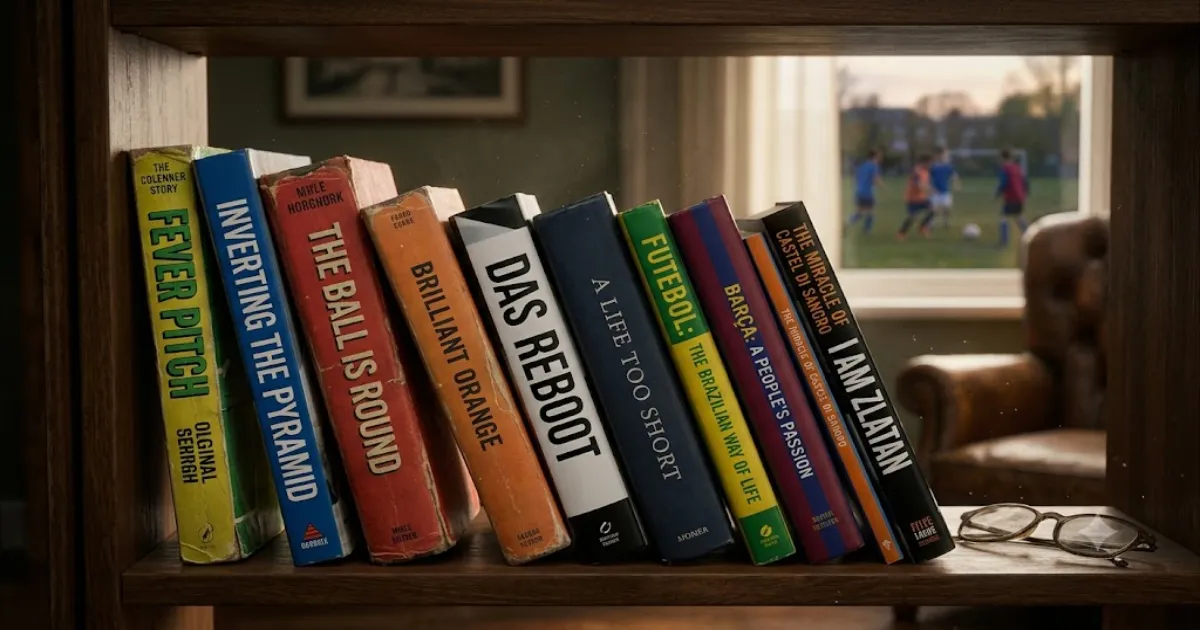
From tactical revolutions and legendary players to tragedy, politics and terrace culture, these are the football books every serious fan should read
Football is usually experienced through ninety minutes: the noise of a stadium, the tension of a penalty, the celebration after a last-minute winner. But some of the sport’s most powerful stories have nothing to do with watching a match. They live in books.
Erling Haaland Baby Names Peru: Why Hundreds of Newborns Are Being Named After the Norway Star
Thiago Messi: Club Career, Playing Style, Lifestyle and Future Prospects
Cristiano Ronaldo Jr.: Club, Lifestyle, Career and Future Prospects
The best football books ever written do more than describe goals, trophies and famous players. They explain why supporters become emotionally attached to clubs, how tactical ideas transform the game, why football becomes intertwined with national identity, and what happens to the people living behind the public image of professional sport.
From Arsenal’s terraces to the tactical laboratories of European football, from Brazil’s streets to the political history of Barcelona, these ten books demonstrate just how many stories can exist inside the world’s most popular sport.
1. Fever Pitch — Nick Hornby
Few football books have captured the psychology of fandom as brilliantly as Nick Hornby’s Fever Pitch. Originally published in 1992, the memoir chronicles Hornby’s lifelong relationship with Arsenal and examines the strange emotional contract between a supporter and a football club.
Rather than simply describing matches, Hornby uses games as landmarks in his own life. Arsenal’s results become connected to relationships, friendships, family events, work and personal development. A victory can transform an otherwise ordinary day, while a defeat can linger far longer than it logically should.
That is what makes Fever Pitch so enduring. You do not have to support Arsenal to understand it. Hornby recognizes that football fandom is frequently irrational, occasionally destructive and almost impossible to explain to someone who has never experienced it. The book remains one of the most accessible introductions to football literature because its real subject is not Arsenal — it is obsession.
2. Inverting the Pyramid — Jonathan Wilson
For readers who want to understand how football became the tactical game it is today, Jonathan Wilson’s Inverting the Pyramid is essential.
Wilson traces the evolution of football formations and tactical philosophies from the early days of the sport through the development of systems such as WM, catenaccio, Total Football and the modern pressing game. More importantly, he introduces the coaches, players and football thinkers responsible for these transformations.
The book can become detailed, particularly for readers unfamiliar with tactical terminology, but Wilson consistently gives the historical developments a narrative quality. Football’s tactical evolution becomes a story of experimentation: coaches changing formations, players redefining positions and entire nations developing distinct approaches to the game.
For anyone who has ever wondered why a 4-3-3 looks different from a 4-4-2 or how modern positional play developed, this is one of the finest places to start.The Fastest NBA Players Ever, Ranked
Who Is Gianluigi Buffon? The Journey of Italy’s Legendary Goalkeeper
3. The Ball Is Round — David Goldblatt
David Goldblatt’s The Ball Is Round attempts something considerably larger than a conventional football history. It uses the sport as a way of understanding the political, social and economic development of the modern world.
Goldblatt explores football’s relationship with colonialism, nationalism, dictatorship, migration, globalization and mass media. The book travels across continents and decades, demonstrating how football has repeatedly reflected the societies in which it developed.
Its enormous scope can occasionally make it feel overwhelming, but that ambition is also its greatest strength. Football is not treated as something isolated from politics or history. Instead, Goldblatt demonstrates how deeply the sport has been embedded in both.
For readers who want to understand football beyond the pitch, The Ball Is Round is arguably one of the most important books available.
4. Brilliant Orange — David Winner
Dutch football has produced some of the most influential tactical ideas in the history of the sport, and David Winner’s Brilliant Orange explores the culture that surrounded that revolution.
The book examines Total Football and the Dutch obsession with space, movement and fluidity, while drawing connections between football, architecture, art and Dutch society. Winner’s central argument is that the Netherlands’ relationship with space — including the country’s history of reclaiming land from the sea — helps explain certain characteristics of its football philosophy.
Not every cultural connection will convince every reader, but that is part of the book’s appeal. Brilliant Orange encourages readers to think about football differently. Instead of treating tactics as isolated instructions from a coach, it asks whether a nation’s football can reflect the way its people see their world.
That makes it one of the most distinctive books on football culture and tactical philosophy.
5. Das Reboot — Raphael Honigstein
How does a football nation rebuild itself after failure?
Raphael Honigstein’s Das Reboot provides one of the best answers by examining Germany’s transformation following its disappointing performance at Euro 2000.
Rather than focusing solely on the players who eventually won the 2014 World Cup, Honigstein investigates the structural changes that happened underneath them. Youth academies were redesigned, coaching education was improved and German football began developing players differently.
The eventual success of the 2014 generation therefore becomes more than a story about Joachim Löw, Manuel Neuer, Philipp Lahm, Thomas Müller or Miroslav Klose. It becomes the conclusion of a long-term national football project.
For supporters interested in academy development, coaching structures and the business of creating successful football systems, Das Reboot is particularly valuable.
6. A Life Too Short — Ronald Reng
Ronald Reng’s A Life Too Short is one of the most moving and difficult books in football literature.
It tells the story of German goalkeeper Robert Enke, whose career included spells with Borussia Mönchengladbach, Benfica, Barcelona and Hannover 96 before his death by suicide in 2009. Reng, who was a close friend of Enke, combines biography with an intimate examination of the psychological pressures surrounding elite sport.
Enke’s story demonstrates how dramatically the public image of a footballer can differ from private reality. A goalkeeper may appear calm and confident in front of tens of thousands of supporters while privately struggling with depression and fear.
The book is not an easy read, but it is an important one. It challenges football’s traditional culture of silence around mental health and reminds readers that professional athletes remain human beings underneath the shirts, statistics and headlines.
Because of its subject matter, A Life Too Short should be approached with care. But its honesty is precisely what makes it one of the most significant football biographies ever published.
7. Futebol: The Brazilian Way of Life — Alex Bellos
Brazilian football is often reduced to familiar images: beaches, street football, samba, skill and legendary No. 10s.
Alex Bellos goes considerably deeper.
In Futebol: The Brazilian Way of Life, Bellos explores how football became embedded within Brazilian society and examines the social, economic and cultural forces that helped create the country’s extraordinary footballing identity.
The book moves beyond romanticized stories of children playing football in the streets. It examines the realities surrounding young players, the football business and the social structures that have helped Brazil produce generation after generation of extraordinary talent.
Bellos also captures the country’s relationship with football away from the professional stadium. The result is both a football book and a cultural portrait of Brazil.
For readers fascinated by why certain countries produce particular footballing identities, this is an especially rewarding choice.
8. Barça: A People’s Passion — Jimmy Burns
To understand FC Barcelona, it helps to understand Catalonia.
Jimmy Burns’ Barça: A People’s Passion examines the history of the club alongside the political and cultural identity of the region. Barcelona became far more than a football team; at various points in its history, it represented Catalan identity, regional pride and opposition to centralized political authority.
The Franco era is particularly important to the book’s narrative. Barcelona’s identity became intertwined with a broader sense of cultural resistance, giving the club’s matches a significance that extended beyond football.
That history also helps explain why Barcelona’s rivalry with Real Madrid has carried such enormous cultural and political weight.
The book is essential reading for anyone who wants to understand why the phrase “Més que un club” — more than a club — means considerably more than a marketing slogan.
9. The Miracle of Castel di Sangro — Joe McGinniss
Some football stories are so strange that they sound fictional.
Joe McGinniss’ The Miracle of Castel di Sangro follows a tiny Italian club from the town of Castel di Sangro as it improbably competes in Serie B.
McGinniss spent an extended period around the club, observing players, coaches, officials and supporters. What emerges is a fascinating portrait of Italian football at a level far removed from the glamour of Juventus, Milan or Inter.
The book explores ambition, money, community, politics and the sometimes murky realities of professional football. It also captures the extraordinary emotional relationship between a small town and its football team.
Its greatest strength is the outsider’s perspective. McGinniss approaches Italian football with the curiosity of someone discovering a culture rather than assuming he already understands it.
The result is part football story, part travelogue and part examination of the strange ecosystem surrounding professional sport.
10. I Am Zlatan — Zlatan Ibrahimović with David Lagercrantz
Very few footballers have ever possessed a personality as unmistakable as Zlatan Ibrahimović.
I Am Zlatan tells his story in the first person, following his journey from Malmö to Ajax, Juventus, Inter Milan, Barcelona, AC Milan and eventually Paris Saint-Germain and beyond.
The book’s greatest attraction is its voice. Zlatan’s confidence, arrogance, humor and self-belief are impossible to separate from the story. He does not present himself as a conventional sporting hero, and that makes the autobiography far more entertaining than a standard chronological account of trophies and goals.
Behind the famous personality, however, there is also a genuine underdog story. Ibrahimović grew up in a working-class immigrant neighborhood in Malmö and developed his football identity in an environment where confidence was not simply useful — it was necessary.
Whether readers love Zlatan or find him infuriating, I Am Zlatan provides an unusually candid portrait of one of football’s most fascinating personalities.
Why These Are Among the Best Football Books Ever Written
The ten books on this list cover completely different subjects, but they share one important characteristic: football is never the only story.
Fever Pitch is ultimately about obsession and identity. Inverting the Pyramid is about tactical evolution. The Ball Is Round examines football’s relationship with world history. A Life Too Short explores mental health and the hidden pressures of professional sport.
That variety is what makes football literature so fascinating.
The best books do not simply recreate matches that supporters have already watched. They provide context that television coverage cannot. A match lasts ninety minutes, but a book can explain the politics behind it, the tactical revolution that produced it, the childhood that shaped the player or the social circumstances that made the club important to an entire community.
What Separates Great Football Books From Ordinary Ones?
Football publishing is filled with autobiographies and quickly produced books that disappear almost as soon as the season ends. The strongest works tend to be different.
They contain genuine storytelling rather than simply a sequence of results. They allow their subjects to be complicated rather than presenting perfect sporting heroes. They explore uncomfortable subjects instead of avoiding them, and they give readers something that cannot be found in a match report.
Specificity also matters.
A Life Too Short works because it focuses intensely on Robert Enke. Brilliant Orange develops a distinctive argument about Dutch football and space. Fever Pitch transforms individual Arsenal matches into chapters in a personal story.
The greatest football writers understand that a narrow subject can reveal something much larger about the sport.
Where Should a New Reader Start?
For someone completely new to football literature, Fever Pitch is probably the easiest starting point. You do not need detailed tactical knowledge or an encyclopedic understanding of Arsenal to appreciate Hornby’s writing.
If tactics are your primary interest, begin with Inverting the Pyramid. It requires more concentration but provides a fascinating education in how football systems have evolved.
For readers more interested in human stories, A Life Too Short is perhaps the most powerful choice, although its themes of depression and suicide make it considerably heavier than the other books on this list.
And if personality is what attracts you to football, I Am Zlatan is difficult to beat.
Honorable Mentions
A top-ten list inevitably leaves out outstanding books.
Simon Kuper’s Soccer Against the Enemy is an excellent examination of football’s relationship with politics across different countries. Michael Calvin’s The Nowhere Men provides a fascinating look into the secretive world of football scouting, while Duncan Hamilton’s Provided You Don’t Kiss Me offers an affectionate and frequently hilarious portrait of legendary English manager Brian Clough.
Other football books worth exploring include works covering clubs, World Cup history, hooligan culture, player biographies and the economics of modern football.
The list can therefore become almost endless.
The Final Whistle
The greatest football books prove that the sport has never really been just about football.
It is about belonging to something. It is about identity, geography, politics, childhood memories and family traditions. It is about tactical ideas that change the way millions of people see a game, and about players carrying private struggles behind public success.
That is why the best football books ever written continue to matter long after the matches they describe have disappeared from television schedules.
Whether you begin with Hornby’s Arsenal obsession, Wilson’s tactical history, Reng’s heartbreaking portrait of Robert Enke or Ibrahimović’s extraordinary autobiography, each book offers a different route into the same enormous subject.
Football happens on the pitch.
But some of its best stories happen on the page.
▪️▪️ follow us on facebook ▪️▪️
About the Author