 Best Football Documentaries of All Time: Must-Watch Films for Every Fan
Football has produced some of the finest sports storytelling ever put on screen, and that’s not an accident. The sport’s mix of national identity, personal tragedy, working-class roots, and staggering wealth gives documentary filmmakers almost too much material to work with. What follows isn’t a ranking by box office or awards, it’s a personal, curated list of the football documentaries that genuinely earn a spot on your watchlist, whether you’re a lifelong obsessive or someone who only tunes in every four years.
LaLiga 2026/27 Schedule: Fixtures, Dates & Times
The 10 Best Football Books Ever Written — Fan Reading List
Critics Choice Creator Awards Launched
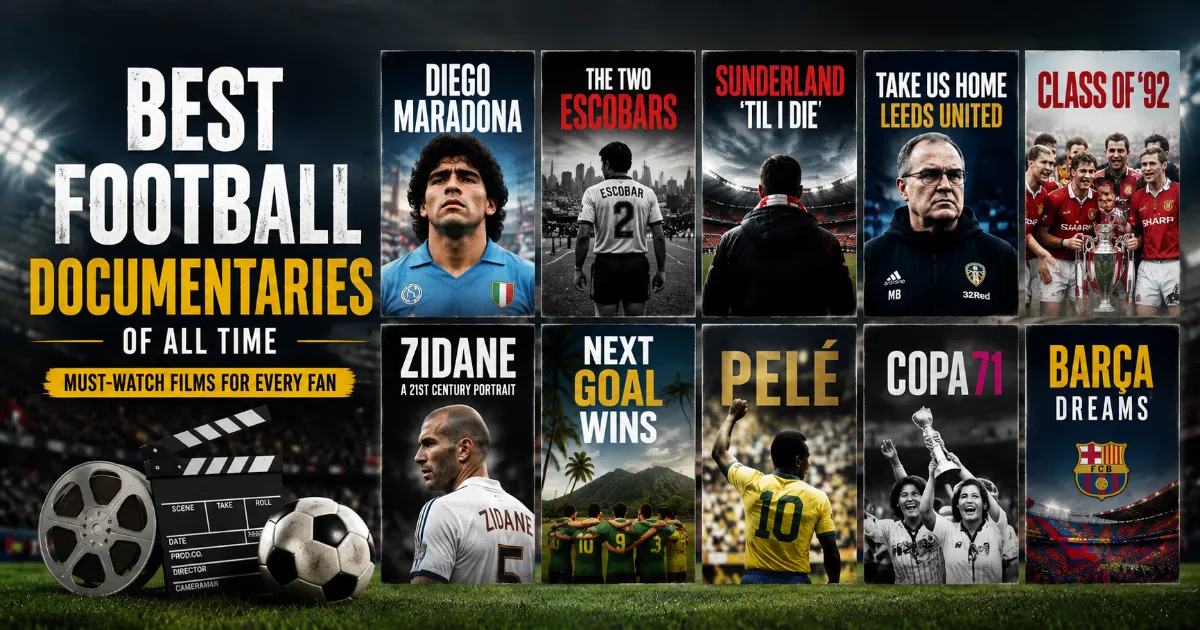
Diego Maradona (2019)
Asif Kapadia’s film is built almost entirely from archival footage, no talking-head interviews staged after the fact, just raw, often unseen video from Maradona’s astonishing and chaotic years at Napoli. It captures a genius who single-handedly dragged a mid-table Italian club to two Scudetti while simultaneously spiraling into addiction and organized crime entanglements, all playing out in real time on camera. It’s less a highlight reel than a genuinely uncomfortable character study, and it remains the definitive account of football’s most contradictory icon.
The Two Escobars (2010)
Part of ESPN’s celebrated 30 for 30 series, this documentary weaves together two entirely separate men who happened to share a surname: Andrés Escobar, the Colombian defender murdered after scoring an own goal at the 1994 World Cup, and Pablo Escobar, the drug lord whose cartel money quietly propped up Colombian football throughout the 1980s and early 90s. The film is as much a story about a nation’s relationship with organized crime as it is about the sport itself, and it remains one of the most sobering football documentaries ever made.
Sunderland ‘Til I Die (2018–)
This Netflix series takes the opposite approach from most football documentaries, focusing not on global superstars but on the unglamorous, often heartbreaking reality of a once-storied English club stuck fighting relegation battles in the lower divisions. Its access to boardroom meetings, dressing rooms, and the club’s fiercely loyal supporters makes it one of the most honest portrayals of what relegation actually does to a football town, economically and emotionally.
Take Us Home: Leeds United (2019)
Similar in spirit to Sunderland ‘Til I Die but built around a genuine promotion charge under Marcelo Bielsa, this series captures one of modern football’s most idiosyncratic managers at close range. Bielsa’s obsessive tactical preparation and unusual personal habits make for compelling viewing even for fans with no attachment to Leeds, and the series does an excellent job explaining why Bielsa’s methods, however strange from the outside, earned near-religious devotion from his players.
Class of ’92 (2013)
This documentary tells the story of Manchester United’s extraordinary mid-1990s youth generation, David Beckham, Ryan Giggs, Paul Scholes, Gary and Phil Neville, and Nicky Butt, who broke into the first team together and went on to dominate English football for over a decade. It’s a rare look at how a single academy intake can reshape a club’s entire era, told largely in the group’s own words decades after their playing careers.
Zidane: A 21st Century Portrait (2006)
An unusual entry on any list, this isn’t really a documentary in the traditional sense at all. Filmed using seventeen synchronized cameras trained exclusively on Zinedine Zidane throughout a single La Liga match, it’s closer to an art film than sports journalism, following his movement, positioning, and quiet moments of stillness rather than the ball itself. It’s a strange, hypnotic watch that captures the physical rhythm of elite football in a way no conventional match broadcast ever could.
Next Goal Wins (2014)
Long before it became a Hollywood comedy, this was a genuinely moving documentary about American Samoa’s national team, infamous for a 31-0 World Cup qualifying defeat to Australia in 2001, as they attempt to win a single competitive match for the first time in the program’s history. It’s funny, occasionally absurd, and ultimately far more emotionally affecting than a film about one of the world’s weakest national teams has any right to be.
Pelé (2021)
Netflix’s account of Pelé’s career leans heavily on the political backdrop of Brazil’s military dictatorship, using it to complicate the standard hagiography that usually surrounds football’s most decorated icon. It doesn’t shy away from criticism of Pelé’s relative public silence during Brazil’s most politically turbulent years, making it a more nuanced watch than most single-subject football biopics manage.
Copa 71 (2023)
This documentary resurrects a nearly forgotten piece of football history: an unofficial Women’s World Cup held in Mexico in 1971 that drew crowds of over one hundred thousand spectators, only for the tournament and its players to be almost entirely erased from football’s official record for decades afterward. It’s an essential watch for understanding both how far women’s football has come and how deliberately its earlier history was buried.
Barça Dreams (2015)
A comprehensive look at FC Barcelona’s modern identity, tracing the club’s transformation from a symbol of Catalan resistance during the Franco dictatorship through to the tiki-taka dynasty built around Xavi, Iniesta, and Messi. It’s particularly strong at explaining why Barcelona’s self-image as “more than a club” isn’t just marketing, but a genuinely rooted piece of the institution’s political history.
Honorable Mentions Worth Seeking Out
A handful of other football documentaries deserve at least a passing mention, even if they didn’t crack the main list. This Is Football, Amazon’s docuseries narrated through a series of loosely connected human stories rather than a single subject, is a strong entry point for viewers who want breadth over depth. The Class of ’92 has an unofficial spiritual cousin in various academy-focused documentaries that followed in its wake, tracking youth systems at clubs like Ajax and Barcelona, though none have quite matched its cultural impact. And for fans specifically interested in football’s business side, several recent streaming documentaries have started tackling ownership disputes, financial doping accusations, and the murky economics of state-backed clubs, a genre that’s likely to keep growing as football’s financial stakes continue to rise.
There’s also a growing crop of docuseries built around a single club’s season rather than a single player or event, following the template set by Sunderland ‘Til I Die and Take Us Home. These club-season documentaries have become something of a genre unto themselves in recent years, with production teams gaining unprecedented dressing-room and boardroom access in exchange for a club’s cooperation, and while the quality varies considerably depending on how eventful the season in question actually turns out to be, the best of them capture a texture of matchday life that traditional broadcast coverage simply doesn’t have the access or patience to show.
How to Choose Where to Start
If you’re new to football documentaries entirely, Diego Maradona or Sunderland ‘Til I Die are the strongest entry points, one for pure narrative drama, the other for an unfiltered look at what the sport means to an ordinary fanbase. If you’re drawn more to football’s political and historical dimensions, The Two Escobars and Copa 71 offer some of the richest context available in documentary form, tackling organized crime and gender inequality respectively through a football lens. And if you simply want to appreciate the craft of the game itself, Zidane: A 21st Century Portrait remains unlike anything else in the genre, an almost meditative study of a single player across ninety uninterrupted minutes.
Why These Films Matter Beyond the Football
What separates a great football documentary from a simple highlight package is context, the politics, tragedy, or social history sitting underneath the matches themselves. Nearly every entry on this list uses football as a lens for something bigger: national identity, addiction, organized crime, gender inequality, or political repression. That’s ultimately why these films hold up for viewers who don’t even follow the sport closely, they’re stories about people and countries that happen to be told through football, rather than films about football that happen to feature people.
🔹🔹 Follow Us on Facebook 🔹🔹
About the Author