 The Complete La Liga History: From a Civil War Interruption to Barcelona’s 29th Title
How Spain’s top division became inseparable from the country’s politics, before evolving into the stage for the greatest individual rivalry the sport has ever seen.
Few domestic leagues anywhere in the world carry the political and cultural weight that La Liga has carried throughout its near-century of existence. Born in 1929 and shaped for decades by Spain’s turbulent twentieth-century politics, the competition has always been about far more than simply which club wins the most matches. This is the story of how La Liga evolved from a fledgling regional competition disrupted by civil war into the stage for football’s greatest individual rivalry, and now into a title race once again dominated by Barcelona and Real Madrid.
Messi Retires: Inside the Rise, Falls, and Redemption of a Legend
Thiago Messi: Club Career, Playing Style, Lifestyle and Future Prospects
The Biggest Transfer Winners After FIFA World Cup 2026
A League Born, Then Interrupted
La Liga began in 1929, with FC Barcelona claiming the inaugural championship in a competition initially featuring just ten clubs. The league’s early growth was violently interrupted just seven years later, when the outbreak of the Spanish Civil War in 1936 forced a three-year suspension of the competition entirely, a pause that mirrored the broader devastation the conflict brought to Spanish society as a whole. When league football finally resumed in 1939, Spain had been fundamentally transformed, now governed under the authoritarian rule of General Francisco Franco, a political reality that would go on to shape the competition’s biggest rivalry for decades to come.
Real Madrid, Barcelona, and the Politics of Franco’s Spain
No single thread runs through La Liga’s history more persistently than the relationship between Real Madrid, Barcelona, and the Francoist state. Franco’s regime, wary of Catalonia’s distinct regional identity and language, viewed Barcelona’s football club with particular suspicion, given the institution’s longstanding role as a symbol of Catalan cultural pride and, at times, quiet political resistance. Real Madrid, based in the capital and enjoying considerably friendlier relations with the Franco government, became closely associated with the regime in the eyes of many Spaniards, whether or not that association was always entirely deserved or accurate in its full complexity.
The most frequently cited episode illustrating this dynamic involves the transfer saga surrounding Argentine forward Alfredo Di Stéfano in 1953, when both Real Madrid and Barcelona pursued the player amid a confusing dispute between two different South American clubs claiming his registration rights. The transfer’s eventual resolution in Real Madrid’s favor, following a series of murky negotiations that some historians have long argued involved political interference from within Franco’s government, became a foundational moment in the Real Madrid-Barcelona rivalry, one that Barcelona supporters have referenced for decades afterward as an example of the political forces they believed were consistently working against their club during the Franco era.
Whatever the precise truth behind individual moments like the Di Stéfano transfer, the broader perception that Real Madrid enjoyed institutional favor under Franco, while Barcelona represented a form of regional resistance against centralized, authoritarian Spanish nationalism, became deeply embedded in how both clubs understood their own identities, a framing that has persisted long after Franco’s death in 1975 and Spain’s subsequent transition to democracy.
Real Madrid’s European Dominance
Whatever the political undertones of the era, Real Madrid’s footballing dominance throughout the 1950s was undeniable on its own sporting merits. Built around Di Stéfano and Hungarian forward Ferenc Puskás, Real Madrid won the first five editions of the European Cup, the forerunner to today’s Champions League, establishing the club as the dominant force not just domestically but across the entire European continent. That sustained continental success gave Real Madrid a global profile that extended well beyond Spain’s borders, laying the foundation for the club’s enduring self-identity as football’s most prestigious institution, a status the club has continued to actively cultivate through the decades that followed.
Barcelona’s Identity as “More Than a Club”
Barcelona’s own institutional identity crystallized around a different set of values during this same period, one built explicitly around Catalan cultural pride and, following Spain’s return to democracy, an increasingly overt embrace of regional political identity. The club’s now-famous motto, “més que un club,” or “more than a club,” reflects this self-conception directly, positioning Barcelona not simply as a football institution but as a genuine vehicle for Catalan cultural and political expression. That identity took on renewed significance during the Johan Cruyff era, both as a player in the 1970s and later as manager through the late 1980s and early 1990s, when Cruyff’s influential “Dream Team” squad helped establish the possession-based playing philosophy that would eventually become the club’s defining tactical identity for generations of players who followed.
The Galácticos Era
The early 2000s brought a new chapter to Real Madrid’s history, one built around then-club president Florentino Pérez’s ambitious “Galácticos” policy of signing one global superstar per year regardless of positional need, assembling a squad featuring Zinedine Zidane, Ronaldo, Luís Figo, and David Beckham simultaneously. The approach delivered genuine commercial success, transforming Real Madrid into arguably the most globally recognizable football brand on the planet, even as the policy’s pure footballing results proved more inconsistent than the sheer star power of the assembled squad might have suggested, with the club’s trophy return during this specific period falling somewhat short of the individual talent involved.
The Messi vs Ronaldo Era
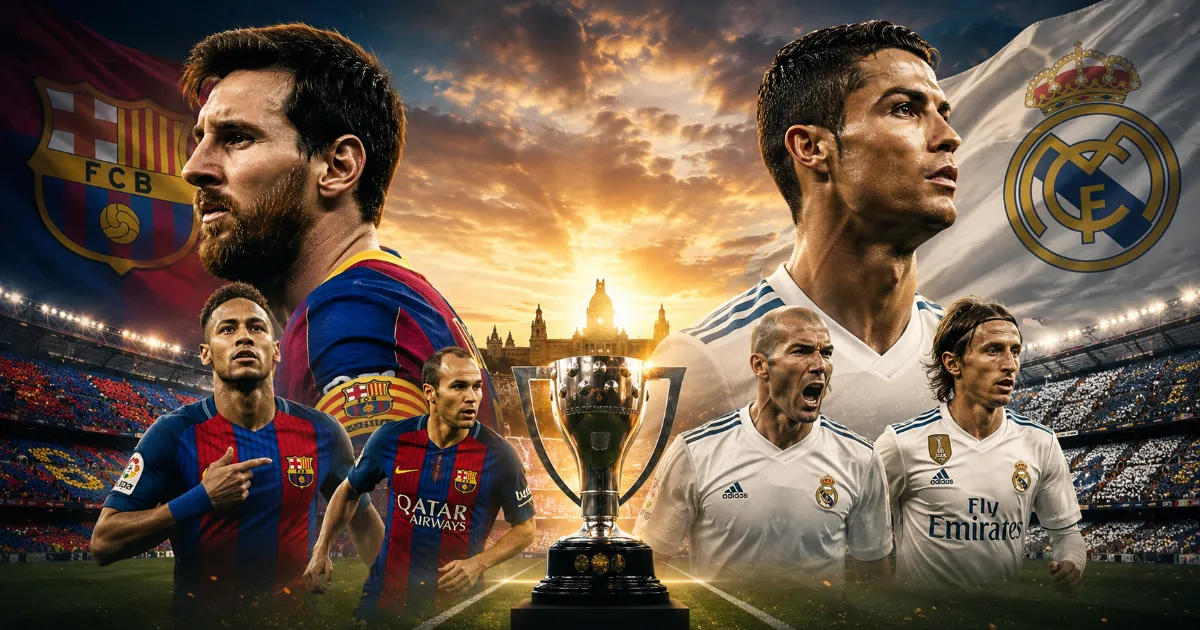
If any single period defines modern La Liga history in the minds of casual global fans, it’s the decade-long rivalry between Lionel Messi and Cristiano Ronaldo, playing out directly through their respective spells at Barcelona and Real Madrid between 2009 and 2018. Ronaldo’s arrival at Real Madrid in 2009, for what was then a world-record transfer fee, set up a direct, sustained individual rivalry with Messi that dominated global football discourse for the better part of a decade, with the two players trading Ballon d’Or awards and record-breaking goal tallies season after season, elevating El Clásico fixtures between their two clubs into some of the most-watched club football matches in the sport’s history.
That rivalry produced some of La Liga’s most statistically extraordinary individual seasons, with both players repeatedly surpassing 40 and even 50 goals across single league campaigns, numbers that reshaped expectations for what elite goalscoring output at the very top of the sport could look like. The rivalry’s eventual conclusion, with Ronaldo’s 2018 transfer to Juventus and Messi’s own eventual 2021 departure from Barcelona amid the club’s severe financial difficulties, closed out what many football historians regard as the single greatest sustained individual rivalry the sport has ever produced, one inseparable from La Liga’s broader identity during that entire decade.
Financial Turmoil and Barcelona’s Rebuild
Barcelona’s departure from the Messi era coincided with a period of genuine financial crisis at the club, driven by years of aggressive spending on player wages and transfer fees that had left the institution facing serious economic constraints just as its greatest player in history was forced to leave. The club’s subsequent rebuilding process, which included high-profile financial restructuring and a shift toward developing and reintegrating academy talent, eventually bore fruit under German manager Hansi Flick, who took charge in 2024 and led Barcelona to consecutive league titles in the 2024-25 and 2025-26 seasons, the club’s 28th and 29th championships respectively. The 2025-26 title was sealed in fittingly dramatic fashion, a direct win over Real Madrid at Camp Nou that clinched the championship with three matches still remaining, continuing a rivalry that has now stretched across nearly a century of Spanish football history.
Real Madrid’s Continued Record
Despite Barcelona’s recent resurgence, Real Madrid remains La Liga’s most decorated club by a clear margin, holding 36 total league titles compared to Barcelona’s 29, a gap that reflects the club’s sustained dominance across nearly the entire history of the competition. Real Madrid’s 2025-26 season, however, proved considerably more turbulent than the club’s storied history might suggest was typical, with manager Xabi Alonso, who had only taken charge the previous summer following Carlo Ancelotti’s departure to take charge of the Brazilian national team, eventually replaced mid-season by Álvaro Arbeloa amid reports of internal squad tension and public speculation about the future of star forward Kylian Mbappé, a reminder that even La Liga’s most historically dominant institution remains far from immune to the kind of internal upheaval that has periodically affected clubs throughout the league’s history.
A Rivalry Still Writing New Chapters
Nearly a century after its founding, and decades removed from the explicitly political undertones of the Franco era, La Liga’s history remains defined overwhelmingly by the ongoing rivalry between its two most successful institutions. What began as a competition shaped by civil war, dictatorship, and deep regional political tension has evolved into a rivalry now driven primarily by football itself, individual genius, financial rebuilding, and managerial upheaval, rather than the explicit political weight that once defined it. Yet the underlying dynamic, Real Madrid and Barcelona locked in a rivalry unmatched anywhere else in world football, remains as central to La Liga’s identity today as it was when Di Stéfano’s transfer saga first cemented the two clubs’ rivalry as something considerably larger than an ordinary sporting contest, nearly seventy years ago.
The Clubs Beyond the Duopoly
While Real Madrid and Barcelona have combined to win the overwhelming majority of La Liga titles throughout the competition’s history, several other clubs have carved out genuinely significant chapters of their own within the league’s broader story. Atlético Madrid, with 11 league titles to their name, have long positioned themselves as Madrid’s working-class alternative to Real Madrid’s more globally glamorous image, and manager Diego Simeone’s lengthy tenure, built on defensive discipline and fierce competitive intensity, produced genuine title challenges and occasional triumphs, including league championships in 2013-14 and 2020-21 that briefly disrupted the Real Madrid-Barcelona duopoly during periods when neither Madrid nor Barcelona’s biggest stars were performing at their absolute peak.
Athletic Bilbao occupies a particularly unique place in La Liga history, having won 8 league titles despite maintaining a strict policy of fielding only players developed through Basque academies or with genuine Basque heritage, a philosophy that ties the club’s footballing identity to regional cultural pride in a manner directly comparable to Barcelona’s own Catalan-focused self-conception, even if Athletic’s specific approach to player recruitment has grown increasingly unusual compared to the globally sourced squads assembled by nearly every other major European club in the modern transfer market. Valencia, Real Sociedad, Real Betis, Sevilla, and Deportivo La Coruña round out the list of clubs to have won the title at least once, each representing a brief interruption to the broader Real Madrid-Barcelona narrative that otherwise dominates the competition’s near-century of history.
How La Liga’s Broadcast Reach Has Grown
Beyond the title races themselves, La Liga’s history also includes a significant commercial transformation, one that closely parallels, even if it hasn’t quite matched in scale, the Premier League’s own broadcast-driven global expansion. The individual brilliance of Messi and Ronaldo throughout their decade-long rivalry proved instrumental in growing La Liga’s international broadcast audience considerably beyond Spain’s own borders, with the league increasingly marketed abroad specifically around the appeal of watching the two players’ head-to-head battles in El Clásico fixtures. That international audience growth has continued in the years since both players departed the league, with La Liga’s current broadcast partnerships spanning considerably more territories than existed during the competition’s earlier, more domestically focused decades.
This commercial expansion has occurred alongside growing financial disparity between La Liga’s leading clubs and the rest of the division, a dynamic reminiscent of similar tensions within the Premier League, even if La Liga’s financial fair play regulations, enforced directly by the league itself rather than delegated entirely to a separate regulatory body, have historically taken a somewhat different regulatory approach than English football’s Profit and Sustainability Rules. Barcelona’s own well-documented financial crisis during the early 2020s, which forced the club into a series of unusual accounting maneuvers just to remain compliant with league spending regulations, offered a particularly stark illustration of how seriously La Liga’s financial oversight has been enforced even against one of the competition’s two most historically dominant institutions.
A League Still Defined by Its Biggest Rivalry
For all of La Liga’s broader institutional history, spanning civil war, dictatorship, financial crises, and genuine underdog champions like Atlético Madrid and Athletic Bilbao, the competition’s identity remains inseparable from the ongoing story of Real Madrid and Barcelona. Whether measured through Franco-era political tension, the Galácticos era’s star-driven commercial ambition, or the individual genius of Messi and Ronaldo trading records throughout the 2010s, that single rivalry has consistently provided the through-line connecting nearly a century of Spanish football history, and Barcelona’s most recent triumph over their fiercest rivals to clinch the 2025-26 title suggests that storyline remains as compelling to a global audience today as it has been at any point across the league’s long, often turbulent history.
Real Madrid’s own turbulent 2025-26 campaign, unfolding just as Barcelona completed back-to-back titles, is itself a reminder that La Liga’s central rivalry rarely stays static for long. A club with 36 total championships and a history of European dominance stretching back to the Di Stéfano era doesn’t typically endure a mid-season managerial change and public speculation over its biggest star’s future, yet that’s precisely what unfolded during a campaign that ultimately ended with Barcelona lifting the trophy at Real Madrid’s own historic expense. It’s a pattern nearly as old as the rivalry itself: whenever one half of Spanish football’s great duopoly appears to have gained a decisive, lasting upper hand, La Liga’s history suggests the other is rarely far behind in writing its own response.
▪️▪️ Premier League 2026/27 Schedule: This Week and Next Week ▪️▪️
About the Author