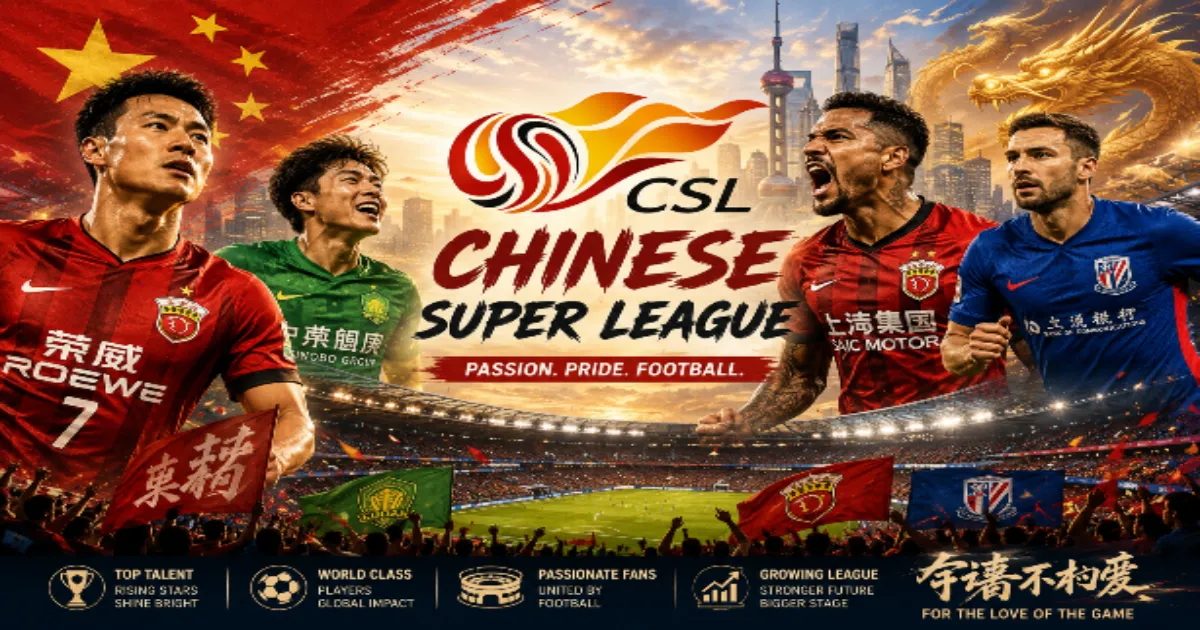
Chinese Super League: The Rise, Fall and Uncertain Future of China’s Top Flight
Few leagues in modern football have swung between two extremes as dramatically as the Chinese Super League. Within the space of a decade, it went from a competition capable of outspending the Premier League for individual transfers to one now operating under strict salary caps and rebuilding its reputation from the ground up. This is the complete story of the CSL: its origins, its superstar era, its very public collapse, and what its future might look like — along with how it now compares to Asia’s other rapidly growing competition, the Indian Super League.
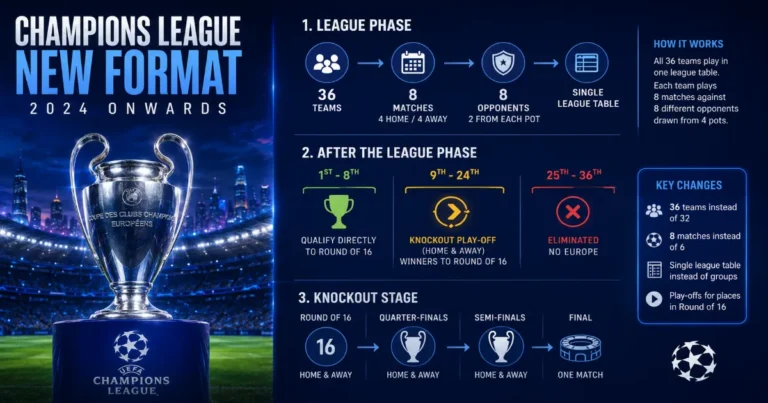
UEFA Champions League Explained: Format, History & How Teams Qualify
Saudi Arabia Gears Up to Host AFC Asian Cup 2027 With Massive Football Ambitions
ISL Players at World Cup 2026: Indian Football’s Growing Global Footprint
Inception and Structure of the Chinese Super League
The Chinese Super League was established in 2004, formed through the rebranding of the former top division, the Chinese Jia-A League, as the Chinese Football Association looked to professionalise and modernise the domestic game. It is governed by the Chinese Football Association and operated by the Chinese Professional Football League. The 2026 season marks the 23rd edition of the competition and the 33rd season of top-flight professional football in China overall, tracing its roots back to the professionalisation of Chinese football in 1994.
The league began with just 12 teams in its inaugural 2004 season and has grown steadily since, now featuring 16 clubs as of the 2026 campaign. In total, 42 different clubs have competed in the CSL since its inception. The competition follows a double round-robin, home-and-away format across 30 rounds, with a “two up, two down” promotion and relegation system connecting it to China League One below. Nine different clubs have been crowned champions, though the honours board is dominated by three names: Guangzhou (eight titles, under various former names including Guangzhou Evergrande), Shandong Taishan (four) and Shanghai Port (four, most recently in 2025). Other one-time champions include Shenzhen, Dalian Shide, Changchun Yatai, Beijing Guoan, Jiangsu and Wuhan Three Towns.
The Superstar Era: When Money Talked
To understand the Chinese Super League’s global profile, you have to go back to the mid-2010s, when Chinese clubs — many backed by real estate conglomerates and state-linked capital — began smashing Asian transfer records to lure some of the biggest names in world football away from Europe and South America.How Do Football Transfer Fees Work? A Complete Beginner’s Guide
The turning point came in January 2017, when Brazilian international Oscar completed a £60 million ($82 million) move from Chelsea to Shanghai SIPG (now Shanghai Port) at just 25 years old, turning down interest from Inter Milan, Juventus and AC Milan in the process. Then-Chelsea manager Antonio Conte called the Chinese market “a danger for all” of European football. Oscar remains in China to this day, having made over 200 appearances for Shanghai and won two league titles — arguably the best return on investment of any marquee signing from that era.
He was far from alone. Hulk joined Shanghai SIPG on a reported £320,000-a-week deal and racked up 130 goal contributions in 145 appearances. Paulinho left Tottenham for Guangzhou Evergrande, thrived under World Cup-winning coach Luiz Felipe Scolari, won the AFC Champions League, and used his form in China to earn a return to the Brazil national team and a subsequent move to Barcelona. Ramires, Alex Teixeira, Jackson Martínez, Marouane Fellaini, Graziano Pelle and Alexandre Pato all followed lucrative contracts eastward, while Carlos Tevez briefly became the highest-paid player in world football on a Shanghai Shenhua deal, though he managed only four goals in 16 games and later admitted the move had felt like “a holiday.”
The Salary Cap and the Great Unwinding
The spending spree didn’t last. Concerned that clubs were being exploited by foreign players chasing paydays rather than genuine footballing ambition, and alarmed at ballooning, often unsustainable debts tied to the real estate sector, the Chinese Football Association introduced a 100% tax on incoming foreign transfer fees in 2017, followed by a hard salary cap in December 2020 restricting foreign players to roughly £2.6 million ($3.6 million) a year.
The financial reckoning that followed was severe. The collapse of the Chinese property market hit club owners hard, most notably Guangzhou Evergrande’s parent company, while Jiangsu Suning folded entirely in 2021 just months after winning the league title — one of the most stunning falls from grace in modern club football history. One by one, the marquee names left: Hulk, Jackson Martínez, Yannick Carrasco, Axel Witsel, Marek Hamsik and Gervinho all departed for other leagues, with few big-money replacements arriving to take their place.Top 15 Football Leagues in the World Ranked (2026): Star Players, Global Standings & Every Continent’s Best
Compounding the financial crisis was a wide-reaching corruption scandal. Since 2022, Chinese authorities have run an anti-corruption probe into Chinese football, resulting in multiple football officials being investigated and, in one case, a former CFA committee secretary pleading guilty in 2024 to accepting more than $6.1 million in bribes. In September 2024, the CFA handed life bans to 38 players and five officials over match-fixing allegations, with further life bans (reportedly extending to 73 individuals in total) issued in early 2026. Nine CSL clubs also received points deductions and fines heading into the 2026 season as punishment for their involvement.
Current Star Power and the New Financial Reality
Today’s Chinese Super League operates under a strict financial framework designed for sustainability rather than spectacle. The Chinese Professional Football League has set an annual player salary cap of 5 million RMB, with total annual club expenditure capped at 600 million RMB and single-match win bonuses limited to 3 million RMB. Foreign player registration is restricted to a maximum of five per club, with four permitted on the field at any one time.
While the days of world-class attackers in their prime signing for Chinese clubs are largely over, the CSL continues to attract experienced overseas talent and coaching names, including former Premier League and Champions League figures moving into Chinese dugouts and squads at more modest wages than the boom years. The league remains a workable stepping stone or late-career destination for established professionals, even as the truly transformative, world-record signings of the Oscar and Hulk era have become a thing of the past.
Popularity, Attendance and Stadium Culture
Despite its financial turbulence, the Chinese Super League remains, on paper, one of the best-attended domestic leagues in Asia. The competition has recorded an average attendance of 25,755 fans per match, a figure that places it well ahead of most of its regional peers and reflects the genuine grassroots enthusiasm for football across major Chinese cities. Clubs such as Shanghai Shenhua, Beijing Guoan and Shandong Taishan continue to draw large, passionate home crowds, and stadium infrastructure across the league — several grounds hold well in excess of 40,000 to 60,000 seats — remains some of the most impressive in Asian club football.The Regista: Football’s Most Cerebral Position, Fully Explained
The challenge for the CSL going forward isn’t filling stadiums; it’s converting that attendance base into a financially healthy, internationally relevant product after several years of negative headlines around club insolvencies, corruption trials and player bans.
Where Does the CSL Rank Among the World’s Leagues?
By UEFA-style continental competition standards, the Chinese Super League has fallen behind the region’s traditional football powers. Since the AFC Champions League began in the 2002–03 season, Chinese clubs have won the continental title only twice — Guangzhou Evergrande in 2013 and 2015 — compared to five wins for South Korea’s K League and three for Japan’s J1 League. With the rise of Saudi Arabia’s oil-funded Pro League since 2023, which has since attracted global superstars the CSL once fought hard to sign, China’s relative standing in Asian club football has slipped further, even as it remains ahead of several smaller Asian leagues in terms of raw attendance and broadcast reach.
Impact on Asian Football
The Chinese Super League’s boom-and-bust cycle has left a lasting mark on the wider Asian football landscape. During its peak spending years, the CSL was widely credited — or blamed, depending on perspective — with distorting the Asian and even global transfer market, driving up wage expectations and forcing clubs across the continent to reconsider how they competed for talent. Arsène Wenger and Antonio Conte both publicly warned that Chinese clubs’ spending posed a genuine threat to the established European football order.
Its subsequent financial collapse has had the opposite effect: a cautionary tale now frequently cited across Asian football administration about the dangers of state-linked, debt-fuelled club ownership models untethered from sustainable revenue. The CFA’s current strategy — explicitly prioritising domestic youth development and long-term financial discipline over short-term spectacle — has become something of a reference point for other Asian federations weighing up their own growth strategies, including in Southeast Asia and South Asia.
Chinese Super League vs Indian Super League: A Tale of Two Growth Models
The comparison to the Indian Super League is a natural one, given both leagues represent large, cricket-or-otherwise-distracted footballing nations attempting to build a modern, commercially viable top flight from a standing start.
The ISL was founded in 2013 and began play in 2014 with eight franchise clubs, expanding steadily to 14 clubs competing in the 2025–26 season, drawn from 12 cities across India. Like the CSL, the ISL initially leaned on marquee overseas signings — often experienced European veterans in the twilight of their careers — to build credibility and fan interest, before shifting its foreign player rules over time; clubs can currently register up to six foreign players, with a maximum of four on the pitch simultaneously.
Attendance-wise, the comparison is closer than many outside India might expect. The ISL posted an average attendance of 27,111 in its second season (2015), and while regular-season figures have fluctuated since, marquee derby fixtures — particularly those involving Kolkata giants Mohun Bagan Super Giant and East Bengal, or Kerala Blasters’ passionate home support — have regularly crossed the 60,000 mark, rivalling anything the CSL’s biggest clubs can produce on a one-off basis. The CSL’s more consistent season-long average of 25,755, however, still generally reflects a broader, more evenly distributed attendance base across its 16 clubs compared to the ISL’s more derby-dependent peaks.
Structurally, both leagues have wrestled with similar growing pains: unclear promotion and relegation systems (the ISL only implemented relegation from the 2025–26 season, decades after most major leagues), disputes between governing federations and league operators, and difficulty translating domestic popularity into meaningful AFC Champions League success. Both leagues currently sit below the K League, J1 League and Saudi Pro League in continental pecking order, though both retain considerable long-term commercial upside given the sheer population and growing middle-class sporting appetite in their respective countries.
The Road Ahead
The Chinese Super League’s future now hinges on execution rather than ambition. The CFA has been explicit that the benchmark for success is no longer marquee spending but sustainability — building a league capable of consistently producing competitive Chinese national team players rather than simply hosting famous names on lucrative farewell contracts. Continued anti-corruption enforcement, tighter financial regulation, and a focus on youth academy standards suggest the governing bodies have learned hard lessons from the Jiangsu Suning collapse and the broader real-estate-linked funding crisis.
Whether that translates into genuine improvement for the Chinese national team — long the primary justification for the entire CSL project since its founding — remains the biggest open question. For now, the Chinese Super League stands as one of world football’s most instructive case studies: proof that a nation’s ability to spend big on foreign stars is no substitute for the slower, harder work of building sustainable structures from the ground up.
Enjoyed this deep dive? Check back for more in-depth coverage comparing Asia’s fastest-growing football leagues, including regular season previews, transfer analysis and continental competition tracking.
Messi World Cup Goals Record Hits 12, Passing Pele and Mbappe
Ronaldo World Cup 2026: Six Tournaments, One Missing Trophy, One Last Chance
Erling Haaland World Cup 2026 Journey: Norway’s Return and a New Superstar Era
🔹🔹 follow us on facebook 🔹🔹
About the Author




1 thought on “Chinese Super League: The Rise, Fall and Uncertain Future of China’s Top Flight”