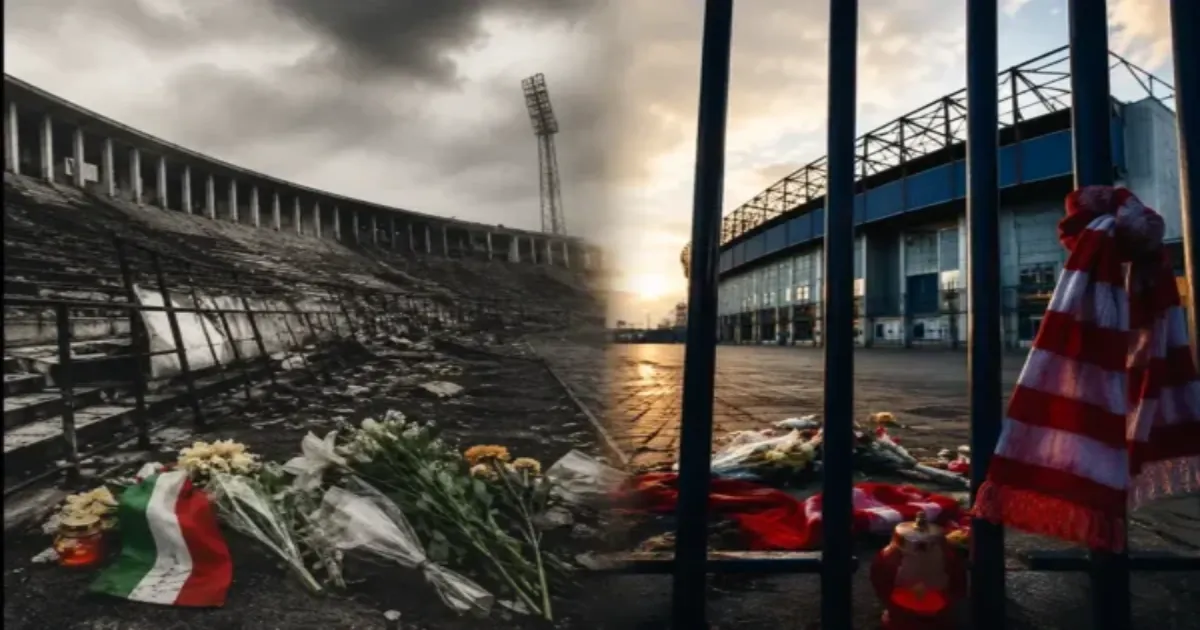
 The Heysel and Hillsborough Disasters: How Tragedy Shaped English Football
Two stadium disasters, four years apart, killed 136 football fans and permanently altered the course of English football. The Heysel Stadium disaster in Brussels in 1985 and the Hillsborough disaster in Sheffield in 1989 are among the darkest chapters in the sport’s history — and both, in different ways, forced English football to confront how badly it had failed the people who watched it.2030 FIFA World Cup: Hosts, Format, Stadiums and Full Details
Where the Noise Never Stops: Ranking the Best Football Stadiums on Earth
Neither tragedy happened in isolation. Both were products of decades of neglect: crumbling stadium infrastructure, inadequate crowd management, and a culture that had normalised dangerous conditions inside grounds long before either disaster occurred. Understanding what happened at Heysel and Hillsborough — and the reforms that followed — is essential to understanding why English football looks and feels the way it does today.
The Backdrop: A Decade of Neglect
To understand why two disasters of this scale happened within four years of each other, it helps to understand the state of English football grounds in the 1970s and 1980s. Many of the country’s largest stadiums had been built in the early twentieth century and had received only minimal modernisation in the decades since. Standing terraces, packed with tens of thousands of fans and enclosed by perimeter fencing intended to prevent pitch invasions and crowd violence, were the norm rather than the exception. Hooliganism, a genuine and growing problem throughout the late 1970s and early 1980s, had prompted authorities to prioritise containment of supporters over their safety — a philosophy that treated fans, in the words of the later Taylor Report, more like a security risk to be managed than a public to be protected.
This was also the era of the 1985 Bradford City fire, in which 56 supporters died after a discarded cigarette is believed to have ignited decades of accumulated rubbish beneath a wooden stand at Valley Parade — a disaster that occurred just eighteen days before Heysel and further underlined how badly England’s football infrastructure had been allowed to deteriorate. Taken together, Bradford, Heysel, and Hillsborough form a grim trilogy of disasters within a four-year span, each exposing a different facet of the same underlying failure: a football culture that had not kept pace with the safety demands of hosting tens of thousands of people in ageing, poorly maintained venues.
Heysel: May 29, 1985
The Heysel Stadium disaster unfolded before the 1985 European Cup final between Liverpool and Juventus, played at the aging Heysel Stadium in Brussels. The stadium, 55 years old at the time and in a poor state of repair, had already failed safety inspections and had been criticised as unsuitable for a major final — Arsenal fans who had visited the ground the previous year had described it as inadequate, and both Liverpool and Juventus had reportedly asked UEFA to consider an alternative venue. UEFA proceeded regardless.
Roughly an hour before kickoff, disorder broke out between Liverpool supporters and a section of largely Juventus fans separated from them by only a thin, flimsy fence in what was meant to be a neutral area of the stadium. Following taunting and objects thrown across the divide, the fence gave way and Liverpool fans surged forward. As Juventus supporters retreated from the advancing crowd, they were pressed against a boundary wall that collapsed under the weight, causing a fatal crush. Thirty-nine people were killed — 32 of them Italian, alongside victims from Belgium, France, and Northern Ireland — and around 600 more were injured. The match was played regardless, with Juventus winning 1-0, a decision made largely out of fear that abandoning the game would trigger further violence given the state of the crowd.
The initial response from a UEFA observer placed blame squarely on Liverpool’s supporters. A subsequent 18-month investigation, however, concluded that responsibility was shared more broadly — implicating UEFA for ignoring known safety concerns about the stadium, and Belgian police for inadequate crowd control on the day. Fourteen Liverpool fans were ultimately convicted of manslaughter, though under Belgian sentencing they served only around a year of three-year terms.
The Fallout From Heysel
The consequences for English football were severe and immediate. Just days after the disaster, the Football Association was pressured by the British government to withdraw English clubs from European competition before a ban could be formally imposed. UEFA moved quickly regardless, banning all English clubs from European competition indefinitely; the ban was later formalised at five years for English clubs generally, with Liverpool given an additional, extended suspension that ultimately kept them out of Europe for six years in total, until the 1991-92 season.
The knock-on effects reshaped an entire era of English football. Clubs that would otherwise have qualified for European competition through league position or cup success — including Everton, Tottenham Hotspur, and Nottingham Forest — missed out on years of continental football through no direct fault of their own. Some observers have argued that Liverpool’s own squad in the late 1980s, considered one of the finest in the club’s history under Kenny Dalglish, was denied the opportunity to add further European Cups to their collection because of the ban.
Heysel also triggered a broader reckoning with football hooliganism, which had plagued English football throughout the late 1970s and early 1980s. Attendances collapsed in the years that followed — the 1985-86 English league season saw crowds fall to roughly 16 million, a post-war low, down from levels more than double that figure in prior decades. For a period, English football was, in the words of football historian John Williams, treated as a source of national shame rather than national pride.
Hillsborough: April 15, 1989
Less than four years after Heysel, English football suffered its worst-ever stadium tragedy on home soil. On April 15, 1989, Liverpool and Nottingham Forest met at Hillsborough Stadium in Sheffield for an FA Cup semi-final, a venue chosen by the Football Association despite it not being either club’s home ground.
Liverpool supporters were allocated the Leppings Lane end of the stadium, which had a limited number of turnstiles — just seven for more than 10,000 fans holding tickets for the standing terraces behind the goal. As kickoff approached, a dangerous bottleneck built up outside the ground. In an attempt to relieve the pressure, the police match commander, Chief Superintendent David Duckenfield, ordered an exit gate to be opened, allowing roughly 2,000 additional fans into the stadium. Rather than being directed to less crowded areas of the terrace, those fans flowed into the two central pens that were already at capacity, triggering a catastrophic crush against the perimeter fencing that had been installed, in that era, to prevent supporters from encroaching onto the pitch.
The match was halted just six minutes after kickoff. Ninety-four people died on the day or shortly afterward; a further victim, Kevin Williams, died later, and Tony Bland, who suffered irreversible brain damage in the crush, died in 1993 after his life support was withdrawn, bringing the toll to 96. In 2021, more than three decades after the disaster, Andrew Devine — who had suffered catastrophic, lifelong injuries in the crush — died from those injuries, and a coroner ruled that he had been unlawfully killed, making him the disaster’s 97th victim. More than 760 people were injured. It remains the deadliest disaster in British sporting history.
The Cover-Up and the Fight for Justice
What followed Hillsborough was not merely a tragedy but a decades-long institutional scandal. In the days and weeks after the disaster, South Yorkshire Police fed false narratives to the press, alleging that hooliganism and drunkenness among Liverpool supporters had caused the crush — claims later definitively disproven, but which caused lasting damage to the reputation of Liverpool fans and the city itself.
Lord Justice Taylor’s official inquiry, published in 1990, identified the true cause: a fundamental failure of crowd control by South Yorkshire Police, compounded by structural failings at the stadium itself. Despite this, the original 1991 coroner’s inquests returned verdicts of accidental death for all victims — verdicts based partly on a controversial 3:15pm cutoff time, after which no evidence of what happened to individual victims was considered, effectively closing off scrutiny of the emergency response.
For more than two decades, bereaved families campaigned for the truth to be fully acknowledged. A breakthrough came in 2012, when the Hillsborough Independent Panel, after reviewing some 450,000 documents, confirmed the scale of the police cover-up, including the alteration of more than 160 officer statements to remove or soften criticism of the police operation. The original accidental death verdicts were quashed, and fresh inquests were ordered. In April 2016, after the longest jury case in British legal history, a new inquest jury concluded that the 96 victims had been unlawfully killed, and that Liverpool supporters bore no responsibility for the disaster.
Despite this, the pursuit of criminal accountability largely failed. David Duckenfield was tried for gross negligence manslaughter and acquitted in 2019. No individual or institution has ever been successfully prosecuted for the deaths, a fact that remains a source of profound frustration for survivors and victims’ families to this day.
How Hillsborough Changed English Football Forever
Hillsborough’s most visible legacy is physical: the disaster led directly to the elimination of fenced standing terraces at the highest level of English football. The Taylor Report’s recommendations became the blueprint for the modern stadium, mandating all-seater grounds in the top two tiers of English football — a transformation that redefined the matchday experience for an entire generation of fans.
Its influence extended well beyond stadium design. Hillsborough is widely credited as one of the foundational events behind the commercial transformation of English football in the years that followed, contributing to conditions that helped enable the launch of the Premier League in 1992 — a competition built, in part, on the promise of modernised, safer stadiums. The introduction of all-seater grounds, improved policing and stewarding models, and a fundamentally different relationship between clubs and supporters can all be traced back to the reckoning forced by Hillsborough.
A Painful, Shared Legacy
Heysel and Hillsborough are sometimes discussed as separate chapters in English football’s history, but they are deeply connected. Both exposed the same underlying problem — stadiums and crowd management systems that had been allowed to deteriorate to a point where they endangered the lives of the people inside them — and together, they forced a reckoning that no single tragedy alone might have achieved.
In 2025, on the 40th anniversary of Heysel, Liverpool and Juventus unveiled new memorials to the 39 victims, timed poignantly close to a separate tragedy at Liverpool’s own Premier League title parade. Hillsborough’s memorial at Anfield, meanwhile, continues to be updated as new victims are confirmed, most recently with the addition of Andrew Devine’s name. Both memorials stand as permanent reminders of a period when English football failed the people who loved it most — and of the long, hard-won reforms that followed in response.
For English football today — with its all-seater stadiums, its stewarding standards, and its emphasis on supporter safety — the game’s modern infrastructure exists, in large part, because of the lessons paid for at Heysel and Hillsborough. It is a legacy no one asked for, and one the game can never allow itself to forget.
Lessons That Reached Beyond England
The influence of Heysel and Hillsborough has not stayed confined to English football. UEFA and FIFA have both cited the disasters, and the Taylor Report specifically, in shaping stadium safety standards applied to major tournaments and international club competitions in the decades since. All-seater requirements, minimum standards for crowd segregation, and stricter licensing conditions for hosting major finals all owe a debt to reforms first driven by these two tragedies. When football fans anywhere in the world sit in a modern, all-seater stadium with clear sightlines, professional stewarding, and rigorously enforced capacity limits, they are, in a very direct sense, benefiting from lessons paid for by the victims of Heysel and Hillsborough.
The families of those who died have also left a lasting institutional legacy beyond stadium design. The decades-long Hillsborough campaign directly influenced calls for a so-called “Hillsborough Law” in the UK — proposed legislation that would impose a legal duty of candour on public officials and institutions, requiring them to be open and truthful in the aftermath of major disasters, rather than prioritising reputational protection. The campaign for such legislation, driven largely by bereaved Hillsborough families who spent over three decades fighting institutional denial, remains an active and closely watched issue in British public life, illustrating how the disaster’s impact has extended well beyond football itself and into the broader relationship between citizens and the state.
Remembering the Victims
Both disasters are marked by permanent, physical memorials that serve as a constant reminder of what was lost. At Anfield, the Hillsborough memorial bears the names of all 97 victims and is tended to continuously by supporters, with fresh flowers and tributes a near-daily presence outside the stadium. The eternal flame that burns above it has become one of the most recognisable symbols in English football, a symbol of both grief and defiance embodied in the enduring supporter chant, “You’ll Never Walk Alone.”
Heysel’s memory is similarly preserved through dedicated monuments — one at Juventus’s Turin headquarters, unveiled in the immediate aftermath of the disaster, and another dedicated specifically to the 39 victims in Reggio Emilia, hometown of one of those who died. Liverpool and Juventus have, particularly around significant anniversaries, made concerted efforts toward reconciliation and shared remembrance, recognising that both clubs, and both cities, carry the weight of that night in Brussels.
What both memorials ultimately represent is a football culture that has learned, however painfully and however belatedly, to prioritise the safety and dignity of the people who fill its stadiums. The physical transformation of English football grounds — from crumbling, fenced terraces to modern, all-seater venues — stands as visible proof that the lessons of Heysel and Hillsborough were, eventually, learned. But for the families who lost loved ones on those two afternoons, no stadium reform can undo what was taken from them. Their fight for truth and accountability remains, in many respects, the disasters’ most important and most enduring legacy.
Disclaimer
This article is published solely for informational and educational purposes. It is not intended to offend, misrepresent, or hurt the sentiments of any individual, community, football club, or organization. The information presented is compiled from publicly available reports, historical records, and reputable online sources believed to be reliable at the time of writing.
The events discussed involve significant loss of life and remain deeply sensitive for many people. We acknowledge the victims, survivors, their families, and everyone affected by these tragedies with the utmost respect and compassion. Any unintentional errors or omissions are regretted and will be corrected where appropriate.
If this article raises difficult emotions, particularly for those personally connected to these events, we encourage seeking support from appropriate mental health, bereavement, or counseling services available in your area.
Cristiano Ronaldo Jr.: Club, Lifestyle, Career and Future Prospects
Thiago Messi: Club Career, Playing Style, Lifestyle and Future Prospects
🔹🔹 Follow Us on Facebook 🔹🔹
About the Author