 Spain Quietly Became the Most Dangerous Team in the World Cup
 Spain Quietly Became the Most Dangerous Team in the World Cup
Every major tournament produces one team that everyone is talking about, and one team that’s quietly doing all the winning while the conversation happens elsewhere. This year, France has owned the headlines, Argentina has owned the drama, Norway has owned the neutral’s heart, and Egypt owned an entire week of controversy that had nothing to do with the football itself. Through all of it, Spain has been sitting there, patiently, efficiently, dismantling opponents one calm possession sequence at a time, and somehow nobody’s talking about them the way their performances actually deserve. That’s the strange thing about Spain most dangerous team status heading into this quarterfinal: it snuck up on almost everyone, including, it seems, most of the football media covering this tournament.
An Opening Draw That Told You Nothing
Spain’s tournament began with a 0-0 draw against Cape Verde, a result that briefly had pundits wondering whether this vaunted squad might be walking into the same trap that’s swallowed Spanish World Cup campaigns before. It’s a fair instinct to have; Spain’s history at this tournament is genuinely strange given how good they usually look at continental level. Their solitary World Cup title in 2010 remains, remarkably, the only time in their last fourteen World Cup appearances that they’ve even reached a semifinal. Spain at the Euros and Spain at the World Cup have, for whatever combination of scheduling, mentality, and matchup reasons, often felt like two different national teams entirely.
But that opening draw against Cape Verde said far less about Spain’s actual quality than the panic suggested at the time. Cape Verde went on to become one of the genuine stories of this tournament, an underdog nation that pushed Argentina to the brink in the Round of 32 and earned admirers across the football world for exactly the kind of disciplined, committed performances that make life miserable for technically superior opponents in a single match. Spain drawing with a team that later gave the eventual runaway favorites their toughest test of the tournament looks, in retrospect, far less like a red flag and far more like an early data point about how good Cape Verde actually were.
The Real Evidence: A Round of 16 Statement
If the group stage draw created doubt, the Round of 16 performance against Portugal erased it entirely. Cristiano Ronaldo’s final World Cup ended in a 1-0 defeat that, on the scoreline alone, might sound close. It wasn’t. Mikel Merino’s goal was the decisive moment, but the story of that match was Spain’s suffocating control of possession and tempo, the kind of performance where the opponent spends ninety minutes chasing shadows and shape rather than genuinely threatening to win the match themselves. Beating Portugal, even a Portugal side well past the peak years of its Ronaldo-inspired golden generation, in a World Cup knockout match is not a small thing. Doing it while looking entirely comfortable throughout is the kind of statement performance that should have generated far more conversation than it did.
Part of the reason it didn’t is timing. Spain’s win over Portugal happened on the same day as some of the tournament’s more chaotic storylines were still dominating headlines, and a clean, controlled 1-0 win simply doesn’t generate the same clicks as a comeback, a controversy, or a shock. That’s a media dynamic, though, not a reflection of what actually happened on the pitch. Spain looked like the best team in that fixture from the opening whistle to the final one.
The Yamal Factor
No conversation about why Spain have become this tournament’s quiet juggernaut can avoid centering on Lamine Yamal, still a teenager and already the most feared individual attacking talent left in the competition not named Messi or Mbappé. What makes Yamal’s influence on this Spain side so dangerous isn’t just raw individual quality, though there’s plenty of that; it’s how naturally his game fits into Luis de la Fuente’s broader tactical framework. Spain don’t ask Yamal to be a lone superstar carrying the team through moments of individual brilliance the way Norway leans on Haaland or Argentina leans on Messi. Instead, Yamal operates as the sharpest point of an attack that’s already dangerous without him, meaning defenses can’t simply set up to stop one player and hope the rest of the team underperforms.
This distinction matters enormously heading into the quarterfinal stage. Teams built around a single transcendent talent carry an obvious ceiling: neutralize that player, even partially, and the whole attacking structure can collapse. Spain’s attack doesn’t have that single point of failure. Ferran Torres has arrived at this tournament in excellent club form, Mikel Oyarzabal offers a different kind of movement and finishing threat, and the midfield platform behind them, with Rodri back fit and captaining the side, gives Spain a level of control in games that few if any remaining teams can match.
The Quiet Defensive Foundation
While Yamal draws the highlight reels, the less glamorous truth about this Spain side is that their defensive foundation has been just as important to their tournament so far. Spain haven’t needed to rely on individual heroics at the back or moments of goalkeeping brilliance to survive knockout football the way Switzerland did against Colombia. Their defensive record across the tournament reflects a team that controls matches so thoroughly through possession that opponents simply don’t generate the sustained pressure needed to create high-quality chances in the first place. That’s a fundamentally different, and generally more sustainable, way of winning knockout football than riding shootouts or late goals.
This is really the crux of why Spain’s danger has gone somewhat unnoticed. Dramatic, error-strewn matches generate conversation. Comebacks generate conversation. Controversial refereeing decisions generate conversation. A team that wins by simply being better than its opponent for ninety minutes, without ever really allowing the match to become chaotic or uncertain, generates far less discussion, even when it should be the most concerning sign for anyone left in the competition hoping to beat them.
Belgium: A Genuine Test, But Not an Equal One
Spain’s quarterfinal opponent, Belgium, arrives having looked genuinely dangerous in flashes this tournament, most notably in their 4-1 demolition of co-host USA in the Round of 16, with Charles De Ketelaere scoring twice in an eye-catching individual display. That result is real and shouldn’t be dismissed; Belgium’s golden generation, even in its later years, retains enough individual quality to trouble any side in world football on its night.
But “on its night” is doing a lot of work in that sentence, because Belgium’s tournament as a whole has been defined by inconsistency in a way Spain’s simply hasn’t. A stuttering group stage that included a draw against Egypt, followed by one explosive attacking performance against a USA side that had itself been somewhat fortunate to progress that far, doesn’t build the same case for genuine title contention that Spain’s steady, controlled march through this tournament does. Belgium have shown they can be brilliant. Spain have shown they can be brilliant consistently, which is a considerably harder thing to do and a considerably more reliable predictor of success deep into a knockout tournament.
The History That Still Looms
None of this analysis erases the historical shadow that follows Spain into every World Cup: the gap between how dominant they typically look at continental level and how often that dominance actually translates into deep World Cup runs. There’s no fully satisfying explanation for why Spain’s Euro-winning teams have so often stumbled at World Cups, though theories range from scheduling and squad fatigue to the psychological weight of a tournament that carries different historical baggage for Spanish football than the Euros do. Whatever the underlying cause, it’s a real pattern, and pretending it doesn’t exist would be its own kind of overconfidence.
What’s different this time, at least so far, is that Spain haven’t needed to rely on the kind of fortune or late drama that’s undone previous vintages of this team at World Cups. Controlled wins built on genuine tactical and technical superiority tend to be more repeatable than wins built on moments of individual brilliance bailing out an otherwise shaky performance. If Spain’s quarterfinal win over Belgium looks anything like their Round of 16 win over Portugal, that historical pattern of World Cup underperformance is going to look increasingly irrelevant to this specific squad.
The Tactical Discipline Behind the Calm
It’s worth spending a moment on exactly how Luis de la Fuente has structured this Spain side to produce such consistent control, because the tactical discipline underpinning it is easy to overlook when the on-field product looks so effortless. Spain’s approach out of possession has been notably patient this tournament, resisting the urge to press aggressively high up the pitch in situations where a more chaotic, high-risk approach might create quicker turnovers but also more defensive exposure. Instead, De la Fuente has generally preferred a structure that invites opponents into predictable areas before squeezing possession back with numerical superiority, an approach that trades some of the highlight-reel intensity of a full-throttle press for a level of control that’s proven remarkably difficult for opponents to break down across four knockout-adjacent fixtures so far.
This matters tactically against Belgium specifically, because Belgium’s most dangerous moments this tournament have come in transition, exploiting exactly the kind of chaotic, stretched defensive shape that Spain’s patient approach is specifically designed to avoid creating. De Ketelaere’s brace against USA came in a match where the Americans were forced into more direct, higher-risk possession patterns out of necessity, opening exactly the kind of space Belgium’s front line thrives in. Spain, by contrast, are unlikely to concede that same kind of space voluntarily, which could make Belgium’s route to goal considerably harder to find than it was against a USA side playing from a position of increasing desperation.
Squad Depth as a Quiet Advantage
There’s one more factor worth mentioning in any honest assessment of why Spain have become this tournament’s most understated threat: squad depth. Rodri’s return to full fitness and the captaincy gives Spain a defensive midfield presence capable of dictating tempo against any opponent left in the competition, while the rotation options available across midfield and attack mean De la Fuente hasn’t had to lean on the same eleven players match after match the way some of the more injury-affected or thinly-squadded sides in the quarterfinals have. That depth doesn’t always show up in a single highlight clip, but it shows up cumulatively, across a tournament format that punishes fatigue and rewards teams capable of maintaining intensity deep into the latter stages of a long, physically demanding summer.
Why “Quietly Dangerous” Is the Right Description
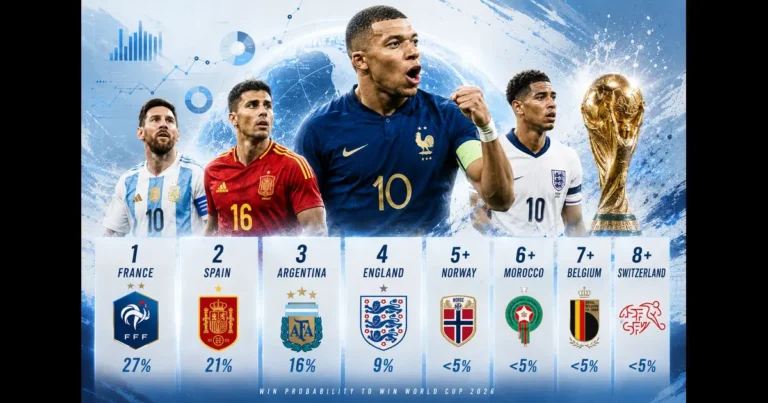
There’s a version of this article that simply calls Spain the tournament favorites and leaves it there, and plenty of statistical models, including Opta’s supercomputer projections, would back that framing up given where Spain currently sit in the tournament’s overall win-probability rankings. But “quietly dangerous” captures something the raw percentages don’t: the fact that Spain’s route through this tournament has generated remarkably little of the discourse that’s followed every other contender. Nobody’s writing thousand-word pieces about Spain’s mentality the way they have about Argentina’s defensive fragility. Nobody’s building entire broadcast segments around a single Spanish player the way networks have built coverage around Haaland or Messi. Spain have simply been winning, consistently and convincingly, while the football world’s attention has been pulled toward louder storylines elsewhere.
That’s precisely what makes them dangerous. A team playing this well while receiving this little scrutiny is a team that gets to enter its biggest remaining matches without carrying the weight of external pressure and expectation that’s been heaped onto France, Argentina, and even England at various points this tournament. Spain get to just play football, largely left alone by a media conversation focused elsewhere, and if their performance against Portugal in the Round of 16 is any indication, that’s exactly the environment in which this particular Spanish squad seems to thrive. Whether that quiet, controlled danger is enough to finally break Spain’s strange World Cup curse is the question the rest of this tournament will answer. Right now, though, no team left in the competition looks more capable of doing it.
🔹🔹 follow us on facebook 🔹🔹
About the Author



1 thought on “Why Spain Quietly Became the Most Dangerous Team Left in the World Cup”