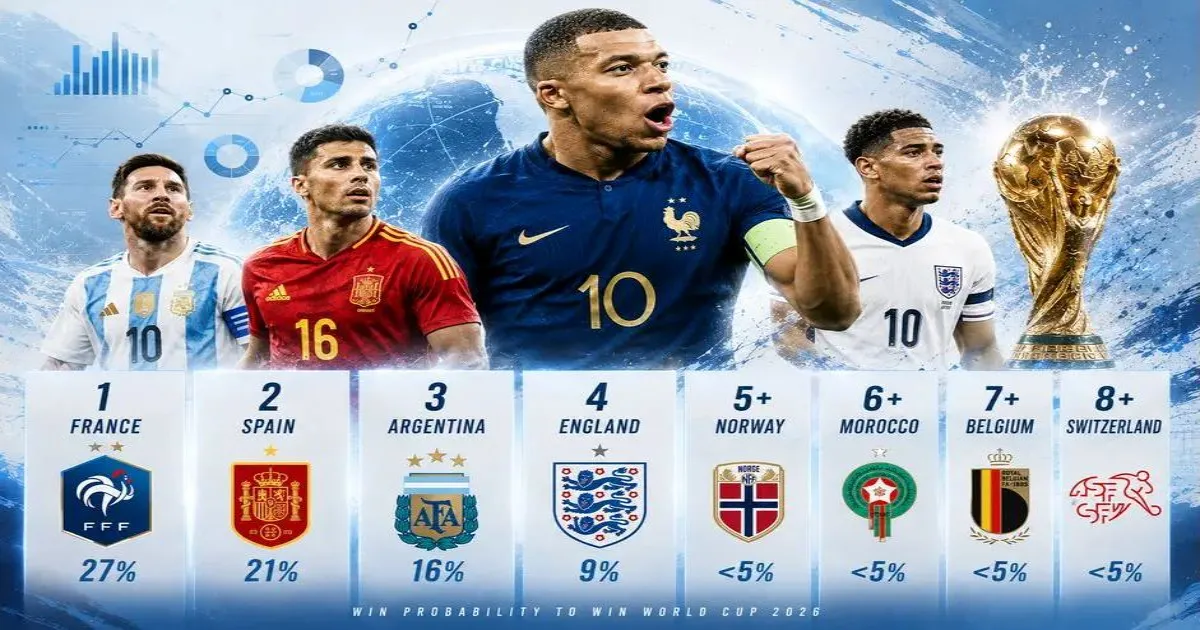
 France, Spain, Norway, and Argentina Face High-Stakes Tests in the Quarter-Finals — Each One Bold Prediction for Every Quarter-Final Almost Came True
From Boston to Kansas City, StrikerReport looks back at its four bold quarter-final predictions — and how the biggest games of the round actually unfolded.
The FIFA World Cup 2026 quarter-finals delivered almost exactly what the knockout stage had promised: elite teams, late drama, tactical battles and several matches that remained alive until the final stages.FIFA World Cup 2026 Quarter-finals, Semi-finals & Final: Dates, Venues & Schedule | StrikerReport
Before the games began, StrikerReport made one bold prediction for each of the four quarter-finals. The idea was not simply to pick the favorite, but to identify the player, tactical matchup or weakness that could change the story.
Some predictions proved surprisingly close. Others went in the opposite direction.
France eliminated Morocco 2-0 in Boston, Spain edged Belgium 2-1 in Los Angeles, England defeated Norway 2-1 after extra time in Miami, and Argentina eventually overcame Switzerland 3-1 after extra time in Kansas City.
Here is how each prediction played out.The 10 Highest-Paid Footballers in the World
France vs Morocco — The Favorite Had the Last Word
Our prediction: France 2-0 Morocco
The original prediction expected France to progress without necessarily relying on Kylian Mbappé for the decisive moment. The logic was that Morocco’s defensive attention would inevitably create opportunities for France’s other attacking players.
The scoreline turned out to be exactly right.
France defeated Morocco 2-0 at Boston Stadium, with Mbappé opening the scoring before Ousmane Dembélé added a second goal.
For Morocco, the quarter-final represented another impressive World Cup campaign. The Atlas Lions had already eliminated the Netherlands on penalties and then swept aside co-hosts Canada 3-0. Their run ultimately ended against a France side that had not conceded during its first three knockout matches.
The bigger story was that France’s depth once again proved decisive.
Mbappé did score, but Dembélé’s goal reinforced the point that France did not need their biggest star to carry every attacking sequence.
Prediction verdict: Partially correct. The 2-0 scoreline was right, but Mbappé did find the net.The Fastest NBA Players Ever, Ranked
Spain vs Belgium — The Clean Sheet Finally Disappeared
Our prediction: Spain 3-1 Belgium
This was perhaps the most interesting tactical prediction of the four.
Spain entered the match with an extraordinary defensive record and had yet to concede at the tournament. Belgium, however, possessed enough attacking quality to make Spain uncomfortable, particularly after Charles De Ketelaere’s excellent performance against the United States.
The prediction suggested that Belgium would finally breach Spain’s defense but that Spain’s attacking quality would ultimately settle the contest.
That proved remarkably close.
Spain won 2-1, with Fabián Ruiz putting them ahead before De Ketelaere equalized. Mikel Merino then struck in the 88th minute to send Spain into the semifinals.
So the prediction correctly identified two important elements: Belgium would score and Spain would find a late winner.
The difference was the final margin.
Rather than Spain winning comfortably, Belgium stayed in the contest until the closing stages.
Merino once again became Spain’s late-match hero after previously scoring the winner against Portugal in the Round of 16.
Prediction verdict: Very close. The predicted Belgian goal and late Spanish winner arrived, but the match finished 2-1 rather than 3-1.
Norway vs England — Haaland Meets the English Wall
Our prediction: Norway 2-1 England
This was the biggest miss of the four.
Norway entered the quarter-final with enormous momentum. Erling Haaland had become one of the tournament’s defining players, while Norway had already eliminated Brazil in the previous round.
England, meanwhile, had survived a difficult knockout match against Mexico and faced the additional challenge of dealing with Haaland’s physical presence.
The prediction backed Norway to exploit England’s defensive reshuffle and believed Haaland could produce another decisive performance.
Instead, England found a way through.
Norway scored, but England eventually won 2-1 after extra time in Miami. The result ended Norway’s remarkable return to the World Cup at the quarter-final stage.
For Norway, reaching the last eight was still an extraordinary achievement. They returned to the World Cup for the first time since 1998 and defeated both Côte d’Ivoire and Brazil in the knockout rounds before England finally stopped them.
For England, the victory confirmed that this team could survive a very different type of challenge.
The match did not become the Haaland showcase predicted. Instead, England’s collective resilience proved more important than the individual battle.
Prediction verdict: Wrong. Norway pushed England all the way, but England survived in extra time.
Argentina vs Switzerland — The Upset That Never Arrived
Our prediction: Switzerland win on penalties
This was supposed to be the shock of the quarter-final round.
Switzerland had already demonstrated their defensive discipline and had eliminated Colombia on penalties. Argentina, meanwhile, had shown moments of vulnerability despite Lionel Messi’s extraordinary tournament.
The prediction therefore imagined a match in which Switzerland would frustrate Argentina for 120 minutes before winning another penalty shootout.
It came close to becoming that kind of game — but Argentina ultimately found the breakthrough.
Argentina defeated Switzerland 3-1 after extra time in Kansas City, ending the Swiss challenge and moving the defending champions into the semifinals.
Switzerland’s run nevertheless represented their best World Cup performance since 1954, when they hosted the tournament and also reached the quarter-finals.
The decisive difference was Argentina’s ability to keep pushing deep into the match.
Rather than allowing the game to become a penalty lottery, the defending champions found the goals necessary to settle it before the shootout.
Prediction verdict: Wrong. Switzerland’s defensive plan was not enough to stop Argentina over 120 minutes.
What the Quarter-Finals Actually Taught Us
The four matches produced an interesting lesson about knockout football.
The favorites ultimately dominated the round.
France eliminated Morocco. Spain defeated Belgium. England overcame Norway. Argentina beat Switzerland.
There was no quarter-final upset, despite the increasingly unpredictable nature of the tournament.
The final scores were:
| Quarter-final | Result |
|---|---|
| France vs Morocco | France 2-0 Morocco |
| Spain vs Belgium | Spain 2-1 Belgium |
| Norway vs England | Norway 1-2 England AET |
| Argentina vs Switzerland | Argentina 3-1 Switzerland AET |
That does not mean the quarter-finals were straightforward.
Far from it.
Spain needed a late Merino goal to defeat Belgium. England required extra time to eliminate Norway. Argentina also needed extra time to finally pull away from Switzerland.
Only France produced a relatively comfortable result.
The Four Semi-Finalists
The quarter-finals left four of international football’s biggest names standing: France, Spain, England and Argentina.
Spain advanced to face France in Dallas, while England earned a semi-final against Argentina in Atlanta.
That created a fascinating final-four lineup.
France brought tournament experience and attacking depth.
Spain brought possession, defensive consistency and one of the most balanced teams in the competition.
England brought resilience after surviving Norway.
Argentina arrived as defending champions with Lionel Messi still leading the charge.
The semifinals therefore promised a very different challenge from the quarter-finals.
Spain’s Defense Becomes the Main Story
One of the biggest developments of the knockout stage was Spain’s transformation from a possession-based favorite into a genuine tournament machine.
Before Belgium, Spain had not conceded a goal in five matches.
Belgium finally ended that run when De Ketelaere scored in the first half.
But rather than collapsing, Spain responded and eventually produced the late winner.
That resilience mattered.
A tournament-winning team needs more than technical superiority. It needs the ability to survive when the game stops following the preferred script.
Spain had now demonstrated both.
France Continue to Look Like Contenders
France’s victory over Morocco reinforced their status as one of the tournament’s most complete teams.
They entered the quarter-finals having already scored heavily during the tournament and had shown that their attacking options extended far beyond Mbappé.
Their 2-0 victory over Morocco was another clean-sheet performance in the knockout stage. FIFA’s tournament summary notes that France went through Sweden, Paraguay and Morocco without conceding before eventually falling to Spain in the semifinal.
That defensive reliability became one of France’s biggest strengths.
England’s Fairytale Survives
Norway’s elimination was disappointing for neutral fans, but England’s victory added another chapter to an increasingly compelling tournament.
Haaland and Norway had already eliminated Brazil, making them one of the stories of the World Cup.
England stopped that run without doing it easily.
The 2-1 extra-time victory showed why knockout football cannot always be reduced to individual stars.
Haaland had the headlines.
England had the answer.
Argentina Refuse to Surrender Their Crown
Argentina’s quarter-final against Switzerland also reinforced the resilience of the defending champions.
Switzerland had every reason to believe they could cause an upset. They were organized, experienced and had already survived a penalty shootout.
But Argentina kept pushing.
The 3-1 extra-time victory sent them into the semifinals and kept alive their hopes of becoming champions again.
For Messi, it was another step in what would become an increasingly historic final World Cup campaign.
Final Verdict on Our Bold Predictions
The original StrikerReport predictions were designed to identify potential surprises rather than simply reproduce the most obvious outcomes.
Looking back, one prediction landed perfectly on the result: France 2-0 Morocco.
The Spain-Belgium prediction was close enough to identify the major tactical story: Belgium would score, but Spain would still find a late winner.
The other two were genuine misses.
Norway could not complete their fairytale against England, while Switzerland were unable to drag Argentina into another penalty shootout.
And that is precisely what makes World Cup prediction pieces so difficult.
The quarter-finals demonstrated that tactical logic can identify possibilities, but knockout football remains brutally unpredictable.
From Four Predictions to Four Giants
The quarter-finals are now part of World Cup history, and the tournament moved into a semifinal stage featuring four teams with completely different stories.
France were chasing another final.
Spain were attempting to restore themselves to the summit of world football.
England were chasing their biggest international prize since 1966.
Argentina were trying to defend the title they won four years earlier.
Ultimately, the quarter-finals did not deliver the massive upset StrikerReport predicted.
They delivered something arguably more valuable for the tournament narrative: four heavyweight semifinalists, each arriving with a convincing argument that they could win it all.
And as the World Cup showed once again, sometimes the boldest prediction is not the one that shocks the bracket — it is the one that correctly identifies how close the favorites will come to falling.
About the Author



1 thought on “One Bold Prediction for Every Quarter-Final Match of FIFA World Cup 2026”