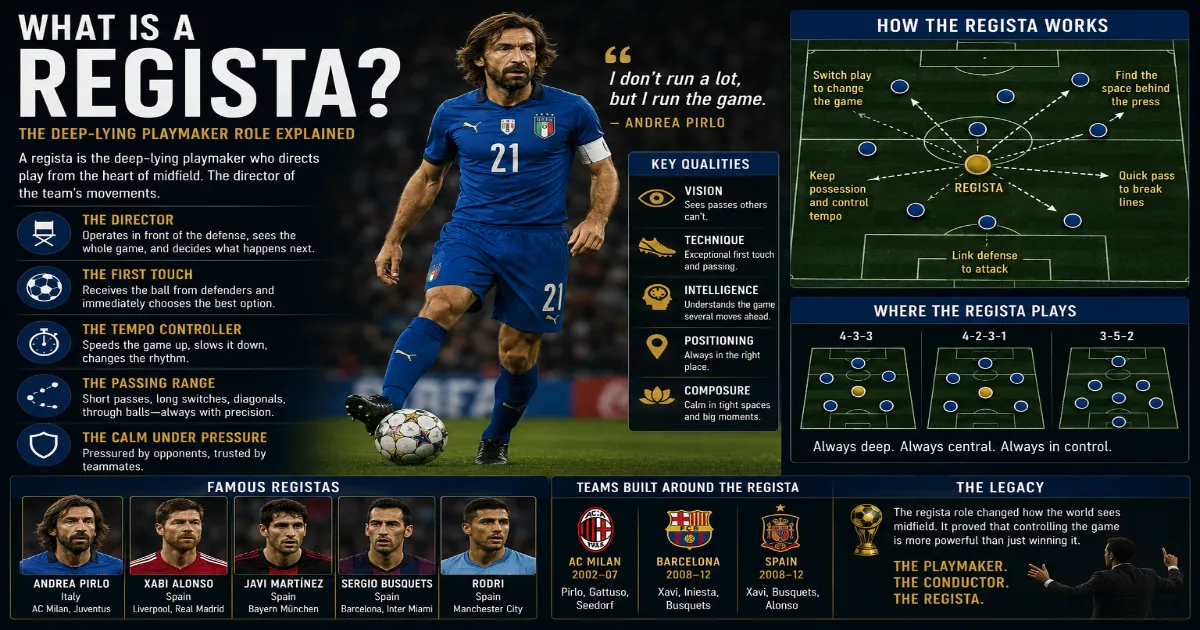
What Is a Regista? The Deep-Lying Playmaker Role Explained
Football has plenty of roles that translate neatly across languages. A goalkeeper is a goalkeeper everywhere. A striker is a striker. But the regista resists easy translation, because it isn’t just a positional description — it’s a philosophy about how football can be controlled, slowed down, and orchestrated from the part of the pitch where most managers instinctively build defensively rather than creatively. Understanding the regista means understanding a different way of thinking about what midfield is actually for.
The Literal Translation and Why It Matters
The word “regista” is Italian, and it translates literally as “director” — specifically, the kind of director who sits behind the camera rather than in front of it. In Italian cinema, the regista is the person with the complete picture of the film in their head, orchestrating every element from a position the audience never actually sees. It’s a deliberately theatrical term for a football position, and the analogy is more precise than it might first appear. A regista in football operates from a deep central position, usually just in front of the defensive line, and directs everything that happens in front of them — not through pace or pressing or even primarily through goals, but through reading the game before the game itself knows what it’s about to do next.
That’s the key distinction from other creative positions. An attacking midfielder or a traditional No. 10 influences the game from deep in the opponent’s half, receiving the ball in advanced areas and threading passes into the final third. The regista works from the opposite end of the pitch’s creative spectrum, collecting the ball from centre-backs or defensive midfielders and immediately deciding — with remarkable speed and accuracy — where, at what weight, and in what direction the next move needs to go to best disrupt what the opponent is trying to build. It is, as coaches have described it, like being a chess player who always gets to move first.
Where the Role Came From
The regista is fundamentally an Italian invention, developed across several decades of Serie A tactical evolution during an era when Italian football was the most tactically sophisticated league in the world. Its earliest recognizable form appeared in the post-war Italian game under managers like Nereo Rocco and later Helenio Herrera, who understood that controlling midfield transitions — specifically who first touches the ball after a defensive action — was the clearest path to controlling a match entirely. The idea that a player with exceptional vision and passing technique could serve as the team’s central nervous system, redistributing the ball before pressure could build, became increasingly central to Italian tactical thinking through the 1960s and 1970s.
The role found its most complete early expression in players like Sandro Mazzola and Gianni Rivera, who operated in slightly different interpretations of the same basic concept, and then, in the 1980s, began evolving toward the more purely deep-lying version that is now the definitive understanding of the term. By the time Serie A was consistently attracting the world’s best foreign talent in the late 1980s and through the 1990s, the regista had become a standard element of the Italian tactical vocabulary, recognized and discussed openly in a way that other European leagues were only beginning to develop the language for.
The Player Who Made It Universal
No discussion of the regista is complete without Andrea Pirlo, the player who more than any other turned the position from a tactical concept into a global cultural reference. Pirlo’s story is itself a perfect illustration of what the role demands — and what it doesn’t. In his early career at Inter Milan, Pirlo was deployed in a more conventional attacking midfield position and struggled to consistently impose himself at the highest level. When Carlo Ancelotti moved him into a deep-lying role at AC Milan in the early 2000s, something clicked into place so completely that it transformed not just Pirlo’s career but the wider conversation about what a midfielder could be.
In that deep role, Pirlo’s exceptional vision, his ability to pass with pinpoint accuracy over short and long distances with either foot, and his extraordinary calmness under pressure became not just assets but the entire engine of a Milan side that won two Champions League titles. He rarely ran when others might — not because he was lazy, but because he understood the geometry of the pitch well enough to know exactly where he needed to be at every moment without the energy expenditure that unnecessary movement requires. At his peak, Pirlo would complete sixty or seventy passes in a match without a single misdirected touch, controlling the tempo of a game the way a conductor controls the pace of an orchestra. His World Cup-winning performances for Italy in 2006 and his later years at Juventus, where he remained an elite influence well into his mid-thirties, cemented his position as the gold standard by which every subsequent regista is measured.
How It Works Tactically
Breaking down what a regista actually does during a match requires looking at several moments in a typical passage of play that are easy to overlook if you’re watching the ball rather than the player.
When a center-back receives the ball during a build-up phase, the regista’s first job is to offer a clean passing option — dropping slightly, angling their body to be immediately useful, and positioning themselves where a short ball can be played safely. The moment that pass arrives, the regista’s next decision is already made: a switch of play to relieve pressure on the right, a diagonal pass into a midfielder’s feet in midfield, a longer ball over the opposition’s press into the advancing full-back’s path, or, occasionally, simply slowing everything down with a deliberate, weighted touch that tells the rest of the team to reset their shape and build more patiently.
The critical technical requirements for the position are: an exceptionally accurate long pass, especially diagonally across the pitch; a first touch capable of controlling difficult balls under pressure from closing players; the composure to make the right decision without hesitation even when an opposing press is arriving; and — perhaps most importantly — a genuinely panoramic reading of the game. That last quality is the hardest to quantify and the most essential. Pirlo famously spoke about scanning the entire pitch before a pass was played to him, so that by the time the ball arrived, the decision was already made. That pre-scanning habit, once invisible to ordinary football watchers, is now tracked and measured by modern performance analysis departments as one of the clearest markers of elite midfield play.
The Regista vs. The Box-to-Box Midfielder
A question that often comes up in tactical discussion is how the regista relates to the box-to-box midfielder — the player like Frank Lampard, Steven Gerrard, or, in the modern game, Jude Bellingham, who contributes across the entire length of the pitch in both directions. The difference is fundamental rather than merely stylistic. A box-to-box midfielder’s contribution depends significantly on their physical presence and their ability to arrive in the right place at the right time across a very large area of the pitch. A regista’s contribution is concentrated in a narrower zone but is far more specifically about quality of decision-making and distribution than about covering ground.
This is also why the regista, historically, has been one of the few positions in football where a player can remain elite and enormously influential into their mid-to-late thirties, long after pace and physical intensity have diminished. Pirlo’s most decorated years as a player came after the age of thirty. Xabi Alonso, who developed a deep-lying playmaking quality in the latter part of his career, was arguably better at thirty-three than he had been at twenty-five. The brain, when trained to read the game with the precision the regista demands, tends to age rather more gracefully than the legs.
The Modern Regista: Still Relevant?
Contemporary football, with its emphasis on high pressing, intensive running, and positional interchangeability across the entire XI, has sometimes been described as inhospitable territory for the classic regista. There is some truth to this — a pure Pirlo-style deep director who contributes almost nothing defensively and covers very little ground is increasingly hard to accommodate in a high-pressing 4-3-3 or 4-2-3-1 system. But the role has adapted rather than disappeared. Sergio Busquets at Barcelona and for Spain was arguably the greatest adaptation of the concept — a player with Pirlo’s passing intelligence and positional awareness, grafted onto a defensive compactness and an ability to break pressing lines that the original Italian conception never demanded. Toni Kroos at Real Madrid brought a similar blend, controlling tempo from deep with both feet while working harder in transition than classical registas ever needed to.
Today, players like Granit Xhaka in his later Arsenal incarnation, Rodri at Manchester City, and Vitinha at Paris Saint-Germain all carry meaningful elements of the regista template inside a broader, more physically demanding midfield brief. The title has blurred somewhat, absorbed into the broader “deep-lying playmaker” description that English-language football writing tends to prefer. But the core concept — a player positioned deep, reading the game earlier than everyone else, and directing the football’s movement with controlled, purposeful distribution — remains one of the most influential ideas Italian football has contributed to the global tactical conversation.
Why the Role Produces Football’s Most Watchable Moments
Most football highlights packages are built around pace, power, and dramatic finishes. The regista’s contributions rarely appear in those packages, which is part of why the position is underappreciated by casual viewers but overrepresented in the thinking of the best managers in the world. When a deep-lying playmaker plays a single diagonal ball that moves a team from defensive shape to attack, bypassing three opposition press lines in a single touch, the moment is gone almost before it registers. Watch it back in slow motion and the intelligence required becomes unmistakable — the weight of the pass, the angle chosen, the split-second reading of where a teammate’s run is heading before that run is obvious to anyone else on the pitch.
That combination of invisibility and indispensability is precisely what the word “regista” was always trying to capture. The director behind the camera. The mind that sees the whole film, even when the audience only sees the frame they’re currently in.
▪️▪️ Follow us on Facebook ▪️▪️
VAR in Football Explained: How It Works, Why It Divides Fans and What’s New at World Cup 2026
About the Author





1 thought on “The Regista: Football’s Most Cerebral Position, Fully Explained”