The Psychology of Penalty Shootouts: Why Football’s Cruellest Moment Fascinates
Roberto Baggio’s hands went to his face before the ball had even finished its journey over the crossbar. It is one of sport’s most recognizable images — not the moment of failure itself, but the instant a man comprehends what he has done and what it means, captured in a single frame that has never needed a caption in thirty years. Italy 1994. The World Cup final. The ball somewhere in the California sky, and Roberto Baggio somewhere else entirely.
The psychology of penalty shootouts has been studied, debated, and agonized over longer than almost any other specific moment in football. Why does this particular format, twelve yards, one ball, one goalkeeper, one player, generate levels of stress and fascination that nothing else in the sport quite matches? The answers, it turns out, involve cognitive science, behavioral economics, neuroscience, and a specific set of mental conditions that are simply not reproducible in any other sports context. Understanding them doesn’t make penalty shootouts any less cruel. But it does make them considerably less mysterious.
What a Penalty Kick Actually Is
Start with the fundamental reality of what a penalty kick requires, stripped of all the drama. A player places a ball twelve yards from the goal. The goalkeeper stands on the line. The player runs forward and kicks. The goalkeeper, based on various cues taken before and during the run-up, dives in a direction they believe the ball will travel. The ball either goes in or it doesn’t.The Regista: Football’s Most Cerebral Position, Fully Explained The process takes approximately two seconds from the moment the ball is struck to its destination.
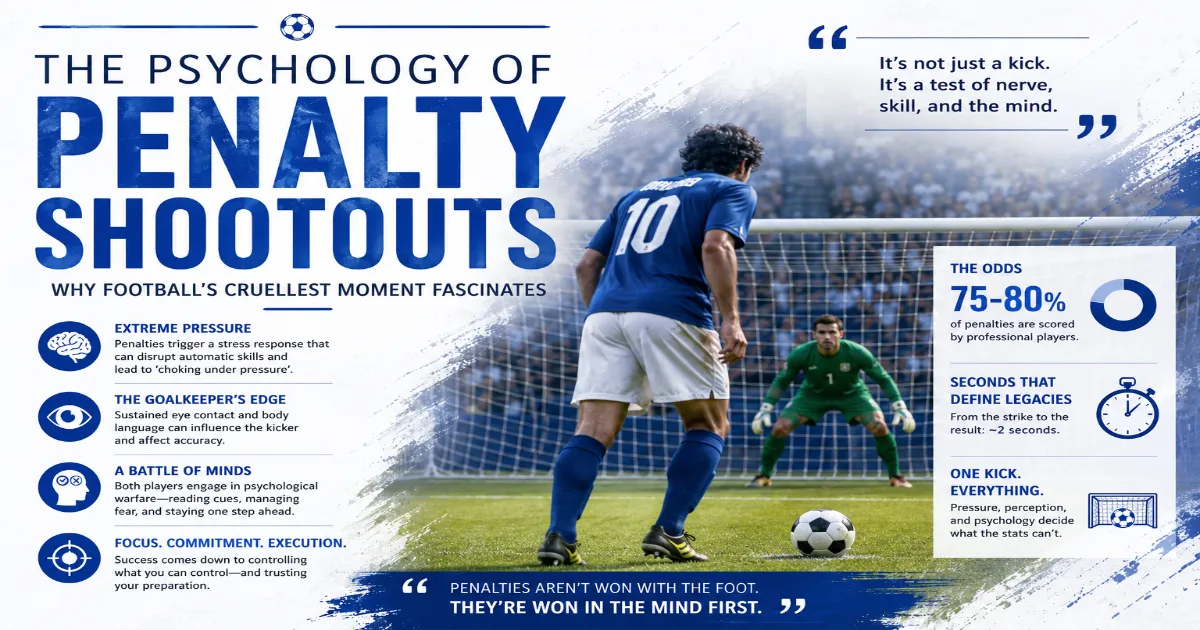
On paper, the odds favor the kicker dramatically. A penalty scored by a world-class player who places the ball accurately in a corner gives even the best goalkeeper almost no chance of saving it — a keeper diving correctly to a well-placed corner kick can only reach a ball struck at the minimum pace required for a legal kick roughly thirty percent of the time. Academic research into penalty conversion rates in competitive matches has historically found that approximately seventy-five to eighty percent of professional penalties are scored. Statistically, the kicker should win comfortably every time.
But shootouts, as every footballer and every football fan knows from experience, don’t play out according to the statistical odds. They don’t feel like a process the taker controls. They feel, most of the time, like something that is happening to the taker — and that perceptual shift from agent to subject is precisely where the psychology becomes fascinating.
The Choking Problem
The word “choke” gets used loosely in sport to describe any high-stakes failure, but sports psychologists use it with considerably more precision. Choking, in the technical sense, refers specifically to a performance that falls below a player’s established level of skill under pressure — not bad luck, not an opponent doing something extraordinary, but a measurable degradation of a skill the player can normally execute reliably. And penalty kicks are one of the clearest environments in sport for studying choking, because the baseline skill — kicking a ball accurately from a standing position at a stationary target — is something professional footballers can perform without difficulty in training, hundreds of times, with a success rate significantly above ninety percent.VAR in Football Explained: How It Works, Why It Divides Fans and What’s New at World Cup 2026
The mechanism behind choking under pressure is well understood at this point. Under normal conditions, skilled actions like kicking a ball accurately are controlled primarily by procedural memory — the implicit, automatic part of the brain that handles learned physical skills without requiring conscious attention. The process of consciously thinking about how to perform a skill you’ve automated through years of repetition actually interferes with procedural memory, causing small but significant errors in movement sequencing and timing. It’s the sporting equivalent of suddenly being unable to walk normally the moment someone tells you to think about what your feet are doing.
Under extreme pressure, conscious attention floods back into actions that should be automatic. The player thinks about where their foot should connect with the ball, about the run-up, about the goalkeeper’s positioning, about the crowd — and each of those conscious thoughts adds friction to a process that normally runs without friction at all. The result is a penalty kick taken with a body in which the conscious and automatic systems are fighting each other, and the outcome is frequently worse than anything that player would produce in training.
The Role of the Goalkeeper’s Gaze
One of the most specific and counterintuitive findings in penalty research concerns the psychological relationship between kicker and goalkeeper. A study conducted at the University of Chichester found that expert goalkeepers tend to maintain their gaze on the kicker’s body — specifically the hip and trunk region, which provides early information about the direction of the kick — rather than watching the ball itself. Crucially, the study also found that when a goalkeeper maintains direct, sustained eye contact with the kicker during the run-up, kicker accuracy drops measurably even among experienced professionals.
Veteran goalkeepers have described using this deliberately — Gianluigi Buffon famously spoke in his autobiography about the importance of making himself feel “bigger” in the kicker’s vision, not just physically, but psychologically, through body language, positioning, and eye contact that communicates to the kicker that they are about to be beaten. This kind of deliberate psychological positioning before the ball is struck represents a genuine strategic layer that the best shot-stoppers have always intuitively understood, even when they couldn’t articulate the mechanism behind it.
Research published in the Journal of Sport and Exercise Psychology went further, finding that when goalkeepers speak to kickers before a penalty — saying anything at all, regardless of content — penalty conversion rates drop slightly. The explanation isn’t magical. It’s attentional: speech from the goalkeeper draws the kicker’s conscious attention away from their own technique and toward the goalkeeper as a social and psychological presence, disrupting the automaticity that accurate kicking requires.Inside Football’s Financial Fair Play Rule and the New Squad Cost Era
Home and Away: The Crowd Effect
Penalty shootouts don’t happen in a vacuum, and the evidence that crowd composition affects shootout outcomes is among the most robustly replicated findings in football psychology research. A widely cited study by Geir Jordet, the Norwegian sports psychologist who has spent more than twenty years studying penalty research, analyzed nearly 200 penalty shootouts from major international tournaments and found that teams playing in front of predominantly hostile crowds converted at a meaningfully lower rate than those with strong home support. The effect was particularly pronounced for players who were also the youngest or most inexperienced in the squad.
Jordet’s research also introduced a concept that has since become one of the most referenced ideas in sports psychology: the role of self-consciousness under observation. The more a player feels watched and evaluated — by the crowd, by television cameras, by teammates, by the opposition, by history — the more conscious attention floods into their performance, triggering exactly the choking mechanism described above. A shootout, by its nature, maximizes every source of self-consciousness simultaneously. The player walks alone from the halfway line. The crowd is silent or screaming, both of which draw attention to the self. The camera follows every step. The entire match, and sometimes the entire tournament, has collapsed into a single moment in which only this player exists.
The Taker’s Dilemma: Decide Early or Adapt Late
One of the most practically significant questions in penalty psychology is whether a kicker is better off deciding where to place the shot before starting the run-up — and committing to that decision regardless of what the goalkeeper does — or attempting to read the goalkeeper’s movement and adjust direction accordingly. The research answer, while counterintuitive for anyone who has watched keepers dive early and left gaps that a waiting kicker could have exploited, leans clearly toward pre-commitment.Football vs Soccer? The Surprising Truth Behind the Argument
A study tracking eye movements and ball placement across hundreds of elite penalties found that players who had clearly decided their direction before beginning the run-up produced more accurate kicks and higher conversion rates than those who attempted to read and respond mid-run. The reason is mechanical as much as psychological: changing the direction of a penalty kick mid-approach requires an alteration in body angle and foot placement that reliably reduces accuracy, even among elite professionals. The goalkeeper might dive early and guess wrong. A taker who responds to that early dive in real time to switch direction frequently produces a penalty so poorly placed that even a diving keeper can recover to reach it.
The practical implication is significant. The optimal penalty strategy for a kicker, in terms of pure outcome probability, is to select a target location and commit to it completely, regardless of what the goalkeeper appears to be doing. What makes this psychologically difficult is that it requires the kicker to accept a loss of perceived control — to commit to a direction before the keeper has shown their hand, trusting the pre-made decision rather than reacting to information that becomes available in the final second. For players used to reading and responding to what opponents do in real time, that pre-commitment feels counterintuitive even when the evidence in favor of it is unambiguous.
The Captain’s Burden: Why Leadership and Penalty Orders Matter
Research into penalty shootout ordering has produced one of the more debated findings in the field. Jordet’s work found that players who volunteer to take the first penalty — typically the team’s most experienced and composed performers — convert at a slightly higher rate than those who take later kicks, and that conversion rates fall in later rounds of a shootout as the cumulative pressure and consequence of each miss compounds. Put differently: the fifth kick in a sudden-death scenario is not the same psychological experience as the first kick in a 0-0 situation, even if the mechanics on the pitch are identical.
This is why the question of who takes which penalty, in which order, and whether players are assigned or volunteer, has become increasingly important in how elite nations prepare for knockout football. England’s notorious history in shootouts — losing six of their first seven in major tournaments before finally converting against Colombia in 2018 — prompted years of soul-searching about exactly this point. When Gareth Southgate, whose own penalty miss against Germany in Euro 1996 created one of the most enduring images in English football history, became England manager and began investing seriously in psychological preparation for shootouts, the reasoning was informed directly by the kind of research described above.
The shift included psychologists working explicitly with players on pre-commitment techniques, desensitization exercises designed to simulate the crowd noise and isolation of a live shootout environment, and specific practice methodologies built around performing under maximum self-consciousness rather than the comfortable anonymity of a training session. That England finally broke their shootout curse under Southgate in 2018 — winning against Colombia and then navigating a shootout against Switzerland in 2023 — hasn’t been attributed entirely to psychological preparation by the manager himself, but the connection is clearly more than coincidental.
Why Goalkeepers Are Different
The goalkeeper’s psychological experience of a shootout differs from the outfield kicker’s in ways that are worth examining separately. Research has found that goalkeepers actually benefit from a form of low-expectation psychology in shootouts — since the statistical baseline has them saving only one in four penalties, each save feels like a bonus rather than a baseline expectation, while each scored goal feels less like a personal failure. This asymmetry in psychological stakes may partly explain why outstanding shootout performances from goalkeepers are somewhat more common than comparable collapses of nerve: the pressure framework for a goalkeeper in a shootout is genuinely less compressing than for the kicker.
Goalkeeper coaches have begun formalizing this advantage through specific preparation methods that go beyond simply studying kicker tendencies. Yassine Bounou, the Morocco goalkeeper who proved decisive against the Netherlands earlier at this tournament, was reported in multiple broadcasts to have spent significant preparation time working on body language and eye contact protocols specifically developed to maximize the psychological pressure on kickers — a formalization of exactly the intuitive tactics that veteran goalkeepers have always understood but rarely codified.
Why the Fascination Never Fades
There is a final question worth addressing directly: why, in a sport full of dramatic and emotionally charged moments, does the penalty shootout hold such a uniquely powerful grip on football’s collective imagination? The answer lies, partly, in how completely it reduces the game to its most human elements. For two hours, elite football is a complex, team-based, tactically intricate spectacle in which individual responsibility is diffused across eleven players and a manager. A shootout strips all of that away. One player. One ball. One goalkeeper. One decision, made under conditions of maximum psychological pressure, that is visible and irreversible the moment it’s made.
We are watching what happens when a human being faces a moment of complete individual responsibility and partial control — knowing that their skill and preparation have gotten them to this point, but also knowing that the result is not entirely in their hands, that the goalkeeper might guess correctly and get lucky, that a millisecond’s hesitation can redirect a ball a foot in any direction. That combination of preparation, courage, psychological demand, and irreducible chance is not something sport produces very often in such concentrated, visible form. It’s why Roberto Baggio’s hands went to his face before the ball had finished flying. It’s why we still remember the image thirty years later. And it’s why football will never fully solve the psychological puzzle of twelve yards, one ball, and everything at stake.
A Record Number: MLS Players at World Cup 2026 and What It Means for the League
▪️▪️ follow us on facebook ▪️▪️
About the Author