A record 45 MLS players are at this summer’s tournament — here’s who, for which country, and why it matters
MLS Players at World Cup 2026
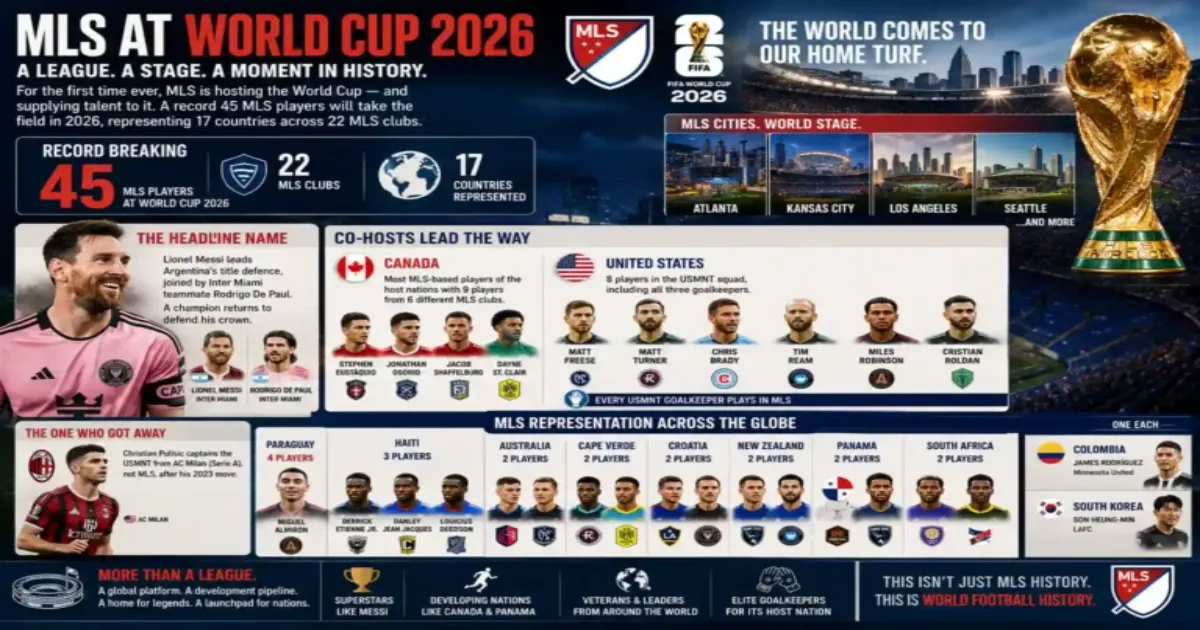
Major League Soccer is, for the first time in its history, not just a participant in a World Cup conversation — it’s hosting one. With the tournament being staged across cities including Atlanta, Kansas City, Los Angeles, Seattle, and beyond, MLS finds itself in the unusual position of supplying players, stadiums, and sheer infrastructure to the biggest event in the sport. The numbers back up the moment: a record 45 MLS players are featuring at the 2026 World Cup, spread across 22 clubs and representing 17 different countries.
PSG v Arsenal: How Paris Won the Champions League Final on Penalties
NBA Schedule 2026-27: Christmas Day Rivalries, Ring Night and the Games to Watch
Bangladesh Create History in Darwin, Defeat Australia by Nine Wickets in Landmark Test Victory
This is the kind of statistic that deserves unpacking rather than just repeating, because it tells a layered story about where MLS sits in the global football hierarchy right now.
The Headline Name, and the One Who Got Away
Lionel Messi remains the most obvious starting point. The Inter Miami forward leads Argentina’s title defence, joined at club level by countryman Rodrigo De Paul — giving the reigning World Cup holders two representatives from MLS’s highest-profile roster. It’s worth noting, for accuracy’s sake, that Christian Pulisic — long MLS’s most prominent American export story in reverse — is not among this group; he moved to AC Milan in 2023 and captains the USMNT from Serie A, not from MLS. The distinction matters if you’re tracking the league’s actual on-pitch representation rather than just its biggest associated names.USA vs Paraguay 4-1 Match Report: Pulisic and Balogun Light Up SoFi Stadium
Co-Hosts Lead the Way, But Not the Way You’d Expect
Here’s a genuine surprise buried in the data: the United States does not have the most MLS-based players at its own home World Cup. That distinction belongs to Canada, who call up nine players from six different MLS clubs — among them Stephen Eustáquio, Jonathan Osorio, Jacob Shaffelburg, and goalkeeper Dayne St. Clair. It’s a meaningful marker of how thoroughly MLS has become Canada’s primary domestic pipeline, even as Canadian players increasingly move abroad mid-career.Lionel Messi Becomes Billionaire: How the Football Icon Built a $1 Billion Empire
The USMNT’s own MLS contingent is substantial in its own right — eight players including all three of the squad’s goalkeepers, Matt Freese, Matt Turner, and Chris Brady, alongside defenders Tim Ream and Miles Robinson and Seattle’s Cristian Roldan. Notably, every USMNT goalkeeper at this tournament currently plays in MLS, an under-discussed data point that says something about the league’s growing reputation for developing — or at least retaining — reliable shot-stoppers.
The Smaller Contingents Tell the More Interesting Stories
Beyond the two host nations, the list becomes a window into MLS’s reach across smaller and emerging football nations. Paraguay carry four MLS players into the tournament, led by Atlanta United’s Miguel Almirón. Haiti’s three MLS representatives — Derrick Etienne Jr., Danley Jean Jacques, and Louicius Deedson — are part of a squad making history as the nation reaches its first World Cup in over five decades, a storyline MLS itself has actively promoted.
Australia, Cape Verde, Croatia, New Zealand, Panama, and South Africa each contribute two MLS players to their World Cup squads, while Colombia’s James Rodríguez — now plying his trade at Minnesota United — represents one of the more unexpected late-career MLS arrivals to find his way onto a World Cup roster. South Korea’s Son Heung-Min, since his move to LAFC, becomes another headline name flying MLS’s flag at a tournament far from the league’s traditional spotlight.
What the Numbers Actually Signal
It would be easy to read “record 45 MLS players” as straightforward validation of the league’s rising quality — and there’s something to that. But the more precise read is about distribution and pathway diversity. MLS is no longer simply an endpoint for declining European stars, nor purely a development league for young Americans headed abroad. It’s become a genuine staging ground across multiple roles simultaneously: a retirement destination for global superstars like Messi, a development pipeline for CONCACAF nations like Canada and Panama, a late-career landing spot for South American and Asian veterans, and increasingly, a credible source of tournament-ready goalkeepers for its host nation.
With group-stage matches actually being played inside MLS markets this summer, the symbolism writes itself. The league spent three decades building toward relevance on the world stage. This World Cup, for the first time, MLS isn’t just watching that stage get built around it — it’s standing on it, with 45 of its own players doing exactly the same.
About the Author


1 thought on “A Record Number: MLS Players at World Cup 2026 and What It Means for the League”