What World Cup 2026 Means for MLS — Inside a Host Country’s Football Revolution, Built Years Before Kickoff
Most football tournaments are events. The World Cup 2026, for Major League Soccer specifically, has been something closer to a deadline — a fixed point on the calendar that an entire domestic football ecosystem has spent eight years building toward, restructuring around, and ultimately will be judged against.
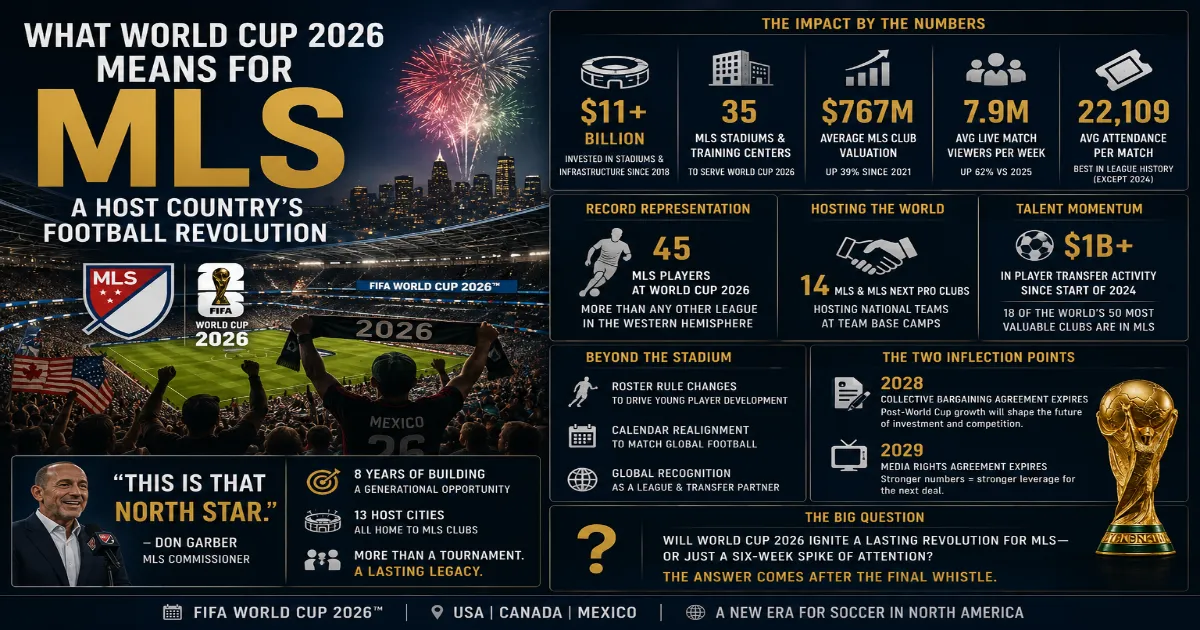
When MLS commissioner Don Garber describes the tournament as “that North Star” rather than a six-week showcase, he is articulating a strategic philosophy that predates the opening kickoff by nearly a decade. Since hosting rights were confirmed in 2018, MLS has treated the 2026 World Cup not as a celebration to be enjoyed but as a structural opportunity to be engineered — and the resulting transformation of the league’s infrastructure, finances, and competitive standing represents one of the more significant case studies in modern sports business strategy.
This is the analyst’s breakdown of what World Cup 2026 actually means for MLS: the investment, the growth, the open questions, and the test the league now faces in converting six weeks of global attention into permanent commercial advantage.
The Eight-Year Build: Infrastructure as Strategy
The most concrete evidence of MLS’s World Cup strategy is also the simplest to measure: money spent on physical infrastructure.
Since 2018, MLS has invested more than $11 billion in soccer stadiums and infrastructure across North America. Approximately 35 MLS stadiums and training centres will serve World Cup purposes during the tournament itself — meaning the league’s existing footprint, rather than purpose-built World Cup venues alone, forms a substantial part of the tournament’s operational backbone.
This is a critical distinction from how many previous World Cup host nations have approached infrastructure. Rather than building stadiums that exist primarily for a six-week tournament and then sit underutilised for years afterward — the familiar “white elephant” problem that has plagued previous host nations from South Africa to Brazil — MLS structured its investment so that World Cup infrastructure and domestic league infrastructure are functionally the same assets.
The league has added seven expansion teams and nine soccer-specific stadiums since the hosting decision. The opening of Inter Miami’s new Nu Stadium in April 2026 brought the league’s total of soccer-specific venues to 27, with further developments underway in New York City, Chicago, and Boston. All 13 World Cup host cities in the United States and Canada are home to MLS clubs — a coordination between league footprint and tournament geography that was clearly not accidental.
The Valuation Story: From League to Asset Class
The financial trajectory of MLS franchises in the build-up to the World Cup tells its own story about how seriously the investment community has taken the league’s growth narrative.
According to Sportico data, the average MLS club valuation reached $767 million ahead of the 2026 season — up 6% year-over-year and a striking 39% increase since 2021. Five MLS clubs are now valued above $1 billion: Inter Miami CF ($1.45 billion), LAFC ($1.4 billion), LA Galaxy ($1.17 billion), Atlanta United ($1.14 billion), and New York City FC ($1.12 billion).
Perhaps the most significant indicator of the league’s elevated commercial standing: 18 of the world’s 50 most valuable soccer clubs are now in MLS — more than any other league globally, according to Sportico’s rankings. This is a remarkable statistic for a league that, within the lifetime of many of its current players, was still commonly characterised internationally as a retirement destination rather than a competitive top-flight product.
The Messi effect deserves specific mention here. Garber has been explicit that Lionel Messi’s 2023 arrival at Inter Miami fundamentally altered global perception of the league — not merely through his individual brand value, but through the signal it sent that a genuinely elite, actively competitive player would choose MLS over rival offers from Barcelona and Saudi Arabia’s domestic league. “He certainly did not come here to retire,” Garber told Reuters, directly addressing the criticism that has historically shadowed the league’s recruitment strategy.
The Viewership Numbers: Evidence of Pre-Tournament Momentum
Beyond infrastructure and valuation, the clearest leading indicator of the World Cup’s potential impact is the viewership trajectory MLS has established in the months immediately preceding the tournament.
Through the first three months of the 2026 season, MLS reported a 62% year-over-year increase in viewership, averaging 7.9 million live-match viewers per week across streaming and linear platforms combined. This growth spans the league’s Apple TV global media partnership alongside US and Canadian linear broadcast partners — a distribution strategy specifically designed to maximise both premium content value and broad accessibility.
Attendance figures tell a parallel story. MLS is averaging 22,109 fans per match through May 2026, with more than 4.8 million total fans attending matches in the season’s first three months — both figures up from 2025 and representing the second-highest attendance numbers in league history, trailing only the record-breaking 2024 season. Several clubs — Colorado Rapids, D.C. United, Inter Miami CF, LAFC, and Toronto FC — have each established new individual club attendance records during this same period.
The league’s roster has also evolved substantially in talent quality. Since the start of 2024, MLS clubs have spent or received more than $1 billion in player transfer activity — a figure exceeding the league’s entire transfer market activity across its first 25 years of existence combined (1996-2020). The 2025 season alone produced more than $336 million in transfer spending and over $200 million in transfer revenue received, reflecting both increased investment in talent and growing global recognition of MLS as a legitimate trading partner in the international transfer market.
The 45 Players: MLS’s Direct World Cup Presence
A record 45 MLS players are competing at the 2026 World Cup across multiple national teams — more representation than any other league in the Western Hemisphere has historically provided to the tournament. This figure serves a dual function for the league: it demonstrates the competitive standard MLS now operates at, while also generating direct promotional value as MLS-affiliated players feature prominently across the tournament’s broadcast coverage.
Fourteen MLS and MLS NEXT Pro clubs are hosting World Cup participating national teams at their official Team Base Camps throughout the tournament — facilities including the newly built Red Bull New York performance centre and Sporting Kansas City’s training complex. This places MLS infrastructure directly inside the operational fabric of the tournament itself, rather than positioning the league as a passive beneficiary of attention generated elsewhere.
MLS also reports that 45% of international players signed by league clubs in 2025 arrived with prior national team experience — a statistic the league uses to counter the long-standing perception that MLS primarily attracts players in career decline rather than players in competitive prime.
The Structural Changes Beyond Infrastructure
Garber has been explicit that the World Cup catalysed changes extending well beyond stadium construction. MLS has altered roster rules specifically to encourage greater investment in young player development — a shift toward the kind of academy-driven, sell-on value model that characterises successful European leagues, rather than the marquee-veteran-signing approach that defined MLS’s earlier growth phase under the Designated Player rule.
The league is also pursuing a calendar restructuring — shifting its season to better align with the global football calendar, including international transfer windows, and moving its postseason outside what Garber describes as an overcrowded US sports calendar dominated by the NFL, NBA, MLB, and NHL postseasons. This alignment matters significantly for two reasons: it positions MLS players for smoother integration into the international transfer market, and it removes a structural competitive disadvantage that has historically limited MLS’s domestic media attention during its own championship period.
The Two Inflection Points That Make Timing Critical
Why does the World Cup’s commercial impact on MLS matter with such specific urgency right now, rather than simply representing a pleasant tailwind? Two structural deadlines explain the stakes.
The Collective Bargaining Agreement between MLS and the Major League Soccer Players Association expires January 31, 2028 — placing the next full labour negotiation cycle squarely within the eighteen months immediately following the World Cup. If MLS can demonstrate durable post-tournament growth in viewership, attendance, sponsorship, and overall commercial demand, that evidence becomes central to negotiations over player investment levels, roster construction rules, revenue sharing structures, and the league’s stated ambition to attract higher-calibre talent on a sustained basis.
The media rights agreement is set to expire in 2029. Strong post-World Cup performance data would provide MLS’s negotiating position with media partners considerable additional leverage — demonstrating that American soccer demand represents a durable, monetisable, year-round commercial proposition rather than a phenomenon limited to quadrennial international tournaments.
The Honest Question: Spike or Foundation?
For all the league’s preparation and genuinely impressive infrastructure investment, the central uncertainty acknowledged even by MLS’s own commercial analysis remains unresolved: will World Cup enthusiasm convert into sustained domestic league engagement, or will it prove to be a temporary spike that recedes once the tournament concludes?
This distinction matters because previous host nations have not uniformly converted World Cup hosting into lasting domestic league benefit. The structural difference MLS is betting on is the depth and permanence of its pre-tournament investment — the theory being that a league which has already built $11 billion in infrastructure, secured five billion-dollar franchise valuations, and established genuine year-round viewership momentum before the tournament even begins is structurally positioned to retain attention in ways that less-prepared domestic leagues in previous host nations were not.
Garber has been deliberately cautious about overpromising specific outcomes, framing success in terms of broader brand metrics — popularity, relevance, awareness, player recognition, fan engagement — rather than committing to specific attendance or revenue targets that could read as failures if narrowly missed.
What World Cup 2026 Means for MLS: The Verdict
The relationship between World Cup 2026 and MLS represents one of the more sophisticated examples of a domestic league using mega-event hosting rights as a deliberate, long-horizon strategic catalyst rather than treating the tournament as an isolated commercial opportunity.
The infrastructure is built. The valuations have already responded. The viewership and attendance trajectories were rising before a ball was kicked at the tournament itself. What remains genuinely uncertain — and what will define whether this represents American football’s structural turning point or simply its most successful six-week promotional campaign — is what happens to those same metrics in August, September, and October 2026, once the global spotlight inevitably moves elsewhere.
MLS spent eight years preparing for that exact question. The answer arrives this autumn.
▪️▪️ Follow us on Facebook ▪️▪️
A Record Number: MLS Players at World Cup 2026 and What It Means for the League
The Next Pulisics: 10 USMNT youth talent Who Could Star at the 2030 World Cup
Tyler Adams: USMNT Midfielder Stats, Career, Club & World Cup 2026 Profile
Home Advantage or Home Pressure? The USMNT’s 2026 World Cup Report Card
About the Author


3 thoughts on “What World Cup 2026 Means for MLS: A Host Country’s Football Revolution”