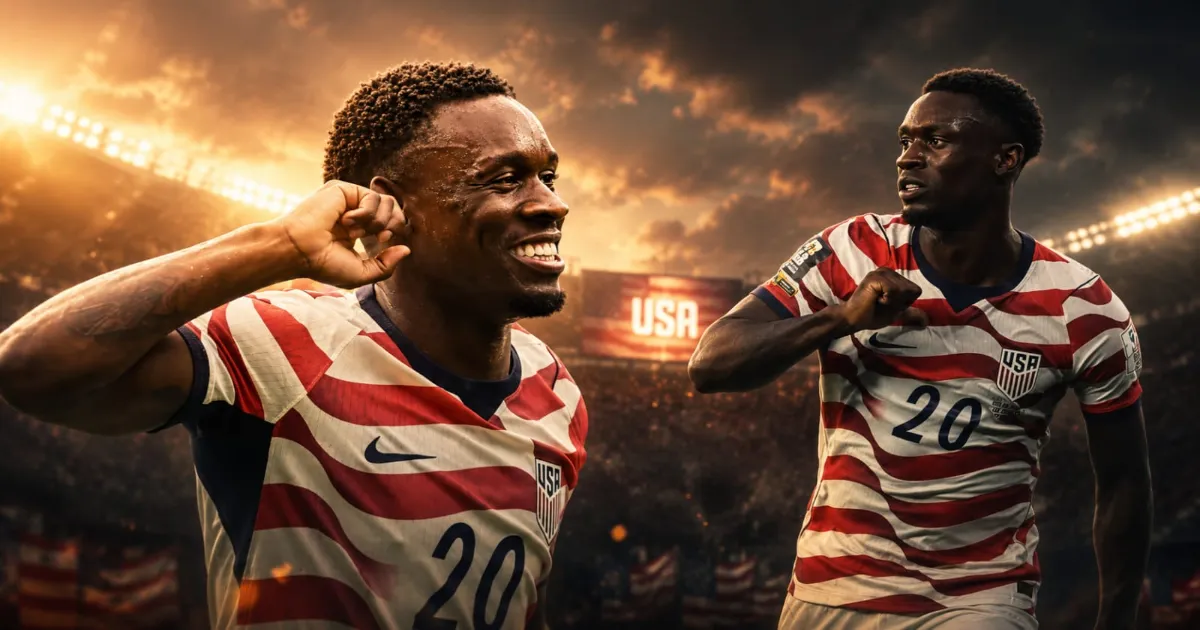
Folarin Balogun at the FIFA World Cup 2026 — The Striker America Always Needed, Right When They Need Him Most
“The kid’s insane. He’s lethal right now.”
Those are Christian Pulisic’s words. The USMNT captain, the man who spent years as the face of American soccer, stepped aside for a moment in the mixed zone after the 4-1 demolition of Paraguay and directed the camera’s attention somewhere else: toward the striker who had just scored twice in the first half and looked like he wanted more.
Folarin Balogun had been waiting for this moment for his entire career. Not the goals themselves — goals are what Balogun does with consistent, almost compulsive regularity across every level of football he has played at. He had been waiting for the specific combination of stage and moment and readiness that make goals feel like they belong to something larger than a football match.
The FIFA World Cup 2026, on home soil, against Paraguay in Inglewood, California — that was the combination. He nailed it.
The Accident of Birthplace That Became His Greatest Asset
The Folarin Balogun World Cup 2026 origin story begins, improbably, with an overzealous airline.
His mother, Rashidat, was visiting New York City from England in 2001 when airlines refused to allow her to board her return flight — her pregnancy was too advanced for the airline’s policies. She stayed. And on July 3, 2001, Folarin Jerry Balogun was born in Brooklyn, New York, to Nigerian parents, in a country he would not live in for more than the first month of his life.
He was taken back to London at one month old. He grew up in London. He joined Arsenal’s Hale End Academy at age eight. He played for England at youth level — the Under-17 European Championship, the whole English football system with its camps and its expectations. He was, to all intents and purposes, an English footballer who happened to have been born in America.
The American football system came for him in 2018, when he was recruited by the United States Under-18 team. He scored twice in the Václav Ježek Youth Tournament in Czech Republic. He represented England at youth level again. He represented the United States. He was, for years, a footballing citizen of three nations — the USA, England, and Nigeria — each with a legitimate claim to one of the most promising young strikers in European football.
In May 2023, he made the decision permanent. The United States it was.
“I’m very happy with the decision,” he said at the time. “I’m excited about what we can build.”
What they have built, two years and a World Cup later, is this: a team with its first genuinely world-class centre-forward since the days when American soccer had to argue for its own seriousness as a global sport.
Arsenal, Reims, Monaco: The Education of a Finisher
The Hale End Academy produced Bukayo Saka, Emile Smith Rowe, and a generation of technically gifted English players. It also produced Folarin Balogun — though his path from Hale End to elite European football was longer and less linear than several of his academy contemporaries.
Arsenal promoted him to the first team in 2020, where he contributed a goal and an assist in his senior debut against Dundalk in the Europa League. But consistent first-team football at Arsenal was never going to come easily in a squad of that depth. The loan moves were the answer.
Middlesbrough (January–May 2022): Eighteen Championship appearances. Three goals. Useful but not transformative.
Stade de Reims (2022-23): This was the loan that changed everything. Twenty-one goals in 37 Ligue 1 appearances — the highest single-season total ever recorded by an American player in a top five European league. He was not merely prolific. He was the kind of prolific that makes clubs open their chequebooks immediately. Arsenal, who had loaned him, received substantial interest from across Europe within weeks of the season ending.
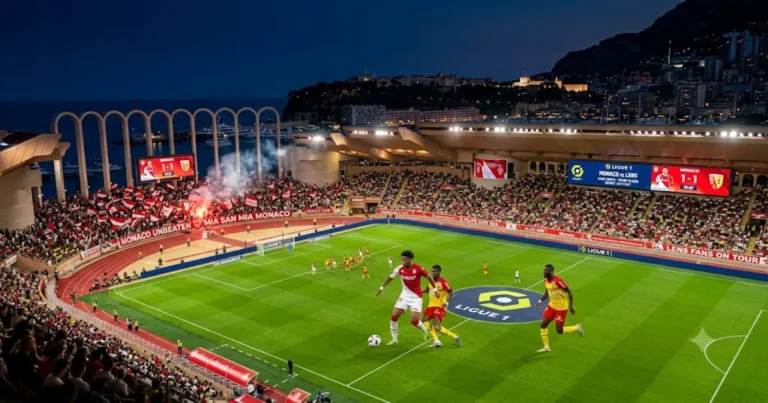
Monaco (2023–present): A €40 million permanent move, with potential add-ons reaching €50 million. One of the most expensive deals in Ligue 1 history for an American player. His first season was interrupted by injuries. His 2025-26 campaign — 19 goals and 4 assists in all competitions, a nine-consecutive-match scoring streak that tied Kylian Mbappé’s 2025-26 Ligue 1 season record, Monaco Player of the Season — was the sustained excellence that confirmed the transfer fee had not been a gamble.
He arrived at the 2026 World Cup having scored in eight consecutive Ligue 1 matches. That kind of streak is not momentum. It is form so profound it becomes a different thing entirely: inevitability.
The 2026 World Cup: Making History in Two Games
The Folarin Balogun World Cup 2026 group stage produced two performances that USMNT supporters will discuss for years.
USA 4–1 Paraguay (June 13, SoFi Stadium, Inglewood, CA)
The United States’ most goal-rich World Cup match since 1930. Paraguay’s Damián Bobadilla put through his own net in the 7th minute after pressure from the USMNT press. Then, in the 31st minute, a Christian Pulisic cutback found Balogun at the penalty spot. He drilled it low and angled into the corner. First World Cup goal. Calm. Placed. Inevitable.
In first-half stoppage time — the eight additional minutes producing the type of moment Hollywood would have written — Pulisic found him with a through ball on the edge of the penalty area. A Paraguayan defender pressed from behind. Balogun held him off — at five feet ten and not especially powerful, he held him off — and then beat another defender before curling the ball into the top corner with his left foot, the weaker foot, as casually as a player in training.
The Pulisic post-match reaction: “The kid’s insane. He’s lethal right now. We’re really lucky to have him.”
The American press was more measured but essentially said the same thing. Balogun had become the first USMNT player to score two goals in a World Cup match since 1930. In the inaugural tournament. Ninety-six years between those two moments.
USA 2–0 Australia (June 19, Lumen Field, Seattle)
The second match was more disciplined, the performance more collective, the scoreline more modest. But Balogun’s contribution was not less significant for its quieter nature. His run down the left flank — scorching pace that surprised the viewer precisely because he does not play like a speed merchant — and low, driven cross into the six-yard box was turned into his own net by Cameron Burgess. An assist. A goal involvement. Three direct contributions from the American striker in two matches.
He was named Michelob Ultra Superior Player of the Match for both victories — consecutive awards that confirmed what the statistics already showed: through two games, Balogun had been directly responsible for three of the USA’s six goals.
How He Scores: The Anatomy of a World Cup Striker
What the numbers tell us, and what the eye confirms, is that Balogun is a penalty-box striker of the classical type — a player whose game is built around positioning, movement, and finishing rather than creation, dribbling, or physical dominance.
At Monaco across his two full seasons, he recorded 444 touches inside the opposition box — a figure that places him among the top five strikers in Ligue 1 by that metric. He converted 20 big chances — an elite conversion rate for a forward of his age operating in a top-five league. He scored from five shots in his World Cup opening match against Paraguay.
His movement is the foundation. He lives on the shoulder of the last defender — the position that requires perfect timing because any earlier and the offside flag kills the chance, any later and the defender wins the race. Balogun’s timing in that specific movement is consistently correct. It is the quality that most clearly separates a good striker from a dangerous one.
His finishing has the clean, unfussy quality of a player who does not over-complicate the moment of contact. He shoots early. He does not reposition when a repositioned defender might block the ball. He trusts his initial assessment of where the ball and the goal are relative to each other, and he executes before that calculation changes.
The Numbers That Explain Everything
| Category | Stat |
|---|---|
| Date of Birth | July 3, 2001 (turns 25 during tournament) |
| Club | AS Monaco (Ligue 1) |
| Position | Striker / Centre-forward |
| Senior USA caps | 29 |
| International goals (to June 2026) | 11 |
| Career Monaco goals | 29 (all competitions) |
| 2025-26 Monaco goals | 19 (all competitions) |
| 2025-26 Ligue 1 goals | 13 (4th top scorer) |
| World Cup 2026: vs Paraguay | 2 goals |
| World Cup 2026: vs Australia | 1 goal contribution (forced own goal) |
| World Cup 2026 total | 2 goals, 3 direct contributions |
| Player of the Match awards | 2 (Matches 1 and 2) |
| USMNT record he broke | First 2-goal WC game for USA since 1930 |
The Transfer Window Question No One Is Avoiding
ESPN’s report from the tournament explicitly noted that European clubs have been watching Balogun’s performances with intense interest. The question of where he plays his club football after this tournament is being asked with greater urgency after each match.
Monaco paid €40 million. After two World Cup goals on home American soil, with European giants watching from the stands and the scouting networks, that fee already looks like a considerable bargain. The conversation about Balogun’s market value was already rising sharply before the tournament began. After the Paraguay match alone, it accelerated significantly.
For the USMNT, the implications are entirely positive. A striker of Balogun’s quality, established at an elite European club, confident and in form at a home World Cup — this is the profile of a player around whom a genuinely competitive American national team can be built for the next decade.
The Road Ahead: Bosnia in the Round of 32
The United States face Bosnia and Herzegovina in the Round of 32 — a match that carries considerable weight for a team with deep knockout-stage aspirations. Bosnia are not without quality; their direct pressing and physical approach in the group stage demonstrated why they advanced despite difficult circumstances.
For Balogun specifically: will Pochettino restore him to the starting eleven after the rotation against Türkiye in the final group game? The indications from Pochettino’s press conferences suggest yes. The form argument is unanswerable. Two goals in two matches is a sufficient evidence base for any head coach’s selection decision.
More importantly: what does Balogun do in a match where Bosnia will specifically plan around stopping him? The evolution from a player who surprises opponents to a player who can succeed despite being specifically targeted is the test that separates very good strikers from genuinely elite ones.
Based on his Monaco form, based on his psychological composure under scrutiny, based on the fact that he walked into one of the sport’s most pressurised environments and scored twice in the first match — the educated guess is that Balogun will handle that test with exactly the combination of directness and intelligence that has made him the World Cup’s most exciting American footballer in a generation.
Related articles:
▪️▪️ Follow us on Facebook▪️▪️
The Next Pulisics: 10 USMNT youth talent Who Could Star at the 2030 World Cup
Tyler Adams: USMNT Midfielder Stats, Career, Club & World Cup 2026 Profile
Home Advantage or Home Pressure? The USMNT’s 2026 World Cup Report Card
About the Author