There are moments in sport when a nation and a tournament align so perfectly that failure becomes almost unthinkable — and yet remains entirely possible. That is the USMNT’s existential condition heading into the 2026 FIFA World Cup. A home tournament. A generation of talent once described as a golden crop. A coach with Premier League pedigree. And a country asking, after decades of near-misses and early exits, whether this time is genuinely different.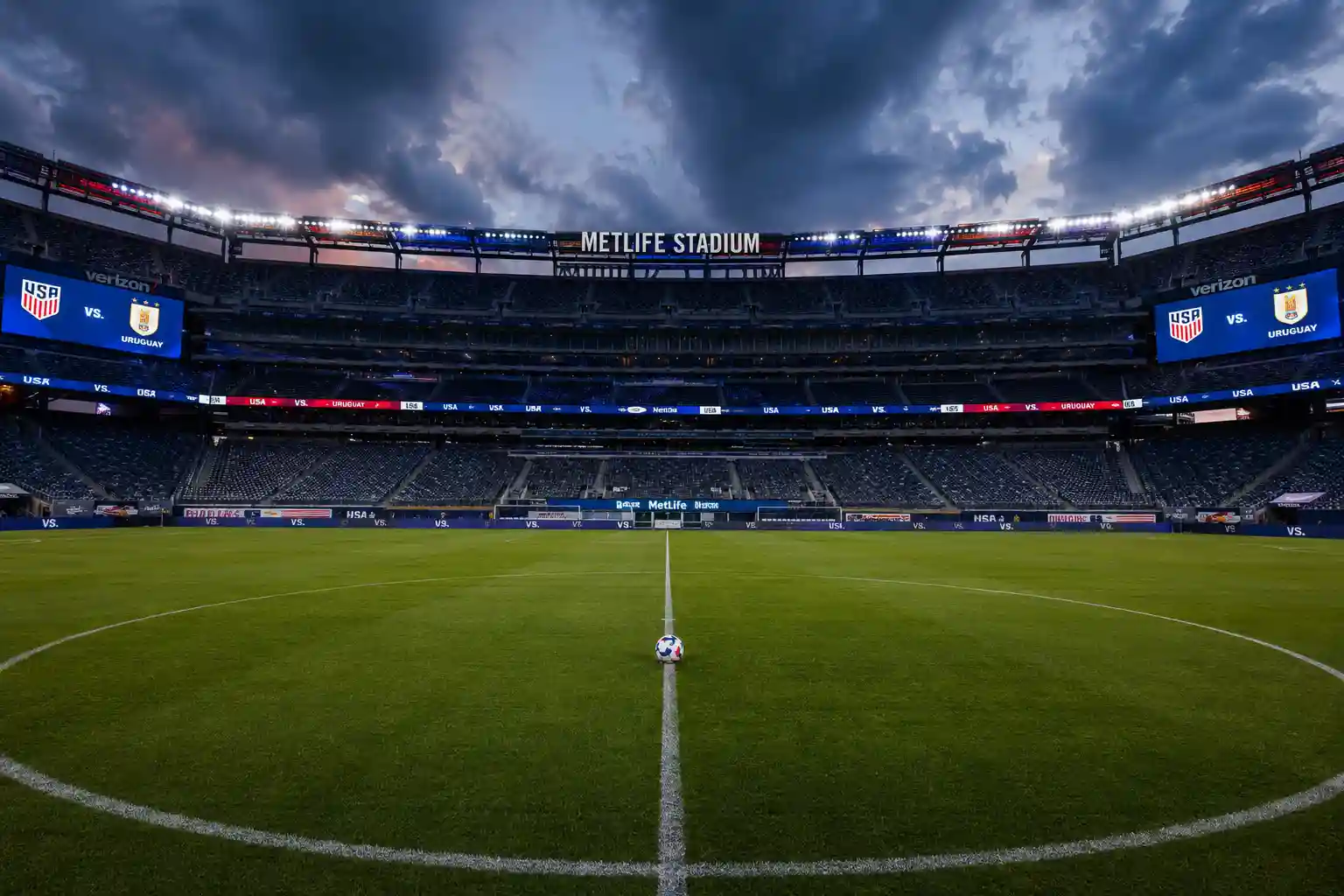
The honest answer is: maybe. And in football, maybe is both thrilling and terrifying.
The Pochettino Project — One Year, One Mission
When Mauricio Pochettino was appointed in 2024, it sent a signal. This wasn’t a developmental hire. The Argentine, who took Tottenham Hotspur to a Champions League final and reinvented Paris Saint-Germain’s tactical identity, was brought in specifically to engineer a deep World Cup run. Everything else — the Nations League campaigns, the friendlies, the Copa América warm-up — was prologue.
Pochettino settled on a 3-4-3 formation that gave the USMNT both defensive structure and the width to exploit their pace-heavy attack. He experimented, he dropped players, he reportedly communicated his roster decisions via email (a controversy that underscored the cultural gap between European managing styles and American sensibilities). Yet the results started coming. A 5-1 demolition of Uruguay in the final window of 2025 suggested a team cohering around an idea.
“We were working really hard for one year and a half or more to try to arrive in this moment,” Pochettino said at the squad announcement in New York City. “It is impossible to be fair with everyone. But I think we made the best decision to be competitive and to try to win.”
That announcement drew from a pool of 13 returnees from the Qatar 2022 squad — a continuity number that ties the programme’s own record set between 1994 and 1998. The message is clear: this isn’t a rebuild. It’s an escalation.
Christian Pulisic and the Weight of a Nation
Let’s address the room’s elephant directly: Christian Pulisic enters this tournament in a form trough. The AC Milan forward — the USMNT’s most technically gifted attacker and spiritual captain — has endured a goalless drought heading into June. His “quiet” windows in 2026 have been noted by analysts, with some wondering whether the weight of expectation surrounding a home World Cup is pressing on his performances.
The counter-argument is historical. Pulisic saved his best for World Cup stages before — he was the decisive force in Qatar, and bright lights have a habit of unlocking elite players who carry too much elsewhere. He remains part of a remarkable trio of Qatar returnees: Pulisic, Tim Weah, and Haji Wright were the USMNT’s only goalscorers at the 2022 tournament, with Weah and Wright the scorers in Group Stage. All three return, forming an attacking continuity rare for American soccer.
Still, the question critics refuse to drop is valid: if Pulisic is misfiring, where do the goals come from? Ricardo Pepi, the striker who was once America’s great hope up front, missed the cut in some projections. The No. 9 role remains the squad’s softest spot — a genuine anxiety for a team with midfield quality but a reliance on Pulisic threading moments of magic through a crowded penalty area.
The Midfield Blueprint: Adams, McKennie, and the Engine Room
Where the USMNT earns genuine admiration from tactical analysts is in central midfield. Tyler Adams, when fit, is a genuine difference-maker — a press-triggering, ball-recovering machine whose energy sets the team’s defensive pulse. Weston McKennie has grown from a gifted talent into a seasoned European operator at Juventus. Brenden Aaronson brings pressing intensity and intelligent movement. Together, they give Pochettino a midfield that can compete with Group D opposition.
And Group D, upon honest inspection, is navigable. The USMNT face Paraguay, Australia, and Türkiye — a draw that avoids the tournament’s heavyweights. Analysts have noted that the USA’s last quarterfinal appearance was in 2002, a fact the squad and coaching staff are acutely aware of. Matching that benchmark in 2026 would require progression through the Round of 32 and Round of 16 — realistic targets on paper, but football does not run on paper.
Eight players who started all four matches in Qatar — Adams, Sergiño Dest, McKennie, Pulisic, Tim Ream, Antonee Robinson, Matt Turner, and Weah — return with that experience encoded in their muscle memory. Antonee Robinson at left back continues to be one of the most underrated attackers in the squad, capable of turning defensive roles into forward momentum. Chris Richards anchors the back three with the composure of a player who has genuinely matured.
The Striker Problem Nobody Wants to Talk About
Stripped of euphoria, the USMNT’s forward line presents the tournament’s most pressing analytical concern. Folarin Balogun, who committed to the United States over England and Nigeria, is a player of genuine Premier League calibre — but his tournament experience remains limited. Haji Wright, a player whose career has been erratic, provides the bench option who can become a sub’s game-winner (as he proved in Qatar). But neither represents the out-and-out, hold-up, dominant No. 9 that knockout football often demands.
Pochettino’s 3-4-3 partly mitigates this by asking his forwards to rotate and press rather than centre their game on a classic striker. But in a knockout match against a compact European or South American side — teams that sit deep and absorb pressure — the USMNT will need someone to convert. That conversion responsibility, in the absence of a natural focal point, falls squarely back on Pulisic.
What Does History Say About USA at Home?
The 1994 World Cup on American soil produced the nation’s best-ever tournament performance — reaching the Round of 16, defeating Colombia, drawing with Switzerland. Home advantage mattered. Crowds mattered. The noise of a nation genuinely engaged with the sport for the first time at that scale mattered.
In 2026, 78 of the tournament’s 104 matches take place in the USA. MetLife Stadium hosts the final. AT&T Stadium, the Rose Bowl, Lumen Field — these are 80,000-capacity cathedrals that will transform into home stands for the USMNT’s matches. That atmospheric advantage is real. It changes individual performances. It creates momentum. It can, in a single match, tilt a 50-50 contest.
The quarterfinal target — a result the USMNT last achieved 24 years ago — is within the realm of plausible outcomes. But only if Pochettino’s tactical system holds under knockout pressure, Pulisic rediscovers his ruthlessness, and the midfield engine absorbs rather than buckles when games turn physical.
Verdict — Contender or Pretender?
In cold analytical terms: the USMNT are a Round of 16 certainty with quarterfinal potential. They have the coaching quality, the tactical structure, and the group draw to reach the last eight. They do not have the squad depth, the proven striker, or the knockout pedigree to be considered genuine dark horses for the final.
What they have — and what is impossible to quantify in a formation grid — is occasion. A home World Cup, a generation of players who grew up watching American soccer’s failures, and a coach who builds teams that peak under pressure.
The United States doesn’t need to win the World Cup in 2026. It needs to make the country believe it can. If Pochettino delivers a quarterfinal — if Pulisic scores a goal that replays for decades — then something shifts in American soccer culture permanently. That is the tournament’s real stakes for the USMNT.
Whether they are ready to seize them is the question that will be answered, match by match, across the stadiums they call home.
StrikerReport.com — Tactical Analysis | FIFA World Cup 2026
About the Author