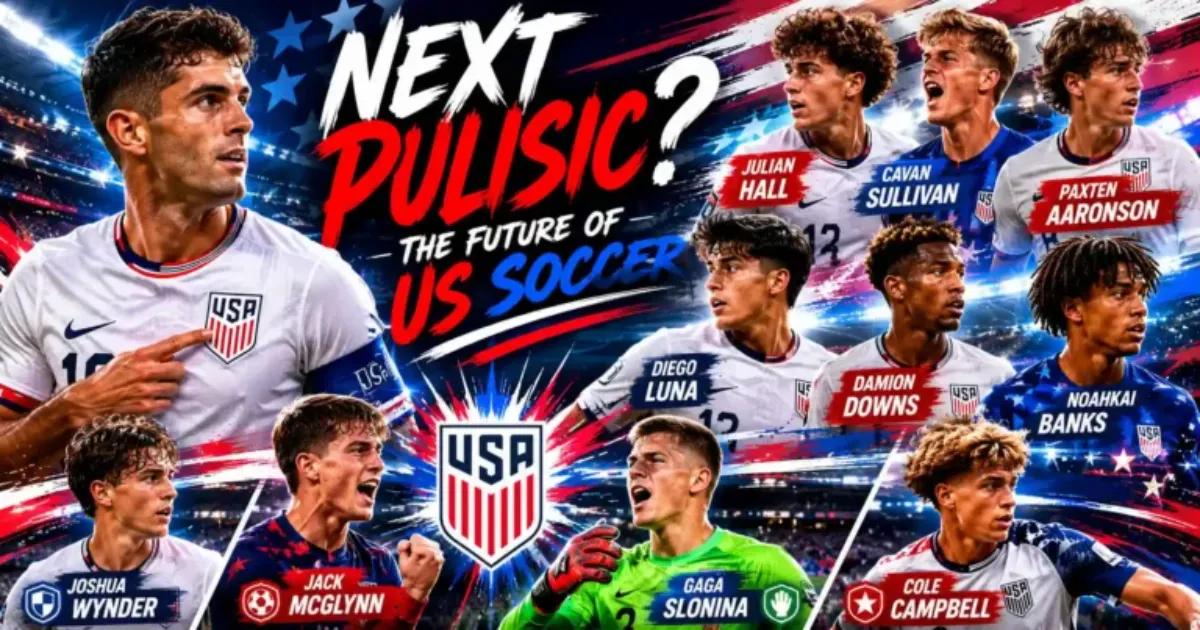
Christian Pulisic was always going to be the hardest act to follow in American soccer. First-choice starter at AC Milan, captain of the USMNT, one of the most recognisable players at the 2026 World Cup on home soil. He’s the benchmark — the proof that American players can compete with the very best in the world at the very highest level.
NBA Schedule 2026-27: Christmas Day Rivalries, Ring Night and the Games to Watch
But football keeps moving, and so does American soccer. The system that produced Pulisic, Giovanni Reyna, Weston McKennie, and Tyler Adams — US Soccer’s emphasis on European pathways, elite academy development, and ruthless identification of talent at younger ages — is already producing the next wave.
The 2030 World Cup, set to be co-hosted across six nations on three continents (Spain, Portugal, Morocco, plus centenary celebration matches in Argentina, Uruguay, and Paraguay), arrives in four years. By then, today’s American teenagers will be in the prime years of their athletic development. Some will be established European starters. Some will be making their names from scratch. A few of them might be genuinely world-class.USMNT World Cup 2026: Pulisic, Pochettino and the Home-Soil Pressure That Could Define American Football Forever
Cristiano Ronaldo Jr.: Club, Lifestyle, Career and Future Prospects
Thiago Messi: Club Career, Playing Style, Lifestyle and Future Prospects
Here are the ten American teenagers with the best chance of being household names at the 2030 World Cup.
1. Julian Hall | Forward | New York Red Bulls | Born: March 24, 2008 (Age 18) | 2030 Age: 22
When a teenager becomes the youngest player in MLS history to score a hat trick — at just 18 years and 50 days old, in a 3-2 win over Columbus Crew in May 2026 — you take notice. When that same teenager was already the second-youngest MLS goalscorer of all time before that, you start running out of superlatives.
Julian Hall is Manhattan-born, Red Bulls-raised, and has already attracted attention from some of Europe’s biggest clubs. Chelsea, Manchester City, Manchester United, and Real Madrid were all reportedly monitoring him when he was still 15 — before he’d even properly broken into MLS senior football.
What makes Hall special is the combination of directness, goalscoring instinct, and the kind of physical development that allows him to impose himself on grown professional footballers at an age when most teenagers are still fighting for first-team minutes at academy level. He scored 6 goals in the 2026 MLS season through mid-May and has demonstrated the clinical composure of a natural striker.
By 2030, Hall will be 22 — the exact age at which the best attacking players tend to begin their peak years. If he makes the right European move in the next 12-18 months, which seems virtually inevitable given the attention surrounding him, he could arrive at a 2030 World Cup as one of America’s most dangerous forward options.
The Pulisic comparison: Like Pulisic, Hall is a player who makes things happen in tight spaces and with limited time on the ball. Unlike Pulisic, his natural position is more centrally goalscoring-oriented. Think less wide forward, more clinical No.9.
2030 potential: First-choice centre-forward, significant European club career already underway.
2. Cavan Sullivan | Midfielder | Philadelphia Union | Born: September 28, 2009 (Age 16) | 2030 Age: 20
No American teenager in soccer has generated more genuine, sustained excitement than Cavan Sullivan. The Philadelphia Union midfielder signed what was described at the time as the largest homegrown deal in MLS history, and embedded within that contract is a clause allowing him to transfer to Manchester City upon turning 18 in September 2027.
Sullivan turns 17 in September 2026. He is, in straightforward terms, still a child. But the evidence available — his movement, his technical quality, his composure on the ball in adult professional environments — suggests something more than typical teenage promise.
He helped the Philadelphia Union to their second-ever Supporters’ Shield in 2025 and has been a regular presence at the youth national team level. His German passport through his mother opens the door to a potential European academy move as early as September 2025 — he could be playing for a top European club before this article is a year old.
At 2030, Sullivan will be just 20 years old. The youngest players at major tournaments are sometimes exactly the kind of fearless, technically pure talents that managers most want in their squads. Kylian Mbappé was 19 when France won the World Cup in 2018. Cavan Sullivan has been described in those kinds of terms by scouts who’ve watched him closely.
The Pulisic comparison: More directly comparable than any other player on this list. Creative central midfielder with the ability to play wide, strong European formation, Philadelphia Union academy heritage — it’s an almost identical profile.
2030 potential: Starting USMNT midfielder, Manchester City first-team player, one of the most-discussed American players of his generation.
3. Paxten Aaronson | Midfielder | On loan at FC Utrecht / Eintracht Frankfurt | Born: December 26, 2002 (Age 23) | 2030 Age: 27
Paxten is the older Aaronson brother — and while his trajectory has been less linear than Brenden’s, his 2024-25 loan season at FC Utrecht in the Eredivisie was the breakthrough that removed all doubt about whether he belongs in European football. Over 2,900 minutes across all competitions, eight goals, six assists, and a spot in the EA SPORTS FC Eredivisie Team of the Season.
He was a breakout star for the US Men’s Olympic team at the 2024 Paris Games. He has the technical quality to operate as an advanced midfielder or wide forward at the highest levels. By 2030, at 27, he should be at the absolute peak of his career — a proven European-level performer who has spent the intervening years accumulating the experience and confidence that transforms good players into great ones.
The Pulisic comparison: Different profile — Paxten is more of a creative goalscoring midfielder than a dribbling wide forward — but the DNA is familiar. Philadelphia Union academy, European pathway, gradual accumulation of senior experience before a senior breakthrough.
2030 potential: Established USMNT regular, top-six European club career, major tournament experience under his belt by 2030.
4. Diego Luna | Midfielder | Real Salt Lake | Born: April 27, 2005 (Age 21) | 2030 Age: 25
Diego Luna has been on the radar of serious USMNT watchers for several years. The Real Salt Lake midfielder is technically polished, reads the game intelligently, and has been a regular presence in US youth national team setups. He is the kind of central midfield organiser that teams at every level need — a player who makes the players around him better through positioning and decision-making rather than pure individual brilliance.
By the time the 2030 World Cup arrives, Luna will be 25 — the age at which midfielders typically consolidate their technical sophistication and physical capability into a genuinely complete playing package. If he makes the right European move before then, which his profile and age timeline strongly suggest he will, he could be a first-choice starting midfielder for the USMNT.
2030 potential: Starting USMNT central midfielder, European club career established, potential captain’s armband material.
5. Damion Downs | Forward | Atlanta United | Born: July 15, 2005 (Age 20) | 2030 Age: 24
Damion Downs is the kind of player who makes scouts reach for their notebooks. The Atlanta United forward is quick, direct, and has the natural instinct for goal that coaches can observe but rarely manufacture. He has been a consistent presence in US youth national teams and has shown, at the MLS level, the ability to score and create in ways that his age profile alone doesn’t fully explain.
At 24 in 2030, Downs will be in the first flush of his prime years as an attacking player. Wide forwards peak in their early-to-mid twenties — the moment when pace, experience, and technical development align perfectly. If Downs develops the consistency his talent suggests is possible, he could be one of the USMNT’s most dangerous wide attacking options at a 2030 World Cup.
2030 potential: European club move likely before 2030, key USMNT wide option, pace and direct running a constant threat.
6. Noahkai Banks | Defender | FC Augsburg | Born: July 20, 2006 (Age 19) | 2030 Age: 24
The most important thing about Noahkai Banks is where he is: FC Augsburg’s first team in the Bundesliga, competing in one of the top five leagues in the world, at 19 years old. Banks broke into the Augsburg first team during the 2024-25 Bundesliga season, earning six consecutive starts before an injury disrupted his progress.
For a young American centre-back, this kind of European pathway is exactly what the USMNT program needs more of. The US has historically struggled to develop world-class central defenders — players like Banks, in the Bundesliga system before turning 20, represent a direct attempt to address that structural gap.
By 2030, Banks will be 24 — an age at which defenders are beginning to develop the positional reading and aerial dominance that separates good defenders from excellent ones. If he remains healthy and continues his development at Augsburg or moves upward, a starting centre-back role in the USMNT’s 2030 World Cup squad is entirely within reach.
2030 potential: Bundesliga-experienced centre-back, regular USMNT defender, physical presence and European footballing education combining into a complete defensive profile.
7. Joshua Wynder | Defender | Benfica | Born: 2004 (Age 21) | 2030 Age: 25
Joshua Wynder’s story is one of the more compelling development arcs in American soccer. After breaking into USL Championship football as a teenager with Louisville City, his move to Benfica’s youth and B team system placed him in one of European football’s finest defensive development environments.
He captained the US U19 national team, featured throughout the 2023 U20 FIFA World Cup, and has been developing steadily in Portugal’s system. His aerial ability — four goals from corners alone for Benfica’s B team — plus his composure in possession mark him as a centre-back with the technical and physical attributes to succeed at the highest level.
By 2030 at 25, Wynder should be either in Benfica’s first-team setup or have made a move to another European club. His size and command of his defensive area give him the profile of a player who could anchor the USMNT back four for a decade.
2030 potential: European first-team defender, leadership profile within the USMNT squad, physical foundation for the back line.
8. Jack McGlynn | Midfielder | Houston Dynamo | Born: October 12, 2002 (Age 23) | 2030 Age: 27
McGlynn’s story doesn’t follow the standard European-pathway template, but it’s no less compelling for that. Traded from the Philadelphia Union to the Houston Dynamo for $3 million ahead of the 2025 season, he had already accumulated over 100 senior professional appearances at MLS level — a depth of experience unusual for a player his age.
His first senior international goal — described as a “belter” by observers — announced him to a wider audience. His left foot is exceptional: wicked from distance, creative in tight spaces, and consistent from set-piece situations in a way that gives any team he plays for an immediate tactical weapon.
At 27 in 2030, McGlynn will be at the absolute peak of a midfielder’s career. If he makes the right European move — which his profile and growing reputation suggest is coming — he could be one of the USMNT’s most complete central midfield options at the tournament.
2030 potential: Potentially European-based by 2030, left-footed midfield creator, 150+ senior professional appearances building tactical maturity.
9. Gaga Slonina | Goalkeeper | Chelsea (on loan history) | Born: May 20, 2004 (Age 22) | 2030 Age: 26
Every World Cup squad needs a goalkeeper narrative, and Gaga Slonina is the American one to watch. Already at Chelsea — the Premier League club with vast global reach and resources — Slonina has used a succession of loan moves to build senior competitive experience, impressing during stints in Belgium and England’s lower tiers.
At 26 in 2030, goalkeepers are entering their peak years. They mature slower than outfield players, develop composure and reading through accumulated match experience, and reach their best in their mid-to-late twenties. Slonina, with nearly 100 senior appearances already behind him and a Chelsea contract providing both European infrastructure and serious coaching, is on course to be the USMNT’s starting goalkeeper by the time the 2030 tournament arrives.
2030 potential: USMNT No.1 goalkeeper, regular European league starter, the most clearly defined goalkeeping candidate in the current American talent pipeline.
10. Cole Campbell | Midfielder | CF Montréal / USMNT Youth | Born: February 12, 2008 (Age 18) | 2030 Age: 22
Cole Campbell has been called one of the most technically gifted American players of his birth year — a creative, attacking midfielder who combines vision, close control, and the natural ability to pick the pass that changes a match’s tempo. He has been a regular in US youth national team camps and is being carefully developed at CF Montréal, where the organisation has a strong record of nurturing young North American talent.
At 22 in 2030, Campbell would arrive at the tournament in the exact profile zone that makes young attacking midfielders so dangerous — old enough to have senior competitive experience and composure, young enough to still have the physical and technical edge that diminishes slightly in the late twenties. If his trajectory continues, he’s a USMNT squad certainty.
2030 potential: European club move likely between now and 2030, creative attacking presence in USMNT midfield, long-term centrepiece of the post-2026 generation.
The Bigger Picture
What’s genuinely exciting about this list is that it represents a fundamentally different kind of American talent pipeline than previous generations. Several of these players are already in European club systems. Several have dual citizenship that opens European academy doors. All of them have grown up watching a USMNT that qualified for the 2026 World Cup on home soil and performed at the highest level.
The 2030 World Cup will be played across six host nations on three continents, with a centenary celebration dimension that makes it one of the most significant editions in the tournament’s history. American soccer, at this moment, is producing a generation capable of making a serious mark on it.
Christian Pulisic built the platform. These ten players are ready to run on it.
Who Is Gianluigi Buffon? The Journey of Italy’s Legendary Goalkeeper
Pelé’s Age in 2026: His Story, Legacy, and Lasting Records
▪️▪️ Follow us on Facebook▪️▪️
About the Author







4 thoughts on “The Next Pulisics: 10 USMNT youth talent Who Could Star at the 2030 World Cup”