Football vs Soccer: What’s the Difference and Why Does It Matter?
Few debates generate as much confident misinformation as football vs soccer. Walk into any pub argument on the subject and you’ll hear someone insist that “soccer” is an American invention, a marketing-driven corruption of the real sport’s name. It’s a satisfying story. It’s also almost entirely wrong, and the actual history is far more interesting than the version most people repeat.
MLS All-Star Skills Challenge 2026: Events, Participants and Schedule
Who Is Gianluigi Buffon? The Journey of Italy’s Legendary Goalkeeper
Where the Word “Soccer” Actually Came From
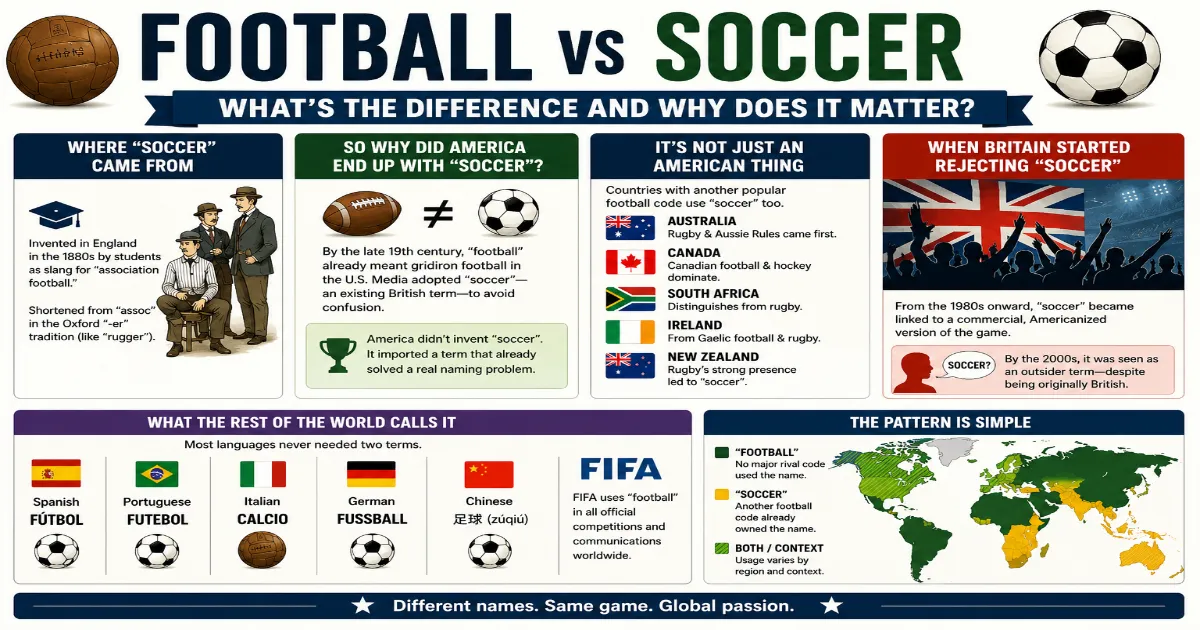
The word “soccer” wasn’t invented in the United States. It was invented in England, by English students, as a slang abbreviation for “association football.” In the 1860s, English football split into two governing codes: the Football Association, which banned handling the ball and became what most of the world now simply calls football, and the Rugby Football Union, which kept handling and carrying as central parts of the game. To distinguish between the two, university students in the 1880s started using clipped slang nicknames in the Oxford “-er” tradition that also gave English slang words like “rugger” for rugby and “brekker” for breakfast. “Association” got shortened to “assoc,” then further abbreviated and stylized into “soccer.”
For decades afterward, the two words coexisted comfortably inside Britain itself, used almost interchangeably by the same people in the same conversations. Newspapers in England referred to “soccer” regularly well into the 20th century, and the term carried no negative connotation whatsoever. It wasn’t a foreign import or an insult. It was simply British slang for British football, created by British students, used by British journalists.
So Why Did America End Up With “Soccer”?
The honest answer is that the United States needed a way to distinguish association football from a sport that had already claimed the word “football” for itself. By the time soccer started gaining any real foothold in American sporting culture in the late 19th and early 20th centuries, gridiron football — what Americans now simply call football — already dominated the term completely, having evolved from rugby-style games played at American universities decades earlier. There wasn’t really room for two sports to share the same primary name in the same country, and American sports media simply adopted the existing British slang term that already distinguished the two codes perfectly well.
This is the part that surprises most people in the argument: America didn’t invent “soccer” to be different. It imported a term the English themselves had created, at a moment when doing so solved an obvious naming problem. The irony is that Britain eventually moved away from the word almost entirely, while the United States kept using it simply because it remained genuinely useful there.
It’s Not Just an American Thing
The football vs soccer divide isn’t actually a simple story of America against everyone else. Several English-speaking countries where another football code already existed first ended up adopting “soccer” for exactly the same reason the United States did. Australia uses “soccer” because Australian rules football and rugby league both already claimed strong cultural ownership of “football” well before the association code became popular there. Canada, similarly, has rival claims from Canadian football and ice hockey’s cultural dominance. South Africa, Ireland, and New Zealand have all used “soccer” at various points for comparable reasons, distinguishing the sport from Gaelic football, rugby, or other regional codes that got to the word “football” first in their own sporting cultures.
The pattern, once you look at it country by country, is remarkably consistent: wherever another major sport already owned the word “football” in everyday usage, “soccer” stepped in to avoid confusion. Wherever association football was effectively the only major football code in a country, as in most of continental Europe, South America, and large parts of Africa and Asia, “football” remained the default term, and no real need for an alternative ever developed.
When Britain Started Treating “Soccer” as a Dirty Word
If “soccer” was perfectly acceptable British slang for most of the 20th century, why does it now sound almost offensive to suggest the term in England? The shift happened gradually, picking up real momentum from the 1980s onward, as English football’s identity became increasingly tied to working-class culture, terrace tradition, and a sense of ownership that felt distinctly British rather than international. As the sport’s popularity exploded in the United States through youth leagues, Major League Soccer’s launch in 1996, and growing media coverage, “soccer” became associated, fairly or not, with an American version of the game that some British fans viewed as commercially driven and culturally hollow compared to their own deeply rooted footballing traditions.
By the 2000s, using “soccer” in Britain had effectively become shorthand for being an outsider to football’s English-rooted culture, regardless of the word’s actual British origins. It’s a strange historical reversal: the country that invented the term came to treat it as a foreign contamination of its own sport, while the country that simply borrowed the existing term for practical reasons kept using it without any of that baggage attached.
What FIFA and the Rest of the World Actually Call It
Outside the English-speaking world, this entire debate barely registers, because most languages never needed two competing terms in the first place. Spanish-speaking countries call it fútbol. Portuguese-speaking countries, including Brazil, call it futebol. Italy calls it calcio, derived from an older medieval ball game rather than from English at all. Germany calls it Fußball, a fairly direct translation of the English original. FIFA itself, despite being headquartered in Switzerland and operating in multiple official languages, uses “football” as its primary English-language term across its own branding and competition names, including the World Cup itself rather than the “Soccer World Cup.”
That single fact tends to settle the argument for plenty of people: the sport’s own global governing body defaults to “football” in English, treating “soccer” as a regional variant rather than an equally valid alternative name. It’s worth noting, though, that FIFA does use “soccer” in some of its American-facing marketing and communications, recognizing that audiences there genuinely use and expect that term in everyday conversation.
Does the Difference Actually Matter?
In terms of the sport on the pitch, no. Eleven players, ninety minutes, one ball, two goals — every law of the game is identical regardless of which word a broadcaster or a fan happens to use to describe it. The rules don’t change depending on which side of the Atlantic you’re watching from. But culturally and commercially, the distinction matters more than purists sometimes want to admit. Word choice signals identity, and in football’s case, it often signals which footballing culture someone grew up inside. An American using “soccer” isn’t disrespecting the sport. A British fan insisting on “football” isn’t being needlessly territorial. Both are simply using the term that has been standard in their own footballing environment for well over a century.
There’s also a practical, commercial dimension to the debate that’s grown more relevant as the sport’s profile in the United States has risen sharply, particularly with the country co-hosting the 2026 World Cup. Some American sports marketers have floated the idea of leaning more heavily into “football” as MLS and the U.S. national team chase mainstream cultural relevance, betting that aligning with the sport’s dominant global term could help the league feel less like a niche alternative and more like part of the world’s most popular sport. Whether that kind of rebranding ever fully takes hold remains to be seen, but it shows that even a century-old naming quirk can still carry real weight in how a sport positions itself for new audiences.
A Few Myths Worth Retiring
Beyond the basic etymology, a handful of related myths tend to surface whenever this debate gets going, and most of them fall apart under similarly light scrutiny. One popular claim suggests “soccer” was deliberately pushed by American broadcasters in the 1970s to make the sport sound more palatable to domestic audiences unfamiliar with the rest of the world’s terminology. In reality, American use of the word predates that era by decades, appearing in U.S. newspapers and amateur league names as early as the 1910s, long before television had any role in shaping the sport’s branding.
Another common misconception holds that “soccer” is somehow grammatically or linguistically inferior to “football,” a lazier or less legitimate word. Given that both terms were coined by the same Victorian-era English university culture using the exact same slang convention, there’s no linguistic basis for treating one as more authentic than the other. The actual difference isn’t quality or correctness. It’s simply which term different football-speaking cultures happened to keep using once their own local need for disambiguation either persisted or faded away.
There’s also a frequent assumption that this is purely a modern, internet-era argument, fueled by social media pile-ons every time a major tournament rolls around. In truth, British newspapers were already debating whether “soccer” sounded appropriately English as far back as the 1960s, well before MLS existed, before satellite television beamed the Premier League into American living rooms, and well before any of the modern commercial pressures that get blamed for the divide today. The argument, in other words, is almost as old as the word itself.
The Real Takeaway
The football vs soccer debate survives mostly on a myth: that “soccer” is a lesser, Americanized corruption of the sport’s true name. In reality, both words came from the same English root, invented by the same English students, for the same practical reason of telling two football codes apart. One side of that debate simply kept using the word longer because it remained useful, while the other side gradually decided the word no longer fit the cultural image it wanted to project. Neither version is wrong. They’re both English. They just ended up traveling very different paths to get to where they are today.
So next time someone confidently declares that real fans say “football” and only Americans say “soccer,” the most accurate response isn’t to pick a side. It’s to point out that the people who started the whole argument were arguing in the same accent the entire time.
▪️▪️ Follow us on Facebook ▪️▪️
The Ultimate FIFA World Cup 2026 Stadium Bucket List — 16 Stadiums, 16 Reasons to Go
10 Best Football Video Games of All Time — Ranked by a Lifelong Fan With No Apologies
About the Author