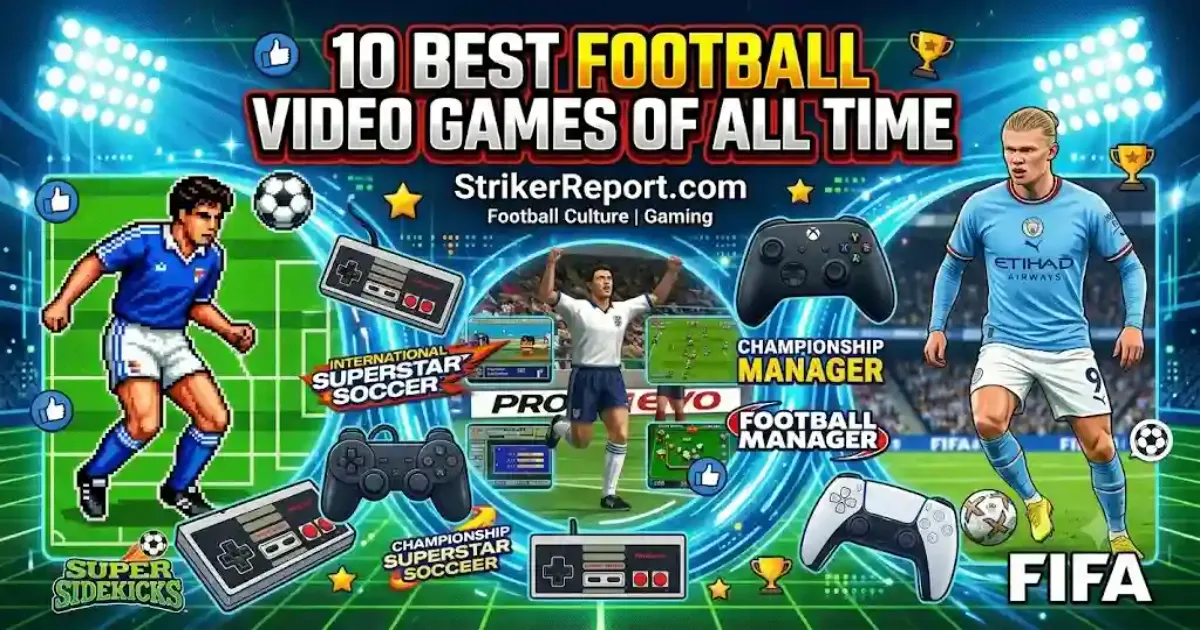
10 Best Football Video Games of All Time
Right. We need to have a conversation.
Because every year someone publishes a ranking of the best football video games of all time, and every year it is demonstrably, frustratingly wrong. The conversation around football gaming is dominated by two things: the loudest recency bias from people who discovered FIFA on their PS4, and the loudest nostalgia from people who refuse to acknowledge that anything after 1998 exists.
We are going to try to thread that needle. This ranking is based on genuine criteria — how groundbreaking the game was at the time of its release, how good it actually felt to play, how long you played it after you bought it, and how it is remembered now by the people who genuinely understand this genre.
The arguments will happen. They are supposed to. Let’s go.
LaLiga 2026/27 Schedule: Fixtures, Dates & Times
Premier League 2026/27 Schedule: This Week and Next Week
NBA Schedule 2026-27: Christmas Day Rivalries, Ring Night and the Games to Watch
The Criteria
Before we begin, the rules we are playing by:
Innovation: Did the game introduce something the genre hadn’t seen before? Did it change what people expected from a football game?
Gameplay feel: Does the actual moment-to-moment experience of playing it feel good? Controls, weight, pace, physicality. Does it feel like football, or does it feel like football’s administrative cousin?
Longevity: How long were people still playing it? How long did the football community talk about it? A game you played for three weeks and shelved is not the best game of all time, no matter how good the graphics were.
Cultural impact: Did it become part of the wider football conversation? Did players reference it? Did managers’ children play it obsessively? Did it shape what real supporters understood about tactics?
Legacy: What did it give to the games that came after it? A game that only borrowed and built on others is less significant than a game that gave the genre something new to build on.
With those criteria established — here are the ten greatest football video games ever made.
10. FIFA Street 2 (2006)
EA Sports | PlayStation 2, Xbox
The argument for it: Before you close this tab in disgust, hear us out. FIFA Street 2 is one of the most purely enjoyable football games ever made and it deserves its position on this list precisely because it understood something the rest of the genre occasionally forgets: football is supposed to be fun.
The trick system in FIFA Street 2 — the “gamebreaker” bar, the nutmegs, the showboat goals, the back-heels and overhead flick finishes — turned football into something joyful and anarchic. You could score a goal where the ball touched eight players before crossing the line and every touch felt deliberate and satisfying.
The roster: prime Ronaldinho as the cover star and the most overpowered player in the game. Ronaldo (Brazilian). Adriano at his absolute physical peak. The game understood that when you remove the tactical conservatism of 11-a-side football and replace it with 5-v-5 in a cage, you get football in its most distilled, pleasure-maximised form.
Why it’s at 10: It is not a serious simulation. By the criteria above, it lacks the tactical depth and longevity of the games above it. But no other football game released in the 2000s produced the kind of pure group-session, friend-screaming-at-friend joy that FIFA Street 2 delivered on demand.
The detail that places it here: The soundtrack. “La La La” and the Brazilian funk-influenced menu music created an atmosphere that made you feel like you were about to play beautiful football in an outdoor court in São Paulo. No football game has ever nailed its atmosphere so specifically.
10 Football Documentaries Every Fan Needs to Watch at Least Once
The 10 Best Football Books Ever Written — The Ultimate Fan Reading List
9. Winning Eleven 6 / Pro Evolution Soccer 5 (2001–2005 era)
Konami | PlayStation 2
The argument for it: The early-to-mid PES era on PlayStation 2 produced football gaming’s most competitive domestic arms race. PES 5 in particular — released in October 2005 — is the title most frequently cited by serious football gaming veterans as the greatest single version in the entire PES/Winning Eleven history.
What made it so good? The weight of the ball. The physicality of the duel system. The way individual players genuinely felt different to control — Ronaldinho played differently from Michael Essien, who played differently from Adriano, who played differently from Thierry Henry. The individuality in PES 5 was ahead of anything FIFA was producing simultaneously.
The Master League — PES’s career mode — was addictive beyond reason. Starting with a team of fictional players on the lowest budget and building toward winning the Champions League equivalent over multiple seasons: this was football management simulation compressed into an arcade-accessible format. Hundreds of hours. Minimum.
The commentary (in UK versions, provided by Peter Drury and Mark Lawrenson) contributed to an atmosphere that felt genuinely live. “Oh, he doesn’t usually miss those.” “Extraordinary from the young man.” It was football as theatre.
Why it’s at 9: The licensing issue that always haunted PES — fake club names, fake player names in many cases, a Champions League equivalent that was clearly not the Champions League — prevented it from ever fully occupying the space that FIFA eventually dominated commercially. The gameplay was better than FIFA for most of this era. The product packaging was worse.
8. FIFA 94 (1993)
EA Sports | Sega Mega Drive / SNES
The argument for it: You have to include FIFA 94. You simply have to. This is where the franchise began in earnest — the first FIFA game to use an isometric top-down view that created genuine spatial understanding of the pitch. Before FIFA 94, football video games were either overhead perspective shooters or side-scrolling arcade experiences. FIFA 94 made the game feel like you were watching a real match, just with you in control.
The eight-directional movement. The first recognisable system of passing lanes and shooting mechanics. The crowd noise that pulsed with the match’s emotional rhythm. In 1993, on a 16-bit console, this was extraordinary.
Why it’s at 8: By the standards of what came later, FIFA 94 is primitive. The gameplay is slow, the tactical sophistication is limited to “pass forward repeatedly and shoot,” and the player individuality is essentially zero. But ranking it on its cultural impact and what it gave the genre — its position is non-negotiable.
The footnote: The SNES version and the Mega Drive version played differently enough that entire friendships divided over which was superior. That kind of platform tribalism is only generated by games that genuinely mattered.
7. Football Manager 2005 (2004)
Sports Interactive / Sega | PC
The argument for it: Football Manager 2005 is the best management simulation ever made — not just the best football management game, but among the most sophisticated strategy simulations in video game history.
The data engine underlying FM2005 contained over 25,000 players across hundreds of leagues, rated on 30+ attributes, with a match engine that translated those attributes into results with accuracy that shocked people who tested it against real-world outcomes. Sports Interactive had been refining the Championship Manager engine for over a decade before FM2005, and this particular iteration landed at the precise moment where the database quality, the tactical interface, and the match engine converged.
The “board confidence,” “player relationship,” and “press conference” systems introduced genuine stakeholder management to football simulation for the first time. You were not just picking the team and tactics. You were managing egos, managing expectations, managing the relationship between your club’s chairman and your contract. This was football as institution, not just football as sport.
Why it’s at 7: The absence of physical gameplay — FM is entirely a simulation viewed through text match reports and later a 2D or 3D engine — means it occupies a different category to the other games on this list. It is ranked separately from the football action games above and below it precisely because it does something none of them attempt.
The cultural footnote: Several real-world professional managers have publicly credited Football Manager with developing their tactical understanding. Gareth Southgate’s interest in data-based squad analysis. Various coaches in lower leagues who used FM as a training tool. The game’s influence on real football is a genuinely measurable phenomenon.
6. FIFA 10 (2009)
EA Sports | PlayStation 3, Xbox 360, PC
The argument for it: FIFA 10 is the game that decisively ended PES’s era of gameplay superiority and established the commercial and critical dominance that FIFA maintained for the following decade. The introduction of 360-degree dribbling — replacing the previous eight-direction system with fully analogue movement — was the single greatest control improvement in the franchise’s history.
Suddenly, players felt like they were being guided rather than directed. The ball physics were the best of any football game released to that point. The weight of the challenge, the variety of finish types, the goalkeeper intelligence — all of it arrived simultaneously and cohesively in FIFA 10 in a way that felt like a genuine generational step.
The Ultimate Team mode — FUT — was introduced in its full commercial form in FIFA 10’s DLC before becoming a base mode. For better or worse, the introduction of card-based squad building created the most financially significant single feature in sports gaming history. FIFA 10’s FUT mode is the seed of a franchise that has since generated hundreds of millions in annual revenue.
Why it’s at 6: It is limited by the era’s technical ceiling. The match experience, while excellent for 2009, is visibly primitive by the standard of games released even three years later.
5. Sensible World of Soccer (1994)
Sensible Software | Amiga, DOS, PC
The argument for it: No ranking of the best football video games of all time that excludes Sensible World of Soccer should be trusted, so here it is.
SWOS is the greatest football simulation ever made in terms of the ratio of simplicity to depth. The match engine was top-down, the players were tiny sprites with over-sized heads, and the controls were two buttons. And yet — through those two buttons, that top-down perspective, and a career mode that contained over 1,500 clubs across multiple continents — SWOS delivered a football experience that was addictive, tactically genuine, and endlessly replayable.
The after-touch system — curling the ball mid-air by continuing to move the joystick after shooting — was the single greatest shooting innovation in football gaming history. Anyone who has scored a dipping volley from outside the box in SWOS at two in the morning, on a sofa that smells like last week, surrounded by empty crisps packets, understands why this game is on this list.
The career depth: The management elements in SWOS were remarkable for 1994 — transfer negotiations, tactical formations, a continental cup structure that felt genuinely earned. The combination of match-level immediacy and career-level strategy gave it the best breadth of any football game released in the pre-PlayStation era.
Why it’s at 5: Sensible World of Soccer deserves to be higher. It isn’t, purely because the games above it are definitional to the modern concept of what football gaming is. SWOS belongs to a specific era that fewer people have played. For those who have, this position feels disrespectful.
4. FIFA 22 (2021)
EA Sports | PlayStation 5, Xbox Series X, PC
The argument for it: The final iteration of FIFA before the franchise rebranded as EA Sports FC, FIFA 22 is the peak of what the FIFA engine could produce. The HyperMotion technology — using real-world motion capture data from professional matches — created a fluency of movement and physical interaction that was genuinely unprecedented.
Player individuality reached its highest expression in FIFA 22. Messi played like Messi. Mbappé played like Mbappé. The difference between controlling a technically gifted 70-rated midfielder and an 87-rated one was tangible in a way it hadn’t been in previous versions.
Presentation, licensing, broadcast-style replays, stadium atmospheres, commentary variety — FIFA 22 was the most complete football package ever assembled in a single game. Career mode had been meaningfully updated. Pro Clubs allowed six friends to build a virtual team together across months of online play. FUT remained financially controversial but technically the most sophisticated card-based sports team builder in gaming.
Why it’s at 4 and not higher: FIFA 22’s post-release support was focused overwhelmingly on Ultimate Team monetisation rather than core gameplay improvements. The microtransaction model that generated so much revenue also generated so much legitimate criticism that it cannot be entirely separated from the game’s legacy. The game itself is excellent. The financial mechanics surrounding it are the sport’s most uncomfortable overlap between football and commerce.
3. Pro Evolution Soccer 3 (2003)
Konami | PlayStation 2
The argument for it: PES 3 is the most important football game ever made that never quite got the mainstream credit it deserved, because it arrived at the precise moment when FIFA was still dominant commercially and hadn’t yet been surpassed in the popular consciousness.
But among serious football gamers — the people who played both platforms, who analysed what each game did and how — PES 3 was a revelation. The pass-and-move system was the first to genuinely replicate how elite football felt: the ball moving between players in one or two touches, the creative movement in the final third producing shooting opportunities that felt genuinely earned.
The tactical depth available to players who engaged with it — pressing triggers, formation adjustments mid-match, the ability to set up complex team instructions — was at least two years ahead of anything FIFA had developed to that point. PES 3 is the game that professional footballers of that era cited when asked what football game they played. Zidane played PES. Beckham played PES. The players of the real game preferred the one that felt real.
Why it’s at 3: Despite its gameplay superiority in its era, PES 3 was limited by licensing and by the direction Konami took the franchise in subsequent years — a slow decline from 2006 onward that left this peak feeling isolated rather than part of a sustained golden era.
2. FIFA 98: Road to World Cup (1997)
EA Sports | Nintendo 64, PlayStation, PC
The argument for it: FIFA 98 is the game that made the genre matter in popular culture. Released ahead of the 1998 World Cup in France, FIFA 98 arrived on the Nintendo 64 with a 3D match engine that was genuinely shocking in quality for the era. Players had individual likenesses. Stadium recreations were recognisable. The match broadcast perspective — a genuine attempt to replicate watching football on television — was a philosophical statement about what video games could aspire to be.
The soundtrack: Blur’s “Song 2” as the menu music. One of the most inspired musical choices in gaming history. The combination of the most anticipated tournament in a generation with the most realistic football game ever made at the time, playing to a track that was everywhere in 1997 — the cultural context of FIFA 98 is as important as the game itself.
The World Cup qualification mode — playing through groups, regional playoffs, and the full tournament bracket — gave it a narrative arc that football games had never previously offered. You were building toward France 1998. Every match mattered. The emotional investment was total.
Why it’s at 2: FIFA 98 is the game that most clearly demonstrates the gap between technical excellence and cultural resonance. On pure gameplay criteria alone, several games on this list are more sophisticated. But as an event — as a cultural moment — FIFA 98 is second only to the game at number one.
1. PES 6 — Pro Evolution Soccer 6 (2006)
Konami | PlayStation 2, PlayStation 3, PC, Xbox 360
The argument for it: PES 6 is the greatest football video game ever made. Not the most commercially successful — that is FIFA by a significant margin. Not the most technically sophisticated by current standards — modern EA Sports FC iterations surpass it in visual and physical realism. But PES 6 is the game that, more completely than any other, captured football as a game within a game: a sport of strategy, physical contest, individual brilliance, and collective organisation, rendered in a format where every match felt unpredictable.
The player individuality in PES 6 is still cited by the game’s veteran community as unmatched by any subsequent release. Ronaldinho’s dribbling felt genuinely supernatural in a way that required specific defensive preparation. Adriano’s shooting was physically different to any other player — you could feel the weight of his strikes through the controller. Henry’s pace and directness made his runs feel threatening in a way that statistics could not fully explain.
The Master League in PES 6 was the deepest iteration of the mode ever produced: a career simulation where your starting team of fictional players (Castolo, Guarin, Minanda — names that football gaming veterans will immediately recognise with something approaching affection) would be gradually replaced by real players as your budget grew, creating a genuine arc of development across seasons.
The online mode — revolutionary for a Konami product, notoriously unstable by modern standards — created the first genuinely global football gaming community. Playing PES 6 online against opponents worldwide in 2006 felt like participating in something new.VAR in Football Explained: How It Works, Why It Divides Fans and What’s New at World Cup 2026
The definitive argument: Every football gamer of the PES 6 era has the same story. They were better at PES 6 than they have been at any other football game before or since. The skill ceiling was higher, the reward for mastering it was greater, and the matches it produced — the last-minute winners, the defensive masterclasses, the Ronaldinho goal that came from nothing, the keeper error that changed a Master League season — are remembered with the same specificity that real football memories carry.
That is the test of the greatest football game ever made. Not technical specification. Not sales figures. The test is: does it live in your memory the way football itself does?
PES 6 passes that test. It has always passed it.
Predicted Score: PES 6 wins. Unanimously, among anyone who played both.
The Final Ranking: At a Glance
| Rank | Game | Year | Platform |
|---|---|---|---|
| 1 | Pro Evolution Soccer 6 | 2006 | PS2, PS3, PC |
| 2 | FIFA 98: Road to World Cup | 1997 | N64, PC, PS1 |
| 3 | Pro Evolution Soccer 3 | 2003 | PS2 |
| 4 | FIFA 22 | 2021 | PS5, Xbox, PC |
| 5 | Sensible World of Soccer | 1994 | Amiga, PC |
| 6 | FIFA 10 | 2009 | PS3, Xbox 360 |
| 7 | Football Manager 2005 | 2004 | PC |
| 8 | FIFA 94 | 1993 | Mega Drive, SNES |
| 9 | PES 5 / Winning Eleven 9 | 2005 | PS2 |
| 10 | FIFA Street 2 | 2006 | PS2, Xbox |
Final Word
The history of football video games is the history of football itself, reflected in a screen. The tactics that games helped players understand. The players that games made famous in countries where they couldn’t watch the league they played in. The hours — the thousands of hours — that football and gaming consumed together.
PES 6 is number one. FIFA 98 is number two. Sensible Soccer belongs on every list. Football Manager is in a category of its own and probably responsible for more real tactical thinking than anyone in football’s coaching infrastructure will ever formally acknowledge.
Now go back and play whatever is on this list that you haven’t played. You owe yourself at least one PES Master League season.
▪️▪️ Follow us on Facebook ▪️▪️
Cristiano Ronaldo Jr.: Club, Lifestyle, Career and Future Prospects
Thiago Messi: Club Career, Playing Style, Lifestyle and Future Prospects
About the Author